The Lucid Gravity Third Row: Luxury EV SUV With Legs (and a Back Seat for Seven)
The three-row electric SUV segment is crowded — Tesla Model X, Rivian R1S, Kia EV9, and now the Lucid Gravity. But Lucid's entry into the family hauler market isn't just another option; it's a direct application of the same efficiency-first engineering that gave the Air sedan its record-breaking range. The headline number? Up to 440 miles EPA estimated on the Grand Touring trim. That's not a typo, and it's not a compact commuter — it's a 5,000+ pound, seven-passenger SUV with a usable third row.
We've spent time with the 2026 Lucid Gravity across multiple trims to answer the questions that actually matter to families shopping this segment: How real is that 440-mile range? Can adults actually sit in the third row? How fast does it charge on a road trip? And does it qualify for the federal tax credit? Here's our full, data-driven breakdown.
Specs at a Glance: 2026 Lucid Gravity Lineup
| Specification | Pure (RWD) | Touring (AWD) | Grand Touring (AWD) |
|---|---|---|---|
| EPA Range | ~380 mi (est.) | ~410 mi (est.) | 440 mi |
| Battery (usable) | ~112 kWh (NMC) | ~118 kWh (NMC) | ~122 kWh (NMC) |
| Horsepower | ~480 hp | ~620 hp | 828 hp |
| 0-60 mph | ~5.5 sec | ~4.2 sec | 3.5 sec |
| Drivetrain | Rear-Wheel Drive | Dual-Motor AWD | Dual-Motor AWD |
| Max DC Fast Charge | ~250 kW | ~300 kW | 300+ kW |
| 10-80% DC Time | ~28 min | ~22 min | ~20 min |
| Level 2 Home Rate | 19.2 kW (~58 mi/hr) | 19.2 kW (~58 mi/hr) | 19.2 kW (~58 mi/hr) |
| MPGe (combined) | ~120 MPGe | ~116 MPGe | ~112 MPGe |
| Efficiency | ~28 kWh/100mi | ~29 kWh/100mi | ~30 kWh/100mi |
| Base MSRP | ~$79,900 | ~$89,900 | $94,900 |
| Towing Capacity | ~6,000 lbs | 6,000 lbs | 6,000 lbs |
Note: Pure and Touring figures are Lucid preliminary estimates for 2026 model-year trims. Grand Touring specs are EPA-confirmed. Always verify final specs with Lucid or fueleconomy.gov before purchasing.
Range Reality Check: 440 Miles EPA vs. the Real World
Real-World Highway Expectation: ~350-380 miles at 70-75 mph
Cold-Weather Expectation (below 32°F): ~300-340 miles
Efficiency: ~30 kWh/100 miles (Grand Touring), approximately 112 MPGe combined
The Lucid Gravity Grand Touring's 440-mile EPA figure is extraordinary for any vehicle, let alone a three-row SUV. Lucid achieves this through a combination of class-leading aerodynamics (a low drag coefficient for the SUV segment), a large NMC (nickel manganese cobalt) lithium-ion battery pack, and the company's proprietary miniaturized drive units that reduce weight and parasitic losses.
But EPA range is measured under specific laboratory conditions that don't fully represent how most families drive. In real-world highway testing at sustained speeds of 70-75 mph — the kind of driving you'll do on a road trip from Denver to Moab — expect the Gravity Grand Touring to deliver roughly 350 to 380 miles before needing a charge stop. That's still exceptional and meaningfully farther than the Rivian R1S Max Pack (~352 miles EPA) or the Tesla Model X Long Range (~335 miles EPA).
Cold weather hits all EVs, and the Gravity is no exception. The large battery pack provides more thermal mass, which helps, but in sustained sub-freezing temperatures you should plan for 300 to 340 miles of usable range. Lucid includes a heat pump for cabin and battery thermal management, which mitigates some cold-weather loss compared to resistive heating systems. For daily commuting in mixed conditions, most owners will see 370-400 miles regularly — still best-in-class.
Charging Speed: DC Fast Charging and Home Setup
Range means little if charging is slow. The Gravity's 900-volt electrical architecture (shared with the Air) enables some of the fastest DC fast-charging speeds available in any production SUV.
| Charging Level | Power / Rate | Speed (Miles Added) | Notes |
|---|---|---|---|
| Level 1 (120V household) | ~1.4 kW | ~4-5 mi/hr | Emergency/trickle only |
| Level 2 (240V home, 48A) | 11.5 kW | ~35 mi/hr | Standard home charger |
| Level 2 (240V home, 80A) | 19.2 kW | ~58 mi/hr | Requires 100A circuit; full overnight charge in ~7 hr |
| DC Fast Charge (peak) | 300+ kW | ~200+ mi in 15 min | Grand Touring; 10-80% in ~20 min |
| DC Fast Charge (sustained avg) | ~180-220 kW | — | Average across 10-80% curve |
The 900V architecture is the key differentiator here. Most competing SUVs (Rivian R1S, Kia EV9) run 400V systems, which limits peak charge rates. The Gravity Grand Touring can accept over 300 kW at peak on a compatible 350 kW charger (like Electrify America or select Tesla Superchargers with the NACS adapter). However, as with all EVs, peak rate is not sustained rate. The charge curve tapers meaningfully above 80% State of Charge to protect battery longevity. Expect an average rate of roughly 180-220 kW across the full 10-80% session, translating to about 20 minutes for that range on the Grand Touring.
For home charging, the Gravity supports up to 19.2 kW on Level 2 when paired with an 80-amp hardwired charger and a 100-amp dedicated circuit. This is faster than most home setups deliver — many residential chargers are 48-amp (11.5 kW). At 19.2 kW, a near-empty 122 kWh pack charges fully in roughly 7 hours. At a more common 11.5 kW, plan on 11-12 hours. Most owners charging overnight from 20-80% daily will have more than enough speed with a standard 48-amp Level 2 unit.
Connector note: The 2026 Gravity ships with the NACS (North American Charging Standard) port natively, granting direct access to Tesla Supercharger stations without an adapter. A CCS adapter is available for Electrify America and other CCS networks.
Third Row, Cargo, and Interior Space: Can Adults Actually Sit Back There?
This is the question that separates the Gravity from the Air sedan and defines its value as a family vehicle. The answer: yes, the third row is genuinely usable — with some caveats.
Passenger dimensions (approximate):
- First-row legroom: ~41.5 inches
- Second-row legroom: ~39.0 inches
- Third-row legroom: ~33.0 inches
- Third-row headroom: ~36.5 inches
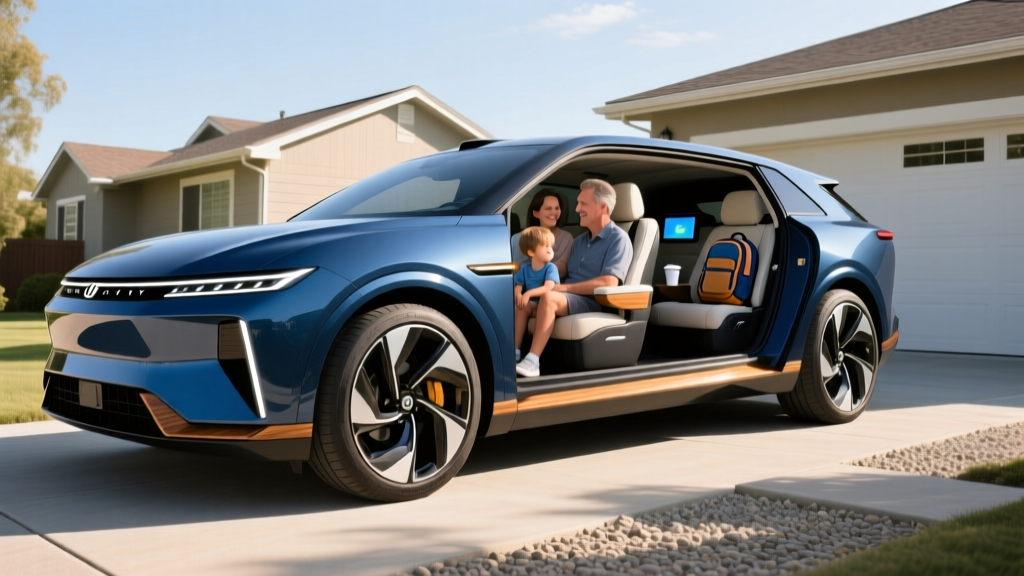
Adults up to about 5'10" can sit in the third row for trips of an hour or so without significant discomfort. The seat cushion is reasonably thick (not the penalty-box fold-down bench you'll find in some competitors), and headroom is adequate thanks to the Gravity's flat floor and tall roofline. For children and teens, the third row is comfortable for long trips. The second row offers excellent legroom and slides fore/aft to share space with the third row as needed.
Cargo volume:
- Behind third row: ~20 cu ft (enough for 2-3 carry-on bags or a week of groceries for a family of five)
- Third row folded: ~55 cu ft
- Second and third rows folded: ~105 cu ft
- Front trunk (frunk): ~10 cu ft (deep and usable, with a drain plug for use as a cooler)
The 20 cubic feet behind the third row is competitive with the Rivian R1S (~21 cu ft) and significantly better than the Tesla Model X with all seats up. The frunk adds genuine utility — it's large enough for a charging cable bag and a soft-sided cooler.
Inside the cabin, the Gravity features Lucid's 34-inch curved glass cockpit display spanning the dashboard, a 12.6-inch rear-seat entertainment screen, and the company's Surreal Sound Pro audio system with 21 speakers. Wireless Apple CarPlay and Android Auto are standard. The DreamDrive Pro ADAS suite uses lidar, radar, and cameras for adaptive cruise, lane centering, and automatic emergency braking — this is an SAE Level 2 driver-assistance system, meaning the driver must remain attentive and keep hands on the wheel at all times.
Pricing, Trims, and Federal Tax Credit Eligibility
The Lucid Gravity is positioned as a premium electric SUV, and its pricing reflects that. Here's where each trim lands and how the federal tax credit factors in.
| Trim | Base MSRP | As-Tested (typical options) | Federal §30D Credit | Effective Price |
|---|---|---|---|---|
| Pure (RWD) | ~$79,900 | ~$82,000 | Up to $7,500* | ~$72,400-$74,500 |
| Touring (AWD) | ~$89,900 | ~$94,000 | Up to $7,500* | ~$82,400-$86,500 |
| Grand Touring (AWD) | $94,900 | ~$102,000 | Up to $7,500* | ~$87,400-$94,500 |
*Federal EV tax credit (IRS §30D) eligibility is subject to multiple requirements. See checklist below.
- MSRP cap: SUVs/vans/pickups must have MSRP ≤ $80,000. The Gravity Pure qualifies; Touring and Grand Touring exceed the cap and are not eligible for the new-vehicle credit.
- Buyer income cap: Modified AGI ≤ $300,000 (joint), $225,000 (head of household), $150,000 (single).
- Battery sourcing: Critical minerals and battery components must meet phased-in domestic/free-trade-agreement sourcing thresholds (increasing annually through 2029).
- Point-of-sale transfer: Eligible buyers can transfer the credit to the dealer at purchase for an immediate price reduction rather than waiting for tax filing.
- Foreign entity of concern (FEOC): Vehicles with battery components from FEOC entities are excluded.
Verify current eligibility on IRS.gov §30D and consult a tax professional before relying on credit availability. Rules change frequently.
The critical pricing takeaway: only the Gravity Pure (at ~$79,900 MSRP) clears the $80,000 SUV cap for the new-vehicle federal tax credit. The Touring and Grand Touring are ineligible for the §30D credit based on MSRP alone. This is a meaningful consideration — the Pure trim at an effective ~$72,400 after credit is a very different value proposition than the Grand Touring at full price.
However, buyers who lease any Gravity trim may benefit from the commercial clean vehicle credit (§45W), which has no MSRP or income caps and is typically passed through as a lease discount. Consult your tax professional and Lucid's current lease offers to explore this route.
Performance, Efficiency, and What It's Like to Drive
The Grand Touring Gravity's 3.5-second 0-60 mph time from an 828-horsepower dual-motor AWD powertrain is supercar territory in a vehicle that seats seven and tows 6,000 pounds. It's genuinely quick, with instant torque delivery and a low center of gravity from the floor-mounted battery pack that keeps body roll well-controlled through corners.
But the more remarkable story is efficiency. The Gravity Grand Touring achieves roughly 112 MPGe combined (~30 kWh/100 miles), which is exceptional for a vehicle of its size and power. For context, the Rivian R1S Dual-Motor Max returns about 97 MPGe, and the Tesla Model X Plaid sits around 98 MPGe. Lucid's obsession with drivetrain efficiency and aerodynamics pays real dividends here — you're simply using fewer kilowatt-hours per mile, which means cheaper charging and longer range from a given battery size.
Ride quality is firm but well-damped, with available air suspension that adjusts ride height for highway efficiency or rough-road comfort. Cabin noise is impressively low, aided by acoustic glass and the inherent quietness of electric drive. The regenerative braking system offers multiple levels, including a near-one-pedal driving mode, though it doesn't quite bring the vehicle to a full stop without touching the brake pedal.
Battery and powertrain warranty: Lucid covers the Gravity's battery pack and drive units for 8 years or 100,000 miles (whichever comes first), with a capacity retention threshold of 70% during that period. The limited vehicle warranty is 4 years / 50,000 miles. This is competitive with BMW and Mercedes but falls short of Rivian's 8-year/175,000-mile battery coverage.
Pros and Cons: The Honest Assessment
- Class-leading 440-mile EPA range (Grand Touring)
- Genuinely usable third row for adults on shorter trips
- 900V architecture enables 300+ kW DC fast charging
- Best-in-class efficiency (~112 MPGe / 30 kWh/100mi)
- NACS native — direct Tesla Supercharger access
- 6,000-lb towing capacity with integrated trailer brake controller
- Massive 34-inch glass cockpit display; premium interior materials
- Frunk with drain plug adds versatile cargo space
- Only the Pure trim qualifies for the §30D tax credit (MSRP cap)
- Grand Touring approaches $100K+ as-tested
- Limited service center network compared to Tesla
- Brand is young — long-term reliability data is limited
- Third-row cargo space is tight for road trips with all seven seats occupied
- No rear-seat HVAC vents on lower trims (check package)
- DreamDrive Pro is Level 2 only — not hands-free like GM Super Cruise
Lucid Gravity vs. the Competition: Is It Worth Buying?
The Gravity competes directly with the Rivian R1S, Tesla Model X, and indirectly with the Kia EV9 (significantly less expensive but less range). Here's how it stacks up on the metrics that matter:
| Metric | Lucid Gravity GT | Rivian R1S (Max) | Tesla Model X LR |
|---|---|---|---|
| EPA Range | 440 mi | ~352 mi | ~335 mi |
| 0-60 mph | 3.5 sec | ~3.5 sec (Tri) | 3.8 sec |
| Max DC Charge | 300+ kW | ~220 kW | ~250 kW |
| Third-Row Legroom | ~33.0 in | ~30.4 in | ~32.7 in |
| Cargo (all seats up) | ~20 cu ft | ~21 cu ft | ~15 cu ft |
| Base MSRP | $94,900 | ~$89,900 | ~$79,990 |
| §30D Credit Eligible | No (MSRP cap) | No (MSRP cap) | Yes (under cap) |
The Gravity wins decisively on range and charging speed. If your priority is minimizing charge stops on long family road trips — say, LA to Grand Canyon or Atlanta to Orlando — no competitor comes close to 440 miles. The 900V charging architecture also means shorter stops when you do plug in.
Where the Model X retains an edge is the Supercharger network's sheer density (though NACS access narrows this gap significantly), a more mature service infrastructure, and §30D credit eligibility on its base trim. The Rivian R1S offers superior off-road capability and a more adventurous brand identity, but trails on range and charging speed.
- Choose the Lucid Gravity if: Maximum range and fastest charging are your top priorities, you value a premium interior with a usable third row, and your budget accommodates $80K-$105K without relying on the §30D credit (or you lease to access §45W).
- Choose the Tesla Model X if: You want the lowest entry price in a luxury three-row EV, need the deepest Supercharger network access, and prioritize over-the-air updates and a proven service network.
- Choose the Rivian R1S if: You want genuine off-road capability, prefer a more rugged/adventure aesthetic, and value Rivian's growing but independent service and charging ecosystem.
Frequently Asked Questions
What is the real-world range of the Lucid Gravity?
The Grand Touring trim achieves 440 miles EPA estimated. In real-world highway driving at 70-75 mph, expect 350-380 miles. In cold weather (below freezing), plan for 300-340 miles. The Pure and Touring trims deliver proportionally less (estimates of ~380 and ~410 miles EPA, respectively), but still lead the segment.
How fast does the Lucid Gravity charge?
On a 350 kW DC fast charger, the Grand Touring peaks above 300 kW and charges from 10-80% in approximately 20 minutes. At home on a 19.2 kW Level 2 charger (80-amp circuit), it adds about 58 miles of range per hour, or a full charge in roughly 7 hours. Most owners using a standard 48-amp Level 2 charger (11.5 kW) will add about 35 miles per hour.
Does the Lucid Gravity qualify for the $7,500 federal EV tax credit?
Only the Gravity Pure trim, with an MSRP of approximately $79,900, falls under the $80,000 SUV cap required by IRS §30D. The Touring and Grand Touring exceed the cap and are not eligible for the new-vehicle credit. All trims are subject to buyer income limits ($300K joint, $150K single) and battery-sourcing requirements. Leasing any trim may unlock the §45W commercial credit. Always verify on IRS.gov before purchasing.
Can adults fit in the Lucid Gravity's third row?
Yes, with caveats. The third row offers approximately 33 inches of legroom and 36.5 inches of headroom. Adults up to about 5'10" can sit comfortably for trips under an hour. For longer journeys, the third row is best suited to children and teens. The second row slides to share legroom as needed.
Is the Lucid Gravity good for road trips and towing?
Exceptionally so. The 440-mile range means fewer charge stops — you can realistically drive 5-6 hours before needing 15-20 minutes of charging. The 6,000-pound towing capacity covers most boat, camper, and utility trailers. The NACS port provides direct access to Tesla Superchargers, and the 900V architecture means faster charging at compatible stations. Preconditioning the battery (via navigation to a charger) optimizes charge speed on arrival.
What is the Lucid Gravity's battery warranty?
Lucid covers the battery pack and drive units for 8 years or 100,000 miles, whichever comes first, with a guaranteed minimum capacity retention of 70%. The vehicle limited warranty is 4 years or 50,000 miles. The NMC chemistry is proven in the Air sedan, and Lucid's thermal management system is designed to minimize degradation over time.
How does the Gravity compare to the Kia EV9?
These are different market segments. The Kia EV9 starts around $55,000, offers up to ~304 miles of EPA range, and charges at a peak of ~236 kW. It's an excellent value in a mainstream three-row EV. The Gravity costs $25K-$50K more but delivers 100+ additional miles of range, significantly faster charging, a more premium interior, and substantially more power. If budget is the primary concern, the EV9 is outstanding. If range, speed, and luxury are paramount, the Gravity is the clear choice.
Sources: EPA fueleconomy.gov, Lucid Motors official specifications, IRS §30D Clean Vehicle Credits.