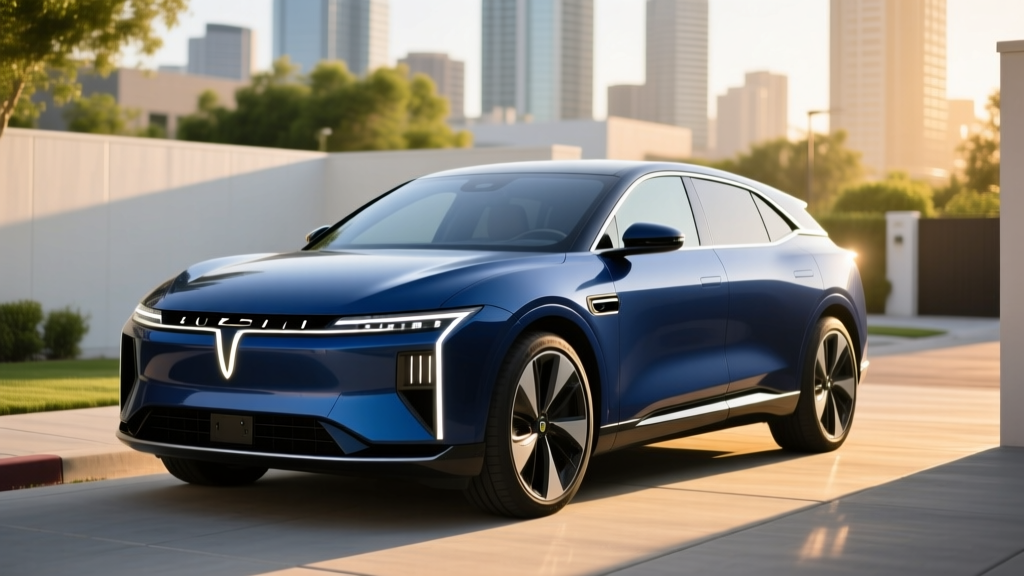
Luxury electric SUVs have proliferated rapidly, but few match the engineering ambition Lucid Motors brings to the segment. After establishing credibility with the Air sedan's record-breaking efficiency, Lucid turned its attention to the three-row family hauler market with the Lucid Gravity — the brand's first SUV and the vehicle most likely to put Lucid on the map for mainstream luxury buyers. While the broader Lucid Cosmos and Earth SUV lineups remain in various stages of development and announcement, the Gravity is the production vehicle you can actually evaluate today, and it sets the template for everything Lucid plans to build next.
This review examines the 2026 Lucid Gravity across the metrics that matter most to EV buyers: real-world range versus EPA estimates, charging speed under real conditions, interior practicality for families, and total cost of ownership after federal incentives. We'll also stack it against the Tesla Model X, Rivian R1S, and BMW iX to see where it wins — and where buyers should look elsewhere.
Range and Efficiency: 440 Miles EPA, But What About the Real World?
Real-World Expectation: ~350–380 miles highway; ~300–330 miles in cold weather (below 32°F)
The Lucid Gravity Grand Touring achieves an EPA-estimated 440 miles of range — a figure that, if validated by independent testing, would make it the longest-range three-row electric SUV on the market. Lucid's reputation with the Air sedan (which achieved 520 miles EPA in Grand Touring configuration) suggests this number is credible, not marketing inflation. Lucid's miniaturized drive units and 900-volt electrical architecture contribute to class-leading efficiency, measured at approximately 2.0–2.2 kWh per mile depending on conditions, translating to roughly 115–120 MPGe combined.
But EPA range assumes a mix of city and highway driving at moderate temperatures with climate control at reasonable settings. In real-world highway use at 70–75 mph, expect to lose 12–18% of that sticker number, landing around 350–380 miles. In freezing temperatures, battery chemistry and cabin heating demands can reduce range by 25–35%, potentially dropping effective range to 300–330 miles. This is still exceptional for a three-row SUV, but buyers in northern climates should plan charging stops accordingly on road trips exceeding 250 miles one-way.
Battery, Powertrain, and Performance Specs
| Specification | Lucid Gravity Grand Touring |
|---|---|
| Battery Capacity | ~112 kWh (usable), NMC chemistry |
| Electrical Architecture | 900V nominal |
| Drivetrain | Dual-motor AWD |
| Horsepower | 800+ hp (estimated) |
| 0–60 mph | ~3.5 seconds |
| EPA Range | 440 miles |
| Efficiency | ~115–120 MPGe combined |
| Towing Capacity | Up to 6,000 lbs (with tow package) |
The Gravity uses a dual-motor all-wheel-drive layout with permanent magnet synchronous motors on both axles. Lucid's proprietary drive units are notably compact — smaller than a carry-on suitcase — which frees up interior volume and contributes to the Gravity's surprisingly low hood line. The 900V architecture is the same system proven in the Air, enabling both the high efficiency and the rapid DC charging speeds discussed below.
Battery chemistry is nickel-manganese-cobalt (NMC), chosen for its higher energy density compared to LFP (lithium iron phosphate). This is the right call for a vehicle targeting 440 miles of range in a package that still needs to accommodate three rows of seating. LFP would add weight and volume that the Gravity's packaging can't absorb. The trade-off is that NMC batteries degrade slightly faster over time and are more sensitive to sustained high state-of-charge storage — Lucid's battery management system mitigates this with active thermal conditioning and a recommended daily charge limit of 80–90%.
Charging Speed: 900V Architecture Delivers Real-World Speed
| Charging Method | Power / Rate | Time / Miles Added |
|---|---|---|
| DC Fast Charge (peak) | Up to 300 kW | 10–80% in ~20 minutes |
| DC Fast Charge (sustained avg) | ~200–220 kW | ~200 miles in 15 minutes |
| Level 2 Home (11.5 kW) | 11.5 kW / 48A | ~30–33 miles per hour |
| Level 2 Home (19.2 kW capable) | 19.2 kW / 80A | ~50–55 miles per hour |
| Level 1 (120V) | 1.4 kW | ~3–4 miles per hour |
The Gravity's 900V electrical system is its charging superpower. At a compatible 350 kW DC fast charger (Electrify America, EVgo, or Tesla Supercharger with NACS adapter), the Gravity can accept up to 300 kW peak. More importantly, the high-voltage architecture allows it to sustain elevated charge rates deeper into the session. Where many 400V EVs begin tapering significantly above 60% state of charge, the Gravity maintains strong throughput through approximately 75–80%, then tapers more gradually. The result: a 10–80% charge in approximately 20 minutes under optimal conditions (preconditioned battery, warm ambient temperature, available charger capacity).
At home, the Gravity supports up to 19.2 kW Level 2 charging on a 100-amp circuit with an 80-amp EVSE. This is faster than most home installations provide — a typical 48-amp Level 2 charger (the most common residential setup on a 60-amp breaker) delivers 11.5 kW, adding roughly 30–33 miles of range per hour. An overnight charge from 20% to 90% takes approximately 7–8 hours at 11.5 kW, which is entirely practical for daily use. Buyers who want faster home charging should budget for a panel upgrade and 100-amp circuit installation, which can add $2,000–$4,000 to total charging setup costs.
One practical note: the Gravity ships with a NACS (Tesla-style) charge port as standard for 2026, granting native access to Tesla Supercharger stations without an adapter. This is a significant advantage for road-trip charging infrastructure access, particularly in regions where Electrify America and other CCS networks remain sparse.
Interior, Cargo, and Practicality
The Gravity accommodates up to seven passengers across three rows, though the third row is best suited for children or occasional adult use on shorter trips. Second-row captain's chairs are available in place of a bench, reducing capacity to six but improving comfort and access. Front-seat legroom is generous at approximately 41 inches, with second-row legroom around 38 inches. Third-row legroom drops to roughly 30 inches — competitive with the Rivian R1S but tighter than a full-size SUV like the Cadillac Escalade IQ.
Cargo volume behind the third row is approximately 20 cubic feet, expanding to roughly 60 cubic feet with the third row folded and over 100 cubic feet with both rear rows down. The front trunk (frunk) adds approximately 5–6 cubic feet of lockable storage — useful for charging cables, groceries, or a small carry-on. The Gravity's glass canopy roof creates an airy cabin feel but does reduce headroom slightly compared to a conventional steel roof; taller drivers should test-fit before purchasing.
The infotainment system centers on a 34-inch curved glass cockpit display spanning the driver's field of view, replacing a traditional instrument cluster. A secondary 17-inch central touchscreen handles navigation, media, and vehicle settings. Lucid's software interface is clean and responsive, though some functions (climate control, seat adjustments) require navigating menus rather than using physical buttons — a common luxury EV design choice that not all buyers prefer. Wireless Apple CarPlay and Android Auto are standard, along with a 21-speaker Surreal Sound audio system.
Pricing, Trims, and Federal Tax Credit Eligibility
| Trim | Base MSRP | Federal Credit Eligibility | Effective Price (if eligible) |
|---|---|---|---|
| Gravity Touring | ~$79,900 | Partial or none (MSRP cap: $80,000 for SUVs) | ~$72,400–$79,900 |
| Gravity Grand Touring | ~$94,900 | Not eligible (exceeds $80,000 MSRP cap) | $94,900 |
The Lucid Gravity is positioned as a luxury vehicle, and its pricing reflects that. The entry-level Touring trim starts around $79,900, while the Grand Touring (with the full 440-mile battery and 800+ hp) lands near $94,900 before options and destination charges.
Federal tax credit eligibility under IRS §30D is constrained for the Gravity. The credit caps new EV eligibility at an MSRP of $80,000 for SUVs, vans, and pickup trucks. The Touring trim barely squeaks under this cap, but the Grand Touring exceeds it entirely. Additionally, buyers must meet income thresholds ($150,000 single / $300,000 joint modified adjusted gross income) and the vehicle's battery components and critical minerals must meet domestic sourcing requirements that tighten annually. For 2026, the critical minerals and battery component sourcing rules are more restrictive than in prior years, and Lucid's supply chain may not fully qualify even the Touring trim for the full $7,500 credit. Always verify eligibility with a tax professional and consult the IRS Clean Vehicle Credit portal before purchasing.
The point-of-sale transfer option (available since 2024) allows eligible buyers to apply the credit as an immediate discount at the dealership rather than waiting for a tax refund — but this only matters if the vehicle and buyer both qualify.
Warranty Coverage
Lucid provides a competitive warranty package for the Gravity:
- Basic Vehicle Warranty: 4 years / 50,000 miles
- Battery & Drive Unit Warranty: 8 years / 100,000 miles (with a capacity retention threshold of approximately 70%)
- Corrosion Warranty: 12 years / unlimited miles
The 8-year/100,000-mile battery warranty is standard for the luxury EV segment and matches Tesla's coverage. The 70% capacity retention threshold means Lucid will repair or replace the battery if it degrades below 70% of original capacity within the warranty period. Based on NMC chemistry degradation curves and Lucid's active thermal management, most owners should retain 85–90% capacity at 100,000 miles under normal use — well above the warranty threshold.
Driver Assistance and Safety Technology
System Name: Lucid DreamDrive Pro
The Gravity comes equipped with Lucid's DreamDrive Pro driver-assistance suite, which includes adaptive cruise control, lane-centering steering, automatic emergency braking, blind-spot monitoring, and a surround-view camera system. DreamDrive Pro uses a combination of cameras, radar, and LiDAR (a roof-mounted unit integrated into the glass canopy) to build a 360-degree environmental model.
It is critical to understand that DreamDrive Pro is a Level 2 system under SAE classification. This means the driver must keep hands on the wheel (or demonstrate attentiveness via steering torque or eye monitoring) and remain prepared to take over immediately. It is not "self-driving" and does not absolve the driver of responsibility. Lucid has not announced a Level 3 or Level 4 system for the Gravity, and no consumer vehicle currently sold in the U.S. offers true self-driving capability outside of geofenced robotaxi services like Waymo.
Safety ratings from NHTSA and IIHS for the Gravity were still pending at the time of this review's publication. Given the Air sedan's strong crash-test performance, the Gravity is expected to perform well, but buyers should check NHTSA.gov and IIHS.org for updated results before purchasing.
Competitor Comparison: Gravity vs. Model X, R1S, and iX
The Gravity enters a crowded luxury electric SUV field. Here's how it stacks up on the metrics that matter:
| Metric | Lucid Gravity GT | Tesla Model X LR | Rivian R1S Dual | BMW iX xDrive50 |
|---|---|---|---|---|
| EPA Range | 440 mi | ~348 mi | ~352 mi | ~324 mi |
| Peak DC Charge | 300 kW | 250 kW | 220 kW | 200 kW |
| 10–80% Time | ~20 min | ~30 min | ~29 min | ~34 min |
| 0–60 mph | ~3.5 sec | ~3.8 sec | ~4.5 sec | ~4.4 sec |
| Third Row | Yes | Yes | Yes | No |
| Starting MSRP | ~$79,900 | ~$79,990 | ~$79,900 | ~$87,250 |
The Gravity's range and charging advantages are substantial on paper. Its 440-mile EPA estimate exceeds the Model X by nearly 100 miles, and its 300 kW peak charge rate meaningfully reduces road-trip downtime. However, Tesla's Supercharger network remains the most reliable and ubiquitous DC fast-charging ecosystem, and the Model X benefits from years of over-the-air updates and established service infrastructure. The Rivian R1S offers superior off-road capability and a more adventurous brand identity, while the BMW iX delivers a quieter, more traditionally luxurious cabin — though it lacks a third row entirely.
For buyers whose top priorities are maximum range, fast charging, and three-row practicality, the Gravity is the strongest candidate. For those who prioritize proven service networks or off-road capability, the Model X and R1S remain compelling alternatives.
Who Should Buy the Lucid Gravity?
The Gravity is best suited for:
- Long-distance commuters who want to charge once per week or less on a home Level 2 setup
- Families needing three rows who refuse to compromise on range for road trips
- Tech-forward buyers who value engineering innovation (900V architecture, miniaturized motors) over brand heritage
- Home-charging owners with access to Level 2 charging who rarely rely on public infrastructure
The Gravity is not ideal for:
- Buyers on a strict budget — even the Touring trim approaches $80,000 before options
- Those who need established dealer service networks in rural areas (Lucid's service footprint is still growing)
- Off-road enthusiasts (the Gravity is a road-focused SUV, not a trail rig like the R1S)
- Buyers who prioritize physical buttons and knobs over touchscreen interfaces
Pros and Cons
- Class-leading 440-mile EPA range
- 300 kW DC fast charging with sustained throughput
- 900V architecture enables efficiency and speed
- Spacious three-row interior with usable frunk
- NACS charge port for native Supercharger access
- Strong performance (3.5-sec 0–60)
- Grand Touring trim ineligible for federal tax credit (MSRP cap)
- Limited service center network vs. Tesla or legacy luxury brands
- Touchscreen-heavy interface lacks physical controls
- Third row tight for adults on long trips
- Premium pricing even at base Touring trim
- Safety ratings pending at publication
Frequently Asked Questions
What is the real-world range of the Lucid Gravity?
The EPA estimates 440 miles for the Grand Touring trim. In real-world highway driving at 70–75 mph, expect approximately 350–380 miles. In cold weather (below freezing), range may drop to 300–330 miles due to battery chemistry limitations and cabin heating demands.
How fast does the Lucid Gravity charge at home and on the road?
On a DC fast charger, the Gravity peaks at 300 kW and can charge from 10–80% in approximately 20 minutes under optimal conditions. At home on a standard 48-amp Level 2 charger (11.5 kW), it adds roughly 30–33 miles of range per hour, fully replenishing overnight.
Does the Lucid Gravity qualify for the $7,500 federal EV tax credit?
The Touring trim (MSRP ~$79,900) is under the $80,000 SUV cap and may qualify, but eligibility depends on battery sourcing requirements, buyer income limits ($150K single / $300K joint), and annual rule changes. The Grand Touring trim exceeds the MSRP cap and does not qualify. Always consult the IRS Clean Vehicle Credit guidelines and a tax professional before purchasing.
Is the Lucid Gravity worth buying over the Tesla Model X or Rivian R1S?
If maximum range and charging speed are your top priorities, the Gravity is the strongest option. If you need a mature service network and the most reliable public charging access, the Model X still wins. If you want off-road capability and a more rugged identity, the R1S is the better fit.
What are the biggest drawbacks of the Lucid Gravity?
The primary concerns are premium pricing (especially for the Grand Touring), a still-growing service center network, limited physical controls in the cabin, and pending safety ratings. The third row, while present, is tighter than a full-size SUV.
What battery chemistry does the Lucid Gravity use?
The Gravity uses NMC (nickel-manganese-cobalt) chemistry for its ~112 kWh usable battery pack. NMC offers higher energy density than LFP, which is necessary to achieve 440 miles of range in a three-row SUV package, though it requires more careful charge-limit management for long-term longevity.
Sources: Lucid Motors official specifications, fueleconomy.gov, IRS.gov Clean Vehicle Credit, NHTSA.gov. All specifications reflect 2026 model-year data available at time of publication. Verify current pricing and tax credit eligibility before purchase.