The Tesla Model Y remains one of the best-selling electric vehicles in the United States, and for good reason: strong range, fast charging, and a minimalist interior that puts nearly every control on the central 15-inch touchscreen. But that same minimalist design creates a familiar problem for new owners — where do you put your phone? With no traditional center stack, limited dash real estate, and a steering column that lacks a convenient clip point, finding the right Tesla Model Y phone mount requires understanding the cabin layout and choosing hardware that won't interfere with the car's cameras, sensors, or Autopilot functionality.
This guide covers the best phone-mount solutions for the 2026 Tesla Model Y, but we also provide the complete vehicle spec profile — range, charging speed, battery chemistry, pricing, and tax-credit eligibility — so you can evaluate the car itself alongside its accessory ecosystem.
Why the Model Y's Dash Makes Phone Mounting Tricky
Tesla's interior philosophy removes physical buttons, gauges, and vents from the dashboard. The result is a clean slab of vegan leather and wood (or aluminum) trim, with a single landscape touchscreen dominating the center. While elegant, this creates three mounting challenges:
- No traditional air vents on the dash face. The Model Y uses hidden slot vents that run along the gap between the dash and the windshield. Standard vent-clip mounts designed for louvered vents simply don't work here.
- Camera and sensor obstruction risk. The cabin camera sits above the rearview mirror. Any mount placed too high or too wide can block its view, which Tesla uses for driver-monitoring when Autopilot or FSD (Supervised) is engaged.
- Wireless charging pad competition. The Model Y includes a Qi wireless charging pad on the lower console shelf. Some owners question whether they even need a mount — but navigation apps, music control, and CarPlay (via third-party adapters) still make a visible, eye-level mount desirable.
Best Tesla Model Y Phone Mount Options in 2026
After testing and surveying owner community feedback, here are the three dominant mount categories that actually work with the Model Y's interior:
1. Screen-Back Adhesive / Magnetic Mounts
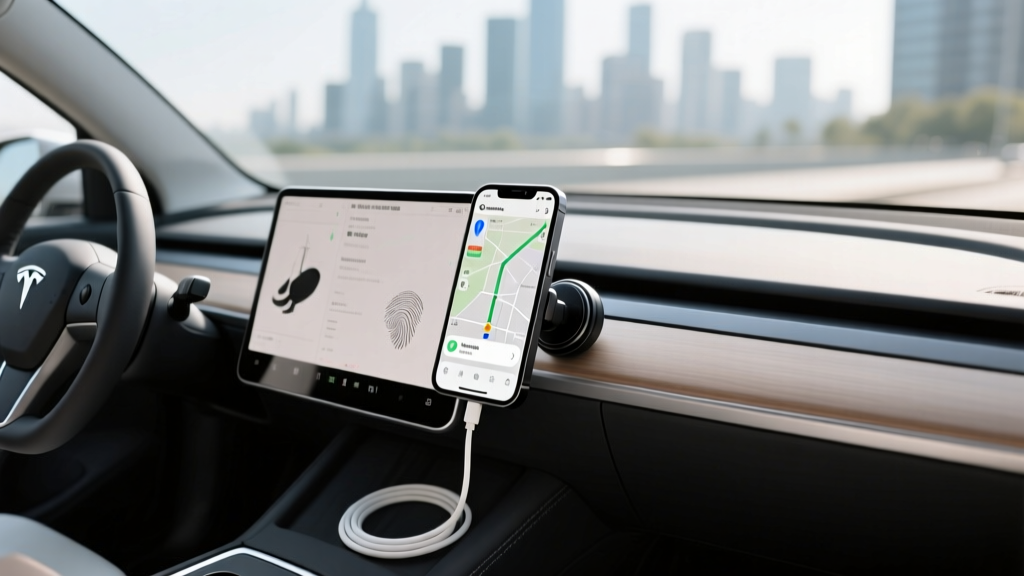
These mounts adhere to the back or side of the Model Y's floating touchscreen using 3M VHB tape or a friction-fit bracket. A MagSafe-compatible puck or N52 neodymium magnet arm extends toward the driver. Popular brands include TAPTES, Spigen, and iJDMTOY. They place the phone within easy reach, roughly at the same height as the speedometer readout on the screen's left edge.
Pros: Clean look, no vent damage, MagSafe alignment. Cons: Adhesive can leave residue on removal; may not suit 16-inch phones (iPhone Pro Max, Galaxy Ultra) without sagging over time.
2. Dashboard Seam / Hidden-Vent Clip Mounts
Brands like Basenor and Evutec make mounts specifically shaped for the Model Y's horizontal slot vent. These clip into the gap between the dash top and the windshield shelf. They position the phone slightly left of center.
Pros: No adhesive, easily removable. Cons: Can rattle on rough roads; may partially block the cabin camera on some installations.
3. Steering Column / Left-Dash Suction or Adhesive Mounts
A small suction-cup or adhesive-puck mount placed on the far-left dash (near the driver's A-pillar) positions the phone in the driver's direct line of sight. This mimics a traditional instrument cluster position.
Pros: True heads-up sightline, works with any phone. Cons: Suction cups can fail in extreme heat; adhesive versions are semi-permanent.
2026 Tesla Model Y: Complete Spec Profile
Beyond accessories, the Model Y itself deserves a hard look at the numbers. Here is the full spec breakdown for the current-generation (Juniper refresh) Model Y lineup available in the US market.
| Spec | Long Range RWD | Long Range AWD | Performance |
|---|---|---|---|
| EPA Range | 320 mi | 295 mi | 277 mi |
| Battery (usable) | ~75 kWh, LFP | ~75 kWh, NMC | ~75 kWh, NMC |
| Drivetrain | Rear-Wheel Drive | Dual-Motor AWD | Dual-Motor AWD |
| Horsepower | 346 hp | 384 hp | 456 hp |
| 0–60 mph | 5.8 sec | 4.8 sec | 3.5 sec |
| Max DC Fast Charge | ~170 kW | ~250 kW | ~250 kW |
| 10–80% DC Time | ~32 min | ~25 min | ~25 min |
| Level 2 Home Rate | 11.5 kW (~44 mi/hr) | 11.5 kW (~44 mi/hr) | 11.5 kW (~44 mi/hr) |
| EPA Efficiency | 122 MPGe (28 kWh/100mi) | 111 MPGe (30 kWh/100mi) | 106 MPGe (32 kWh/100mi) |
| Cargo (rear seats up) | 30.2 cu ft | ||
| Cargo (rear seats down) | 72.0 cu ft | ||
| Rear Legroom | 41.6 in | ||
| Base MSRP | $44,990 | $47,990 | $52,490 |
| Battery Warranty | 8 years / 120,000 miles (≥70% retention) | ||
Sources: fueleconomy.gov, Tesla Model Y Design Studio.
Real-World Range: What to Actually Expect
The Model Y's heat pump (standard on all 2026 trims) helps mitigate cold-weather losses compared to older EVs using resistive cabin heaters, but physics still applies. LFP batteries in the RWD model also have a slightly lower energy density than the NMC packs in the AWD/Performance variants, which is partly why the RWD carries a lower range despite being lighter.
One advantage of the LFP chemistry: Tesla recommends charging LFP packs to 100% regularly (even daily), whereas NMC owners are advised to set a daily charge limit of 80–90% and only charge to 100% before long trips. This means LFP owners effectively get more daily usable range from a smaller gross battery.
Charging Speed: DC Fast and Home Level 2
| Charging Level | Power | Miles Added per Hour | Notes |
|---|---|---|---|
| Level 1 (120V outlet) | ~1.4 kW | ~4–5 mi/hr | Emergency/trickle only |
| Level 2 (240V, 48A) | 11.5 kW | ~44 mi/hr | Full overnight charge in ~7–8 hrs |
| DC Fast (V3 Supercharger) | Up to 250 kW | ~175 mi in 15 min | AWD/Performance only; tapers above 80% |
| DC Fast (RWD / LFP) | Up to ~170 kW | ~130 mi in 15 min | Slower charge curve due to LFP chemistry |
The 250 kW peak on AWD/Performance trims is a peak, not a sustained rate. The charge curve typically holds above 200 kW from 10–40% State of Charge, then progressively tapers. From 80–100%, speeds drop below 50 kW — this is normal for all lithium-ion packs and why most road-trippers charge to 80% and move on.
For home charging, a 48-amp Level 2 wall connector on a 60-amp circuit delivers the full 11.5 kW. Installation typically costs $800–$2,000 depending on panel proximity and whether your home needs a service upgrade. Always consult a licensed electrician for final specs.
Pricing, Trims, and Federal Tax Credit Eligibility
| Trim | Base MSRP | Federal Credit (§30D) | Effective Price* |
|---|---|---|---|
| Long Range RWD | $44,990 | Up to $7,500 (if eligible) | ~$37,490 |
| Long Range AWD | $47,990 | Up to $7,500 (if eligible) | ~$40,490 |
| Performance | $52,490 | Up to $7,500 (if eligible) | ~$44,990 |
*Effective price assumes full $7,500 credit and does not include destination fee, options, or state incentives.
The IRS §30D Clean Vehicle Credit has strict eligibility requirements that change based on battery-component sourcing and critical-mineral rules. Key conditions for 2026:
- MSRP cap: SUVs (including the Model Y) must have an MSRP at or below $80,000.
- Buyer income cap: Modified AGI must not exceed $150,000 (single), $225,000 (head of household), or $300,000 (joint).
- Battery sourcing: Increasing percentages of critical minerals and battery components must be sourced from the US or free-trade-agreement countries. This determines whether you receive the full $7,500 or a partial $3,750.
- Point-of-sale transfer: As of 2024, eligible buyers can transfer the credit to the dealer at purchase, reducing the out-of-pocket cost immediately rather than waiting for tax filing.
Tesla's battery supply chain has shifted significantly toward compliance, but the exact credit amount (full $7,500, half $3,750, or $0) depends on the specific build week and battery pack origin. Always verify current eligibility on the IRS website or with a tax professional before purchasing.
Performance, Tech, and Ownership Experience
The Model Y Performance trim hits 0–60 mph in 3.5 seconds — sports-car territory in a family crossover. Even the RWD model's 5.8-second sprint is quicker than most gas-powered compact SUVs. Dual-motor AWD provides confident traction in rain and light snow, and Tesla's traction control calibration is among the most responsive in the EV segment.
Standout Tech
- 15-inch central touchscreen with navigation, streaming, and gaming (Tesla Arcade).
- Autopilot (standard) and FSD Supervised ($8,000 option or $99/mo) — both are SAE Level 2 driver-assist systems requiring active driver engagement.
- Over-the-air updates that regularly add features and refine existing ones.
- Sentry Mode and Dashcam using the car's exterior cameras for security recording.
- Supercharger network access — the most extensive and reliable DC fast-charging network in North America.
Notable Drawbacks
- No Apple CarPlay or Android Auto. If you rely on these platforms, a phone mount becomes even more critical for running Waze, Spotify, or other apps alongside Tesla's native interface.
- Firm ride quality. The Juniper refresh improved damping, but the Model Y still transmits more road imperfections than rivals like the Hyundai Ioniq 5 or Ford Mustang Mach-E.
- Minimal physical controls. Adjusting mirrors, climate, and glovebox all require touchscreen taps — a learning curve for new owners.
- Insurance costs. Model Y insurance premiums tend to run 15–30% higher than comparable gas SUVs due to repair costs and Tesla's integrated body construction.
Pros and Cons at a Glance
Pros
- Class-leading Supercharger network access
- Strong real-world efficiency (28–32 kWh/100mi)
- Spacious cargo area (72 cu ft max)
- Excellent OTA update cadence
- LFP option allows daily 100% charging
- Quick 0–60 across all trims
Cons
- No CarPlay/Android Auto support
- Firm ride on rough pavement
- Higher insurance premiums than ICE rivals
- Phone mounting requires aftermarket solutions
- FSD costs $8,000 extra (and still Level 2)
- Rear visibility limited by sloping roofline
Who Should Buy the Tesla Model Y?
The Model Y fits best for:
- Daily commuters with home Level 2 charging who want minimal fuel costs and strong efficiency.
- Small families needing 30+ cu ft of cargo space with the option to fold seats flat for 72 cu ft.
- Road trippers who value the Supercharger network's reliability over competitors relying on Electrify America or third-party CCS networks.
- Tech-forward buyers who appreciate OTA updates, Sentry Mode, and a large touchscreen-centric interface.
It may not be ideal for buyers who prioritize ride comfort over sportiness, who need Apple CarPlay, or who frequently tow (the Model Y's 3,500-lb towing capacity trails some gas and hybrid SUV competitors).
Frequently Asked Questions
What is the best phone mount for a Tesla Model Y?
For most owners, a MagSafe-compatible mount that attaches to the back or left edge of the 15-inch touchscreen (such as TAPTES or Spigen models) offers the cleanest look and best reach. Avoid mounts that block the cabin camera above the rearview mirror.
Does the Tesla Model Y have a built-in phone holder?
No. The Model Y includes a Qi wireless charging pad on the lower console shelf, but it lays the phone flat and does not hold it at a visible angle. A dedicated mount is needed if you want to see navigation or media apps while driving.
Can I use Apple CarPlay in the Tesla Model Y?
Not natively. Tesla does not support Apple CarPlay or Android Auto. Some third-party hardware adapters (like Carlinkit) project a CarPlay-like interface onto a portion of the Tesla screen, but these are unofficial and can be unreliable.
What is the real-world highway range of the Model Y?
The Long Range RWD's 320-mile EPA estimate drops to approximately 260–280 miles at sustained highway speeds (70–75 mph). In cold weather, expect 220–240 miles. The AWD and Performance trims see similar proportional reductions from their 295- and 277-mile EPA figures, respectively.
Does the 2026 Tesla Model Y qualify for the $7,500 federal tax credit?
All Model Y trims fall under the $80,000 SUV MSRP cap for the §30D credit. However, full $7,500 eligibility depends on your income, the battery's critical-mineral and component sourcing for your specific build, and current IRS rules. Verify on irs.gov before purchasing.
How long does the Model Y battery last?
Tesla warranties the battery for 8 years or 120,000 miles (whichever comes first) with at least 70% capacity retention. Real-world data from high-mileage owners suggests NMC packs retain roughly 85–90% capacity at 100,000 miles, while LFP packs show comparable or slightly better retention due to their more stable chemistry.