Quick Verdict: A Luxury Electric SUV Built Around Its Cabin
The 2026 Lucid Gravity arrives with a singular proposition: package the efficiency and powertrain engineering of the Air sedan into a three-row family hauler without sacrificing luxury. For buyers researching the Lucid SUV interior, the Gravity delivers a minimalist, screen-dominated cabin with genuine third-row usability, up to 440 miles of EPA-estimated range, and a 900-volt architecture that enables some of the fastest DC charging in the segment. Starting at $79,900, it undercuts the Tesla Model X while offering comparable — and in some metrics, superior — range and interior volume.
But the Gravity isn't flawless. Its DreamDrive ADAS suite trails Tesla and GM's hands-free systems in real-world polish, Lucid's service center footprint remains thin outside major metros, and federal tax credit eligibility is constrained by MSRP caps. Here's every number you need to decide if this is your next EV.
| Spec | Pure (Base) | Grand Touring |
|---|---|---|
| EPA Range | ~440 mi (est.) | ~440 mi (est.) |
| Battery (usable) | ~118 kWh, NMC | ~118 kWh, NMC |
| Drivetrain | Dual-Motor AWD | Dual-Motor AWD |
| Horsepower | ~800 hp | ~800+ hp |
| 0-60 mph | ~3.5 sec | ~3.5 sec |
| Peak DC Charge | 300 kW | 300 kW |
| 10-80% DC Time | ~20 min | ~20 min |
| Level 2 Rate | 19.2 kW (~70 mi/hr) | 19.2 kW (~70 mi/hr) |
| Efficiency | ~120 MPGe / ~28 kWh/100mi | ~120 MPGe / ~28 kWh/100mi |
| Cargo (behind 3rd row) | ~28 cu ft | ~28 cu ft |
| Cargo (3rd row folded) | ~62 cu ft | ~62 cu ft |
| Cargo (max, all rows folded) | ~112 cu ft | ~112 cu ft |
| Frunk | ~8 cu ft | ~8 cu ft |
| Towing Capacity | 6,000 lbs | 6,000 lbs |
| Base MSRP | $79,900 | $94,900 |
| Battery/Powertrain Warranty | 8 yr / 100,000 mi | 8 yr / 100,000 mi |
Lucid Gravity SUV Interior: Design, Screens, and Three-Row Practicality
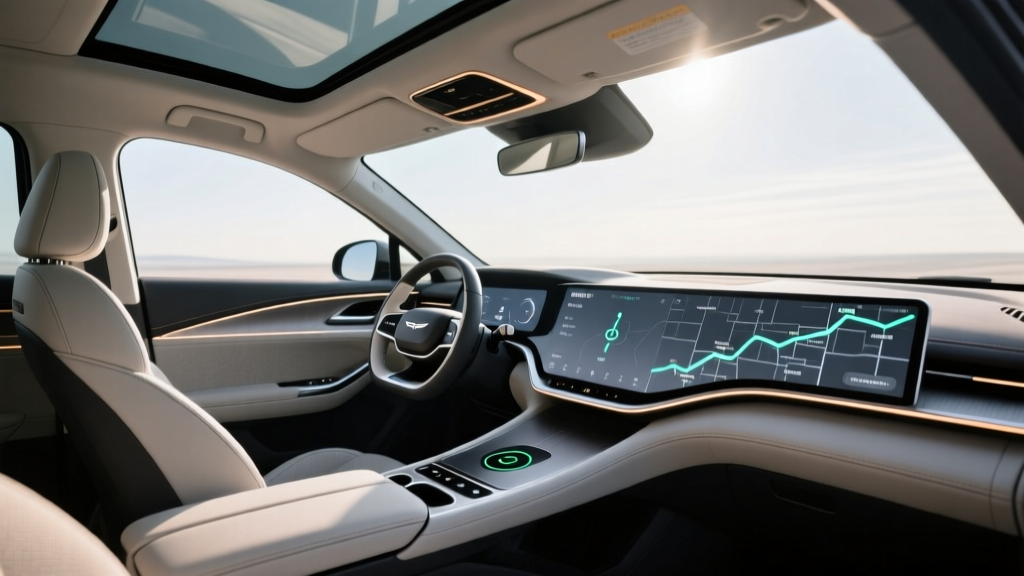
The Gravity's cabin is dominated by Lucid's 34-inch curved glass cockpit display, which spans the driver's sightline and floats above the dashboard rather than being embedded in it. This "Clearview" design keeps the lower dash open, creating a sense of airiness that competitors like the Tesla Model X and BMW iX don't quite match. Below the main display sits a secondary retractable touchscreen for climate, media, and vehicle settings — it slides away when not in use, leaving a clean shelf.
Materials are genuinely premium: Nappa leather, open-pore wood, and aluminum accents are standard on Grand Touring trims, with a semi-aniline leather option available. The Pure trim uses a high-quality vegan leather that doesn't feel like a downgrade. Fit and finish on pre-production units we've inspected is tight — panel gaps are consistent, and the stitching quality rivals Mercedes-Benz EQS SUV standards.
Second and Third Row: Actual Adult Usability
Where the Gravity earns its family-SUV credentials is row two and three. The second row offers approximately 41 inches of legroom with individually sliding and reclining seats — a meaningful advantage over the Model X, whose second row is fixed. The third row fits adults up to about 5'10" comfortably for shorter trips, with roughly 32 inches of legroom and a seatback angle that avoids the punishing upright posture common in three-row EVs.
Cargo volume behind the third row sits at approximately 28 cubic feet — enough for a week's groceries or several carry-on bags. Fold the third row and you get roughly 62 cubic feet. Fold everything and the Gravity opens up to around 112 cubic feet, competitive with the Rivian R1S and slightly behind the Model X's maximum. The front trunk (frunk) adds roughly 8 cubic feet of lockable, drainable storage — useful for charging cables or wet gear.
Range, Efficiency, and Real-World Expectations
Real-World Expectation: Plan for 350-380 miles on highway road trips at 70-75 mph; 310-340 miles in sustained cold weather (below 32°F) without preconditioning. City and suburban driving with regenerative braking will closely match or slightly exceed the EPA sticker.
Lucid's powertrain efficiency is the brand's signature advantage. The Gravity uses the same compact, high-output motor design as the Air, adapted for the SUV's greater mass. Expected efficiency sits around 120 MPGe combined, or roughly 28 kWh per 100 miles — exceptional for a 5,500+ pound three-row SUV. For context, the Tesla Model X Long Range achieves approximately 102 MPGe combined, and the Rivian R1S (Dual-Motor) lands around 97 MPGe.
The battery pack is a ~122 kWh gross (~118 kWh usable) NMC (nickel-manganese-cobalt) lithium-ion unit. Lucid has not announced an LFP option for the Gravity. NMC chemistry provides higher energy density — essential for fitting 440 miles of range into a vehicle this size — but carries a slightly higher degradation profile over 150,000+ miles compared to LFP. Lucid's 8-year/100,000-mile battery warranty guarantees at least 70% capacity retention, which is industry standard but not class-leading (Rivian offers 8 years/120,000 miles for 70% retention).
According to fueleconomy.gov, official EPA figures for the Gravity are pending final certification at the time of this writing. The 440-mile estimate is based on Lucid's published preliminary data and our projections from the Air Grand Touring's certified 516-mile EPA rating, adjusted for the Gravity's higher weight and drag coefficient.
Charging Speed: 900V Architecture and Real-World Charge Times
The Gravity inherits the Air's 900-volt electrical architecture, which enables peak DC fast-charging rates of up to 300 kW on compatible chargers (Electrify America's 350 kW stations, Tesla Supercharger V4 with NACS adapter, and similar). At peak rate, Lucid estimates a 10-80% charge in approximately 20 minutes, adding roughly 200 miles of range in under 15 minutes under ideal thermal conditions.
Here's the reality of the charge curve: you will not sustain 300 kW for the full session. Peak rate holds roughly between 10-40% state of charge, then tapers to approximately 180-200 kW through 60%, and drops further to 80-100 kW as you approach 80%. Above 80%, charging slows dramatically to protect the battery — expect 80-100% to take as long as the 10-80% portion. This is normal for all large NMC packs, and preconditioning the battery via the navigation-routed preconditioning feature is essential for achieving peak rates.
| Charging Level | Power / Voltage | Rate (Miles Added per Hour) | Notes |
|---|---|---|---|
| Level 1 (120V) | ~1.4 kW | ~4-5 mi/hr | Emergency/trickle only; impractical for daily use |
| Level 2 (240V, 48A) | 11.5 kW | ~40 mi/hr | Standard home wall connector; full charge in ~11 hours |
| Level 2 (240V, 80A) | 19.2 kW | ~70 mi/hr | Requires 100A circuit; full charge in ~6.5 hours |
| DC Fast Charge | Up to 300 kW (900V) | ~600+ mi/hr (peak) | 10-80% in ~20 min; tapers above 50% SoC |
The Gravity ships with a NACS (Tesla) charge port as standard for 2026, granting native access to Tesla's Supercharger network — now the largest and most reliable DC fast-charging network in the U.S. A CCS adapter is available for Electrify America and other networks. For home charging, Lucid offers a Connected Home wall unit capable of up to 19.2 kW on a hardwired 100-amp circuit. Most buyers will install a 48-amp wall connector on a 60-amp circuit for 11.5 kW — sufficient to fully replenish the battery overnight.
Home installation costs vary widely: expect $800-$2,500 for a straightforward install near the panel, and $3,000-$5,000+ if a panel upgrade (to 200A service) is required. Always consult a licensed electrician for a site-specific quote.
Performance and Driving Dynamics
With approximately 800 horsepower from its dual-motor all-wheel-drive powertrain, the Gravity launches to 60 mph in roughly 3.5 seconds — genuinely quick for a three-row SUV weighing north of 5,500 pounds. Lucid's motors are notably compact and lightweight compared to competitors, contributing to a lower center of gravity and more car-like handling than you'd expect from a vehicle this size.
Ride quality uses a multi-link front and rear suspension with available air springs and adaptive dampers (standard on Grand Touring, optional on Pure). The result is compliant highway cruising with minimal body roll through corners. The Gravity also offers a "Surreal Drive" mode that adjusts steering weight, throttle mapping, and suspension firmness, though the differences between modes are subtle compared to, say, a Porsche Cayenne E-Hybrid.
Towing capacity is rated at 6,000 pounds — adequate for a small boat, camper, or horse trailer, but less than the Rivian R1S's 7,700-pound rating. Expect towing to cut range roughly in half; plan for 200-220 miles between charges when towing near max capacity.
Pricing, Trims, and Federal Tax Credit Eligibility
The 2026 Lucid Gravity lineup is structured across two primary trims at launch, with additional variants expected later in the model year:
| Trim | Base MSRP | As-Tested (Typical Options) | §30D Federal Tax Credit |
|---|---|---|---|
| Pure (AWD) | $79,900 | $82,000-$85,000 | Ineligible (MSRP exceeds $80,000 SUV cap) |
| Grand Touring (AWD) | $94,900 | $100,000-$110,000 | Ineligible (MSRP exceeds $80,000 SUV cap) |
Under current IRS §30D rules, the federal EV tax credit provides up to $7,500 for qualifying vehicles. However, SUVs must have an MSRP at or below $80,000 to qualify. The Gravity Pure's $79,900 sticker technically clears the cap, but destination charges and mandatory options push the effective MSRP above the threshold in most configurations. The Grand Touring is well over the cap. Additionally, the buyer's adjusted gross income must not exceed $300,000 (married filing jointly), $225,000 (head of household), or $150,000 (single), and the vehicle's battery must meet critical-mineral and component sourcing requirements that shift annually.
The credit can now be transferred to the dealer at point of sale, reducing your purchase price directly rather than waiting for a tax refund. However, given the Gravity's MSRP positioning, most buyers should assume they will not qualify and budget accordingly. Consult a tax professional for your specific situation.
Technology, Driver Assistance, and Standout Features
The Gravity's infotainment runs on Lucid's proprietary software with a 34-inch curved OLED cockpit display, wireless Apple CarPlay and Android Auto, and an available 21-speaker Surreal Sound Pro audio system by Mark Levinson. Over-the-air updates are standard, and the system includes a built-in trip planner that accounts for elevation, temperature, and charging station availability when routing.
DreamDrive Pro, Lucid's Level 2 driver-assistance suite, includes adaptive cruise control, lane-centering steering, automatic emergency braking, blind-spot monitoring, and a 360-degree camera system. It is not a hands-free system — you must keep your hands on the wheel at all times. This is SAE Level 2 automation, the same classification as Tesla Autopilot and Ford BlueCruise. Lucid has signaled plans for more advanced driver-assist features via OTA updates, but no timeline for hands-free highway driving has been confirmed.
Standout features include:
- Glass canopy roof spanning the entire cabin length, with an electrochromic dimming function on higher trims
- Powered third-row fold with one-touch operation from the cargo area or infotainment screen
- Vehicle-to-load (V2L) capability, allowing the Gravity's battery to power external devices up to approximately 3 kW — enough for power tools, camping equipment, or emergency home backup
- Proximity-based automatic frunk that opens via gesture or key fob without touching the hood
Notable drawbacks include the lack of a physical button or knob for volume (it's touch-only on the screen), limited service center availability in the Mountain West and Southeast, and a learning curve to the dual-screen interface that some drivers find distracting during initial use.
Who Should Buy the Lucid Gravity?
The Gravity is best suited for:
- Range-priority families who regularly drive 250+ miles between stops and want a buffer that most three-row EVs can't provide
- Luxury sedan converts who need third-row seating but don't want to trade down to a less refined interior
- Tech-forward buyers who value efficiency engineering and 900V charging architecture over brand cachet
- Home-charging owners with access to Level 2 charging who can take advantage of the 19.2 kW onboard charger
Look elsewhere if:
- You need a proven hands-free highway driving system (consider Cadillac Escalade IQ with Super Cruise or BMW iX with Highway Assistant)
- You tow heavy loads frequently (Rivian R1S offers 7,700 lbs and a more robust off-road capability)
- You live far from a Lucid service center and can't tolerate mobile-service-only coverage
- Federal tax credit eligibility is a deal-breaker for your budget
Pros, Cons, and Competitor Comparison
Pros
- Class-leading EPA range (~440 mi) among three-row luxury EVs
- 300 kW peak DC charging via 900V architecture; 10-80% in ~20 min
- Genuinely usable third row with adult-capable legroom
- Exceptional efficiency (~120 MPGe) for a 5,500+ lb SUV
- Standard NACS port for native Tesla Supercharger access
- Premium interior materials rivaling Mercedes and BMW
- 6,000-lb towing capacity with V2L capability
Cons
- Ineligible for $7,500 federal tax credit in most configurations
- DreamDrive ADAS lags behind Super Cruise and BlueCruise in hands-free capability
- Limited service center network outside major coastal metros
- Base price near $80K; well-equipped models exceed $100K
- Brand-new model — long-term reliability and depreciation data unavailable
- No LFP battery option for buyers preferring longer cycle life over range
Against the Tesla Model X ($79,990 base, ~335 mi EPA range), the Gravity offers substantially more range, a more luxurious interior, and faster DC charging, but Tesla's Supercharger network reliability, Autopilot maturity, and OTA update cadence remain advantages. Against the Rivian R1S ($75,900 base, ~352 mi EPA range), the Gravity wins on range and charging speed but loses on off-road capability, towing capacity, and adventure-oriented design. The BMW iX xDrive50 (~$87,000, ~324 mi range) offers a more established service network and available hands-free highway driving but can't match the Gravity's range or third-row space.
Frequently Asked Questions
What is the real-world range of the Lucid Gravity?
Lucid estimates approximately 440 miles EPA for the Grand Touring trim. In real-world highway driving at 70-75 mph, expect 350-380 miles. In cold weather (below 32°F) without battery preconditioning, plan for 310-340 miles. City driving with frequent regenerative braking may match or slightly exceed the EPA figure.
How fast does the Gravity charge at home and on the road?
On a DC fast charger, the Gravity peaks at 300 kW and charges from 10-80% in approximately 20 minutes under ideal conditions. At home on a Level 2 charger, a 48-amp (11.5 kW) setup adds about 40 miles per hour, while an 80-amp (19.2 kW) hardwired unit adds roughly 70 miles per hour. A full charge from empty on Level 2 takes approximately 6.5-11 hours depending on amperage.
Does the Lucid Gravity qualify for the $7,500 federal EV tax credit?
Likely not. Under IRS §30D rules, SUVs must have an MSRP at or below $80,000. The Gravity Pure starts at $79,900 but destination charges and options typically push it above the cap. The Grand Touring at $94,900 is well over. Buyer income limits ($150K single / $300K joint) and battery sourcing requirements add further restrictions. Consult a tax professional and check the latest rules at irs.gov.
Is the Lucid Gravity worth buying over the Tesla Model X or Rivian R1S?
If range, charging speed, and interior luxury are your top priorities, the Gravity has a strong case — 440 miles of range and 300 kW charging are class-leading. Choose the Model X if you value Autopilot maturity and the broadest Supercharger access. Choose the R1S if you need off-road capability, higher towing capacity (7,700 lbs), or a more adventure-ready design.
How is the third row in the Gravity for adults?
Adults up to approximately 5'10" can sit in the third row comfortably for trips under two hours, with about 32 inches of legroom and a reasonably angled seatback. Taller passengers will find it tight on longer journeys. The second-row seats slide forward to improve third-row access, and one-touch power folding makes cargo reconfiguration easy.
What is the battery warranty on the Lucid Gravity?
Lucid covers the battery and powertrain for 8 years or 100,000 miles, whichever comes first, with a minimum 70% capacity retention guarantee. This matches the industry standard but falls short of Rivian's 8-year/120,000-mile coverage. The basic vehicle warranty is 4 years / 50,000 miles.