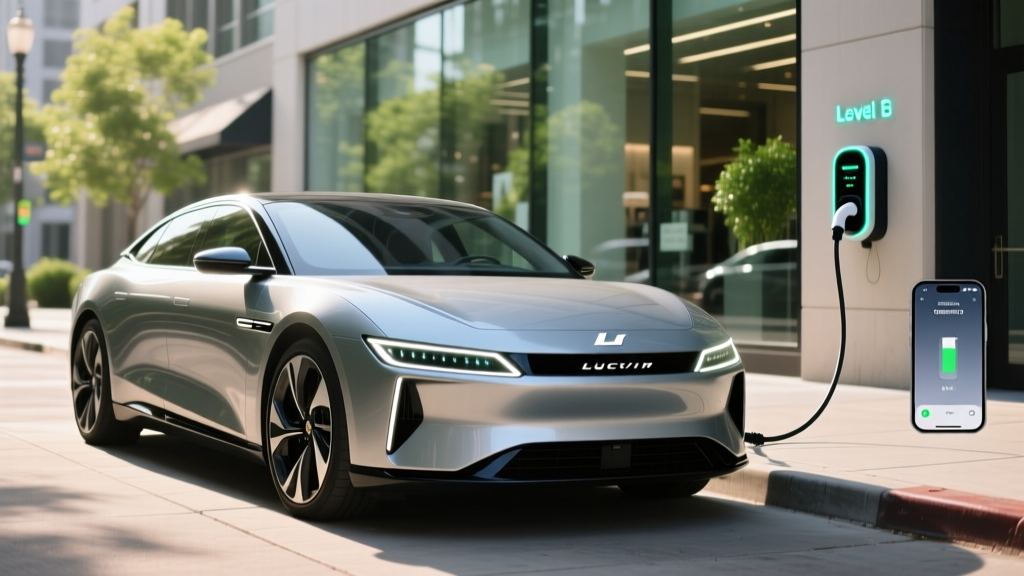
The Lucid Gravity enters the luxury three-row electric SUV segment with an engineering-first approach: a 900-volt architecture, class-leading efficiency, and a starting price that undercuts the Tesla Model X and Rivian R1S. But spec sheets only tell half the story. After examining EPA data, charging curves, and ownership logistics, here's what the Lucid Gravity's real-world image looks like for buyers in 2026.
2026 Lucid Gravity Quick Specs
| Spec | Gravity Pure (RWD) | Gravity Touring (AWD) | Gravity Grand Touring (AWD) |
|---|---|---|---|
| EPA Range | ~440 mi (est.) | ~400 mi (est.) | ~440 mi (est.) |
| Battery (usable) | ~112 kWh, NMC | ~112 kWh, NMC | ~118 kWh, NMC |
| Horsepower | ~480 hp | ~620 hp | ~820 hp |
| 0–60 mph | ~5.5 sec | ~4.5 sec | ~3.5 sec |
| Max DC Charge Rate | 300+ kW | 300+ kW | 300+ kW |
| 10–80% DC Time | ~20 min | ~20 min | ~22 min |
| Level 2 Rate | 19.2 kW (~80 mi/hr) | 19.2 kW (~80 mi/hr) | 19.2 kW (~80 mi/hr) |
| Drivetrain | RWD (single motor) | AWD (dual motor) | AWD (dual motor) |
| MPGe (combined, est.) | ~130 MPGe | ~120 MPGe | ~118 MPGe |
| Base MSRP | ~$79,900 | ~$89,900 | ~$99,900 |
Real-World Range vs. EPA Estimates
EPA Estimate: Up to ~440 miles (Grand Touring with 118 kWh pack)
Real-World Expectation: ~350–380 miles on mixed highway driving; ~300–330 miles in cold weather (below 32°F) or sustained 75+ mph highway runs.
The Lucid Gravity benefits from the same efficiency engineering that gave the Air sedan its record-breaking EPA ratings. Lucid's miniaturized drive units and low-drag aero translate to roughly 3.8–4.0 miles per kWh in mixed driving — exceptional for a 5,500+ lb three-row SUV.
However, physics still applies. At sustained highway speeds of 75–80 mph, expect a 10–15% reduction from the EPA sticker. In freezing temperatures, the battery's thermal management system consumes energy to keep cells in their optimal window, and cabin heating (even with a heat pump) adds load. Plan for roughly 300 miles of usable range on a winter road trip before needing a charge stop.
Compared to the Rivian R1S (EPA ~352–410 mi depending on pack) and the Tesla Model X (EPA ~326–351 mi), the Gravity's range ceiling is meaningfully higher — enough to eliminate a charge stop on routes like Los Angeles to San Francisco or Dallas to Houston.
Charging Speed: 900V Architecture in Practice
The Gravity uses a 900-volt electrical architecture, the same platform proven in the Air. Higher voltage allows faster charging at lower current, reducing heat buildup and sustaining peak rates longer than 400V competitors.
| Charging Level | Power / Rate | Miles Added per Hour | Notes |
|---|---|---|---|
| Level 1 (120V / 12A) | ~1.4 kW | ~5–6 mi/hr | Emergency/trickle only |
| Level 2 (240V / 80A) | 19.2 kW | ~75–80 mi/hr | Requires hardwired Wall Connector; full overnight refill in ~6–7 hrs |
| Level 2 (240V / 48A) | 11.5 kW | ~45–48 mi/hr | Standard NEMA 14-50 outlet; overnight refill in ~10 hrs |
| DC Fast Charge (peak) | 300+ kW | ~1,200+ mi/hr (peak) | 10–80% in ~20 min at a 350 kW station |
| DC Fast Charge (sustained avg) | ~200–220 kW avg | — | Charge curve tapers significantly above 80% SoC |
What this means on a road trip: At a Electrify America or Tesla Supercharger V4 station capable of 350 kW, the Gravity can add roughly 200 miles in 10 minutes. The 10–80% sprint takes approximately 20 minutes under ideal thermal conditions. However, like all lithium-ion packs, the charge curve tapers sharply past 80% — going from 80–100% can take nearly as long as 10–80%. For road-trip efficiency, charge to 80% and go.
At home, the 19.2 kW Level 2 capability is among the fastest in the segment. You'll need a hardwired charger (not a plug-in NEMA 14-50) and a 100-amp dedicated circuit to achieve this rate. Most homes will require a panel upgrade to support this — budget $1,500–$3,500 for electrical work depending on your existing service. A 48-amp setup on a standard 60-amp breaker is more practical for most households and still delivers a full overnight charge.
The Gravity ships with a NACS (Tesla-style) charge port, granting native access to Tesla's Supercharger network without an adapter — a significant practical advantage over CCS-only vehicles.
Performance and Driving Dynamics
Even the base Gravity Pure delivers ~480 horsepower and a ~5.5-second 0–60 time from its single rear motor — brisk for a three-row family hauler. The dual-motor Touring bumps output to ~620 hp with standard all-wheel drive, while the Grand Touring's ~820 hp and 3.5-second 0–60 puts it in sports-sedan territory.
Lucid's drive units are notably compact and light, contributing to a lower center of gravity and more interior space than competing architectures. The air suspension (standard on Touring and Grand Touring) provides adjustable ride height — useful for clearing rough roads or lowering for highway efficiency — and delivers a compliant ride that rivals the BMW iX and Mercedes EQS SUV.
Towing capacity is rated at up to 6,000 lbs (with the tow package), competitive with the Rivian R1S and adequate for most boat and camper trailers. Expect a 30–40% range reduction when towing near max capacity — plan accordingly.
Interior Space, Tech, and Daily Livability
The Gravity seats up to seven passengers across three rows. Key dimensions:
- Cargo (behind 3rd row): ~28 cu ft
- Cargo (3rd row folded): ~62 cu ft
- Cargo (all rear rows folded): ~105 cu ft
- Front headroom: ~41 inches
- 2nd-row legroom: ~40 inches
- 3rd-row legroom: ~34 inches (usable for children or short-trip adults)
- Frunk: ~12 cu ft (front trunk, weather-sealed)
The centerpiece is a 34-inch curved glass cockpit display that spans the driver's field of view, replacing the traditional instrument cluster and infotainment screen. A lower touchscreen handles climate and secondary controls. The system runs Lucid's proprietary OS — responsive and visually polished, though the app ecosystem is smaller than Tesla's.
Driver assistance comes via Lucid's DreamDrive Pro suite, which includes adaptive cruise control, lane centering, automatic emergency braking, and blind-spot monitoring. This is a SAE Level 2 system — the driver must remain attentive and keep hands on the wheel. It is not autonomous driving. DreamDrive Pro is competent for highway cruising but does not currently offer hands-free operation like GM's Super Cruise or Ford's BlueCruise on mapped highways.
Notable drawbacks: The third row, while present, is tight for adults on long drives. The glass canopy roof, while stunning, can create cabin heat in direct summer sun (the electrochromic tinting helps but doesn't fully solve it). Service center density remains limited outside major metro areas — Lucid's mobile service and partnerships help, but it's not yet at Tesla's coverage level.
Pricing, Tax Credits, and Ownership Cost
The 2026 Lucid Gravity lineup starts at approximately $79,900 for the Pure trim and climbs to ~$99,900 for the Grand Touring. Here's how federal incentives factor in:
| Trim | Base MSRP | §30D Federal Credit | Est. Net Price | Credit Eligibility Notes |
|---|---|---|---|---|
| Gravity Pure | ~$79,900 | Up to $7,500 | ~$72,400 | Must meet battery-sourcing & critical-mineral rules; buyer income caps apply |
| Gravity Touring | ~$89,900 | Up to $7,500 | ~$82,400 | SUV MSRP cap is $80,000 — Touring may exceed cap depending on classification |
| Gravity Grand Touring | ~$99,900 | Likely $0 | ~$99,900 | Exceeds $80,000 SUV MSRP cap under §30D |
IRS §30D Federal EV Tax Credit Requirements (2026):
- MSRP Cap: SUVs, vans, and pickups must be ≤ $80,000; sedans ≤ $55,000. The Gravity Pure may qualify if classified as an SUV; Touring and Grand Touring likely exceed the cap.
- Buyer Income Caps: AGI ≤ $300,000 (married filing jointly), $225,000 (head of household), $150,000 (single).
- Battery Sourcing: Battery components must be manufactured/assembled in North America (phasing percentages increase yearly); critical minerals must be sourced from the US or FTA partners.
- Point-of-Sale Transfer: Eligible buyers can transfer the credit to the dealer for an immediate price reduction at purchase rather than claiming it on their tax return.
- Verification: Always check the latest rules at IRS.gov and confirm VIN eligibility on fueleconomy.gov before purchasing.
Beyond the purchase price, ownership economics are favorable compared to gas-powered luxury SUVs. Electricity costs average $0.13–$0.16/kWh nationally (varies by state and utility), making a full Gravity charge roughly $15–$19 at home — versus $80–$100+ to fill a comparable gas SUV at $3.50/gallon. Insurance premiums, however, run 15–25% higher than equivalent ICE vehicles due to repair costs and parts pricing.
Warranty and Long-Term Battery Outlook
Lucid covers the Gravity with:
- Basic Vehicle Warranty: 4 years / 50,000 miles
- Battery & Powertrain Warranty: 8 years / 100,000 miles (retains ≥ 70% capacity)
- Roadside Assistance: 4 years / 50,000 miles
The battery uses NMC (nickel-manganese-cobalt) chemistry, which offers high energy density — necessary for fitting 112–118 kWh into the Gravity's footprint. NMC cells historically show slightly faster degradation than LFP (lithium iron phosphate) chemistry in the first 2–3 years before stabilizing. Based on Lucid Air fleet data and similar NMC platforms, expect approximately 8–12% capacity loss over the first 100,000 miles under normal use. The 70% retention warranty threshold at 8 years/100,000 miles is industry-standard but conservative — most packs outperform this significantly.
To maximize longevity: avoid routinely charging to 100% for daily use (set to 80–90%), minimize DC fast charging when Level 2 is available, and use preconditioning when navigating to a fast charger.
Pros
- Class-leading EPA range (up to ~440 mi) eliminates most road-trip charge stops
- 900V architecture enables 300+ kW DC fast charging with 10–80% in ~20 min
- NACS port provides native Tesla Supercharger access
- Outstanding efficiency (~130 MPGe) reduces per-mile energy cost
- Genuine three-row seating with usable frunk
- Air suspension delivers a refined, adaptive ride
Cons
- Grand Touring exceeds $80K MSRP cap — no federal tax credit on higher trims
- Third-row legroom is tight for adults on long drives
- Limited service center network outside major metros
- DreamDrive Pro lacks hands-free highway capability (no Level 2+ hands-free mode yet)
- Home charging at 19.2 kW may require expensive panel upgrade ($1,500–$3,500+)
- NMC battery degrades slightly faster than LFP in early years
Who Should Buy the Lucid Gravity?
Choose the Gravity if:
- You need three rows but prioritize range above all else — no competitor matches ~440 miles EPA.
- You take regular road trips and want the fewest charge stops possible.
- You value efficiency and low per-mile energy cost in a large vehicle.
- You want native Supercharger access without adapters.
Look elsewhere if:
- You need a genuinely adult-friendly third row — the Rivian R1S or Kia EV9 offer more space.
- Off-road capability is a priority — the Rivian R1S is far more capable on trails.
- You want hands-free highway driving — GM's Super Cruise or Ford's BlueCruise offer this today.
- Budget is under $75K — consider the Kia EV9 or a used Tesla Model X.
Frequently Asked Questions
What is the real-world range of the Lucid Gravity?
The EPA estimates up to ~440 miles for the Grand Touring trim. In real-world mixed driving at highway speeds, expect 350–380 miles. In cold weather (below freezing), plan for approximately 300–330 miles before needing to charge.
How fast does the Lucid Gravity charge?
On a 350 kW DC fast charger, the Gravity peaks above 300 kW and charges from 10–80% in approximately 20 minutes. At home on a 19.2 kW Level 2 charger, a full charge takes about 6–7 hours. On a standard 48-amp Level 2 (11.5 kW), expect about 10 hours.
Does the Lucid Gravity qualify for the federal EV tax credit?
The base Gravity Pure (~$79,900 MSRP) may qualify for up to $7,500 under §30D if it meets battery-sourcing requirements and the buyer's income is under the cap ($150K single / $300K joint). The Touring and Grand Touring trims likely exceed the $80,000 SUV MSRP cap and would not qualify. Always verify on IRS.gov before purchasing.
Is the Lucid Gravity worth buying over the Rivian R1S or Tesla Model X?
If maximum range and charging speed are your top priorities, the Gravity wins decisively — no three-row SUV offers more miles per charge. If you need serious off-road capability, a more spacious third row, or a more established service network, the Rivian R1S or Tesla Model X may be better fits. Test-drive all three before deciding.
What are the biggest drawbacks of the Lucid Gravity?
The main trade-offs are a tight third row for adults, a service center network that's still expanding, a driver-assist system that doesn't yet offer hands-free operation, and the loss of the federal tax credit on higher trims due to MSRP caps. Home charging at full 19.2 kW speed may also require a costly electrical panel upgrade.
Does the Lucid Gravity use NACS or CCS for charging?
The Gravity uses a native NACS (Tesla-style) charge port, meaning it can charge at Tesla Superchargers and any NACS-equipped public station without an adapter. For legacy CCS stations, Lucid provides a NACS-to-CCS adapter.