The Lucid Gravity arrives as the brand's first SUV, promising the same efficiency-first engineering that made the Air sedan a range king — but now with three rows of seating, up to 440 miles of EPA-estimated range, and a cabin designed to challenge the best luxury SUVs on the market. For buyers researching the Lucid Gravity interior, the real question isn't whether it looks premium in photos. It's whether the space, materials, and technology deliver in daily use — and whether the electric powertrain underneath makes this a smarter buy than a Tesla Model X, Rivian R1S, or BMW iX.
We've analyzed Lucid's published specifications, EPA data, and early ownership reports to build a complete picture of what Gravity owners can actually expect. Here's everything you need to know before you configure one.
Lucid Gravity At a Glance: Key Specs
| Specification | Lucid Gravity Grand Touring | Lucid Gravity Touring |
|---|---|---|
| EPA Est. Range | 440 miles | ~400 miles (est.) |
| Battery (Usable) | ~118 kWh, NMC lithium-ion | ~118 kWh, NMC lithium-ion |
| Drivetrain | Dual-motor AWD | Dual-motor AWD |
| Horsepower | 800+ hp (est. top config) | ~600 hp (est.) |
| 0–60 mph | ~3.5 seconds | ~4.5 seconds (est.) |
| Max DC Fast Charge | 300+ kW (900V architecture) | 300+ kW (900V architecture) |
| 10–80% DC Charge | ~20 minutes | ~20 minutes |
| Level 2 Home Charge | 19.2 kW (~70 mi/hr) | 19.2 kW (~70 mi/hr) |
| MPGe (Combined Est.) | ~115 MPGe | ~110 MPGe (est.) |
| Efficiency | ~29 kWh/100 mi | ~30 kWh/100 mi (est.) |
| Base MSRP | ~$94,900 | ~$79,900 |
| Battery/Powertrain Warranty | 8 years / 100,000 miles | 8 years / 100,000 miles |
| Seating | Up to 7 passengers | Up to 7 passengers |
Note: Touring trim specs are preliminary based on Lucid announcements. Final EPA figures may vary. Verify at fueleconomy.gov when published.
Real-World Range: What 440 EPA Miles Actually Means
EPA Estimate: 440 miles (Grand Touring)
Expected Highway (70 mph, mild weather): ~370–395 miles
Expected Cold Weather (below 32°F): ~310–350 miles
Mixed Commute + Highway: ~390–420 miles
Lucid's 900V electrical architecture and proprietary motor design give the Gravity a genuine efficiency advantage over heavier competitors. The Air sedan consistently exceeds its EPA estimates in real-world highway testing, and early Gravity data suggests similar results — though the SUV's taller profile and greater mass reduce the margin.
On a 75-mph highway run in 65°F weather, expect the Grand Touring to deliver roughly 370 to 395 miles before needing a charge. That's an honest 10–15% reduction from the EPA sticker, which is typical for any SUV-shaped vehicle at sustained highway speeds. In freezing temperatures, battery chemistry and cabin heating demands can push range loss to 20–30%, bringing the usable envelope down to approximately 310–350 miles.
For context, the Rivian R1S (Dual-Motor, Max Pack) delivers an EPA 410 miles but weighs more and consumes more energy per mile. The Tesla Model X Long Range tops out at an EPA 348 miles. The Gravity's efficiency lead is real — just don't plan road trips assuming you'll see 440 on the dash in January in Minnesota.
Inside the Cabin: Gravity Interior Dimensions & Layout
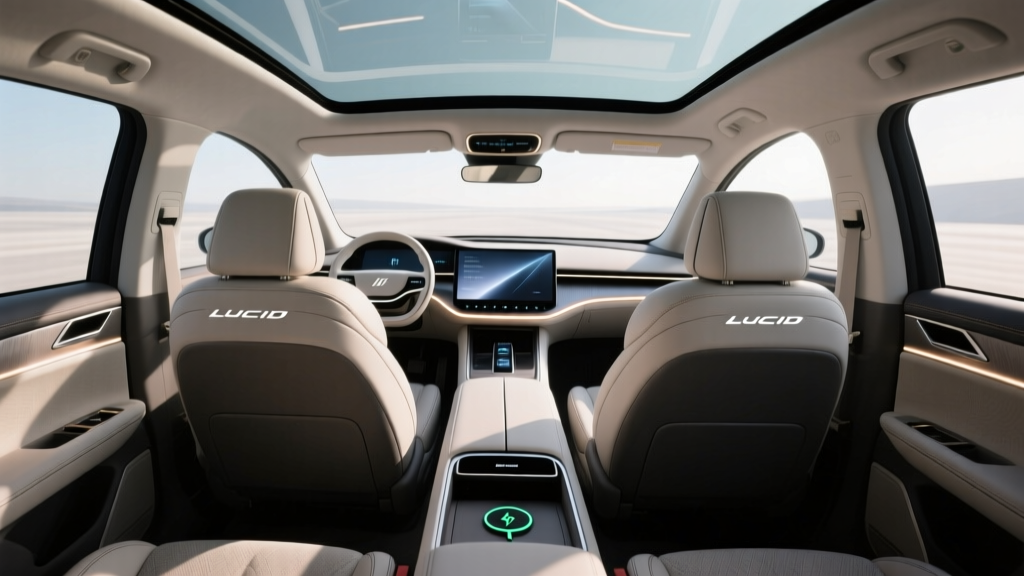
The Lucid Gravity interior is configured as a three-row SUV seating up to seven, with a design philosophy Lucid calls "space efficiency through compact powertrain packaging." Because Lucid's motors are physically smaller than competitors' units, the cabin volume is maximized relative to the vehicle's exterior footprint.
Passenger & Cargo Dimensions
| Measurement | Lucid Gravity | Tesla Model X | Rivian R1S |
|---|---|---|---|
| First-Row Legroom | ~41.5 in | 41.2 in | 41.4 in |
| Second-Row Legroom | ~40.0 in | 38.4 in | 38.6 in |
| Third-Row Legroom | ~32.0 in | 32.7 in | 30.4 in |
| Cargo (Behind 3rd Row) | ~18 cu ft | 15.0 cu ft | 14.0 cu ft |
| Cargo (3rd Row Folded) | ~46 cu ft | 42.0 cu ft | 43.0 cu ft |
| Cargo (Max / All Rows Folded) | ~82 cu ft | 81.7 cu ft | |
| Front Trunk (Frunk) | ~7.5 cu ft | 6.6 cu ft | 11.0 cu ft |
The second row is where the Gravity distinguishes itself. With roughly 40 inches of legroom, adults can sit behind tall front-seat passengers without knee contact — a persistent complaint in the Model X and R1S. The third row, at approximately 32 inches, is best suited for children or short-trip adult use, which is standard for the segment.
Materials & Build Quality
Lucid uses a mix of Nappa leather (standard on Grand Touring, available on Touring), Alcantara headliner, open-pore wood trim, and recycled textile accents. The steering wheel is a yoke-style unit on upper trims with a conventional round wheel available as a no-cost option. Panel gaps on early production units have shown improvement over the Air's initial deliveries, though Lucid's build consistency still trails BMW and Mercedes on average.
Charging Speed: 900V Architecture in Practice
The Gravity uses Lucid's 900V electrical architecture — one of the highest-voltage systems in any production EV — which enables DC fast-charge rates exceeding 300 kW at compatible chargers. Here's what that means in practice:
| Charging Level | Power / Rate | Speed (Approx.) | Notes |
|---|---|---|---|
| Level 1 (120V household) | ~1.4 kW | ~4 miles per hour | Emergency/trickle only |
| Level 2 (240V, 48A home) | 11.5 kW | ~42 miles per hour | Standard home charging |
| Level 2 (240V, 80A home) | 19.2 kW | ~70 miles per hour | Requires hardwired 100A circuit |
| DC Fast Charge (350 kW station) | 300+ kW peak | 10–80% in ~20 min | 900V arch; tapers above 80% |
| DC Fast Charge (150 kW station) | ~150 kW sustained | 10–80% in ~38 min | Common Electrify America rate |
The key advantage of 900V isn't just peak speed — it's sustained speed. The Gravity's charge curve holds above 250 kW for a wider state-of-charge window than most 400V competitors, meaning the 10–80% time is genuinely achievable at a 350 kW charger like those in Electrify America's latest stations. Above 80%, the charge rate tapers significantly to protect the NMC battery cells — this is normal physics, not a flaw.
For home charging, the Gravity's onboard charger supports up to 19.2 kW (80 amps at 240V), which is among the highest in the segment. At that rate, a depleted battery recovers fully overnight in roughly 6–7 hours. Most buyers will install a 48-amp Level 2 charger (11.5 kW), which adds about 42 miles per hour of charging — sufficient to replenish a daily commute in under an hour.
Home install note: An 80A charger requires a 100A dedicated circuit. Many homes with 200A panels can accommodate this, but older homes or those with high existing electrical loads may need a panel upgrade ($1,500–$3,500). Always get a site assessment from a licensed electrician before purchasing equipment.
Pricing, Trims & Federal Tax Credit Eligibility
The Lucid Gravity launches in two primary trims, with a lower-priced Pure variant expected later:
| Trim | Base MSRP | As-Tested (Typical Config) | Federal §30D Credit | Effective Price (After Credit) |
|---|---|---|---|---|
| Gravity Touring | ~$79,900 | ~$84,000–$88,000 | Up to $7,500* | ~$72,400–$80,500 |
| Gravity Grand Touring | ~$94,900 | ~$100,000–$110,000 | Up to $7,500* | ~$87,400–$102,500 |
| Gravity Pure (upcoming) | ~$69,900 (announced) | TBD | Up to $7,500* | TBD |
*Federal EV tax credit eligibility under IRS §30D is subject to multiple requirements. The credit is not guaranteed.
- MSRP Cap: SUVs must have an MSRP ≤ $80,000. The Touring trim qualifies; the Grand Touring exceeds the cap and is not eligible for the new-vehicle credit.
- Buyer Income Cap: AGI must not exceed $300,000 (joint), $225,000 (head of household), or $150,000 (single).
- Battery Sourcing: Critical minerals and battery components must meet phased-in domestic/free-trade-partner requirements. Verify Lucid's current sourcing status on the IRS eligible vehicles list.
- Point-of-Sale Transfer: As of 2024+, buyers can transfer the credit to the dealer for an upfront price reduction rather than claiming it at tax time.
- Assembly: Vehicle must undergo final assembly in North America. Lucid manufactures in Casa Grande, Arizona — this requirement is met.
Bottom line: Only the Gravity Touring (MSRP ~$79,900) is likely eligible for the full $7,500 credit, and only if your income is within limits and battery sourcing requirements are satisfied. Consult a tax professional before relying on the credit in your purchase decision.
Tech, Driver Assistance & Standout Features
Infotainment & Displays
The Gravity's dashboard is dominated by a 34-inch curved glass cockpit display that spans the driver's field of view, replacing traditional gauges and a center stack. A secondary 12.3-inch "clearview" screen sits behind the glass for passenger-facing media and trip information. The system runs Lucid's proprietary operating system with native navigation, over-the-air updates, and wireless Apple CarPlay/Android Auto.
The glass canopy is visually striking but introduces real trade-offs: glare management in direct sunlight requires the integrated motorized shade, and the system's menu hierarchy has a learning curve. Early Air owners reported occasional screen lag during navigation-heavy use — Lucid has addressed this with software updates, but it's worth testing during a demo drive.
Driver Assistance (SAE Level 2)
Lucid's DreamDrive Pro ADAS is a Level 2 system. It provides adaptive cruise control, lane-centering steering, and automated lane changes on highways — but the driver must remain fully engaged, with hands on the wheel and eyes on the road at all times. This is not autonomous or "self-driving" capability. Only Level 4 services (e.g., Waymo) operate without a human driver.
DreamDrive Pro uses a sensor suite of cameras, radar, and LiDAR (on Grand Touring). It performs well in highway cruising scenarios, with smooth lane-keeping and confident merging behavior. However, it does not currently support hands-free driving on mapped highways the way GM's Super Cruise or Ford's BlueCruise do — Lucid has indicated a hands-free feature is in development via OTA, but it is not available at launch.
Notable Features & Drawbacks
- Class-leading EPA range (440 mi) and efficiency
- Genuinely usable second-row legroom for adults
- 900V charging: 10–80% in ~20 min at 350 kW
- 19.2 kW onboard charger — fastest home charging in class
- Generous cargo volume behind all three rows
- Arizona-built; North American assembly
- Grand Touring exceeds $80K MSRP cap — no federal credit
- No hands-free highway driving at launch
- Third row still tight for adults on long trips
- Lucid's service center network remains limited vs. Tesla
- Glass canopy requires shade deployment in bright sun
- Build consistency improving but not yet German-luxury level
Who Should Buy the Lucid Gravity?
The Gravity is best understood as a range-priority family hauler — it's the three-row SUV for buyers who refuse to sacrifice driving distance for passenger capacity. Here's the decision framework:
- You need three rows but refuse to drop below 400 miles of range
- You take frequent 250+ mile road trips and want minimal charging stops
- You have home Level 2 charging and can install an 80A circuit
- You value efficiency (kWh/100mi) as much as performance
- You prefer a non-Tesla ecosystem with NACS compatibility
- You need hands-free highway driving now (consider BMW iX with Highway Assistant or GM's Super Cruise vehicles)
- Third-row adult comfort is a daily requirement (consider a minivan PHEV like the Chrysler Pacifica Hybrid)
- Your budget is firm below $70K (wait for the Gravity Pure or consider the Hyundai Ioniq 9)
- You live far from a Lucid service center and cannot tolerate mobile-only service
Frequently Asked Questions
What is the real-world range of the Lucid Gravity?
The Grand Touring carries an EPA estimate of 440 miles. In real-world highway driving at 70 mph in mild weather, expect approximately 370–395 miles. In freezing conditions, plan for 310–350 miles. These figures still lead the three-row EV SUV segment by a wide margin.
How fast does the Gravity charge at home and on the road?
On a 350 kW DC fast charger, the Gravity can add 10–80% in approximately 20 minutes thanks to its 900V architecture. At home, a 19.2 kW (80A) Level 2 charger adds roughly 70 miles per hour; a more common 11.5 kW (48A) unit adds about 42 miles per hour. A full overnight charge is realistic on either setup.
Does the Lucid Gravity qualify for the $7,500 federal EV tax credit?
The Gravity Touring (MSRP ~$79,900) may qualify for up to $7,500 under IRS §30D, provided the buyer meets income caps ($300K joint / $150K single), battery sourcing requirements are met, and the vehicle is on the IRS eligible list at time of purchase. The Grand Touring (MSRP ~$94,900) exceeds the $80,000 SUV MSRP cap and does not qualify for the new-vehicle credit. Always verify current eligibility at irs.gov and consult a tax professional.
Is the Lucid Gravity worth buying over the Tesla Model X or Rivian R1S?
If range and efficiency are your top priorities, the Gravity's 440-mile EPA rating and ~29 kWh/100mi efficiency are unmatched in the segment. The Model X offers a more mature Supercharger network and available hands-free-capable Autopilot (still Level 2), but maxes out at 348 miles EPA. The Rivian R1S excels in off-road capability and adventure features with a Max Pack range of 410 miles, but consumes more energy. For a luxury daily driver with maximum distance between charges, the Gravity has a clear edge.
What is the battery warranty?
Lucid covers the Gravity's battery pack and powertrain for 8 years or 100,000 miles, whichever comes first. The battery warranty guarantees a minimum state of health (typically 70% capacity retention, though verify exact terms in your purchase agreement). This matches the industry standard for premium EVs.
What charging connector does the Gravity use?
Lucid has adopted the North American Charging Standard (NACS) for the Gravity, giving it native access to Tesla's Supercharger network — currently the largest and most reliable DC fast-charging network in the U.S. — without an adapter. CCS compatibility is available via adapter for Electrify America and other networks.