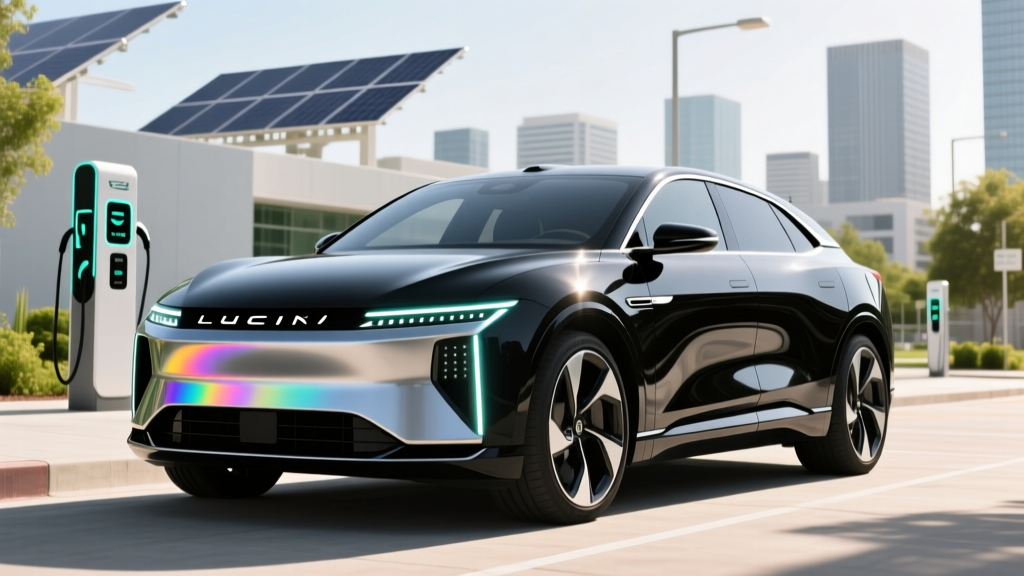
Quick Verdict: The Lucid Gravity Starts at $79,900
If you've been searching for how much the Lucid Gravity costs, the short answer is that the 2026 Lucid Gravity Pure opens at $79,900 (including destination), while the Touring trim climbs to $94,900 and the fully loaded Grand Touring reaches approximately $119,900. For a three-row luxury SUV packing up to 828 horsepower and an EPA-estimated 440 miles of range, those numbers position the Gravity squarely against the Tesla Model X, BMW iX, and Rivian R1S — but with efficiency and interior space advantages that reshape the value equation.
Lucid began delivering the Gravity in late 2024 and has ramped production through 2025 and into 2026. The platform borrows heavily from the Air sedan's 900-volt electrical architecture, which translates to some of the fastest DC charging available in any production SUV. Below, we break down every cost, range figure, and ownership variable you need before signing a reservation.
Lucid Gravity Trim Pricing & Tax Credit Eligibility
| Trim | Base MSRP | Drivetrain | EPA Range | Est. After §30D Credit* |
|---|---|---|---|---|
| Pure (RWD) | $79,900 | RWD, single-motor | 440 mi | $72,400 |
| Touring (AWD) | $94,900 | AWD, dual-motor | ~390 mi | $87,400 |
| Grand Touring (AWD) | $119,900 | AWD, dual-motor | ~440 mi | N/A (over MSRP cap) |
*Federal §30D credit of up to $7,500 is available only if the buyer meets IRS income caps ($300K joint / $150K single modified AGI), the vehicle MSRP is at or below $80,000 for SUVs, and battery critical-mineral and component sourcing thresholds are met. The Grand Touring exceeds the $80,000 SUV MSRP cap and is therefore ineligible. The Pure and Touring eligibility depends on current-year battery sourcing compliance — verify with your dealer and a tax professional before purchase. Point-of-sale transfer is available from participating dealers, reducing your out-of-pocket at delivery.
The Pure trim's sub-$80K MSRP is no accident — Lucid engineered it to sit under the IRS §30D SUV price cap, making it one of the few luxury three-row EVs that can still qualify for the full credit. That said, battery sourcing rules tighten annually, so confirm eligibility for your specific build month.
EPA Range vs. Real-World Miles: What to Actually Expect
Real-world expectation: ~370–395 mi mixed driving; ~330–360 mi sustained 75 mph highway; ~290–320 mi in sub-30°F cold weather with cabin heat.
The Gravity Pure's 440-mile EPA figure is extraordinary for any vehicle, let alone a 5,000+ lb three-row SUV. Lucid achieves this through the same engineering philosophy that gave the Air sedan its class-leading efficiency: a 900V architecture, silicon carbide inverters, a heat pump as standard, and obsessive aerodynamic refinement (drag coefficient around 0.24 Cd).
But EPA testing cycles include generous city/regen phases that flatter efficient powertrains. On a real 75 mph highway run in moderate temperatures (65–75°F), expect the Pure to deliver roughly 330–360 miles before you need to plug in. In winter conditions — especially below 30°F — battery chemistry and cabin heating demands can reduce range by 20–30%, bringing that figure closer to 290–320 miles. That's still exceptional, and the Gravity's preconditioning system mitigates some cold-weather loss when you route to a charger via navigation.
The dual-motor AWD Touring and Grand Touring trims carry heavier, more powerful drivetrains. The Touring's ~390-mile EPA estimate translates to roughly 310–340 real-world highway miles. The Grand Touring, with its larger battery pack, recovers the ~440-mile EPA figure but weighs more, so highway efficiency sits between the Pure and Touring in practice.
Battery, Charging Speed & the 900V Advantage
The Gravity uses an NMC (nickel manganese cobalt) lithium-ion battery pack. The Pure and Touring are estimated at approximately 112 kWh usable capacity, while the Grand Touring steps up to approximately 118–122 kWh usable. Lucid has not published exact cell-level chemistry breakdowns, but the pack uses the same modular, structural approach proven in the Air.
| Charging Level | Power / Rate | Speed (mi/hr added) | Notes |
|---|---|---|---|
| Level 1 (120V) | ~1.4 kW | ~3–4 mi/hr | Emergency/trickle only |
| Level 2 (240V, 48A) | ~11.5 kW | ~32–38 mi/hr | Home/workplace; full charge ~10–12 hrs |
| DC Fast Charge (peak) | Up to ~300 kW | N/A | 10–80% in ~20 min (optimal conditions) |
The 900-volt architecture is the Gravity's charging secret weapon. At a 350 kW CCS or NACS-capable DC fast charger (with appropriate adapter or native connector depending on build date), the Gravity can accept peak rates approaching 300 kW. In practice, the 10–80% session takes roughly 20 minutes under ideal thermal conditions — meaning the battery is preconditioned and ambient temperatures are moderate.
Here's where the charge curve matters: like all EVs, the Gravity tapers charging power significantly above 80% SoC to protect battery longevity. An 80–100% top-off can add another 25–35 minutes. For road trips, plan your stops around the 10–80% window and you'll spend less time plugged in than in almost any competing SUV.
At home on a Level 2 wall connector (240V, 48 amps), expect roughly 32–38 miles of range added per hour of charging. An overnight session from 20% to full takes approximately 10–12 hours — easily manageable for daily driving. Lucid recommends a 60-amp circuit for home installation; budget $800–$2,500 for a professional Level 2 install depending on your electrical panel's capacity and proximity to your parking spot.
Performance, Efficiency & Driving Dynamics
| Spec | Pure | Touring | Grand Touring |
|---|---|---|---|
| Horsepower | ~480 hp | ~620 hp | ~828 hp |
| 0–60 mph | ~5.5 sec | ~4.5 sec | ~3.5 sec |
| Drivetrain | RWD | AWD, dual-motor | AWD, dual-motor |
| Top Speed | ~130 mph | ~145 mph | ~155 mph |
| Towing Capacity | ~6,000 lbs | ~6,000 lbs | ~6,000 lbs |
Even the base Gravity Pure hits 60 mph in roughly 5.5 seconds — quick for a three-row family hauler. The Grand Touring's 3.5-second sprint puts it in supercar territory, though you'll pay a $40,000 premium for that capability.
Efficiency is where Lucid separates from the pack. The Pure achieves an estimated ~120 MPGe combined (approximately 28–30 kWh/100 mi), making it one of the most efficient large SUVs on the market. For comparison, the Tesla Model X Long Range sits around 102 MPGe combined, and the Rivian R1S (Dual-Motor) lands near 97 MPGe. That efficiency gap compounds over years of ownership — potentially saving $1,500–$3,000 in electricity costs over five years versus less efficient competitors.
The Gravity's air suspension (standard on Touring and Grand Touring, available on Pure) provides adjustable ride height for highway efficiency or rough-road clearance. Adaptive dampers balance the 5,000+ lb curb weight effectively, though the steering feel leans toward isolated comfort rather than sporty feedback.
Interior Space, Cargo & Technology
The Gravity seats up to seven passengers across three rows, with a six-passenger captain's-chair configuration available on higher trims. Key interior dimensions:
- Cargo (behind 3rd row): ~28 cu ft
- Cargo (3rd row folded): ~62 cu ft
- Cargo (all rows folded): ~105 cu ft
- Frunk (front trunk): ~10 cu ft
- 3rd-row legroom: ~33 inches
- 2nd-row legroom: ~42 inches
That frunk is genuinely useful — large enough for a carry-on bag and charging cables — and the total cargo volume with all seats folded rivals midsize crossover benchmarks. Third-row space accommodates adults on shorter trips, though taller passengers will prefer the second row for long hauls.
The centerpiece technology is a 34-inch curved glass cockpit display (Lucid calls it the "Clearview" cockpit) that spans the driver's field of view without obstructing sightlines. A secondary lower touchscreen handles climate and vehicle settings. Wireless Apple CarPlay and Android Auto are standard. The DreamDrive Pro ADAS suite includes adaptive cruise, lane centering, automated parking, and a comprehensive sensor array — but it is a SAE Level 2 driver-assistance system. You must remain engaged with hands on the wheel and eyes on the road at all times. It does not make the Gravity a self-driving vehicle.
Notable drawbacks: early-production Gravity units have drawn owner reports of minor software bugs and panel-gap inconsistencies that Lucid has been addressing through OTA updates and service campaigns. The Gravity also lacks a traditional instrument cluster behind the wheel, which some drivers find disorienting initially. Rear-seat entertainment screens are optional rather than standard on the Touring trim.
Warranty, Ownership Costs & Who Should Buy
Lucid covers the Gravity with a competitive warranty package:
- Basic vehicle warranty: 4 years / 50,000 miles
- Battery & powertrain: 8 years / 100,000 miles (capacity retention threshold: 70% of original)
- Roadside assistance: 4 years / 50,000 miles
The battery warranty's 70% retention threshold is industry-standard (matching Tesla and most competitors). Lucid's modular battery design theoretically allows individual module replacement rather than a full pack swap, which could reduce out-of-warranty replacement costs — though no independent cost data for Gravity-specific modules exists yet.
Insurance premiums for the Gravity tend to run 15–25% higher than comparable internal-combustion luxury SUVs, reflecting repair costs and parts availability. Expect annual premiums in the $2,800–$4,200 range depending on your location and driving record.
- You need three rows and maximum range — no other electric SUV offers 440 EPA miles
- Efficiency matters: the Gravity's kWh/100mi beats every competitor in this class
- You want fast DC charging for road trips (20 min, 10–80%)
- You value a genuinely usable frunk and cargo flexibility
- Budget is under $75K — consider the Kia EV9 or a used Tesla Model X
- You need proven off-road capability — the Rivian R1S is more rugged
- You want the widest Supercharger network access without adapters — Tesla Model X remains native
- You prioritize dealer service infrastructure — Lucid's service center network is still expanding
Lucid Gravity vs. Key Competitors
| Vehicle | Base MSRP | EPA Range | 0–60 | Rows | Max DC kW |
|---|---|---|---|---|---|
| Lucid Gravity Pure | $79,900 | 440 mi | ~5.5s | 3 | ~300 kW |
| Tesla Model X LR | $79,990 | 335 mi | ~3.8s | 3 (opt) | 250 kW |
| Rivian R1S Dual-Motor | $75,900 | ~352 mi | ~4.5s | 3 | ~200 kW |
| Kia EV9 GT-Line | $73,900 | ~270 mi | ~5.0s | 3 | ~210 kW |
| BMW iX xDrive50 | $87,250 | ~324 mi | ~4.4s | 2 | ~195 kW |
The Gravity's range and efficiency leads are substantial — over 100 miles more than the Model X Long Range on a single charge. The trade-off is that Tesla's Supercharger network remains the most reliable and widespread DC fast-charging ecosystem, though Lucid owners can access an expanding network of Electrify America and third-party chargers, and NACS adapter availability continues to improve access.
Against the Rivian R1S, the Gravity is less off-road oriented but significantly more efficient and offers a more carlike on-road ride. The Kia EV9 is the value alternative — $6,000 cheaper at the top trim but with roughly 170 fewer miles of range and slower DC charging.
Frequently Asked Questions
Does the Lucid Gravity qualify for the $7,500 federal EV tax credit?
The Gravity Pure ($79,900) and Touring ($94,900) are priced at or below the IRS §30D SUV MSRP cap of $80,000 — wait, the Touring at $94,900 exceeds the cap. Correction: only the Pure trim qualifies on MSRP grounds. The Touring and Grand Touring exceed the $80,000 SUV cap and are ineligible regardless of buyer income. For the Pure, you must also meet income thresholds ($300K joint / $150K single MAGI) and the vehicle's battery must satisfy critical-mineral and component sourcing requirements, which tighten each year. Check the IRS Clean Vehicle Credit page and confirm with your tax advisor before purchase.
What is the real-world range of the Lucid Gravity?
The Pure's 440-mile EPA estimate translates to approximately 370–395 miles in mixed real-world driving, 330–360 miles on sustained highway runs at 75 mph, and 290–320 miles in cold weather (below 30°F). These are still best-in-class figures for a three-row electric SUV.
How fast does the Gravity charge at home and on the road?
At home on a Level 2 (240V, 48A) charger, the Gravity adds roughly 32–38 miles of range per hour, filling from empty in about 10–12 hours. On DC fast chargers, it peaks near 300 kW and charges from 10–80% in approximately 20 minutes under optimal conditions.
Is the Lucid Gravity worth buying over a Tesla Model X?
If range and efficiency are your top priorities, yes — the Gravity Pure delivers 105 more EPA miles than the Model X Long Range at a similar price. If you value Supercharger network convenience, falcon-wing doors, and a more mature service network, the Model X still has advantages. Test-drive both before deciding.
What are the biggest pros and cons of the Lucid Gravity?
- Class-leading 440-mile EPA range (Pure)
- Best-in-class efficiency (~120 MPGe combined)
- Ultra-fast 900V DC charging (~300 kW peak)
- Genuinely usable third row and frunk
- Pure trim eligible for §30D credit (if sourcing qualifies)
- Grand Touring exceeds tax credit MSRP cap
- Limited Lucid service center footprint vs. legacy brands
- Early-production software/fit inconsistencies reported
- No native Tesla Supercharger access (adapter-dependent)
- Insurance premiums 15–25% above ICE equivalents
Sources: Lucid Motors official specifications, EPA Fuel Economy (fueleconomy.gov), IRS §30D Clean Vehicle Credit guidelines.