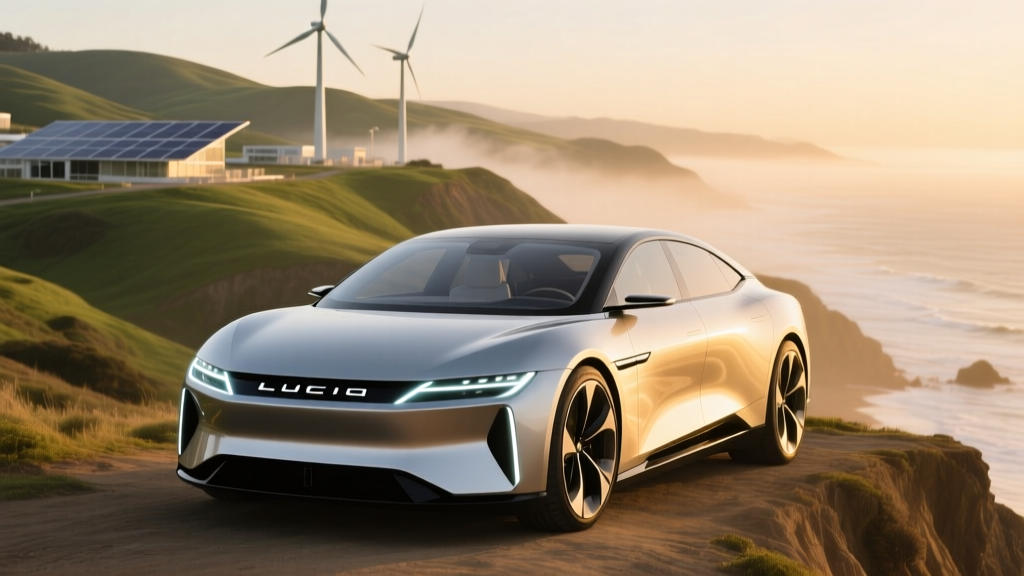
If you've been researching luxury electric sedans, you've likely encountered the question: what is the Lucid country of origin? Unlike legacy automakers that shuffle production across global plants, Lucid Motors has a relatively concentrated manufacturing story — one that directly impacts build quality, supply-chain resilience, and, critically, whether its vehicles qualify for the U.S. federal EV tax credit under IRS §30D.
This guide traces exactly where Lucid vehicles are designed, engineered, and assembled in 2026, then dives deep into the specs that matter most to buyers: real-world range, DC fast-charging performance, pricing across trims, and whether the Air still holds up against the Tesla Model S, Mercedes EQS, and BMW i7.
Where Are Lucid Vehicles Made? The Full Manufacturing Picture
Lucid Motors is headquartered in Newark, California, where all vehicle design, powertrain engineering, software development, and prototyping take place. But the actual production happens at Lucid's purpose-built AMP-1 (Advanced Manufacturing Plant-1) in Casa Grande, Arizona.
AMP-1 began limited production of the Lucid Air in late 2021 and has since scaled through multiple expansion phases. By 2026, the facility covers approximately 1.5 million square feet and supports production of both the Air sedan lineup and the Lucid Gravity SUV. The plant is vertically integrated: Lucid manufactures its own electric drive units, battery packs, and power electronics in-house rather than sourcing complete assemblies from Tier-1 suppliers.
The Lucid country of origin, by any meaningful definition, is the United States. The company also operates a growing international presence — including an assembly facility in King Abdullah Economic City (KAEC), Saudi Arabia, where vehicles destined for the Middle Eastern market are assembled from CKD (completely knocked down) kits shipped from Arizona. Saudi Arabia's Public Investment Fund (PIF) is Lucid's largest shareholder, holding a majority stake, which has funded this international expansion but does not change where U.S.-market vehicles are built.
2026 Lucid Air: Range, Efficiency, and Real-World Numbers
The 2026 Lucid Air lineup spans four trims, each offering a distinct battery and powertrain configuration. Lucid's hallmark has always been efficiency — the Air achieves more miles per kWh than virtually any competitor in the luxury segment, thanks to its proprietary miniaturized drive units and advanced aerodynamic design (a drag coefficient of just 0.20 Cd for the Pure and Touring).
| Trim | Battery (usable kWh) | Chemistry | EPA Range | MPGe (combined) | kWh/100 mi |
|---|---|---|---|---|---|
| Air Pure (RWD) | 88 kWh | NMC | 419 mi | 146 MPGe | 23 |
| Air Touring (AWD) | 112 kWh | NMC | 425 mi | 134 MPGe | 25 |
| Air Grand Touring (AWD) | 112 kWh | NMC | 516 mi | 131 MPGe | 26 |
| Air Sapphire (AWD) | 118 kWh | NMC | 427 mi | 109 MPGe | 31 |
Charging Speed: DC Fast Charging and Home Level 2
Lucid uses the CCS1 connector on all 2026 Air models (a NACS adapter is available for Tesla Supercharger access). The Air's 900-volt electrical architecture enables exceptionally fast DC charging — but as with every EV, peak kW is not sustained across the entire charging session.
| Charging Method | Max Rate | Miles Added per Hour / 10-80% Time |
|---|---|---|
| Level 1 (120V household) | ~1.4 kW | ~4–5 mi/hr |
| Level 2 (240V, 48A home charger) | 11.5 kW | ~38–42 mi/hr |
| DC Fast Charge (Grand Touring) | Peak 300+ kW | 10–80% in ~20 min (~300 mi added in 20 min) |
| DC Fast Charge (Pure/Touring) | Peak ~220 kW | 10–80% in ~25 min |
Charging curve insight: The Grand Touring's 900V architecture allows it to sustain charging above 200 kW longer than most competitors operating on 400V systems. However, above 80% State of Charge (SoC), the charge rate tapers significantly — this is standard for NMC lithium-ion chemistry to protect long-term battery health. For road trips, plan your stops around the 10–80% window to minimize time at the charger.
At home on a Level 2 charger (such as a ChargePoint Home Flex or Tesla Wall Connector with J1772 adapter), a full overnight charge from 10% to 100% takes roughly 10–11 hours for the Grand Touring's 112 kWh battery. Most owners will rarely charge from empty; topping up from 50% to 80% takes about 3 hours.
Performance: 0-60, Horsepower, and Drivetrain
Lucid's in-house developed drive units are among the smallest and most power-dense in the industry. Even the "base" Pure trim delivers serious acceleration.
| Trim | Drivetrain | Horsepower | 0–60 mph | Top Speed | |
|---|---|---|---|---|---|
| Air Pure | RWD (single motor) | 430 hp | 5.0 sec | 145 mph | |
| Air Touring | AWD (dual motor) | 620 hp | 3.4 sec | 155 mph | |
| Air Grand Touring | AWD (dual motor) | 819 hp | 3.0 sec | 168 mph | |
| Air Sapphire | AWD (tri-motor) | 1,234 hp | 1.89 sec | 205 mph |
The Sapphire's tri-motor setup (one front, two rear) makes it one of the quickest production sedans ever built, rivaling hypercars at a fraction of their price. For most buyers, the Touring's 620 hp and 3.4-second 0–60 is more than sufficient for confident highway merging and passing.
Interior Space, Cargo, and Technology
The Air's interior is designed around a "space concept" philosophy — the compact drivetrain components free up more cabin room than the exterior dimensions suggest.
- Front legroom: 44.1 inches
- Rear legroom: 37.4 inches (class-leading for a luxury sedan)
- Trunk (rear cargo): 22.1 cu ft
- Frunk (front trunk): 7.1 cu ft
- Total cargo: 29.2 cu ft (more than most midsize SUVs)
Infotainment: The Air features a 34-inch curved glass cockpit display (dubbed the "Glass Canopy") that spans the driver's instrument cluster and center infotainment. Lucid's in-house software runs natively — no Apple CarPlay or Android Auto is offered, though Bluetooth media and phone integration work as expected. The system supports over-the-air (OTA) updates, and navigation includes real-time charger routing.
Driver Assistance: Lucid's DreamDrive Pro system uses a combination of cameras, radar, ultrasonic sensors, and a lidar unit (on Grand Touring and Sapphire) to provide adaptive cruise control, lane-centering, and automated lane changes. This is an SAE Level 2 system — the driver must remain attentive and keep hands on the wheel at all times. It is not a self-driving system.
Notable drawbacks: The absence of Apple CarPlay/Android Auto frustrates some buyers. Rear-seat headroom can feel tight for passengers over 6'2" due to the sloping roofline. The center console lacks physical climate-control buttons — all adjustments route through the touchscreen, which requires more attention than tactile knobs.
Pricing, Trims, and Federal Tax Credit Eligibility
| Trim | Base MSRP | Destination | Est. As-Tested |
|---|---|---|---|
| Air Pure | $69,900 | $1,500 | $71,400–$76,000 |
| Air Touring | $77,900 | $1,500 | $80,000–$88,000 |
| Air Grand Touring | $109,900 | $1,500 | $115,000–$130,000 |
| Air Sapphire | $249,000 | $1,500 | $250,500+ |
Does the Lucid Air Qualify for the §30D Federal EV Tax Credit?
This is where the Lucid's U.S. manufacturing origin matters. Under IRS §30D rules, the federal tax credit for new clean vehicles can provide up to $7,500 — but eligibility depends on multiple requirements that shift frequently:
- MSRP cap: Sedans must have an MSRP at or below $55,000. This immediately disqualifies all 2026 Air trims, as even the Pure starts at $69,900.
- Buyer income cap: Modified adjusted gross income (MAGI) must not exceed $150,000 (single), $225,000 (head of household), or $300,000 (joint filing).
- Battery sourcing: Critical minerals and battery components must meet escalating domestic-content and free-trade-agreement thresholds set by the IRS.
- Final assembly: Must occur in North America (the Air passes this requirement — assembled in Arizona).
Bottom line: As of 2026, no Lucid Air trim qualifies for the $7,500 federal tax credit because every trim exceeds the $55,000 sedan MSRP cap. The Lucid's U.S. assembly satisfies the final-assembly requirement, but the price ceiling is the disqualifying factor. Buyers should consult a tax professional and check the latest eligibility details at fueleconomy.gov before making purchase decisions based on incentives.
Lucid Air vs. Key Competitors: Is It Worth Buying?
| Spec | Lucid Air GT | Tesla Model S LR | Mercedes EQS 580 | BMW i7 xDrive60 |
|---|---|---|---|---|
| EPA Range | 516 mi | 402 mi | 371 mi | 318 mi |
| Battery (kWh) | 112 | ~100 | 108.4 | 101.7 |
| Peak DC Charge (kW) | 300+ | 250 | 200 | 195 |
| 0–60 mph | 3.0 sec | 3.1 sec | 4.1 sec | 4.5 sec |
| Starting MSRP | $109,900 | $74,990 | $104,400 | $124,200 |
| Country of Origin | USA (AZ) | USA (CA/TX) | Germany | Germany |
- Choose the Lucid Air if: Maximum range and efficiency are your top priorities, you value a spacious rear seat, and you want the most advanced 900V charging architecture in a sedan.
- Choose the Tesla Model S if: You want Supercharger network access without an adapter, a lower starting price, and proven Autopilot/FSD (Supervised) software — while accepting lower range and a more minimalist interior.
- Choose the Mercedes EQS if: Brand prestige, dealer service infrastructure, and a plush, quiet ride matter more than maximum range or sporty driving dynamics.
- Choose the BMW i7 if: You want a flagship luxury experience with rear-seat entertainment and executive-lounge seating — and are willing to accept the shortest range in the segment.
Warranty Coverage
Lucid backs the Air with competitive warranty terms:
- Basic vehicle warranty: 4 years / 50,000 miles
- Battery and powertrain warranty: 8 years / 100,000 miles (whichever comes first), covering defects and battery capacity degradation below 70% of original capacity
- Roadside assistance: 4 years / 50,000 miles
The 8-year/100,000-mile battery warranty is standard for the luxury EV segment. The 70% capacity retention threshold matches what Tesla and most competitors offer. Lucid's NMC cells use an advanced thermal management system with liquid cooling to minimize degradation — early 2022–2024 Air owners have reported minimal capacity loss at higher mileages, though long-term data across a full decade is still accumulating.
Who Is the Lucid Air For?
The 2026 Lucid Air is best suited for:
- Long-distance commuters and road-trippers who prioritize maximum range and minimal charging stops. The Grand Touring's 516-mile EPA rating means many commuters could go a full work week without charging.
- Luxury sedan buyers who want something less ubiquitous than a Tesla and more technologically advanced than legacy German offerings.
- Performance enthusiasts (Sapphire trim) who want hypercar acceleration in a four-door sedan.
It is less ideal for:
- Buyers on a budget — the Pure starts near $70K, and no trim qualifies for the federal tax credit.
- Those who demand Apple CarPlay/Android Auto integration.
- Drivers in areas with limited CCS DC fast-charging infrastructure (though the NACS adapter helps).
Frequently Asked Questions
What is the Lucid country of origin?
Lucid Motors is an American company headquartered in Newark, California. All U.S.-market Lucid Air and Gravity vehicles are manufactured at AMP-1 in Casa Grande, Arizona. Lucid also operates a CKD assembly facility in Saudi Arabia for Middle Eastern market vehicles.
What is the real-world range of the Lucid Air?
The EPA rates the Air Grand Touring at 516 miles. In real-world highway driving at 70–75 mph, expect approximately 420–460 miles. In freezing temperatures, range can drop 15–25%, yielding roughly 360–410 miles. The Air Pure (RWD) is rated at 419 miles EPA and delivers approximately 340–370 miles in mixed real-world use.
How fast does the Lucid Air charge?
On a DC fast charger, the Grand Touring peaks above 300 kW and can charge from 10–80% in approximately 20 minutes, adding up to 300 miles of range. The Pure and Touring peak around 220 kW with 10–80% in about 25 minutes. At home on Level 2 (240V, 48A), expect roughly 38–42 miles of range added per hour.
Does the Lucid Air qualify for the federal EV tax credit?
No. As of 2026, the §30D federal tax credit caps eligible sedans at $55,000 MSRP. All Lucid Air trims exceed this threshold. The Air does meet the North American final assembly requirement, but the MSRP cap is disqualifying. Always verify current rules at IRS.gov and consult a tax professional.
Is the Lucid Air worth buying over a Tesla Model S?
If range, interior space, and ride refinement are your priorities, the Air (particularly the Grand Touring) offers clear advantages. If you prefer the Supercharger network, lower entry pricing, and more mature driver-assist software, the Model S remains compelling. Both are U.S.-manufactured.
What are the biggest pros and cons of the Lucid Air?
- Class-leading EPA range (516 mi Grand Touring)
- Exceptional efficiency (23 kWh/100 mi on Pure)
- 900V fast-charging architecture
- Spacious rear seat and generous cargo volume
- U.S.-manufactured (Arizona)
- No federal tax credit eligibility (MSRP above cap)
- No Apple CarPlay or Android Auto
- CCS connector requires adapter for Superchargers
- Limited service center network vs. legacy brands
- Touchscreen-only climate controls