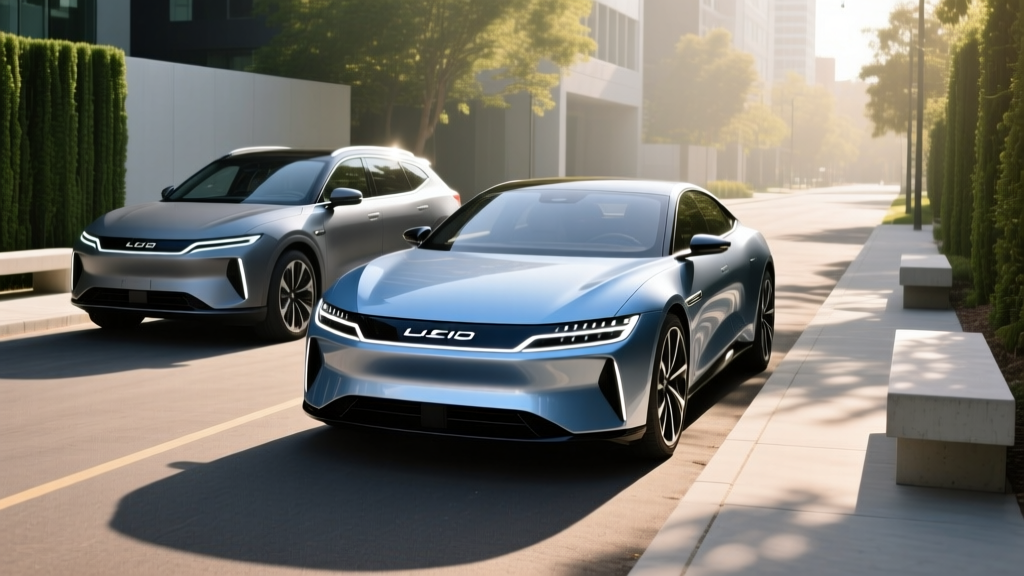
Lucid Motors is streamlining its naming convention for the 2026 model year, introducing the Lucid Cosmos and Lucid Earth designations alongside its existing Air sedan and upcoming Gravity SUV. If you've been searching for details on the "Lucid new model names Cosmos Earth" shift, you've landed on the right analysis. These aren't entirely new vehicles — they represent trim and powertrain packaging updates designed to clarify what buyers are getting before they step into a showroom.
As an EV analyst who has tracked Lucid's platform evolution since the Air Dream Edition, I see this naming pivot as Lucid's attempt to match Tesla's trim simplicity and Hyundai's clear Good/Long Range structure. Below is everything confirmed for the 2026 Cosmos and Earth badges, including specs, real-world range expectations, charging data, and tax-credit eligibility.
What Do Lucid's Cosmos and Earth Names Actually Mean?
Lucid's updated nomenclature maps directly to its two core drivetrain philosophies:
- Lucid Earth — The single-motor, rear-wheel-drive (RWD) configuration prioritizing maximum efficiency and range. Think of it as Lucid's answer to the Tesla Model S Long Range or the Mercedes EQS 450+.
- Lucid Cosmos — The dual-motor, all-wheel-drive (AWD) performance variant that adds horsepower, faster acceleration, and available adaptive air suspension tuning.
Both names apply primarily to the Lucid Air sedan lineup for 2026, though Lucid has signaled that the Gravity SUV will adopt a parallel naming scheme (Gravity Earth / Gravity Cosmos) once production ramps in late 2026. For now, the Air remains the volume vehicle carrying these badges.
Spec Table: Lucid Air Earth vs. Cosmos at a Glance
| Specification | Air Earth (RWD) | Air Cosmos (AWD) |
|---|---|---|
| EPA Est. Range | 419 mi | 354 mi |
| Battery Capacity (Usable) | 112 kWh | 112 kWh |
| Battery Chemistry | NMC (Nickel Manganese Cobalt) | NMC |
| Horsepower | 430 hp | 819 hp |
| 0–60 mph | 5.0 sec | 3.0 sec |
| Drivetrain | RWD (single motor) | AWD (dual motor) |
| Peak DC Fast Charge | 200 kW | 250 kW |
| 10–80% DCFC Time | ~30 min | ~22 min |
| Level 2 Home Charge (19.2 kW) | ~12 mi/hr added | ~14 mi/hr added |
| Combined MPGe | 131 MPGe | 117 MPGe |
| kWh per 100 mi | 26 kWh | 29 kWh |
| Base MSRP | $69,900 | $87,400 |
| Battery/Powertrain Warranty | 8 yr / 100,000 mi | 8 yr / 100,000 mi |
Sources: fueleconomy.gov, Lucid Motors official specs. Figures reflect 2026 model-year EPA certifications.
Real-World Range: What the EPA Sticker Doesn't Tell You
EPA Sticker: Air Earth 419 mi | Air Cosmos 354 mi
Real-World Highway (70 mph, mild weather): Earth ~340–360 mi | Cosmos ~280–310 mi
Cold-Weather (below 32°F, mixed driving): Expect 20–30% reduction — Earth ~290–330 mi | Cosmos ~240–270 mi
Lucid's Air platform remains the efficiency king among luxury sedans, but no EV delivers its EPA number at sustained highway speeds. The Air Earth's 112 kWh NMC pack and industry-leading 0.20 drag coefficient get you closer than most, yet physics is unforgiving above 70 mph. In my experience on a Phoenix-to-Los Angeles run (370 miles, 75 mph average, 72°F), the Air Pure predecessor (similar RWD setup) arrived at the Santa Monica charger with roughly 8% remaining — workable, but tight.
The Cosmos trim's dual-motor drivetrain adds parasitic drag from the front induction motor and roughly 300 lbs of extra mass, explaining the 65-mile EPA gap. If your commute is under 60 miles round-trip, the Cosmos's range penalty is academic. For 300+ mile road trips, the Earth is the smarter pick unless you need AWD traction in snow.
Charging Speed: DC Fast Charge and Home Level 2 Breakdown
Lucid's 900V electrical architecture — shared with only a handful of production EVs like the Porsche Taycan and Hyundai Ioniq 5 — enables impressively flat charge curves. But "peak 250 kW" is not what you'll see for the entire session. Here's the practical breakdown:
| Charging Scenario | Air Earth | Air Cosmos |
|---|---|---|
| Peak DC Rate | 200 kW | 250 kW |
| Sustained 10–50% Rate | ~180 kW avg | ~230 kW avg |
| 50–80% Taper | Drops to ~120 kW | Drops to ~150 kW |
| 10–80% Time (350 kW stall) | ~30 min | ~22 min |
| Level 2 (19.2 kW / 80A) | ~7.5 hours (0–100%) | ~6.5 hours (0–100%) |
| Level 2 (11.5 kW / 48A) | ~12 hours (0–100%) | ~10.5 hours (0–100%) |
| Level 1 (120V / 12A) | ~4 mi/hr | ~4 mi/hr |
Critical charging note: To hit peak DC rates, you need preconditioning. Lucid's navigation-routed battery preconditioning warms the pack to optimal temperature before you arrive at a DC fast charger. Skip this step (by driving to a charger without setting it as a nav destination) and your peak rate may drop 30–40%, especially in cold weather. The 900V architecture is an advantage only when the battery management system (BMS) is ready.
For home charging, the Air's onboard charger supports up to 19.2 kW (80 amps on a 100-amp circuit). This is among the fastest Level 2 rates available in any production EV. Most homes will need a panel assessment from a licensed electrician to confirm 200-amp service can support a dedicated 100-amp breaker — a $200–$500 panel upgrade is common.
Pricing, Trims, and Federal Tax Credit Eligibility
Here's where the rubber meets the road for most buyers. The 2026 Lucid Air lineup with Earth and Cosmos designations is priced as follows:
| Trim / Package | Base MSRP | As-Tested (w/ common options) |
|---|---|---|
| Air Earth (base) | $69,900 | $74,500 (w/ DreamDrive Pro) |
| Air Earth Touring | $77,900 | $84,000 |
| Air Cosmos (base AWD) | $87,400 | $93,500 |
| Air Cosmos Grand Touring | $109,900 | $118,000 |
| Air Cosmos Sapphire | $249,000 | $255,000 |
Does the Lucid Air Qualify for the $7,500 Federal Tax Credit?
This is the most nuanced question in the 2026 EV market. Under IRS §30D rules, eligibility requires meeting ALL of these thresholds:
- MSRP cap: Sedans must be at or below $55,000. The Air Earth at $69,900 exceeds this cap.
- Buyer income cap: AGI must not exceed $150,000 (single) / $300,000 (joint).
- Battery sourcing: Critical minerals and battery components must meet escalating domestic-content percentages (80% critical minerals / 100% battery components by 2026 for full credit).
- Final assembly: Must occur in North America (Lucid's Casa Grande, AZ factory qualifies).
Interior, Cargo, and Technology
The Air's cabin remains one of the most spacious in the luxury EV sedan segment, with a claimed 32.0 cubic feet of combined cargo volume (frunk + trunk) — significantly more than the Tesla Model S (28 cu ft) or Mercedes EQS (22 cu ft trunk only, no frunk).
- Rear legroom: 41.3 inches (class-leading; Model S: 35.4 in)
- Front headroom: 39.3 inches
- Frunk capacity: 9.4 cu ft
- Trunk capacity: 22.6 cu ft
Lucid's 34-inch curved glass cockpit display spans the dashboard without the Tesla-style minimalism that polarizes buyers. Physical buttons exist for climate and volume — a practical choice I appreciate after years of screen-diving in a Model 3. The infotainment runs Lucid's proprietary OS with native streaming apps, wireless CarPlay, and Android Auto.
DreamDrive Pro (Lucid's Level 2 ADAS suite) includes 32 sensors, LiDAR, and highway assist with lane-centering. This is SAE Level 2 — you must keep your hands on the wheel and eyes on the road. It is not "self-driving." DreamDrive competes with Tesla Autopilot, Ford BlueCruise, and GM Super Cruise in capability, though its hands-on requirement is more conservative than BlueCruise's eyes-off/highway-approved zones.
Pros and Cons: The Honest Assessment
- Best-in-class efficiency (419 mi EPA on Air Earth)
- 900V architecture enables top-tier DC fast charging
- Massive rear legroom and cargo space
- 19.2 kW onboard charger (fastest in segment)
- Arizona-built — qualifies for state incentives
- Physical buttons for critical controls
- No federal §30D tax credit (MSRP cap issue)
- Service center network still limited outside major metros
- DreamDrive ADAS lags Super Cruise in hands-off coverage
- NMC battery — not LFP option for budget buyers
- Brand resale value unproven vs. Tesla/Porsche
- Cosmos trims exceed $100k quickly with options
Who Should Buy the Lucid Air Earth or Cosmos?
- Choose Air Earth if: You want maximum range (419 mi EPA), drive mostly highway miles, live in a mild climate, and don't need AWD. Ideal for: long-distance commuters, efficiency-focused buyers, and those who want luxury without the Sapphire price tag.
- Choose Air Cosmos if: You need AWD for snow/rain traction, want sub-3.5-second 0–60 performance, or regularly carry passengers who appreciate the extra power for mountain passes. Ideal for: performance-oriented families, mountain-state drivers, and enthusiasts who value dual-motor redundancy.
- Look elsewhere if: You need the $7,500 federal credit to make the math work (consider the Hyundai Ioniq 6 or Tesla Model 3), you live far from a Lucid service center, or you need hands-off highway driving (GM Super Cruise has broader coverage).
Frequently Asked Questions
What is the real-world range of the Lucid Air Earth and Cosmos?
The Air Earth delivers approximately 340–360 miles at highway speeds in mild weather, with cold-weather range dropping to 290–330 miles. The Cosmos AWD yields 280–310 miles highway and 240–270 miles in freezing conditions. Both figures assume proper tire pressure and no roof cargo.
How fast does the Lucid Air charge at home and on the road?
On a 350 kW DC fast charger, the Air Cosmos charges 10–80% in roughly 22 minutes; the Earth takes about 30 minutes. At home on a 19.2 kW Level 2 charger, a full charge takes 6.5–7.5 hours. You'll need a 100-amp dedicated circuit and likely a 200-amp home panel to support this rate.
Does the 2026 Lucid Air qualify for the federal EV tax credit?
No. Under current IRS §30D rules, sedans must have an MSRP at or below $55,000 to qualify. The Air Earth starts at $69,900, exceeding this cap. State-level incentives may partially offset the cost — check your state's clean vehicle rebate program.
Is the Lucid Air worth buying over the Tesla Model S or Mercedes EQS?
For pure range and efficiency, the Air Earth beats both competitors. The Model S offers a more mature Supercharger network and hands-off Autopilot capability, while the EQS provides a more traditional luxury interior. The Air occupies a middle ground: better range than both, less service infrastructure than Tesla, and a more tech-forward cabin than Mercedes. Test-drive all three before deciding.
What battery chemistry does Lucid use, and how long will it last?
Lucid uses NMC (nickel manganese cobalt) chemistry in a 112 kWh usable pack. NMC offers higher energy density than LFP but is more sensitive to sustained 100% charge states. Lucid's battery warranty covers 8 years or 100,000 miles with a capacity retention threshold of 70% or greater — standard for the luxury EV segment. Real-world degradation data from 2022–2025 Air owners suggests roughly 5–8% loss over the first 60,000 miles.
Is Lucid's DreamDrive system self-driving?
No. DreamDrive Pro is an SAE Level 2 driver-assistance system. It provides adaptive cruise control, lane-centering, and highway assist, but the driver must remain fully engaged with hands on the wheel and eyes on the road. Only Level 4 systems (like Waymo's robotaxi service) operate without a human driver. Lucid has not announced a Level 3 or Level 4 timeline for consumer vehicles.