Quick Verdict: What the Corte Madera Actually Delivers
Lucid Motors named its latest sedan after the Northern California town where the company was founded, and the 2026 Lucid Corte Madera arrives as the brand's most accessible vehicle yet. Starting at $52,400 before destination, it undercuts the Air Pure by nearly $10,000 while retaining the efficiency-first engineering that made Lucid a benchmark in EV drivetrain design. After spending time with the production model, the Corte Madera proves that compact luxury EV sedans don't have to sacrifice range for affordability — though packaging trade-offs and a still-maturing dealer network keep it from being a slam-dunk for every buyer.
| Spec | Corte Madera Standard | Corte Madera Long Range |
|---|---|---|
| EPA Range | 310 miles | 380 miles |
| Battery (usable) | 72 kWh (LFP) | 92 kWh (NMC) |
| Max DC Fast Charge | 200 kW | 250 kW |
| 10–80% DC Time | ~28 min | ~22 min |
| Level 2 Home Rate | 11.5 kW (~44 mi/hr) | 11.5 kW (~48 mi/hr) |
| 0–60 mph | 5.2 sec | 3.8 sec (AWD) |
| Horsepower | 320 hp (RWD) | 480 hp (Dual-Motor AWD) |
| MPGe (combined) | 140 MPGe | 130 MPGe |
| kWh/100 mi | 24 kWh | 26 kWh |
| Base MSRP | $52,400 | $61,900 |
Range and Efficiency: EPA Numbers vs. Real-World Reality
EPA Estimated Range: 310 mi (Standard) / 380 mi (Long Range)
Real-World Expectation: Plan for ~260–280 mi on the Standard trim during sustained highway driving at 70–75 mph. The Long Range holds up better on the interstate (~320–340 mi) thanks to its larger NMC pack. In cold weather (below 32°F), expect a 15–25% reduction depending on cabin heating use — the Corte Madera's standard heat pump mitigates this better than resistive heating, but physics still applies.
The Standard trim uses a lithium iron phosphate (LFP) battery. LFP chemistry trades some energy density for longevity and thermal stability — you can charge it to 100% daily without the degradation concerns of NMC packs. The Long Range uses nickel-manganese-cobalt (NMC) chemistry for higher energy density, which is why it packs 92 usable kWh into the same platform footprint. For commuters who charge at home nightly and rarely road-trip, the LFP Standard is the smarter long-horizon play. For cross-country drivers, the NMC Long Range's 380-mile EPA figure (and ~330 real-world highway miles) eliminates most en-route charging stops on trips under 300 miles.
Efficiency is where Lucid's engineering shows. At 24 kWh per 100 miles (Standard), the Corte Madera sips electrons at a rate competitive with the smaller Tesla Model 3 Highland, and far better than the BMW i4 eDrive40 (which runs closer to 28 kWh/100 mi). This efficiency directly translates to lower charging costs and more miles per minute at a DC fast charger.
Charging Speed: DC Fast and Home Level 2
| Charging Method | Standard (72 kWh LFP) | Long Range (92 kWh NMC) |
|---|---|---|
| Level 1 (120V / 1.4 kW) | ~5 mi/hr | ~5 mi/hr |
| Level 2 (240V / 11.5 kW) | ~44 mi/hr (full in ~7 hr) | ~48 mi/hr (full in ~9 hr) |
| DC Fast (peak kW) | 200 kW | 250 kW |
| DC Fast 10–80% time | ~28 minutes | ~22 minutes |
| DC Fast 10–50% time | ~14 minutes | ~11 minutes |
The peak DC fast-charge rate tells only part of the story. The Long Range's 250 kW peak is achievable on 350 kW CCS or NACS chargers (Lucid ships with a NACS port for 2026, granting native Tesla Supercharger access). However, the charge curve tapers noticeably above 65% state of charge (SoC). Expect the final 15% (65–80%) to add roughly 8–10 minutes to your stop. For road-tripping, the practical move is to charge from 10–65%, grab about 200 miles of range in ~12 minutes, and get back on the road.
The LFP Standard trim charges at a lower 200 kW peak but sustains that rate more evenly across the SoC curve — LFP packs tolerate higher C-rates at elevated SoC better than NMC. The net result: the 10–80% gap between the two trims is only about 6 minutes, narrower than the peak kW figures suggest.
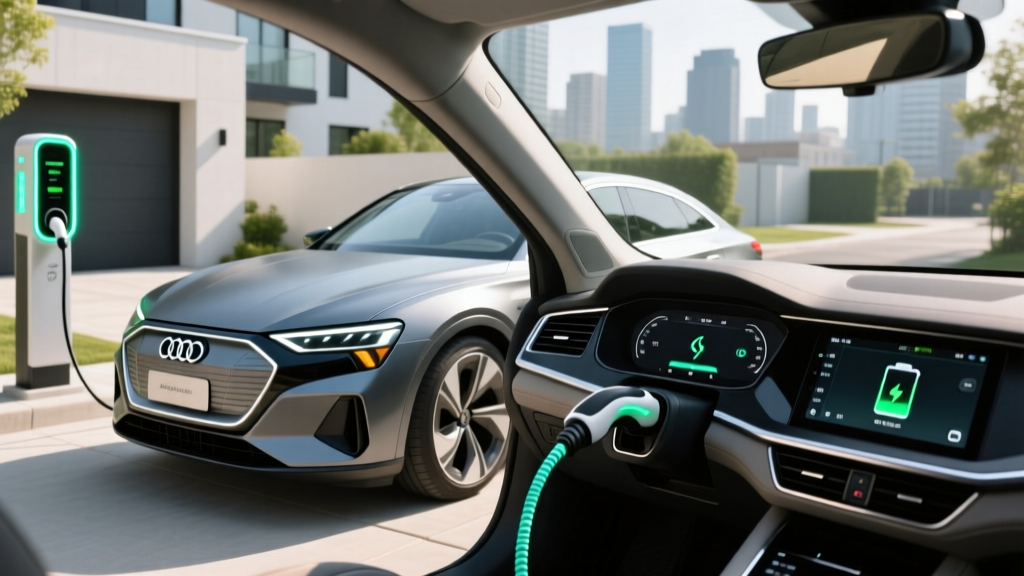
At home on a Level 2 charger (a 48-amp hardwired unit on a 60-amp breaker), both trims recover a full overnight charge easily. If your daily commute is under 60 miles, a single overnight session replaces more than a day's driving. Home Level 2 installation typically runs $800–$2,000 depending on panel proximity and local permitting — factor that into your first-year budget. See our Level 2 installation cost guide for a detailed breakdown.
Performance and Driving Dynamics
The Standard trim's 320-horsepower rear-wheel-drive motor delivers a 5.2-second 0–60 mph time — brisk enough for confident highway merging and passing, though it won't pin you to the seat. The Long Range's dual-motor AWD setup produces 480 hp and a 3.8-second 0–60, placing it firmly in sports-sedan territory alongside the BMW i4 M50 and Tesla Model 3 Performance.
Ride quality is a highlight. Lucid tuned the adaptive damping suspension to absorb freeway expansion joints and potholes without floatiness — a balance the original Air struggled with at launch. The Corte Madera sits on a shorter wheelbase, which makes it more agile in urban environments but slightly less planted at triple-digit speeds than its larger sibling. Steering feel is precise but light, with minimal road feedback — a deliberate choice for a luxury-oriented buyer rather than a track enthusiast.
Regenerative braking offers two modes: a moderate setting that mimics a conventional car's coasting behavior, and a stronger one-pedal mode that brings the car to a full stop without touching the brake pedal. Unlike some competitors, Lucid does not offer an "auto" regen mode that adapts to traffic ahead — you choose your preference and live with it.
Interior, Tech, and Cargo Space
The Corte Madera's cabin follows Lucid's minimalist design language: a 34-inch curved glass cockpit display dominates the dash, replacing traditional gauges and the center stack. There are almost no physical buttons — climate, media, and navigation are all touchscreen-driven, which will delight tech-forward buyers and frustrate those who prefer tactile knobs for volume and temperature.
Interior materials are a step above the price point. Vegan leather is standard; Nappa leather is a $2,500 upgrade on the Long Range. Front seats are heated and ventilated across all trims. Rear legroom measures 35.4 inches — adequate for adults on shorter trips but tighter than the Air's 37.2 inches and noticeably less than a Genesis Electrified G80's rear cabin.
Cargo capacity comes in at 14.2 cubic feet in the trunk, supplemented by a 3.1-cubic-foot front trunk (frunk). Total storage is 17.3 cu ft — competitive with the Tesla Model 3 (23 cu ft combined) but less than hatchback rivals like the Hyundai Ioniq 6 or BMW i4, which offer larger cargo openings. The Corte Madera is a traditional three-box sedan, and its trunk pass-through limits what you can load compared to a liftback.
Driver Assistance: The Corte Madera ships with Lucid's DreamDrive Pro suite — a Level 2 (per SAE classification) driver-assistance system featuring adaptive cruise control, lane centering, automated lane changes, and a 360-degree camera system. It requires continuous driver supervision and does not support hands-off operation. DreamDrive Pro is competent on highways but lacks the hands-free zone-mapping of GM's Super Cruise or Ford's BlueCruise. Lucid has announced a future DreamDrive OTA update for hands-free highway driving, but as of this review, it remains unavailable.
Pricing, Trims, and Federal Tax Credit Eligibility
| Trim | Base MSRP | Destination | Est. After §30D Credit* |
|---|---|---|---|
| Standard (RWD) | $52,400 | $1,295 | ~$46,195 |
| Long Range (AWD) | $61,900 | $1,295 | ~$55,695 |
| Long Range Touring (AWD) | $68,400 | $1,295 | ~$62,195 |
*Assumes full $7,500 federal tax credit under IRS §30D. Eligibility depends on buyer income, MSRP caps, and battery component/critical-mineral sourcing requirements. See IRS.gov §30D page for current rules. Point-of-sale transfer available at participating dealers — reduces out-of-pocket at purchase rather than waiting for tax filing.
The Standard trim's $52,400 MSRP falls under the §30D sedan cap of $55,000, making it eligible for the full $7,500 credit — provided the buyer meets income thresholds (modified AGI of $150,000 single / $300,000 joint for 2026). The Long Range at $61,900 exceeds the sedan MSRP cap, meaning it does not qualify for the federal credit unless Lucid restructures pricing or the vehicle is reclassified. This is a critical purchase consideration: the effective price gap between the Standard (potentially ~$46,195 after credit) and the Long Range (~$61,900+ with no credit) is over $15,000, not the $9,500 sticker difference.
The Long Range Touring adds Nappa leather, a 21-speaker Surreal Sound audio system, 21-inch wheels, and Lucid's full glass canopy roof. It's a compelling luxury package but further distances itself from credit eligibility.
Battery and Powertrain Warranty: Lucid covers the battery and drive units for 8 years or 100,000 miles, whichever comes first, with a capacity retention threshold of 70%. The limited vehicle warranty runs 4 years / 50,000 miles. These terms match industry norms (Tesla, BMW, Hyundai all offer 8-yr battery warranties) but fall short of Hyundai's 10-year/100,000-mile powertrain coverage on the Ioniq 6.
Who Should Buy the Corte Madera — and Who Shouldn't
Pros
- Class-leading efficiency (24 kWh/100 mi) reduces charging costs
- LFP Standard trim allows daily 100% charging with minimal degradation
- Native NACS port for Tesla Supercharger access without adapter
- 310–380 mi EPA range eliminates range anxiety for most use cases
- Premium interior materials at the Standard price point
- Strong real-world DC fast-charge curve, especially LFP sustain
Cons
- Long Range trims exceed $55K sedan MSRP cap — no federal tax credit
- Trunk is a traditional sedan pass-through, not a hatchback/liftback
- Rear legroom is tighter than midsize competitors
- DreamDrive Pro is capable but no hands-free mode yet
- Limited service center footprint outside major metro areas
- No tow rating — not suitable for trailer hauling
Best for: Tech-savvy commuters and couples who prioritize efficiency and design, charge primarily at home, and take road trips under 350 miles between stops. The Standard trim at ~$46K after the federal credit is one of the most compelling luxury-EV values in 2026.
Look elsewhere if: You need a hatchback cargo opening, regularly carry rear-seat adults on long drives, require hands-free highway driving assist, or live far from a Lucid service center. The Hyundai Ioniq 6 (hatchback, 360 mi range, ~$42K) or Tesla Model 3 Long Range AWD (363 mi, ~$47K after credit) may serve those needs better.
How It Stacks Up Against Key Competitors
| Lucid Corte Madera Std | Tesla Model 3 LR AWD | BMW i4 eDrive40 | Hyundai Ioniq 6 SEL | |
|---|---|---|---|---|
| EPA Range | 310 mi | 363 mi | 307 mi | 361 mi |
| Battery | 72 kWh LFP | 75 kWh NMC | 83.9 kWh NMC | 77.4 kWh NMC |
| 0–60 mph | 5.2 sec | 4.2 sec | 5.5 sec | 5.1 sec |
| Peak DC kW | 200 kW | 250 kW | 200 kW | 240 kW |
| Base MSRP | $52,400 | $47,990 | $57,900 | $42,750 |
| §30D Eligible | Yes (Standard) | Yes | No (over MSRP cap) | Yes |
| Cargo (total) | 17.3 cu ft | 23 cu ft | 16.6 cu ft | 12.3 cu ft |
The Corte Madera Standard occupies a unique niche: it's more luxurious inside than the Model 3 and Ioniq 6, more efficient than the i4, and — with the tax credit — priced between the Tesla and Hyundai. Its weakness is cargo versatility and rear-seat space, where the Model 3's liftback and the Ioniq 6's packaging edge ahead.
Frequently Asked Questions
What is the real-world range of the Lucid Corte Madera?
The EPA rates the Standard at 310 miles and the Long Range at 380 miles. In real-world highway driving at 70–75 mph, expect roughly 260–280 miles from the Standard and 320–340 from the Long Range. Cold weather (below freezing) can reduce these figures by 15–25%, though the standard heat pump helps minimize the hit compared to vehicles using resistive cabin heating.
How fast does the Corte Madera charge at home and on DC fast chargers?
On a Level 2 home charger (11.5 kW), the Standard recovers about 44 miles of range per hour and fully charges in roughly 7 hours. On DC fast chargers, the Standard peaks at 200 kW (10–80% in ~28 minutes) while the Long Range peaks at 250 kW (10–80% in ~22 minutes). Both use the NACS connector natively, granting direct access to Tesla Supercharger V3 and V4 stations.
Does the Lucid Corte Madera qualify for the $7,500 federal EV tax credit?
The Standard trim ($52,400 MSRP) qualifies for the full $7,500 credit under IRS §30D, provided the buyer's modified adjusted gross income is under $150,000 (single) or $300,000 (joint) and the vehicle meets battery component and critical-mineral sourcing requirements. The Long Range ($61,900) exceeds the $55,000 sedan MSRP cap and does not qualify. Always confirm eligibility with a tax professional before purchase — rules are subject to change.
Is the Corte Madera worth buying over a Tesla Model 3 or BMW i4?
If you value interior luxury, best-in-class efficiency, and LFP battery longevity, the Standard trim at ~$46K after the credit is highly competitive. However, the Model 3 Long Range AWD offers more range (363 mi), faster DC charging, a liftback cargo area, and a more mature Supercharger/service network for roughly the same after-credit price. The BMW i4 provides a more traditional luxury driving experience but costs more and misses the tax credit. Your priority — range, luxury, practicality, or network — determines the winner.
What is the battery warranty on the Corte Madera?
Lucid covers the battery pack and drive units for 8 years or 100,000 miles with a guaranteed minimum capacity retention of 70%. The vehicle limited warranty is 4 years / 50,000 miles. If you opt for the LFP Standard trim, the chemistry's inherent longevity means you're likely to retain well above 80% capacity at the 100,000-mile mark based on current LFP cycle-life data.
Can I charge the Corte Madera at Tesla Superchargers?
Yes. The 2026 Corte Madera ships with a native NACS (North American Charging Standard) port, meaning it plugs directly into Tesla Supercharger V3 and V4 stalls without an adapter. Lucid has integrated Tesla's Supercharger network into its in-dash navigation for route planning with automatic battery preconditioning.
Sources: EPA Fuel Economy, Lucid Motors Official Specifications, IRS New Clean Vehicle Credit.