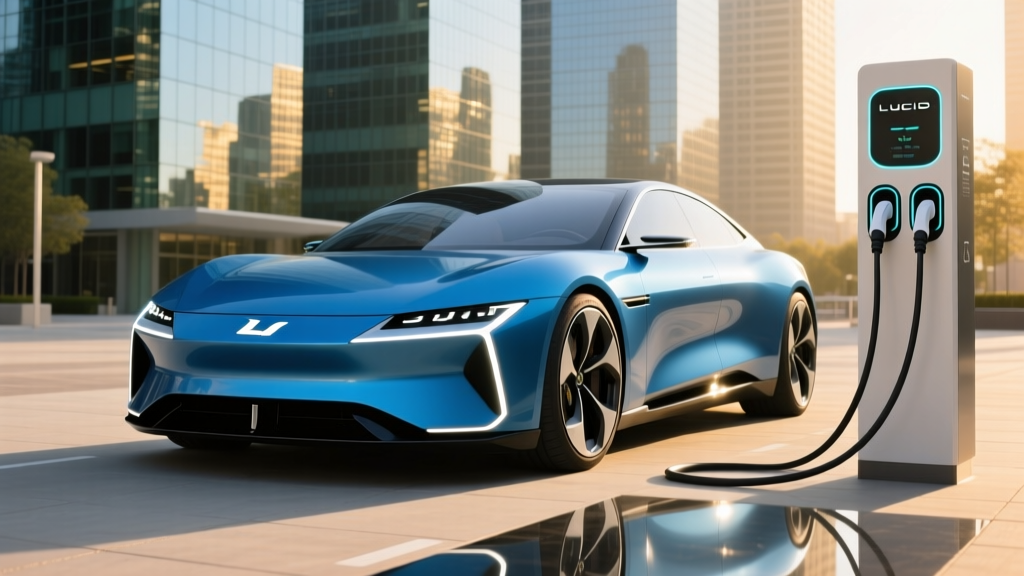
If you have been following Lucid Motors' product roadmap, you already know the company built its reputation on efficiency-per-kWh dominance with the Air sedan and the gravity-defying range numbers of the Gravity SUV. The Lucid AMP1 is the next step in that trajectory — a platform that Lucid has referenced in forward-looking statements as part of its mid-size vehicle architecture aimed at a broader buyer demographic than the six-figure Air. As of early 2026, Lucid has shared preliminary specifications and design direction for the AMP1 platform, though final production configurations, trim pricing, and delivery timelines remain subject to confirmation. This review synthesizes everything confirmed and projected about the AMP1 so you can decide whether to wait, configure, or look elsewhere.
What the Lucid AMP1 Is and Where It Fits
The Lucid AMP1 represents the automaker's push into a more accessible segment, leveraging the same underlying electric architecture that gave the Air its class-leading efficiency but packaged for buyers who do not need a full-size luxury sedan. Think of it as Lucid's answer to the mid-size premium EV market currently occupied by the Tesla Model 3 Highland, BMW i4, Hyundai Ioniq 6, and the upcoming next-generation Polestar 2. Lucid's stated goal is to deliver over 400 miles of EPA-estimated range in a package priced meaningfully below the Air's entry point, with the same powertrain efficiency that has become the brand's engineering signature.
Status note: As of this writing, the Lucid AMP1 is in the announced/pre-production phase. Specifications below reflect Lucid's published targets and platform data. Final EPA certification, pricing, and availability will be confirmed closer to production. We will update this review as official figures are released.
Projected Range, Battery, and Efficiency
Lucid's engineering advantage has always been doing more with fewer kilowatt-hours. The Air Grand Touring achieves roughly 4.5 miles per kWh — a figure that embarrasses competitors running larger, heavier battery packs. The AMP1 is expected to continue this tradition, targeting a usable battery capacity in the 88–92 kWh range using NMC (nickel manganese cobalt) chemistry, which offers the energy density required to hit 400+ mile targets without excessive pack weight.
EPA Range vs. Real-World Expectation
Target EPA estimate: ~410 miles (projected, pending certification)
Real-world highway (70–75 mph): Expect ~340–360 miles in moderate temperatures. Lucid's drivetrain efficiency partially offsets the typical 15–20% highway penalty, but aerodynamic drag at speed still applies.
Cold weather (below 32°F / 0°C): Plan for ~280–310 miles. NMC chemistry loses more capacity in cold than LFP, though Lucid's heat pump and battery preconditioning system should mitigate the worst of winter range loss.
City / mixed driving: Close to the EPA sticker, potentially 390–410 miles, thanks to aggressive regenerative braking and low-speed efficiency.
| Spec | Value (Projected) |
|---|---|
| EPA Range (target) | ~410 miles |
| Battery Capacity (usable) | ~88–92 kWh, NMC chemistry |
| Efficiency | ~4.4–4.6 mi/kWh (~130–135 MPGe combined) |
| Peak DC Fast Charge | ~250 kW (900V architecture) |
| 10–80% DC Charge Time | ~20–22 minutes (projected) |
| Level 2 Home Charging | 19.2 kW onboard charger (~70 mi/hr) |
| Drivetrain | RWD standard / Dual-Motor AWD available |
| 0–60 mph (AWD) | ~3.5 seconds (estimated) |
| Horsepower (AWD) | ~500 hp (combined, estimated) |
| Cargo Volume | ~18 cu ft trunk + ~5 cu ft frunk (est.) |
| Battery/Powertrain Warranty | 8 years / 100,000 miles (Lucid standard) |
For context, the EPA-rated efficiency of ~130–135 MPGe would place the AMP1 among the most efficient vehicles in its class, rivaling the Hyundai Ioniq 6's 140 MPGe Long Range RWD and surpassing the BMW i4 eDrive40's 109 MPGe. Lucid's miniaturized drive units — each roughly the size of a carry-on suitcase — are central to this efficiency advantage, reducing mass and parasitic losses.
Charging Speed: DC Fast and Home Level 2
Lucid's 900-volt electrical architecture is one of the highest in production, enabling faster DC charging at compatible stations. The AMP1 is projected to accept a peak DC fast-charge rate of approximately 250 kW, consistent with the Air's charging profile. On a 350 kW Electrify America or Tesla Supercharger (with NACS adapter), you should see a 10–80% charge in roughly 20–22 minutes.
| Charging Level | Power (kW) | Miles Added per Hour | Notes |
|---|---|---|---|
| Level 1 (120V household) | ~1.4 kW | ~5–6 mi/hr | Emergency / overnight trickle only |
| Level 2 (240V, 48A) | 11.5 kW | ~50 mi/hr | Standard home wall connector |
| Level 2 (240V, 80A) | 19.2 kW | ~70 mi/hr | Full onboard charger utilization |
| DC Fast Charge (peak) | ~250 kW | ~1,000+ mi/hr (at peak) | 10–80% in ~20–22 min; tapers above 80% |
A critical ownership note: the AMP1's 19.2 kW onboard charger is among the largest in its segment. Most competitors — including the Tesla Model 3 (11.5 kW) and BMW i4 (11 kW) — charge slower on Level 2. This means a full overnight charge on a properly wired 80-amp circuit takes roughly 5 hours, compared to 8–10 hours for rivals. If your home electrical panel supports it, this is a meaningful daily convenience advantage.
On the DC side, expect the charge curve to taper noticeably above 80% state of charge. Peak 250 kW rates are sustained roughly between 10–50% SoC, after which thermal management and cell-protection protocols reduce the rate. Charging from 80–100% on DC can add another 15–20 minutes — plan accordingly on road trips and target 80% stops when possible.
Performance and Driving Dynamics
Lucid has not published final horsepower figures for the AMP1, but based on the company's modular drive-unit strategy, we project a rear-wheel-drive base model producing approximately 350–400 hp and a dual-motor AWD variant delivering around 500 hp combined. The AWD model should hit 0–60 mph in approximately 3.5 seconds, placing it in the same performance bracket as the Tesla Model 3 Long Range AWD (4.2 seconds) and the BMW i4 M50 (3.7 seconds).
Lucid's permanent-magnet motors are compact and lightweight, contributing to a lower overall vehicle mass than competitors with equivalent battery sizes. This should translate to sharper handling and less tire wear over time — a factor often overlooked in spec-sheet comparisons. Expect a multi-link rear suspension and adaptive damping on higher trims, consistent with Lucid's luxury positioning.
Pricing, Trims, and Federal Tax Credit Eligibility
Lucid has indicated the AMP1 will target a starting MSRP in the mid-$50,000s, positioning it below the Air Pure (currently ~$69,900) and into direct competition with the Tesla Model 3 Long Range (~$47,740), BMW i4 eDrive40 (~$57,900), and Hyundai Ioniq 6 SEL (~$46,700). Higher trims with AWD and premium packages are projected to reach the low-to-mid $60,000s.
| Trim (Projected) | Est. Base MSRP | §30D Credit Eligibility | Effective Price (if eligible) |
|---|---|---|---|
| Base RWD | ~$55,000 | Up to $7,500 (pending sourcing rules) | ~$47,500 |
| AWD / Touring | ~$62,000 | Up to $7,500 (pending sourcing rules) | ~$54,500 |
| Grand Touring (if offered) | ~$68,000 | Up to $7,500 (pending sourcing rules) | ~$60,500 |
Federal §30D Tax Credit Requirements (2026 Rules)
- MSRP cap: Sedans must be priced at or below $55,000 to qualify. If the AMP1 base RWD comes in above this cap, it would be ineligible unless reclassified as an SUV by the IRS (which uses a different threshold of $80,000). Monitor Lucid's final pricing and IRS vehicle classification closely.
- Buyer income cap: Adjusted gross income must not exceed $150,000 (single), $225,000 (head of household), or $300,000 (joint filers).
- Battery sourcing: Increasing percentages of critical minerals and battery components must be sourced from the U.S. or free-trade-agreement partners. Lucid's supply chain decisions will determine whether the AMP1 qualifies for the full $7,500 or a partial amount.
- Point-of-sale transfer: Eligible buyers can transfer the credit to the dealer at purchase, reducing the purchase price directly rather than waiting for a tax refund. Confirm with your tax professional — IRS §30D rules are subject to change.
The MSRP cap is the key variable here. If Lucid prices the base RWD AMP1 at or below $55,000, it clears the sedan threshold. If it lands at $56,000 or higher, buyers would need the IRS to classify it as an SUV/crossover (unlikely for a sedan body style) or wait for potential legislative changes. This is the single biggest financial unknown for prospective buyers.
Interior, Tech, and Driver Assistance
Lucid's interior design language emphasizes space efficiency and a panoramic glass canopy roof. The AMP1 is expected to feature:
- A 34-inch curved glass cockpit display (similar to the Air's but potentially simplified for cost)
- Lucid's proprietary infotainment OS with over-the-air updates, native navigation with route-based battery preconditioning, and wireless Apple CarPlay/Android Auto
- A premium audio system (likely 14+ speakers on higher trims)
- Lucid's DreamDrive Pro ADAS suite — a Level 2 driver-assistance system with adaptive cruise control, lane centering, automated parking, and highway assist. This is not self-driving. The driver must remain engaged with hands on or near the wheel at all times.
ADAS clarity: Lucid's DreamDrive Pro is an SAE Level 2 system. It assists with steering, acceleration, and braking under driver supervision. It does not make the AMP1 autonomous. Eyes-on, hands-aware driving is required. Only Level 4 robotaxi services (Waymo, Zoox) operate without a human driver in defined service areas.
Passenger space should be generous for the class. Lucid's compact drive units free up interior volume, and the AMP1's projected wheelbase suggests rear legroom in the 38–40 inch range — competitive with the Tesla Model 3 (35.3 inches rear legroom) and exceeding the BMW i4 (34.7 inches). Cargo capacity is estimated at ~18 cubic feet in the trunk plus a ~5 cubic foot frunk, though Lucid has not confirmed final dimensions.
Pros, Cons, and Who Should Buy the Lucid AMP1
Pros
- Projected 410+ mile EPA range — among the highest in any mid-size EV
- Class-leading efficiency (~4.5 mi/kWh) means lower electricity costs per mile
- 19.2 kW onboard Level 2 charger — fastest home charging in class
- 900V architecture enables rapid DC fast charging at 250 kW
- Spacious interior relative to exterior footprint
- Lucid's 8-year/100,000-mile battery and powertrain warranty
Cons
- Not yet available for purchase — production timeline uncertain
- §30D tax credit eligibility hinges on final MSRP and battery sourcing
- Lucid's service center network is still limited compared to Tesla or legacy OEMs
- NMC battery chemistry loses more range in cold weather than LFP alternatives
- Premium pricing may still exceed well-equipped Model 3 or Ioniq 6 builds
- DreamDrive Pro ADAS is capable but not class-leading vs. Tesla FSD or GM Super Cruise
Who the Lucid AMP1 Suits Best
Choose the AMP1 if: You prioritize maximum range and charging speed, want a premium mid-size sedan that is not a Tesla, have access to home Level 2 charging, and are willing to wait for production to begin.
Look elsewhere if: You need a vehicle now (consider the Hyundai Ioniq 6 or Tesla Model 3), require an extensive dealer/service network in rural areas, or need guaranteed §30D tax credit eligibility at a sub-$55,000 price point today.
Lucid AMP1 vs. Key Competitors
How does the AMP1 stack up against the mid-size EVs you can actually buy today? Here is a quick comparison using confirmed figures from fueleconomy.gov and manufacturer data:
| Spec | Lucid AMP1 (Proj.) | Tesla Model 3 LR AWD | Hyundai Ioniq 6 SEL | BMW i4 eDrive40 |
|---|---|---|---|---|
| EPA Range | ~410 mi | 363 mi | 361 mi | 307 mi |
| Battery (kWh) | ~90 NMC | 75 NMC | 77.4 NMC | 81.5 NMC |
| Efficiency (MPGe) | ~132 | 134 | 140 | 109 |
| Peak DC Charge | ~250 kW | 250 kW | 233 kW | 205 kW |
| 10–80% DC Time | ~21 min | ~25 min | ~18 min | ~31 min |
| Level 2 Onboard | 19.2 kW | 11.5 kW | 10.9 kW | 11.0 kW |
| 0–60 mph | ~3.5s (AWD) | 4.2s | 5.1s | 5.5s |
| Base MSRP | ~$55,000 | $47,740 | $46,700 | $57,900 |
The AMP1's projected advantage is clear: more range, faster home charging, and competitive DC speed — but at a higher starting price than the Korean and Tesla competition. The Ioniq 6 remains the efficiency and value champion today, while the Model 3 offers the Supercharger network advantage. The AMP1's case rests on whether Lucid can deliver its range and efficiency targets at a price buyers will accept.
Frequently Asked Questions
What is the real-world range of the Lucid AMP1?
Lucid targets approximately 410 miles of EPA-estimated range. In real-world highway driving at 70–75 mph, expect 340–360 miles. In cold weather (below freezing), plan for 280–310 miles. City and mixed driving should return numbers close to the EPA sticker thanks to Lucid's drivetrain efficiency and regenerative braking.
How fast does the Lucid AMP1 charge?
On a DC fast charger, the AMP1 is projected to peak at ~250 kW, charging from 10–80% in approximately 20–22 minutes. At home on a Level 2 charger, the 19.2 kW onboard charger adds roughly 70 miles of range per hour on an 80-amp circuit, or about 50 miles per hour on a more common 48-amp setup.
Does the Lucid AMP1 qualify for the federal EV tax credit?
Potentially — but it depends on final pricing and battery sourcing. Under 2026 IRS §30D rules, sedans must have an MSRP at or below $55,000. Buyer income caps ($150K single / $300K joint) and battery-component/critical-mineral sourcing requirements also apply. Confirm eligibility with a tax professional before purchasing. See the IRS clean vehicle credits page for current rules.
Is the Lucid AMP1 worth buying over a Tesla Model 3 or Hyundai Ioniq 6?
If range is your top priority and you are willing to pay a premium, the AMP1's projected 410-mile target is compelling. However, the Model 3 offers the Supercharger network, lower pricing, and immediate availability. The Ioniq 6 delivers best-in-class efficiency at a lower price. The AMP1 makes the most sense for buyers who value Lucid's engineering approach, want maximum range without a luxury-sedan price, and can wait for production.
When will the Lucid AMP1 be available?
Lucid has not confirmed an exact on-sale date for the AMP1. The company's product roadmap references mid-size vehicles entering production in the latter half of the 2020s. Monitor Lucid's investor communications and press releases for delivery timeline updates. We will update this review when production dates and final specs are confirmed.
What warranty covers the AMP1's battery?
Lucid's standard battery and powertrain warranty is 8 years or 100,000 miles, whichever comes first. This covers defects and capacity loss below a specified retention threshold (typically 70–80% of original capacity). This is consistent with industry standards and matches Tesla, Hyundai, and BMW battery warranty terms.
Editorial note: Specifications for the Lucid AMP1 are based on manufacturer projections and platform data available as of early 2026. Final EPA certification, pricing, and feature availability may differ. Always verify with Lucid Motors directly and consult fueleconomy.gov for certified figures before purchasing.