Quick Verdict: Two Luxury EV Sedans, Very Different Philosophies
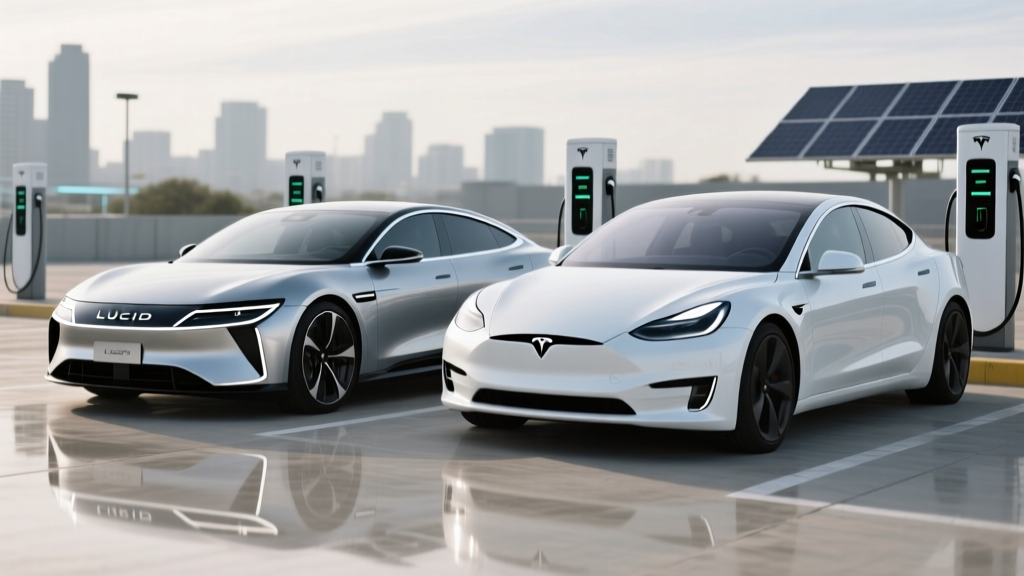
The rivalry between the Lucid Air and Tesla Model S defines the luxury electric sedan segment. Both deliver blistering acceleration, 400+ mile EPA ranges in their top trims, and tech-heavy cabins — but they solve the ownership equation very differently. The Lucid Air prioritizes efficiency, interior space, and ride comfort with a traditional luxury approach, while the Tesla Model S leans on the Supercharger network, over-the-air updates, and brand cachet. This head-to-head breaks down the numbers that actually matter once the showroom excitement fades: real-world range, charging curves, total cost after incentives, and daily livability.
Real-World Range Reality Check
Lucid Air Grand Touring: EPA-estimated 512 miles. Expect ~410–440 miles in mixed highway driving at 70–75 mph; ~340–370 miles in sub-30°F winter conditions.
Tesla Model S Long Range: EPA-estimated 402 miles. Expect ~330–360 miles highway; ~270–300 miles in cold weather.
Both vehicles lose roughly 15–20% range at sustained highway speeds and 25–35% in freezing temperatures — consistent with NMC lithium-ion behavior. The Lucid's efficiency advantage (more miles per kWh) means it stretches further on less energy, which also translates to faster effective road-trip charging.
Spec-by-Spec Comparison Table
| Specification | 2026 Lucid Air Grand Touring | 2026 Tesla Model S Long Range |
|---|---|---|
| EPA Range | 512 miles | 402 miles |
| Battery (usable) | ~112 kWh (NMC) | ~95 kWh (NMC/Panasonic) |
| Efficiency | 131 MPGe / 24 kWh/100mi | 120 MPGe / 28 kWh/100mi |
| Drivetrain | Dual-motor AWD | Dual-motor AWD |
| Horsepower | 819 hp | 670 hp |
| 0–60 mph | 3.0 seconds | 3.1 seconds |
| Peak DC Fast Charge | ~250 kW | ~250 kW |
| 10–80% DC Charge | ~22 minutes | ~25 minutes |
| Level 2 Home Charging | 19.2 kW (~75 mi/hr) | 11.5 kW (~44 mi/hr) |
| Connector | CCS (NACS adapter available) | NACS (native) |
| Cargo Volume | 32 cu ft (trunk + frunk) | 28 cu ft (trunk + frunk) |
| Rear Legroom | 38.4 inches | 35.4 inches |
| Base MSRP | $110,900 | $79,990 |
| Federal Tax Credit (§30D) | Not eligible (MSRP cap $55k sedans) | Not eligible (MSRP cap $55k sedans) |
| Battery Warranty | 8 yr / 100,000 mi | 8 yr / 150,000 mi |
Charging Speed: Home, Highway, and Network Access
Charging is where the Lucid Air vs Tesla Model S debate gets practical. Both sedans peak around 250 kW on DC fast chargers, but the Lucid's larger battery and superior efficiency mean it adds more real-world miles per minute of charging. The Lucid can recover approximately 200 miles of range in 15 minutes under ideal conditions, while the Model S recovers roughly 175 miles in the same window.
| Charging Level | Lucid Air Grand Touring | Tesla Model S LR |
|---|---|---|
| Level 1 (120V / 12A) | ~1.4 kW — ~3 mi/hr | ~1.4 kW — ~3 mi/hr |
| Level 2 (240V / 48A–80A) | Up to 19.2 kW — ~75 mi/hr | Up to 11.5 kW — ~44 mi/hr |
| DC Fast Charge (peak) | ~250 kW — 10–80% in ~22 min | ~250 kW — 10–80% in ~25 min |
Home charging advantage — Lucid: The Air's onboard charger accepts up to 19.2 kW on Level 2, meaning a full overnight replenishment even from near-empty. The Model S caps at 11.5 kW — still adequate for daily use (most owners charge 20–40% overnight), but slower for those who drain the battery on road trips and want a quick home top-up.
Network advantage — Tesla: The Model S charges natively on Tesla Superchargers, the most reliable and widespread DC fast-charging network in the U.S. with over 30,000 stalls. Lucid owners rely on Electrify America, EVgo, and other third-party networks via CCS, or use a NACS adapter for Supercharger access. Adapter-based Supercharging works but can be inconsistent at older V2 stalls and adds a step to the charging experience.
Range, Efficiency, and the kWh Advantage
Lucid's engineering hallmark is efficiency. The Air Grand Touring achieves roughly 24 kWh per 100 miles — exceptional for a 5,200-pound luxury sedan. That translates to more range from every electron, lower charging costs, and less stress on long drives. The EPA's fueleconomy.gov data confirms the Air's class-leading MPGe figures.
The Model S Long Range at 28 kWh/100mi is still efficient for its class but trails the Lucid by about 15%. On a 400-mile road trip, that difference means the Tesla needs one additional charging stop or a longer cumulative charge time — a meaningful gap for frequent travelers.
Cold-weather note: Both vehicles use liquid-cooled NMC battery packs with heat pumps for cabin and battery thermal management. Expect 25–35% range reduction below freezing, with the Lucid's larger battery providing a bigger absolute buffer. Preconditioning the battery before DC fast charging is essential on both vehicles to hit peak kW rates — skip it and your 250 kW peak may drop to 120–150 kW in cold conditions.
Performance and Driving Dynamics
Both sedans deliver supercar-rivaling acceleration. The Lucid Air Grand Touring's 819 hp and 3.0-second 0–60 time edge out the Model S Long Range's 670 hp and 3.1-second sprint — differences you'll feel on a drag strip but rarely exploit on public roads.
Where they diverge is ride quality. The Lucid Air uses a sophisticated adaptive air suspension tuned for comfort-first grand touring, absorbing highway imperfections with a suppleness that rivals the Mercedes S-Class. The Model S, refreshed in recent years with improved damping, still leans slightly sportier and firmer — engaging on canyon roads but more noticeable on broken pavement.
Steering feel favors the Lucid for precision and weighting. The Model S yoke (standard) or optional round wheel offers quick ratios but can feel artificial at low speeds. Both vehicles offer one-pedal driving via adjustable regenerative braking, though Tesla's regen implementation remains among the smoothest in the industry.
Interior, Tech, and Daily Livability
Lucid Air: The cabin feels like a modernist lounge — a 34-inch curved glass cockpit display spans the dash, materials include premium leather and sustainable wood, and rear-seat space (38.4 inches of legroom) genuinely accommodates adults on long trips. The 32 cu ft of combined cargo space (trunk + frunk) handles luggage for a family of four on a week-long trip. Lucid's DreamDrive Pro ADAS (SAE Level 2) includes adaptive cruise, lane centering, and highway assist — competent but requiring full driver engagement at all times.
Tesla Model S: The minimalist interior centers on a 17-inch touchscreen controlling virtually every function. Build quality has improved markedly since the 2021 refresh, with ventilated seats, a rear touchscreen for passengers, and a yoke steering wheel. Rear legroom (35.4 inches) is adequate but tighter than the Lucid. Cargo space of 28 cu ft is competitive. Tesla's Autopilot and optional Full Self-Driving (Supervised) — also SAE Level 2, not autonomous — remain among the most feature-rich driver-assist systems, though they require constant supervision.
Infotainment: Tesla's vertically oriented UI is responsive and feature-dense (streaming, gaming, navigation with live Supercharger routing). Lucid's system is visually stunning but has historically lagged in third-party app integration, though OTA updates continue to close the gap.
Pricing, Tax Credits, and Ownership Cost
| Cost Factor | Lucid Air Grand Touring | Tesla Model S Long Range |
|---|---|---|
| Base MSRP | $110,900 | $79,990 |
| As-Tested (typical options) | ~$118,000 | ~$87,000 |
| Federal §30D Tax Credit | $0 (exceeds $55k sedan MSRP cap) | $0 (exceeds $55k sedan MSRP cap) |
| Est. 5-Year Charging Cost | ~$3,800 | ~$4,500 |
| Est. 5-Year Insurance | ~$16,500 | ~$14,000 |
| Est. 5-Year Depreciation | ~$55,000 | ~$35,000 |
| Est. 5-Year Total Cost | ~$186,200 | ~$140,500 |
Tax credit reality: Neither vehicle qualifies for the IRS §30D federal EV tax credit. The credit caps sedan eligibility at $55,000 MSRP, and both vehicles far exceed that threshold. State-level incentives may apply (California's CVRP, Colorado's innovative motor vehicle credit, etc.), but these vary by jurisdiction — check your state's official energy office for current programs.
Ownership economics: The Model S holds a significant cost advantage — roughly $30,000 less upfront and lower projected depreciation. The Lucid's higher efficiency saves about $700 in charging over five years, but that barely dents the purchase-price gap. Insurance tends to be higher on the Lucid due to its elevated repair costs and lower production volume.
Battery, Warranty, and Long-Term Durability
Both vehicles use nickel-manganese-cobalt (NMC) lithium-ion battery packs optimized for energy density. Neither uses LFP chemistry, which is reserved for lower-range, lower-cost models in each brand's lineup.
Lucid battery warranty: 8 years / 100,000 miles, with a capacity retention threshold of 70%. Lucid's Wunderbox battery architecture uses miniaturized modules that may allow partial pack repairs rather than full replacement — potentially reducing out-of-warranty costs, though real-world data is still limited given the brand's youth.
Tesla battery warranty: 8 years / 150,000 miles, also at 70% retention. Tesla's longer mileage coverage and larger service network provide more peace of mind for high-mileage drivers. Out-of-warranty pack replacement for the Model S currently ranges from $15,000–$22,000 depending on configuration.
Both batteries are liquid-cooled with active thermal management. Degradation data from early Lucid owners suggests approximately 5–8% capacity loss over the first 50,000 miles — in line with Tesla's well-documented NMC degradation curves of roughly 10% over 100,000 miles. Routine charging between 20–80% SoC (state of charge) and avoiding repeated DC fast charging will maximize longevity on either vehicle.
Pros and Cons at a Glance
Lucid Air Grand Touring — Pros
- Class-leading 512-mile EPA range
- Best-in-class efficiency (24 kWh/100mi)
- Spacious rear cabin with genuine adult legroom
- 19.2 kW Level 2 home charging — fastest in segment
- Exceptional ride comfort and quietness
Lucid Air Grand Touring — Cons
- $110k+ price with no federal tax credit
- Limited service center network
- CCS native — needs adapter for Superchargers
- Infotainment app ecosystem still maturing
- Higher insurance and depreciation costs
Tesla Model S Long Range — Pros
- Native Supercharger network access
- Proven reliability track record and service infrastructure
- Strong resale value relative to luxury EV peers
- Feature-rich Autopilot/FSD (Supervised) suite
- $30k+ less expensive than comparable Lucid
Tesla Model S Long Range — Cons
- 110 fewer EPA miles of range than the Lucid
- Slower Level 2 home charging (11.5 kW cap)
- Tighter rear-seat legroom
- Yoke steering polarizing; round wheel optional
- No federal tax credit at this price point
Decision Framework: Which Should You Buy?
Choose the Lucid Air if: You prioritize maximum range, ride comfort, and interior space; you charge primarily at home with a high-amperage Level 2 setup; you take frequent long road trips where efficiency reduces stop count; and budget allows for the premium.
Choose the Tesla Model S if: You want native Supercharger reliability without adapters; you value a mature service network and stronger resale value; you prefer Tesla's software ecosystem and OTA feature pipeline; and you want luxury EV performance at a lower entry price.
Frequently Asked Questions
What is the real-world range of the Lucid Air vs Tesla Model S?
The Lucid Air Grand Touring delivers approximately 410–440 real-world highway miles and 340–370 miles in freezing weather, against its 512-mile EPA sticker. The Model S Long Range achieves roughly 330–360 highway miles and 270–300 cold-weather miles against its 402-mile EPA estimate. Both are excellent, but the Lucid's efficiency edge gives it a meaningful buffer on long trips.
How fast does each car charge at home and on the road?
On DC fast chargers, both peak near 250 kW — the Lucid hits 10–80% in about 22 minutes, the Tesla in about 25 minutes. At home on Level 2, the Lucid charges significantly faster at up to 19.2 kW (~75 miles of range per hour) versus the Tesla's 11.5 kW (~44 miles per hour). For daily overnight top-ups, both are more than adequate.
Does either qualify for the federal EV tax credit?
No. Under current IRS §30D rules, new sedan eligibility is capped at $55,000 MSRP. Both the Lucid Air and Tesla Model S far exceed this threshold. Additionally, buyer income caps ($150k single / $300k joint) and battery critical-mineral sourcing requirements apply to qualifying vehicles. Check your state for separate incentive programs.
Is the Lucid Air worth the premium over the Tesla Model S?
It depends on your priorities. If range, rear-seat comfort, and ride quality are paramount and you have home charging dialed in, the Lucid's $30,000 premium buys a genuinely more refined grand-touring experience. If charging convenience (Superchargers), service infrastructure, software, and value retention matter more, the Model S is the pragmatic choice.
What are the biggest drawbacks of each?
The Lucid Air's main limitations are its limited service network, CCS connector requiring an adapter for Superchargers, and higher insurance/depreciation costs. The Model S's drawbacks include less range, slower home charging, tighter rear seats, and a yoke-first steering approach that doesn't suit every driver.
Which is better for road trips?
The Lucid Air requires fewer charging stops thanks to its superior range and efficiency. However, the Tesla Model S benefits from the Supercharger network's reliability and integrated trip planning. If your routes are Supercharger-dense, the Tesla experience is more seamless. If you drive in areas with sparse Supercharger coverage, the Lucid's range advantage becomes decisive.