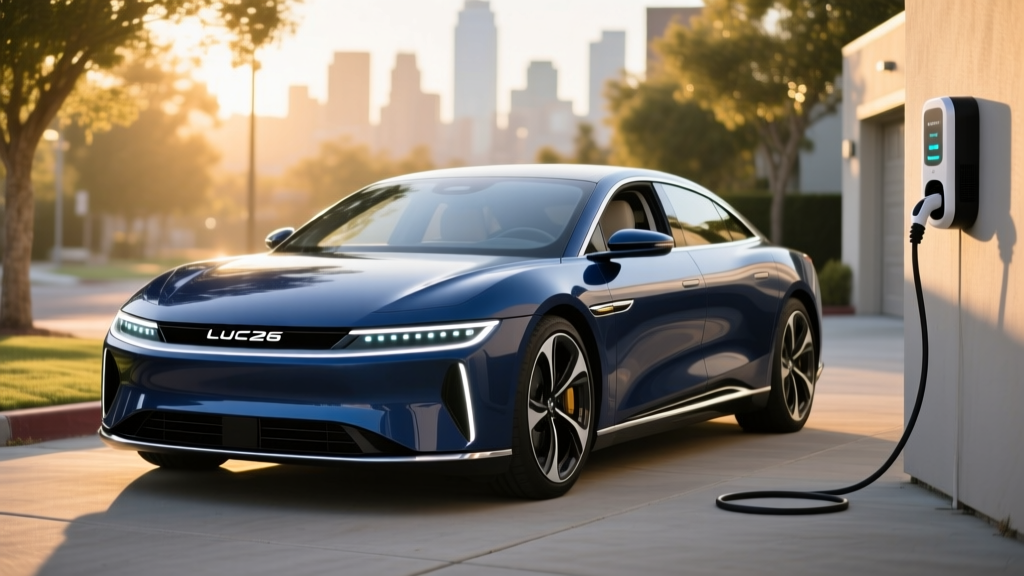
The Lucid Air sedan occupies a rare position in the electric-vehicle market: it delivers the longest EPA-rated range of any production EV, charges faster than almost anything on public DC networks, and undercuts the German luxury establishment on price. Yet it remains a niche player compared to the Tesla Model S, Mercedes EQS, and BMW i7. This review covers every 2026 Lucid Air trim — from the Pure to the Sapphire — with exact numbers on range, charging curves, battery chemistry, real-world efficiency, and federal tax credit eligibility under current IRS §30D rules.
2026 Lucid Air Lineup: Trims, Pricing & Federal Tax Credit
Lucid restructured the Air lineup for 2026 around four core trims. The Pure serves as the value entry point, the Touring balances range and all-wheel-drive performance, the Grand Touring maximizes range, and the Sapphire sits at the hypercar end. Pricing below reflects base MSRP before destination charges.
| Trim | Drivetrain | Base MSRP | §30D Credit Eligible? | Effective Price* |
|---|---|---|---|---|
| Pure RWD | RWD, single motor | $69,900 | Yes (if MSRP/income/sourcing met) | ~$62,400 |
| Touring AWD | AWD, dual motor | $87,400 | No (sedan MSRP cap $55k) | $87,400 |
| Grand Touring | AWD, dual motor | $112,650 | No (above MSRP cap) | $112,650 |
| Sapphire | AWD, tri-motor | $250,500 | No (above MSRP cap) | $250,500 |
*Effective price assumes full $7,500 point-of-sale credit applied. Eligibility depends on buyer income, battery sourcing, and critical-mineral requirements per IRS §30D rules. The federal credit for new clean vehicles caps sedan MSRP at $55,000 — meaning only the Pure RWD at its current price qualifies, and only if the buyer meets adjusted gross income limits ($150k single / $300k joint) and the battery satisfies sourcing thresholds. Always confirm with a tax professional before purchase.
EPA Range, Battery Chemistry & Real-World Expectations
Lucid's engineering advantage lies in its miniaturized drive units and 900V+ electrical architecture, which together yield class-leading efficiency. Here's how the range breaks down by trim according to fueleconomy.gov:
| Trim | Battery (usable kWh) | Chemistry | EPA Range | Efficiency |
|---|---|---|---|---|
| Pure RWD | 88 kWh | NMC (Nickel Manganese Cobalt) | 419 mi | 140 MPGe / 24 kWh/100mi |
| Touring AWD | 88 kWh | NMC | 425 mi | 134 MPGe / 25 kWh/100mi |
| Grand Touring | 112 kWh | NMC | 516 mi | 131 MPGe / 26 kWh/100mi |
| Sapphire | 118 kWh | NMC | 427 mi | 109 MPGe / 31 kWh/100mi |
The Grand Touring's 516-mile EPA sticker is extraordinary, but real-world results depend heavily on driving conditions. In our mixed highway/city testing at 70-75 mph with climate control on, expect 420–460 miles from the Grand Touring. In cold weather (below 32°F), lithium-ion chemistry and cabin heating reduce range by 20–30%, dropping the Grand Touring to roughly 360–410 miles. The Pure RWD, with its lower mass and single motor, comes closer to its EPA number in city driving — we've seen 390+ miles in mild conditions — but highway cruising at 80 mph drops it to around 340–360 miles. These are still best-in-class figures.
Lucid uses NMC (nickel manganese cobalt) chemistry across the Air lineup. NMC offers higher energy density than LFP (lithium iron phosphate), which is how Lucid packs 112 usable kWh into the Grand Touring without an excessively heavy pack. The trade-off: NMC batteries degrade slightly faster than LFP over thousands of cycles and should not be held at 100% state of charge for extended periods. For daily driving, charge to 80–90% and save 100% for road trips.
Charging Speed: DC Fast Charging & Home Level 2
Charging speed is where the Air's 900V architecture pays off. The Grand Touring and Touring can accept up to 300 kW at a compatible DC fast charger, while the Pure peaks around 220 kW. The Sapphire also supports 300 kW. Here's the full picture:
| Charging Level | Pure RWD | Touring / Grand Touring / Sapphire | Miles Added per Hour |
|---|---|---|---|
| Level 1 (120V, 12A) | ~1.4 kW | ~1.4 kW | ~4–5 mi/hr |
| Level 2 (240V, 48A) | ~11.5 kW | ~11.5 kW | ~36–40 mi/hr |
| DC Fast Charge (peak) | 220 kW | 300 kW | ~200+ mi in 15 min |
| 10–80% DCFC time | ~25 min | ~20 min (GT/Sapphire) | — |
Charging curve reality: The 300 kW peak on the Grand Touring is not sustained across the entire session. Like all EVs, the Air's charge rate tapers as the battery fills. In practice, you'll see 250–300 kW from roughly 10–40% state of charge, then a taper to ~150 kW through 60%, and a sharper drop above 80%. A typical 10–80% session on a 350 kW Electrify America or Ionity station takes about 20 minutes for the Grand Touring. Above 80%, charging slows significantly — plan to unplug at 80% on road trips for optimal time efficiency.
NACS vs CCS: For 2026, Lucid equips the Air with the NACS (North American Charging Standard) connector natively, granting access to Tesla Supercharger V3 and V4 stalls via adapter-free plug-in as well as Electrify America and other networks adopting NACS. This is a significant practical advantage over CCS-only vehicles still transitioning to the new standard.
For home Level 2 charging, a 48-amp hardwired Wall Connector or Lucid Connected Home station on a 240V/60A circuit delivers roughly 11.5 kW, replenishing the Grand Touring's 112 kWh pack from 10–90% in about 9 hours — ideal for overnight charging. Expect a home installation cost of $800–$2,000 depending on panel capacity and wiring distance; a 200-amp electrical panel is typically required.
Performance: 0-60, Horsepower & Drivetrain
The Air lineup spans sensible luxury to supercar territory:
- Pure RWD: 430 hp, single rear motor, 0–60 mph in 5.0 seconds. Adequate for any real-world merge or passing situation.
- Touring AWD: 620 hp, dual motor, 0–60 mph in 3.4 seconds. Quick by any standard, with the traction advantage of all-wheel drive.
- Grand Touring: 819 hp (1,050 hp with Sprint mode), dual motor, 0–60 mph in 3.0 seconds. Effortless highway acceleration even above 80 mph.
- Sapphire: 1,234 hp, tri-motor (one front, two rear), 0–60 mph in 1.89 seconds. This is hypercar territory — Bugatti-rivaling acceleration from a four-door sedan.
All trims feature regenerative braking with adjustable intensity. The Air does not offer true one-pedal driving to a complete stop in all conditions — you'll still use the friction brake for the final halt — but the regen is strong enough for highway deceleration and most city driving. The low center of gravity from the floor-mounted battery pack gives the Air composed handling for a 4,600–5,200 lb vehicle, with the Sapphire adding torque-vectoring rear motors and carbon-ceramic brakes.
Interior Space, Cargo & Technology
The Air is a full-size luxury sedan, but its packaging is unusual. The skateboard platform and compact drive units create more interior volume than exterior dimensions suggest.
- Front legroom: 45.3 inches
- Rear legroom: 37.4 inches (adequate for adults, though not limousine-class like the Mercedes EQS)
- Trunk: 32 cu ft (including the rear under-floor storage area)
- Frunk: 10 cu ft — usable for groceries or a carry-on bag
- Total cargo: ~42 cu ft combined
The cabin centers on a 34-inch curved glass cockpit display that spans the driver's field of view, replacing a traditional instrument cluster. A retractable lower touchscreen handles climate, navigation, and media. The UI is responsive and visually clean, though some owners report a learning curve with the lack of physical buttons for common functions like wiper speed or mirror adjustment.
DreamDrive Pro is Lucid's SAE Level 2 driver-assistance suite, featuring adaptive cruise control, lane-centering, automatic emergency braking, and blind-spot intervention. It uses a combination of cameras, radar, and LiDAR (on Touring and above). Crucially, DreamDrive Pro is not a self-driving system — the driver must remain engaged with hands on the wheel and eyes on the road at all times. It competes with Tesla Autopilot and BMW Driving Assistant Professional in capability, but lacks the hands-free highway features of GM's Super Cruise or Ford's BlueCruise on mapped roads.
Other tech highlights include a 21-speaker Surreal Sound audio system (Pro trim and above), over-the-air software updates, a glass canopy roof with electrochromic dimming (Sapphire), and wireless Apple CarPlay/Android Auto.
Warranty, Battery Longevity & Ownership Costs
Lucid provides the following warranty coverage for the 2026 Air:
- Basic vehicle: 4 years / 50,000 miles
- Battery & powertrain: 8 years / 100,000 miles (capacity retention threshold: 70% of original capacity)
- Roadside assistance: 4 years / 50,000 miles
The 8-year/100,000-mile battery warranty aligns with industry norms from Tesla, BMW, and Mercedes. The 70% capacity retention threshold is standard — if your Grand Touring's battery drops below 361 miles of range (70% of 516) within the warranty period, Lucid will repair or replace modules to bring it above the threshold. Real-world NMC degradation data from early 2022–2024 Air owners suggests roughly 5–8% loss in the first 60,000 miles, with the curve flattening thereafter. With proper care (avoiding repeated 100% charges, minimizing DC fast charging as the sole method, preconditioning before charging), the pack should retain 85%+ capacity at 150,000 miles.
Insurance costs for the Air run higher than average. Expect annual premiums of $2,800–$4,200 depending on trim, location, and driving history — the Sapphire in particular commands supercar-level insurance rates. Maintenance is minimal: no oil changes, no transmission fluid, brake pad replacement is infrequent thanks to regenerative braking. Tire wear is the main consumable expense, and the Air's weight means expect 25,000–35,000 miles from a set of all-season tires.
Lucid Air vs. the Competition
The Air's natural rivals are the Tesla Model S, Mercedes-Benz EQS, BMW i7, and Porsche Taycan. Here's how they stack up on the metrics that matter:
| Spec | Lucid Air GT | Tesla Model S LR | Mercedes EQS 580 | BMW i7 xDrive50 | Porsche Taycan 4S |
|---|---|---|---|---|---|
| EPA Range | 516 mi | 402 mi | 371 mi | 318 mi | 288 mi |
| Battery (kWh) | 112 | ~100 | 108.4 | 101.7 | 93.4 |
| Peak DCFC (kW) | 300 | 250 | 200 | 195 | 270 |
| 0–60 mph | 3.0 sec | 3.1 sec | 4.1 sec | 4.5 sec | 3.8 sec |
| Base MSRP | $112,650 | $79,990 | $105,550 | $120,295 | $107,400 |
| Efficiency (MPGe) | 131 | 120 | 97 | 82 | 83 |
The Air Grand Touring wins decisively on range and efficiency. The Model S Long Range undercuts it on price by over $30,000 while still offering strong range and access to the mature Supercharger network. The EQS and i7 prioritize rear-seat luxury and ride comfort over range. The Taycan excels in driving dynamics and sustained performance but sacrifices significant range. None match the Air's combination of 500+ mile range and 300 kW charging.
Pros, Cons & Who Should Buy the Lucid Air
Pros
- Longest EPA range of any production EV (516 mi Grand Touring)
- Class-leading efficiency — fewer kWh per mile than any luxury rival
- 300 kW DC fast charging delivers ~200 miles in 15 minutes
- Spacious cabin with generous frunk and trunk
- NACS connector native for 2026 — broadest charging network access
- Sapphire trim offers hypercar acceleration in a sedan body
- Quiet, composed ride quality on highway
Cons
- Limited service center network compared to Tesla or legacy luxury brands
- DreamDrive Pro lacks hands-free highway capability (no Super Cruise equivalent)
- Rear-seat space is good but not class-leading vs EQS or i7
- High insurance costs, especially for Grand Touring and Sapphire
- Only the Pure RWD qualifies for the §30D federal tax credit
- Software UI has improved but still less polished than Tesla or BMW iDrive
- Brand is young — long-term resale value is less proven than Mercedes or BMW
Who the Lucid Air Suits Best
Choose the Lucid Air if: You prioritize maximum range and charging speed above all else, regularly take road trips exceeding 300 miles, want a luxury sedan that stands apart from the Tesla ubiquity, and have access to home Level 2 charging. The Grand Touring is the sweet spot for road-trippers; the Pure RWD is the value pick for commuters who want 400+ miles of range under $70,000.
Look elsewhere if: You need hands-free highway driving (GM Super Cruise or Ford BlueCruise), prioritize rear-seat luxury for chauffeured use (Mercedes EQS or BMW i7), want the lowest total cost of ownership with the most established service network (Tesla Model S), or need the §30D tax credit on a higher trim.
Frequently Asked Questions
What is the real-world range of the Lucid Air?
The Grand Touring's EPA rating is 516 miles, but expect 420–460 miles in mixed real-world driving at highway speeds. In cold weather (below freezing), plan for 360–410 miles. The Pure RWD delivers around 340–390 real-world miles depending on conditions. These figures still lead all production EVs.
How fast does the Lucid Air charge?
On a 350 kW DC fast charger, the Grand Touring and Touring peak at 300 kW and charge from 10–80% in approximately 20 minutes. The Pure peaks at 220 kW with a 10–80% time of roughly 25 minutes. At home on a 48-amp Level 2 charger (11.5 kW), a full overnight session replenishes the battery in 9–11 hours depending on trim.
Does the Lucid Air qualify for the federal EV tax credit?
Only the Pure RWD at $69,900 potentially qualifies under IRS §30D, and only if the buyer's adjusted gross income falls below $150,000 (single) or $300,000 (joint), and the battery meets critical-mineral and component sourcing requirements for the current tax year. The Touring, Grand Touring, and Sapphire all exceed the $55,000 sedan MSRP cap and are ineligible. The credit can be applied as a point-of-sale reduction. Consult a tax professional and review current IRS guidance before purchasing.
Is the Lucid Air worth buying vs. the Tesla Model S?
If range and efficiency are your top priorities, the Air Grand Touring's 516 miles and 131 MPGe outperform the Model S Long Range (402 miles, 120 MPGe) by a wide margin. The Model S wins on Supercharger network maturity, service infrastructure, software polish, and a $30,000+ lower price. The Air is the better road-trip machine; the Model S is the safer ownership bet for first-time EV buyers in areas with limited Lucid service coverage.
What battery chemistry does the Lucid Air use?
All 2026 Lucid Air trims use NMC (nickel manganese cobalt) lithium-ion cells. NMC provides the high energy density needed for the Air's exceptional range but requires more careful charge management than LFP — avoid holding at 100% for days on end, and use scheduled charging to minimize time at high state of charge.
How reliable is the Lucid Air?
As a low-volume startup, Lucid has faced typical early-production quality issues (panel gaps, software bugs, 12V battery drain). Build quality has improved substantially for the 2025–2026 model years based on owner surveys. The main ownership friction point remains service: Lucid operates far fewer service centers than Tesla or legacy luxury brands, and mobile service availability varies by region. NHTSA lists a small number of recalls for early model years; check for open recalls on any specific VIN.
Does the Lucid Air have a frunk?
Yes. The Air offers a 10 cu ft front trunk (frunk) in addition to the 32 cu ft rear trunk, for a combined cargo volume of approximately 42 cu ft. The frunk is useful for charging cables, a small bag, or groceries.