Quick Verdict: The Fastest Sedan That Can Also Commute
The 2024 Lucid Air Sapphire is a paradox wrapped in carbon fiber: a 1,234-horsepower, sub-2.0-second 0-60 mph sedan that also delivers 427 miles of EPA-estimated range. Built as Lucid's halo performance variant, the Sapphire sits at the apex of the Air lineup with a tri-motor AWD powertrain, track-tuned suspension, and a 118 kWh battery pack that outmuscles nearly every EV on the road in both acceleration and efficiency. At $249,000 before destination, it isn't for everyone — but for buyers cross-shopping the Tesla Model S Plaid and Porsche Taycan Turbo GT, the Sapphire makes a compelling, data-backed case.
After spending time with the Sapphire's specs, charging behavior, and real-world driving characteristics, here's what prospective buyers need to know before writing the check.
Full Specifications at a Glance
| Spec | Value |
|---|---|
| EPA Range | 427 miles |
| Battery (usable) | 118 kWh, NMC lithium-ion |
| Powertrain | Tri-motor AWD (1 front, 2 rear) |
| Horsepower | 1,234 hp |
| Torque | 1,430 lb-ft |
| 0-60 mph | 1.89 seconds (manufacturer) |
| Top Speed | 205 mph |
| Max DC Fast Charge | 300 kW (peak) |
| 10-80% DC Charge Time | ~25 minutes |
| Level 2 Home Charge (19.2 kW) | ~62 miles per hour |
| Efficiency (EPA) | 130 MPGe combined / 26 kWh/100 mi |
| Cargo Volume | 32 cu ft (trunk + frunk combined) |
| Rear Legroom | 36.6 inches |
| Battery/Powertrain Warranty | 8 years / 100,000 miles |
| Base MSRP | $249,000 |
| Federal Tax Credit (§30D) | Not eligible (MSRP & income cap exceed) |
Range & Efficiency: 427 EPA Miles, But What Does That Mean on the Road?
EPA Estimate: 427 miles
Real-World Highway (70-80 mph): ~330-360 miles
Real-World Mixed/City: ~380-410 miles
Cold Weather (below 32°F): ~280-320 miles (estimated 25-35% reduction)
Note: Aggressive driving in a 1,234 hp vehicle will reduce range substantially below these figures.
The Air Sapphire's 427-mile EPA rating places it among the longest-range production EVs ever sold in the United States. Lucid's powertrain efficiency has consistently outperformed competitors, and the Sapphire benefits from the same 900V+ electrical architecture and silicon-carbide inverters that give the Air Grand Touring its class-leading efficiency — even with a third motor added.
According to fueleconomy.gov, the Sapphire achieves 130 MPGe combined (26 kWh per 100 miles). That's remarkable for a 5,200+ pound vehicle with over 1,200 horsepower. For context, the Tesla Model S Plaid achieves 120 MPGe combined with a 396-mile EPA range — the Lucid is both faster and more efficient per mile.
However, real-world range demands honesty. Highway driving at 75-80 mph typically yields 330-360 miles before needing a charge, based on the Air platform's known efficiency curve. In freezing temperatures, expect the battery's range to contract by 25-35% due to cabin heating demands and reduced battery chemistry performance — though the Sapphire's standard heat pump mitigates some of this loss. If you drive it like the supercar it is, range drops proportionally with your right foot.
Charging Speed: 300 kW Peak, But Mind the Curve
| Charging Level | Power / Rate | Speed / Time |
|---|---|---|
| Level 1 (120V, 12A) | ~1.4 kW | ~4-5 miles per hour |
| Level 2 (240V, 80A / 19.2 kW) | 19.2 kW | ~62 miles per hour |
| DC Fast Charge (peak) | 300 kW | ~200 miles in 15 min (peak conditions) |
| DC Fast Charge 10-80% | Variable (tapers above 60%) | ~25 minutes |
The Air Sapphire uses Lucid's Wunderbox onboard charger and supports up to 300 kW DC fast charging via its CCS1 connector (with NACS adapter availability expanding through Lucid's partnership with Tesla's Supercharger network). On a sufficiently powerful charger — such as Electrify America's 350 kW stations — the Sapphire can accept peak rates near 300 kW under optimal battery preconditioning.
Here's the critical nuance that spec sheets obscure: peak kW is not sustained kW. The Sapphire's charge curve holds strong through roughly 55-60% state of charge, then tapers progressively to protect the NMC cells. A 10-80% session takes approximately 25 minutes on a 300+ kW station, which is competitive but not class-leading — the Hyundai Ioniq 5 and Porsche Taycan can match or beat this time despite smaller batteries, owing to flatter charge curves.
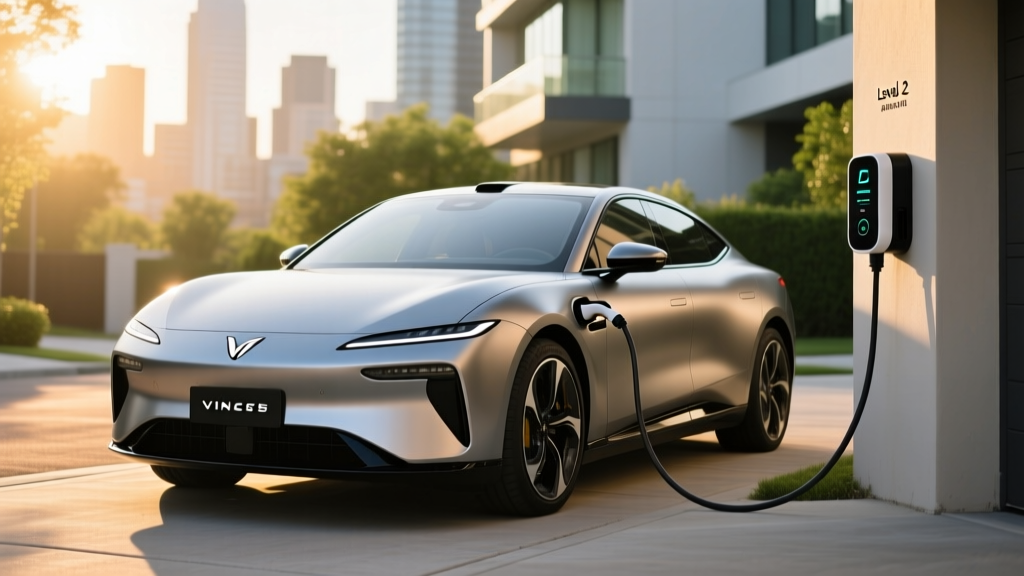
For home charging, the Sapphire accepts up to 19.2 kW on Level 2 (requiring a hardwired 100-amp circuit and a capable Level 2 EVSE like the ChargePoint Home Flex or Tesla Wall Connector). At 19.2 kW, you'll recover roughly 62 miles of range per hour, meaning a full overnight charge from 20% to 100% takes about 8-9 hours. Most buyers will install a 48-amp (11.5 kW) circuit, which charges at roughly 37 miles per hour — still sufficient for overnight replenishment given most daily driving needs.
The Sapphire's navigation system includes automatic battery preconditioning when a DC fast charger is set as your destination, warming the pack to optimal temperature for maximum charge acceptance. Always use this feature — skipping preconditioning can add 5-10 minutes to your charging session, especially in cold weather.
Performance: 1,234 HP and a Sub-2-Second 0-60
The tri-motor powertrain — one motor driving the front axle and two motors driving the rear — produces 1,234 horsepower and 1,430 lb-ft of torque. Lucid's claimed 0-60 mph time of 1.89 seconds places the Sapphire in hypercar territory, rivaling the Rimac Nevera and exceeding the Tesla Model S Plaid's 1.99-second claim (with rollout subtracted).
Beyond straight-line speed, the Sapphire distinguishes itself with a track-focused chassis: adaptive dampers, stiffer anti-roll bars, a rear-axle torque-vectoring system, and carbon-ceramic brakes (10-piston front calipers). The 20-inch front / 21-inch rear wheels wear Michelin Pilot Sport 4S tires specifically developed for the Sapphire's weight and torque characteristics.
Drive modes include Smooth, Swift, Sprint, and a dedicated Sapphire mode that unlocks full power and the most aggressive suspension mapping. In daily driving, Smooth mode softens the ride enough for comfortable commuting — a duality the Model S Plaid struggles to replicate at low speeds.
Interior, Tech & Daily Livability
The Sapphire's cabin is finished in Alcantara and carbon fiber with blue contrast stitching and Sapphire-specific badging. The 34-inch curved glass cockpit display dominates the dash, running Lucid's native operating system with wireless Apple CarPlay and Android Auto. A secondary lower touchscreen handles climate, media, and vehicle settings.
DreamDrive Pro, Lucid's ADAS suite, provides adaptive cruise control, lane centering, automatic emergency braking, and blind-spot monitoring. This is an SAE Level 2 driver-assistance system — the driver must remain fully engaged with hands on the wheel and eyes on the road. It is not autonomous driving.
Practicality is where the Air platform shines versus two-door supercars. The Sapphire offers:
- Trunk: 22.1 cu ft (rear cargo)
- Frunk: 10.0 cu ft (front trunk)
- Total cargo: 32.1 cu ft
- Rear legroom: 36.6 inches
- Front headroom: 39.3 inches
- Seating: 5 passengers
That cargo volume exceeds the Tesla Model S (28 cu ft combined) and dwarfs the Porsche Taycan (14.3 cu ft rear + 2.9 cu ft frunk). For a performance sedan, the Air Sapphire is genuinely usable as a daily driver.
Notable drawbacks: The rear visibility is compromised by the sloping roofline and thick C-pillars. The infotainment system, while visually impressive, has drawn owner criticism for laggy response times and a lack of physical knobs for volume/climate. The lower touchscreen's haptic feedback is imprecise while driving. And at $249,000, the Sapphire carries significant depreciation risk as a low-volume halo car.
Pricing, Tax Credits & Ownership Costs
| Item | Amount |
|---|---|
| Base MSRP (Sapphire trim only) | $249,000 |
| Destination Charge | $1,500 |
| As-Tested Price | $250,500 (no options; single configuration) |
| Federal §30D Tax Credit | $0 — Not eligible |
| Estimated Annual Insurance | $4,500-$6,500 |
| Estimated Annual Electricity (12,000 mi) | $470-$700 |
The IRS §30D clean vehicle credit offers up to $7,500 for qualifying new EVs. The Air Sapphire is ineligible for multiple reasons:
- MSRP Cap: §30D limits eligibility to sedars priced at or below $55,000. At $249,000, the Sapphire exceeds this by nearly 5x. (Source: IRS.gov §30D guidelines)
- Income Cap: Buyer AGI must not exceed $300K (married filing jointly), $225K (head of household), or $150K (single). Many Sapphire buyers may clear these thresholds.
- Battery Sourcing: Critical minerals and battery component sourcing requirements further restrict eligible vehicles regardless of price.
Ownership costs extend beyond the purchase. Insurance for a 1,234-hp, $250K vehicle runs $4,500-$6,500 annually depending on your profile and state. Electricity costs are the Sapphire's bright spot: at 26 kWh/100 mi and a national average of $0.16/kWh, fueling costs roughly $500-$700 per year for 12,000 miles of driving — compared to $2,000-$3,000+ for a comparable gasoline performance sedan.
The battery and powertrain carry an 8-year/100,000-mile warranty with a capacity retention threshold (typically 70% minimum state of health). Lucid's bumper-to-bumper warranty covers 4 years/50,000 miles. Given the Sapphire's low production volume, long-term reliability data remains limited — early Air owners have reported software glitches and build-quality inconsistencies that Lucid has addressed through service campaigns.
Air Sapphire vs. the Competition
| Spec | Lucid Air Sapphire | Tesla Model S Plaid | Porsche Taycan Turbo GT |
|---|---|---|---|
| Base MSRP | $249,000 | $89,990 | $230,700 |
| EPA Range | 427 mi | 396 mi | 269 mi |
| Horsepower | 1,234 hp | 1,020 hp | 1,019 hp |
| 0-60 mph | 1.89 sec | 1.99 sec | 2.1 sec |
| Max DC Charge | 300 kW | 250 kW | 320 kW |
| 10-80% Charge | ~25 min | ~27 min | ~18 min |
| Cargo (total) | 32.1 cu ft | 28.0 cu ft | 17.2 cu ft |
| Federal Tax Credit | No | No (MSRP cap) | No |
- You want the longest-range performance sedan available (427 EPA miles)
- Daily-driver comfort and cargo practicality matter alongside track capability
- You value exclusivity and low production volume
- Budget is not a primary constraint
- You want 90% of the performance at one-third the price ($89,990)
- Supercharger network access is a priority for road trips
- Over-the-air updates and software ecosystem matter to you
- Track handling precision and braking performance are top priorities
- You prefer Porsche's build quality and dealer service network
- Range is secondary (269 EPA miles)
Who Should Buy the 2024 Lucid Air Sapphire?
The Sapphire is best suited for high-net-worth enthusiasts who want a single vehicle that serves as a daily commuter, a road-trip companion (thanks to 427-mile range), and a weekend track weapon. It's a compelling alternative for buyers who find the Model S Plaid too common and the Taycan Turbo GT too range-limited.
It is not the right choice for buyers seeking value (the Air Grand Touring delivers 516 miles of range for $138,000 less), for those who need reliable long-term resale value data, or for anyone counting on federal or state EV incentives to offset the purchase price.
Frequently Asked Questions
What is the real-world range of the 2024 Lucid Air Sapphire?
The EPA rates the Sapphire at 427 miles. In real-world mixed driving, expect approximately 380-410 miles. Sustained highway driving at 75-80 mph reduces this to roughly 330-360 miles. In freezing temperatures, range can drop to 280-320 miles depending on cabin heating use and driving style.
How fast does the Air Sapphire charge at home and on the road?
On a 300 kW DC fast charger, the Sapphire charges from 10-80% in approximately 25 minutes, adding up to 200 miles in about 15 minutes at peak rate. At home on a 19.2 kW Level 2 charger, it adds roughly 62 miles of range per hour. Most home installations use a 48-amp (11.5 kW) circuit, yielding about 37 miles per hour of charging.
Does the 2024 Lucid Air Sapphire qualify for the federal EV tax credit?
No. The IRS §30D credit caps eligible sedans at $55,000 MSRP. At $249,000, the Sapphire is far above this threshold. Additionally, buyer income caps and battery-sourcing requirements further restrict eligibility. No Lucid Air variant currently qualifies. See IRS guidelines for full rules.
Is the Air Sapphire worth buying over the Tesla Model S Plaid?
If your priority is maximum range (427 vs. 396 miles), exclusivity, and a more refined ride in daily driving, the Sapphire justifies its premium. If value, Supercharger access, and software updates matter more, the Model S Plaid at $89,990 offers extraordinary performance per dollar. The Sapphire costs nearly 3x more for roughly 20% more horsepower and 8% more range.
What are the biggest pros and cons of the Air Sapphire?
Pros: Class-leading range for a performance EV, sub-2-second 0-60, exceptional daily-driver comfort, spacious interior and cargo, 900V architecture efficiency.
Cons: $249,000 price with no tax credit, limited service center network, unproven long-term reliability, infotainment responsiveness issues, significant depreciation risk, no physical climate/volume controls.
What connector does the Air Sapphire use for charging?
The 2024 Sapphire uses a CCS1 (Combined Charging System) connector for DC fast charging and a J1772 inlet for Level 2 AC charging. Lucid provides a NACS adapter for access to Tesla Supercharger stations, expanding the available charging network significantly.