Quick Verdict: The Sapphire Is a Hypercar in Executive Sedan Clothing
The Lucid Air Sapphire occupies a singular niche: a four-door, 1,234-horsepower tri-motor electric sedan that can dispatch the quarter-mile in under 9 seconds, then ferry four adults across three state lines on a single charge. But for a vehicle starting above $250,000, the Lucid Air Sapphire interior and ownership experience must justify the price as convincingly as the stopwatch numbers. This review dissects what it is actually like to live with Lucid's flagship — from real-world range and charging behavior to the cabin materials, tech stack, and the cold arithmetic of federal tax-credit eligibility.
| Spec | Value |
|---|---|
| EPA Range | 427 miles |
| Battery (usable) | 118 kWh, NMC lithium-ion |
| Drivetrain | Tri-motor AWD (1 front, 2 rear) |
| Horsepower | 1,234 hp |
| 0-60 mph | 1.89 seconds |
| Top Speed | 205 mph |
| Max DC Fast Charge | 300 kW (peak) |
| 10-80% DCFC Time | ~25 minutes |
| Level 2 Home Charging | 19.2 kW / ~82 mi/hr |
| EPA Efficiency | 131 MPGe / 26 kWh/100 mi |
| Cargo (trunk + frunk) | 32 cu ft total |
| Rear Legroom | 36.6 inches |
| Battery Warranty | 8 years / 100,000 miles |
| Base MSRP | $250,500 (incl. destination) |
Real-World Range: 427 Miles on Paper, What You Actually Get
The EPA pegs the Air Sapphire at 427 miles — a figure made possible by Lucid's class-leading powertrain efficiency and the 118 kWh (usable) NMC battery pack. But as with every EV, the sticker is a ceiling, not a guarantee.
- EPA combined: 427 miles
- Highway (70-75 mph, mild weather): ~340-370 miles
- City / mixed suburban: ~390-420 miles (regen-heavy routes approach EPA)
- Cold weather (below 32°F, highway): ~280-320 miles
- Track / aggressive driving: 150-200 miles (1,234 hp is thirsty)
Lucid's heat pump and sophisticated thermal management mitigate cold-weather losses better than most competitors, but a 118 kWh NMC pack still loses roughly 20-30% range in sustained sub-freezing temperatures. On a 75 mph interstate run in January from Chicago to Indianapolis, expect to arrive with roughly 30% State of Charge remaining from a full start — comfortable, but not the 427-mile fantasy.
Efficiency is the Sapphire's quiet superpower. At 26 kWh per 100 miles (131 MPGe combined per fueleconomy.gov), it sips electrons more frugally than a Tesla Model S Plaid (28 kWh/100 mi) and dramatically outperforms the Porsche Taycan Turbo GT (~35-40 kWh/100 mi depending on spec). That efficiency translates directly to fewer charging stops on road trips.
Charging Speed: 300 kW Peak, But Read the Fine Print on the Curve
The Air Sapphire supports up to 300 kW peak DC fast charging via its CCS1 connector (with NACS adapter now included for Tesla Supercharger access). Lucid's 900V+ electrical architecture is the enabler — higher voltage means lower current for the same power, reducing heat and allowing faster sustained charging.
| Charging Level | Power / Voltage | Miles Added per Hour | Notes |
|---|---|---|---|
| Level 1 (120V outlet) | ~1.4 kW | ~4-5 mi/hr | Emergency / trickle only |
| Level 2 (240V, 19.2 kW) | 19.2 kW | ~82 mi/hr | Full charge in ~13 hours |
| Level 2 (240V, 48A / 11.5 kW) | 11.5 kW | ~49 mi/hr | Common home Wall Connector |
| DC Fast Charge (peak) | 300 kW | ~700+ mi/hr (at peak) | Only at 350 kW+ stations |
| DC Fast Charge (typical 150 kW) | 150 kW | ~350 mi/hr | Most Electrify America / EVgo stalls |
The 10-80% claim is approximately 25 minutes on a capable 350 kW charger. However, charging curves matter more than peak numbers. The Sapphire's NMC pack pulls peak power in a narrow window roughly between 10-35% State of Charge, then tapers progressively. From 60-80%, you are typically seeing 100-130 kW — still respectable, but far from the 300 kW headline. On a road trip, the practical move is to charge to 70-75% and drive on rather than wait for the taper zone.
For home charging, Lucid includes a mobile cord, but most Sapphire buyers will install a hardwired Level 2 station. To exploit the car's 19.2 kW onboard charger, you need a 100-amp dedicated circuit — which often requires a panel upgrade in older homes. Budget $1,200-$3,000 for a quality Level 2 installation including electrician labor, permit, and a ChargePoint Home Flex or Wallbox Pulsar Max unit.
The Lucid Air Sapphire Interior: Materials, Space, and Screen Real Estate
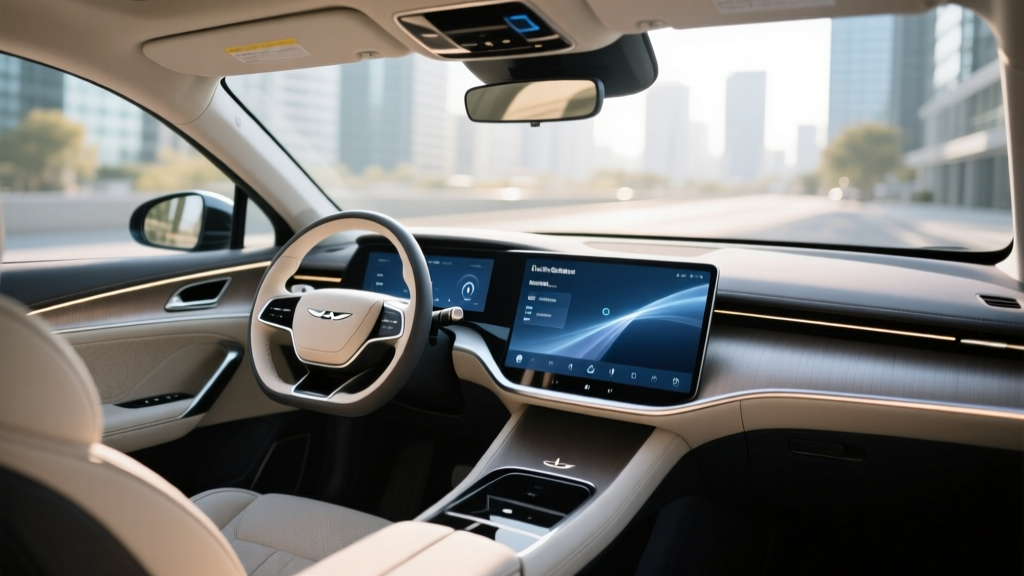
The keyword that brought you here deserves its own deep section. The Lucid Air Sapphire interior diverges from the standard Air lineup with Alcantara headliner, Sapphire-specific blue contrast stitching, carbon-fiber trim accents, and heavily bolstered sport seats with a unique diamond-quilted pattern. The 21-spoke Revel audio system with Dolby Atmos is standard, as is the full glass canopy roof that floods the cabin with light — though it lacks a physical shade, relying on electrochromic dimming instead.
The centerpiece is the 34-inch curved Glass Cockpit display floating above the dash, supplemented by a lower 17-inch retractable touchscreen for climate, media, and vehicle settings. The UI is Lucid's proprietary system — responsive, visually clean, but with a smaller third-party app ecosystem than Tesla's. Wireless Apple CarPlay and Android Auto are standard, which largely resolves that gap for most users.
Space is genuinely impressive for a performance sedan. Rear legroom measures 36.6 inches — more than a BMW M5 or Mercedes-AMG GT 4-Door — and the flat floor (no transmission tunnel) makes the middle seat usable for short trips. Cargo volume totals roughly 32 cubic feet split between the trunk (22 cu ft) and a front trunk (10 cu ft), enough for four carry-ons plus weekend bags. Headroom is generous front and rear thanks to the sedan's tall roofline, though the sloping rear glass does cut into taller passengers' space slightly.
Notable interior drawbacks: the steering wheel controls use haptic-touch surfaces that some drivers find imprecise compared to physical buttons. The lower retractable screen can produce glare in direct sunlight. And while material quality is excellent, the cabin lacks the handcrafted, bespoke character of a Bentley Flying Spur or even a high-spec Porsche Taycan — the Sapphire reads as premium-tech rather than old-world luxury.
Performance: 1.89 Seconds to 60, and What That Feels Like
The numbers are absurd on paper — 1,234 horsepower, 1,430 lb-ft of torque, 1.89 seconds 0-60 mph — but the sensation of deploying them is what lingers. The tri-motor AWD system (one front motor, two rear) manages torque vectoring across the rear axle, giving the Sapphire a playful, adjustable character under hard cornering that single-motor-per-axle EVs cannot match. The carbon-ceramic brakes (standard) provide repeated 130-0 mph stops without fade, a necessity given the mass (~5,200 lbs curb weight).
Drive modes include Smooth, Swift, Sprint, and a dedicated Sapphire track mode that unlocks full power and adjusts suspension damping, steering weight, and stability control thresholds. The adaptive air suspension lowers the car by roughly an inch in Sprint mode, reducing drag and sharpening handling. Ride quality in Smooth mode is compliant enough for daily commuting — a duality few hyper-sedans achieve.
For comparison, the Tesla Model S Plaid hits 60 in 1.99 seconds at roughly $90,000 less, and the Porsche Taycan Turbo GT (with Weissach package) manages 2.1 seconds. The Sapphire is the quickest, but it is also the most expensive by a wide margin — you are paying for exclusivity and engineering theater as much as the tenth-of-a-second advantage.
Pricing, Tax Credits, and Total Cost Reality
The 2026 Lucid Air Sapphire carries a base MSRP of $250,500 including destination. As-tested examples with Sapphire-specific paint ($3,000-$5,000), Surreal Black trim, and Lucid's DreamDrive Pro ADAS package can push to $260,000+ before delivery.
| Item | Amount |
|---|---|
| Base MSRP (incl. destination) | $250,500 |
| Typical as-tested (w/ options) | $258,000 - $262,000 |
| Federal §30D Tax Credit | $0 — exceeds MSRP cap |
| IRS §30D Sedan MSRP Cap | $55,000 |
| Buyer MAGI Cap (Married Filing Jointly) | $300,000 |
| Estimated Annual Insurance | $5,500 - $8,000 |
| 5-Year Electricity Cost (15k mi/yr) | ~$7,800 (at $0.15/kWh national avg) |
The federal tax credit situation is straightforward: the Sapphire does not qualify. Under current IRS §30D rules (irs.gov), new EVs classified as sedans must have an MSRP at or below $55,000 to be eligible for the up-to-$7,500 credit. At $250,500, the Sapphire misses that cap by a factor of nearly five. Buyer income limits ($300,000 MAGI for married filing jointly) and battery-sourcing/critical-mineral requirements are moot here — the price alone disqualifies it. State-level incentives (California's CVRP, for example) also typically have MSRP caps well below the Sapphire's price. Consult a tax professional for your specific situation, but assume no federal or state purchase incentives apply.
Warranty, Ownership Costs, and Long-Term Battery Outlook
Lucid covers the Air Sapphire with a 4-year/50,000-mile limited vehicle warranty and an 8-year/100,000-mile battery and powertrain warranty — standard for the luxury EV segment and matching Tesla's coverage. The battery warranty guarantees a minimum 70% capacity retention over that period. Lucid's NMC pack has shown encouraging degradation data in early Air models: owners report roughly 3-5% capacity loss in the first 30,000 miles, with the curve flattening significantly afterward. Projecting to 150,000 miles, a 10-15% total loss is plausible — meaning the Sapphire would still deliver ~365-385 EPA miles at that mileage.
Insurance is a genuine cost factor. The Sapphire's combination of high value, extreme performance, and limited repair-network data pushes premiums to $5,500-$8,000 annually depending on driver profile, state, and garage location. That is roughly 2-3x a Model S Plaid and 4-5x an average sedan. Get quotes before ordering — this is not a rounding error on a $250K car.
Maintenance costs are low relative to ICE hyper-sedans (no oil, no transmission fluid, minimal brake wear thanks to regen), but tires are expensive. The Sapphire's staggered Michelin Pilot Sport 4S setup (265 front / 295 rear, 20-inch) runs $1,800-$2,400 per set and will need replacement every 15,000-25,000 miles under normal use — less if you actually explore the 1,234 hp regularly.
DreamDrive Pro ADAS: Level 2, Not Self-Driving
Lucid's DreamDrive Pro is a Level 2 driver-assistance system. It combines adaptive cruise control, lane-centering, and automated lane changes on highways — but the driver must remain engaged, hands on or near the wheel, and eyes on the road at all times. This is not autonomous driving. Only Level 4 services like Waymo operate without a human driver in defined geofenced areas.
DreamDrive Pro uses a sensor suite of cameras, radar, and LiDAR (a roof-mounted unit) to deliver highway assist, traffic-jag assist, and parking automation. In practice, it is competent and smooth in lane-keeping, but it lacks the hands-free capability of GM's Super Cruise or Ford's BlueCruise on mapped highways. Lucid has signaled future over-the-air updates for expanded functionality, but as of 2026, plan on active supervision at all times. For a car in this price bracket, the absence of a true hands-free highway mode is a competitive gap versus Cadillac and BMW's latest offerings.
Who Should Buy the Lucid Air Sapphire — and Who Shouldn't
- Fastest production sedan ever measured (1.89s 0-60)
- 427-mile EPA range — class-leading for a performance EV
- 131 MPGe efficiency is remarkable for 1,234 hp
- Genuine four-adult interior space with 32 cu ft cargo
- 900V architecture enables 300 kW peak charging
- Carbon-ceramic brakes and torque-vectoring rear axle
- Exclusivity — fewer than 500 expected to be built
- $250,500+ with zero federal or state tax credit eligibility
- Insurance premiums of $5,500-$8,000/year
- Charging taper above 60% SoC slows road-trip top-ups
- DreamDrive Pro lacks hands-free highway mode
- Limited Lucid service-center footprint vs. Tesla/Porsche
- Interior reads premium-tech, not bespoke luxury
- Depreciation on a $250K low-volume EV is uncertain and likely steep
- Choose the Sapphire if: You want the fastest sedan ever built, value 400+ mile range, and the $250K price is discretionary spending — not a stretched budget.
- Choose the Tesla Model S Plaid if: You want 95% of the performance for $90K less, access to the Supercharger network natively, and a more mature service infrastructure.
- Choose the Porsche Taycan Turbo GT if: Driving dynamics, brand heritage, and dealer-service experience matter more than straight-line acceleration and maximum range.
- Choose the Lucid Air Grand Touring if: You want the 516-mile range, the same elegant interior architecture, and a $130,000 price that still disqualifies from tax credits but leaves room in the budget for a second vehicle.
Frequently Asked Questions
What is the real-world range of the Lucid Air Sapphire?
The EPA rates it at 427 miles combined. In real-world highway driving at 70-75 mph in mild weather, expect 340-370 miles. In cold weather (below freezing), plan on 280-320 miles. City driving with heavy regenerative braking can approach the EPA figure.
How fast does the Lucid Air Sapphire charge at home and on the road?
On a 350 kW-capable DC fast charger, it peaks at 300 kW and reaches 10-80% in approximately 25 minutes, though the charge curve tapers significantly above 60% SoC. At home on a 19.2 kW Level 2 station, it adds roughly 82 miles per hour, completing a full charge in about 13 hours.
Does the Lucid Air Sapphire qualify for the federal EV tax credit?
No. Under IRS §30D rules, sedans must have an MSRP at or below $55,000 to qualify. At $250,500, the Sapphire is ineligible regardless of buyer income or battery sourcing. State incentives typically also have MSRP caps it exceeds. Always verify current rules at irs.gov and consult a tax professional.
Is the Lucid Air Sapphire interior worth the premium over the Air Grand Touring?
That depends on what you value. The Sapphire adds Alcantara headliner, sport seats with diamond quilting, carbon-fiber trim, and unique blue accents. But the fundamental architecture — the 34-inch Glass Cockpit, 17-inch lower screen, glass roof, and rear-seat dimensions — is shared with the Grand Touring. You are paying primarily for the 1,234 hp powertrain, carbon-ceramic brakes, and exclusivity, not a fundamentally different cabin.
How does the Sapphire compare to the Tesla Model S Plaid?
The Sapphire is 0.1 seconds quicker to 60 mph, has significantly more range (427 vs. ~359 EPA miles), and is far more exclusive. The Plaid costs roughly $90,000 less, has access to the native Supercharger network, and offers a more mature software ecosystem. For pure value-to-performance, the Plaid wins. For exclusivity and range, the Sapphire takes it.
What is the battery warranty and expected degradation?
Lucid covers the battery for 8 years or 100,000 miles, guaranteeing at least 70% capacity retention. Early Air models show approximately 3-5% degradation in the first 30,000 miles with a flattening curve thereafter. A full battery replacement out of warranty would likely cost $25,000-$35,000 based on current NMC pack pricing, though this is speculative for a vehicle this new.
Can the Lucid Air Sapphire use Tesla Superchargers?
Yes, via the included NACS adapter. The Sapphire ships with CCS1 as its native connector but includes a NACS adapter enabling access to Tesla's Supercharger network. Charging speeds on Superchargers (typically 150-250 kW) will be lower than the Sapphire's 300 kW peak, but the network's reliability and coverage are significant road-trip advantages.