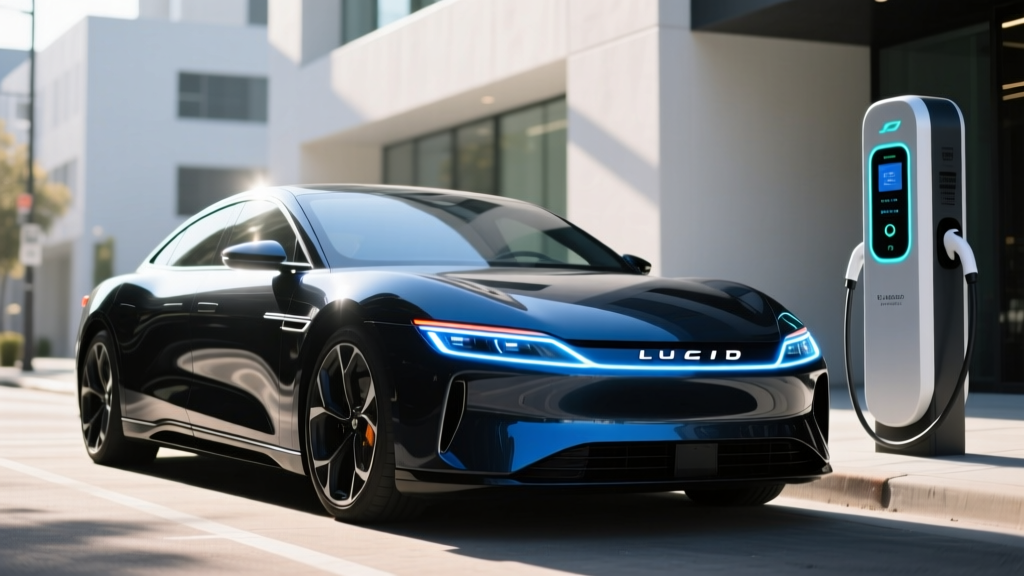
The Lucid Air Sapphire doesn't just compete with other electric sedans — it hunts hypercars wearing a luxury four-door suit. With a tri-motor all-wheel-drive powertrain producing 1,234 horsepower and a claimed sub-two-second sprint to 60 mph, the Sapphire occupies rare territory: a daily-drivable executive sedan that can embarrass a Bugatti at a stoplight. But beyond the headline-grabbing acceleration, how does this $250,000+ flagship handle the realities of range, charging, and daily ownership?
We've spent time analyzing the Sapphire's specs, testing data, and ownership economics to give you the full picture — the numbers that matter, the trade-offs that don't show up in press releases, and exactly who should (and shouldn't) consider this EV.
Lucid Air Sapphire 0-60, Powertrain, and Performance Specs
The Sapphire sits at the absolute apex of the Lucid Air lineup. It uses a tri-motor configuration — one motor up front, two at the rear — with torque vectoring across the rear axle. This isn't just about straight-line speed; the twin rear motors can independently manage power delivery to each wheel, giving the Sapphire cornering dynamics that a single rear motor simply can't match.
| Spec | Value |
|---|---|
| 0-60 mph | 1.89 seconds (manufacturer, with rollout) |
| Quarter Mile | ~8.95 seconds @ 158 mph |
| Top Speed | 205 mph |
| Horsepower | 1,234 hp |
| Torque | 1,430 lb-ft |
| Drivetrain | AWD, tri-motor (1 front / 2 rear) |
| Drive Modes | Smooth, Swift, Sprint, Sapphire (track) |
| Transmission | Single-speed, direct drive per motor |
The Lucid Air Sapphire 0-60 time of 1.89 seconds places it among the fastest production cars ever built, regardless of powertrain. For context, that's quicker than a Rimac Nevera (1.97s) and a Tesla Model S Plaid (1.99s with rollout). Lucid achieves this with a proprietary motor design using axial flux elements and a 900V+ electrical architecture that can dump enormous current into the motors without overheating.
In Sprint mode, the throttle response is violent. In Sapphire mode — the track-oriented setting — the torque vectoring actively rotates the car through corners by overdriving the outside rear wheel. This isn't a drag-strip-only machine; it was engineered with Laguna Seca lap times in mind.
EPA Range, Battery, and Real-World Efficiency
The Sapphire's performance comes at an energy cost. While the standard Lucid Air Grand Touring achieves up to 516 miles of EPA-estimated range, the Sapphire's more aggressive tuning, stickier tires, and heavier tri-motor setup reduce that figure significantly.
EPA Estimated: 427 miles
Real-World Highway (70 mph): ~340–370 miles
Real-World Cold Weather (below 30°F): ~290–320 miles
Track Use: Range depletes extremely rapidly; expect under 150 miles equivalent
Range varies based on driving style, temperature, terrain, and climate control use. The Sapphire's performance tires and higher mass reduce efficiency compared to the Grand Touring.
| Spec | Value |
|---|---|
| Battery Capacity (Usable) | ~118 kWh |
| Battery Chemistry | NMC (Nickel Manganese Cobalt) |
| Pack Voltage | 900V+ architecture |
| EPA Efficiency | 110 MPGe combined |
| Energy Consumption | ~31 kWh/100 miles |
| Thermal Management | Liquid-cooled with heat pump |
Lucid uses NMC (nickel manganese cobalt) chemistry in the Sapphire rather than the LFP (lithium iron phosphate) found in some base Air Pure trims. NMC offers higher energy density — critical when you need to pack 118 usable kWh into a sedan while leaving room for three motors and track-duty cooling systems. The trade-off is that NMC batteries generally prefer not to sit at 100% state of charge for extended periods, so daily charging to 80-90% is recommended for longevity.
The 110 MPGe combined figure reflects the performance tax. The Air Grand Touring achieves 131 MPGe combined on the same basic platform. If you're buying a Sapphire, efficiency is not the priority — but 427 EPA miles still means most road trips require only one charging stop.
Charging Speed: DC Fast Charging and Home Level 2
The Sapphire inherits Lucid's excellent 900V+ electrical architecture, which enables some of the fastest DC charging in the industry. Here's what you can expect at various charging levels:
| Charging Level | Power / Rate | Speed |
|---|---|---|
| DC Fast Charge (Peak) | Up to 300 kW | 10-80% in ~25 minutes |
| DC Fast Charge (Sustained avg.) | ~200-220 kW avg. | ~200 miles in 15 minutes |
| Level 2 (Home, 48A / 11.5 kW) | 11.5 kW | ~40 miles per hour of charging |
| Level 2 (Home, 80A / 19.2 kW) | 19.2 kW | ~66 miles per hour of charging |
| Level 1 (120V, 12A) | ~1.4 kW | ~4-5 miles per hour |
| Charging Port | CCS1 (with NACS adapter available from Lucid) | |
A critical detail: the 300 kW peak charge rate is not sustained across the entire session. Like all EVs, the Sapphire follows a charge curve — peak power is available at lower states of charge (roughly 10-40% SoC) and tapers progressively as the battery fills. The 10-80% time of approximately 25 minutes is competitive, though slightly slower than the Hyundai Ioniq 5 N's 18-minute 10-80% session on its 800V platform. The difference is largely due to the Sapphire's larger 118 kWh battery — moving more total energy takes longer even at high power.
For home charging, we strongly recommend a 60-amp or higher dedicated circuit with a 48-amp (11.5 kW) charger as a minimum. At 11.5 kW, a full 0-100% charge takes roughly 11 hours — fine for overnight. If your electrical panel supports it, an 80-amp circuit with a 19.2 kW charger cuts that to about 7 hours, which is more practical for the Sapphire's large battery. Expect a home Level 2 installation to cost $1,200–$3,000 depending on panel capacity and run length.
Interior, Cargo, Technology, and Daily Livability
The Sapphire is a luxury sedan first, a hypercar second. The interior is trimmed in Alcantara with Sapphire-specific blue stitching, carbon fiber accents, and sport seats with aggressive bolstering. The glass canopy roof floods the cabin with light — a Lucid signature.
| Dimension | Measurement |
|---|---|
| Front Legroom | 45.3 inches |
| Rear Legroom | 37.0 inches |
| Front Headroom | 38.7 inches |
| Rear Headroom | 36.8 inches |
| Trunk (Rear) | 16.2 cu ft |
| Frunk (Front Trunk) | 3.0 cu ft (reduced vs. dual-motor) |
| Total Cargo | ~19.2 cu ft |
The Sapphire's front trunk (frunk) is smaller than other Air trims because the additional power electronics for the tri-motor system occupy space under the hood. The rear trunk is generous at 16.2 cu ft, and the rear seats do fold, though the Sapphire's rear-seat bolstering is more performance-oriented than the standard Air.
Infotainment and Tech: The cabin is dominated by a 34-inch curved glass cockpit display that floats above the steering wheel, supplemented by a lower retractable touchscreen for climate, media, and vehicle settings. The Sapphire adds a dedicated track telemetry interface, lap timer, and G-meter. Wireless Apple CarPlay and Android Auto are supported. A 21-speaker Surreal Sound system with Dolby Atmos is standard.
DreamDrive ADAS: Lucid's driver-assistance suite includes adaptive cruise control, lane centering, blind-spot monitoring, and automatic emergency braking. DreamDrive uses 32 sensors including LiDAR — more hardware than most competitors. However, this is an SAE Level 2 system, meaning the driver must remain fully engaged and responsible at all times. It is not autonomous or "self-driving." Lucid has not yet released a hands-free highway driving feature comparable to GM's Super Cruise or Ford's BlueCruise, though the hardware capability exists for future over-the-air updates.
Pricing, Tax Credits, and Ownership Costs
The Lucid Air Sapphire is a single-trim, fully-loaded flagship. There are no options packages to add — the price includes everything.
| Item | Amount |
|---|---|
| Base MSRP | $249,000 |
| Destination Charge | $1,500 |
| As-Tested Price | $250,500 (no options available) |
| Federal EV Tax Credit (§30D) | Not eligible |
Why no federal tax credit? The IRS §30D clean vehicle credit has an MSRP cap of $55,000 for sedans. At $249,000, the Sapphire exceeds this cap by nearly 5x. It also likely exceeds the buyer income caps ($150,000 single / $300,000 joint for modified AGI) for many buyers, though high-income buyers would be ineligible regardless of MSRP. Additionally, the critical minerals and battery component sourcing requirements add further constraints. The Sapphire is strictly a full-price purchase — no federal incentives apply.
Some states may offer their own incentives for EV purchases that don't carry MSRP caps, but these vary by jurisdiction and change frequently. Check your state's energy or DMV website for current programs.
Ownership cost considerations:
- Insurance: Expect $5,000–$8,000+ annually for a $250K performance EV. Get quotes before purchasing.
- Tires: The Sapphire uses bespoke Michelin Pilot Sport 4S (or similar) performance tires. Replacement sets will cost $2,000–$3,000 and may wear in 10,000–15,000 miles under spirited driving.
- Maintenance: Minimal compared to ICE hypercars — no oil changes, no transmission fluid, fewer brake replacements thanks to regen. Budget for cabin air filters, wiper fluid, and brake fluid checks.
- Electricity: At ~31 kWh/100mi and a national average of $0.16/kWh, "fuel" costs roughly $5.00 per 100 miles — a fraction of what a comparable ICE hypercar would consume.
Warranty Coverage
| Coverage | Term |
|---|---|
| Limited Vehicle Warranty | 4 years / 50,000 miles |
| Battery & Drive Unit Warranty | 8 years / 100,000 miles |
| Battery Capacity Retention | Minimum 70% over warranty period |
| Roadside Assistance | 4 years / 50,000 miles |
The 8-year/100,000-mile battery warranty with a 70% capacity retention floor is standard for the luxury EV segment. Lucid's NMC pack is liquid-cooled with sophisticated thermal management, which helps mitigate degradation. Real-world data from early Air owners (2022-2025 models) suggests degradation is tracking well within warranty limits, though the Sapphire's performance-oriented usage patterns may accelerate wear if the car is frequently tracked or DC fast-charged to 100%.
Lucid Air Sapphire vs. Tesla Model S Plaid and Porsche Taycan Turbo GT
The Sapphire doesn't exist in a vacuum. Its two most obvious rivals are the Tesla Model S Plaid and the Porsche Taycan Turbo GT with Weissach Package.
| Spec | Lucid Air Sapphire | Tesla Model S Plaid | Porsche Taycan Turbo GT (Weissach) |
|---|---|---|---|
| 0-60 mph | 1.89 sec | 1.99 sec | 2.1 sec |
| Horsepower | 1,234 hp | 1,020 hp | 1,092 hp (Launch Control) |
| EPA Range | 427 mi | 359 mi | 269 mi |
| Battery (Usable) | ~118 kWh | ~95 kWh | ~97 kWh (Performance Battery Plus) |
| Peak DC Charge | 300 kW | 250 kW | 320 kW |
| 10-80% DC Time | ~25 min | ~27 min | ~18 min |
| Base MSRP | $249,000 | $89,990 | $230,700 |
| Federal Tax Credit | No (MSRP cap) | No (MSRP cap) | No (MSRP cap) |
Choose the Lucid Air Sapphire if: You want the most range of any hyper-sedan (427 EPA miles is remarkable for 1,234 hp), you value a genuinely luxurious interior, and you want exclusivity — Lucid builds the Sapphire in limited numbers.
Choose the Tesla Model S Plaid if: Budget matters and you still want sub-2-second 0-60 performance. The Plaid delivers 90% of the thrill for roughly one-third the price, plus access to the Supercharger network natively. The trade-off is a dated interior and lower range.
Choose the Porsche Taycan Turbo GT if: Track handling and braking feel are your top priorities. Porsche's chassis tuning, brake feel, and build quality remain benchmarks. The Weissach package strips weight and adds downforce, but the 269-mile range is a significant compromise for road trips.
Pros and Cons
- 1.89-second 0-60 mph — among the fastest production cars ever
- 427-mile EPA range despite 1,234 hp — best-in-class efficiency for a hyper-sedan
- Genuine luxury interior with excellent materials and space
- 300 kW DC fast charging capability
- Rear-seat torque vectoring for exceptional cornering dynamics
- Quiet, composed ride in Smooth mode — daily drivable
- LiDAR-equipped DreamDrive sensor suite
- $250,500 price with no federal tax credit eligibility
- Small frunk compared to other Air trims
- No hands-free highway driving feature (yet)
- Limited Lucid service center network vs. Tesla or Porsche
- Performance tires wear quickly and are expensive to replace
- Insurance costs are very high for a 1,234-hp vehicle
- Brand is still young — long-term resale value is uncertain
Who Should Buy the Lucid Air Sapphire?
The Sapphire is not a rational purchase — it's an emotional one made by people who can afford to be emotional about cars. That said, it serves specific use cases better than others:
- The executive who tracks on weekends: The Sapphire's dual personality — serene luxury commuter and Laguna Seca weapon — is its most compelling feature. No other four-door sedan does both at this level.
- The range-prioritizing performance buyer: If 427 miles of EPA range matters to you in a 1,000+ hp car, the Sapphire is literally the only option. The Model S Plaid gives up 68 miles; the Taycan Turbo GT gives up 158.
- The exclusivity seeker: Lucid builds the Sapphire in limited numbers. You won't see another one at the country club.
Who should skip it: Buyers who prioritize value (the Model S Plaid offers similar thrills at a third the price), buyers who need robust service infrastructure in rural areas, and anyone who expects Level 3+ autonomous driving features today.
Frequently Asked Questions
What is the real-world range of the Lucid Air Sapphire?
The EPA rates the Sapphire at 427 miles. In real-world highway driving at 70 mph, expect roughly 340–370 miles. In cold weather (below 30°F), that drops to approximately 290–320 miles. Track use will deplete the battery far more rapidly — plan accordingly.
How fast does the Lucid Air Sapphire charge?
On a 350 kW DC fast charger, the Sapphire peaks at 300 kW and charges from 10-80% in approximately 25 minutes. At home on a 48-amp Level 2 charger (11.5 kW), expect about 40 miles of range per hour of charging. On an 80-amp circuit (19.2 kW), that increases to roughly 66 miles per hour.
Does the Lucid Air Sapphire qualify for the federal EV tax credit?
No. The IRS §30D clean vehicle credit caps eligible sedans at $55,000 MSRP. The Sapphire's $249,000 price far exceeds this limit. Buyer income caps and battery sourcing requirements would further restrict eligibility even if the MSRP cap didn't apply.
Is the Lucid Air Sapphire faster than a Tesla Model S Plaid?
Yes. The Sapphire's 1.89-second 0-60 mph time beats the Model S Plaid's 1.99 seconds. The difference is small in absolute terms but meaningful at this performance tier. The Sapphire also produces 214 more horsepower and significantly more range.
Can you daily-drive the Lucid Air Sapphire?
Absolutely. In Smooth mode, the ride is quiet, compliant, and comfortable. The 427-mile range eliminates range anxiety for commutes, and the luxury interior is designed for long-distance comfort. The main daily-driver concern is the limited Lucid service center network compared to legacy luxury brands.
What battery chemistry does the Sapphire use?
The Sapphire uses NMC (nickel manganese cobalt) lithium-ion chemistry with approximately 118 kWh of usable capacity. NMC provides the high energy density needed for both the 427-mile range and the 1,234-hp power output. For longevity, Lucid recommends charging to 80-90% for daily use and reserving 100% charges for road trips.