From Atieva to Lucid: A Brief History
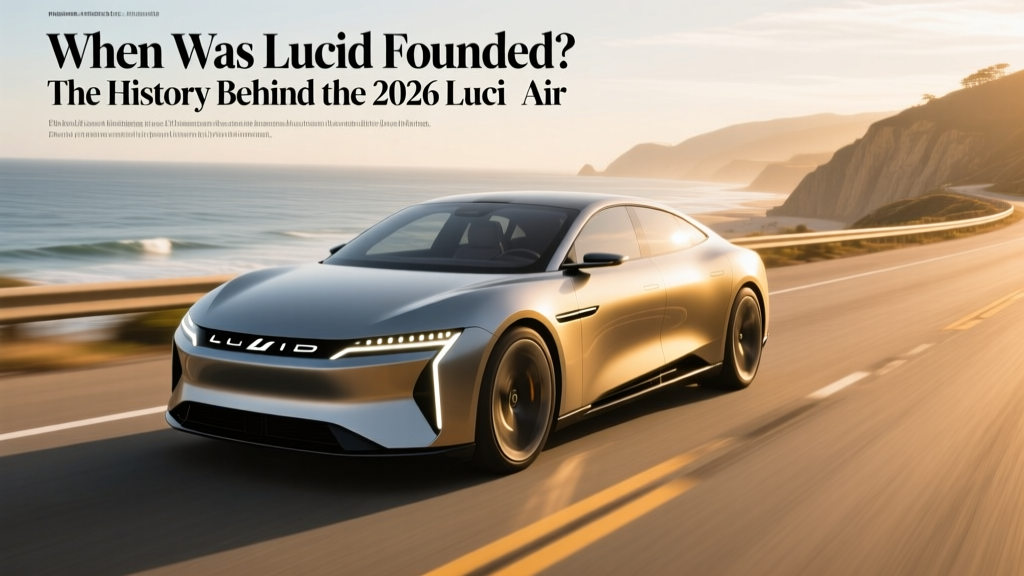
If you've ever typed "when was Lucid founded" into a search bar, you're not alone. Lucid Motors traces its origins to 2007, when it was established under the name Atieva by Bernard Tse, Sheaupyng Lin, and Sam Weng. Initially, the company focused on developing advanced battery packs and powertrain components for other automakers — essentially operating as a technology supplier rather than a vehicle manufacturer.
In 2016, Atieva rebranded as Lucid Motors and pivoted toward building its own luxury electric sedan. Peter Rawlinson, who previously served as chief engineer on the Tesla Model S, joined as CTO and later became CEO, steering Lucid toward the ultra-efficient, range-leading vehicles the brand is known for today. The company's purpose-built factory in Casa Grande, Arizona — dubbed AMP-1 — began production in late 2021, with the Lucid Air as its debut vehicle.
By 2026, Lucid has expanded its lineup to include the Air sedan in multiple trims and the Gravity SUV, while continuing to supply battery technology through partnerships including Aston Martin. Let's break down what the current Lucid Air delivers for buyers today.
2026 Lucid Air: Range, Efficiency, and Real-World Expectations
The Lucid Air's defining achievement remains its efficiency. The Air Pure RWD, equipped with an 88 kWh usable battery pack (NMC lithium-ion chemistry), achieves an EPA-estimated 419 miles of range — among the highest of any production EV sold in the U.S. The Air Grand Touring, with a larger 112 kWh pack, pushes that figure to an EPA-estimated 512 miles.
EPA estimates assume a mix of city and highway driving at moderate temperatures. In real-world highway testing at 70-75 mph, expect the Air Pure RWD to deliver approximately 350–375 miles, while the Grand Touring yields roughly 430–460 miles. Cold-weather driving (below 30°F) can reduce range by 15–25%, depending on cabin heating demands and whether you precondition the battery. The Air's standard heat pump helps mitigate this loss compared to resistive heating systems.
Efficiency numbers back up the range claims. The Air Pure RWD achieves an EPA-rated 146 MPGe combined (approximately 23 kWh/100 mi), while the dual-motor Grand Touring posts 131 MPGe combined (~26 kWh/100 mi). These figures make the Air one of the most energy-efficient luxury sedans on the market, extracting more miles per kilowatt-hour than competitors like the Mercedes EQS or BMW i7.
Charging Speed: DC Fast Charging and Home Level 2
Lucid equips the Air with a 900V+ electrical architecture, enabling exceptionally fast DC charging. The Air Grand Touring can accept a peak charge rate of 300 kW at a compatible DC fast charger, adding up to 200 miles of range in approximately 12 minutes under ideal conditions. A 10–80% charge takes roughly 20–25 minutes depending on ambient temperature and station output.
| Charging Level | Power (kW) | Speed / Notes |
|---|---|---|
| Level 1 (120V household) | ~1.4 kW | ~4–5 miles per hour |
| Level 2 (240V home, 48A) | 11.5 kW | ~38–42 miles per hour; full charge overnight |
| DC Fast Charge (Peak) | Up to 300 kW | 10–80% in ~20–25 min (Grand Touring); Pure peaks at ~220 kW |
At home on a Level 2 charger wired to a 60-amp circuit (48-amp continuous), the Air replenishes at approximately 11.5 kW, adding roughly 40 miles of range per hour of charging. A full charge from 10% to 100% takes about 10–12 hours — easily achievable overnight.
The Air uses the NACS (Tesla-style) connector for DC fast charging as of the 2025 model year, granting access to Tesla Supercharger stations via native compatibility. For older CCS-equipped chargers, Lucid provides a NACS-to-CCS adapter. This dual-network access significantly expands the Air's road-trip practicality.
Performance and Drivetrain
The Lucid Air lineup spans efficient single-motor and high-performance dual-motor configurations:
| Trim | Drivetrain | Horsepower | 0–60 mph | EPA Range |
|---|---|---|---|---|
| Air Pure | RWD (single motor) | 430 hp | 4.0 sec | 419 mi |
| Air Touring | AWD (dual motor) | 620 hp | 3.4 sec | 406 mi |
| Air Grand Touring | AWD (dual motor) | 1,050 hp | 3.0 sec | 512 mi |
| Air Sapphire | AWD (tri-motor) | 1,234 hp | 1.89 sec | 427 mi |
The Air Sapphire, with its tri-motor setup, is one of the quickest production sedans ever built, rivaling hypercars in straight-line acceleration. Even the base Pure's 430 hp and 4.0-second sprint to 60 mph outpace most gas-powered luxury sedans. All trims feature adaptive air suspension and torque-vectoring capabilities that translate the Air's low center of gravity into composed handling.
Pricing, Trims, and Federal Tax Credit Eligibility
Lucid positions the Air as a premium luxury sedan, with pricing reflecting that positioning. As of the 2026 model year:
| Trim | Base MSRP | §30D Federal Credit Eligibility |
|---|---|---|
| Air Pure | $69,900 | Potentially eligible (MSRP under $55,000 sedan cap does NOT apply — sedan cap is $55,000; Air Pure MSRP exceeds cap) |
| Air Touring | $87,400 | Not eligible (exceeds $55,000 sedan MSRP cap) |
| Air Grand Touring | $125,600 | Not eligible |
| Air Sapphire | $249,000 | Not eligible |
Critical tax credit note: Under IRS §30D rules, new clean vehicle credits are capped at $55,000 MSRP for sedans. Because every Lucid Air trim exceeds this threshold, the Air does not qualify for the up-to-$7,500 federal purchase credit. However, buyers who lease a Lucid Air may benefit from the commercial clean vehicle credit (§45W), which some lessors pass through as a reduced lease payment — check with your dealer and a tax professional for specifics.
Additionally, §30D has buyer income caps ($150,000 single / $300,000 joint for new vehicles) and battery critical-mineral sourcing requirements that further limit eligibility even for qualifying vehicles. Always consult irs.gov or a tax advisor before relying on credit assumptions.
Interior Space, Cargo, and Technology
The Air's cabin prioritizes openness, aided by a curved 34-inch glass canopy display (dubbed the "Glass Cockpit") that spans the dashboard. A retractable lower touchscreen handles secondary controls, navigation input, and media.
Passenger space: The Air offers 41.1 inches of front legroom and 38.9 inches of rear legroom — competitive with the Mercedes S-Class and exceeding the Tesla Model S. The flat floor (no transmission tunnel) makes the rear middle seat genuinely usable for adults on shorter trips.
Cargo: The trunk provides 22.1 cubic feet of space, supplemented by a 7.1 cu-ft front trunk (frunk). Total storage exceeds most luxury sedans, and the trunk opening is wide enough for golf bags or luggage for four on a week-long trip.
Driver assistance: Lucid's DreamDrive Pro system includes adaptive cruise control, lane-centering, automatic emergency braking, and a 3D sensor array with LiDAR on upper trims. This is a SAE Level 2 system — the driver must remain fully engaged and hands-on or eyes-on at all times. It is not autonomous driving.
Warranty and Ownership Considerations
Lucid backs the Air with a competitive warranty package:
- Basic vehicle warranty: 4 years / 50,000 miles
- Battery and powertrain warranty: 8 years / 100,000 miles (covers battery capacity retention below 70% of original capacity)
- Roadside assistance: 4 years / 50,000 miles
The 70% capacity-retention threshold during the warranty period is standard for the industry, matching Tesla and most legacy automakers. Real-world degradation data on Lucid's NMC packs is still accumulating given the Air's relatively short time on the road, but the 900V architecture and active thermal management system are designed to minimize stress on cells during fast charging.
Pros and Cons
- Class-leading EPA range (up to 512 mi)
- Outstanding efficiency (23–26 kWh/100 mi)
- Extremely fast DC charging (up to 300 kW peak)
- Spacious cabin with generous rear legroom
- NACS native + Supercharger access
- Sapphire trim offers hypercar-level acceleration
- No federal §30D tax credit (MSRP exceeds sedan cap)
- Service center network still limited vs. Tesla/BMW
- Infotainment learning curve; no Apple CarPlay/Android Auto
- Premium pricing; base Pure starts near $70K
- Resale value data still limited for the brand
Who Should Buy the Lucid Air?
The Lucid Air is best suited for luxury sedan buyers who prioritize range and efficiency above all else. If you regularly drive 300+ miles between charges — whether for long commutes or interstate road trips — the Air Grand Touring's 512-mile EPA rating removes most charging-stop anxiety. The Air Pure is a strong pick for buyers wanting a premium EV with 400+ miles of range at a (relatively) accessible price point.
It's less ideal for buyers who need a robust local service network, want the simplicity of Apple CarPlay, or are counting on the $7,500 federal tax credit to bring the price down. Families needing maximum cargo versatility may prefer the Lucid Gravity SUV or a competitor like the Rivian R1S.
Frequently Asked Questions
When was Lucid founded?
Lucid was originally founded in 2007 as Atieva, a battery technology company. It rebranded to Lucid Motors in 2016 and began vehicle production in 2021.
What is the real-world range of the Lucid Air?
Expect approximately 350–375 highway miles from the Air Pure RWD and 430–460 from the Grand Touring, with 15–25% range reduction in sustained cold weather below 30°F.
How fast does the Lucid Air charge?
On a 300 kW DC fast charger, the Grand Touring reaches 10–80% in roughly 20–25 minutes. At home on Level 2 (11.5 kW), it adds about 40 miles per hour.
Does the Lucid Air qualify for the federal EV tax credit?
No. Under current IRS §30D rules, the sedan MSRP cap is $55,000, and all Air trims exceed this. Lease customers may benefit from pass-through commercial credits — consult a tax professional.
Is the Lucid Air worth buying vs. the Tesla Model S or Mercedes EQS?
The Air wins on range and efficiency. The Model S offers a more established Supercharger network (though Lucid now has native NACS access) and lower starting price. The EQS provides a more traditional luxury dealership experience. Test-drive all three and weigh service-center proximity in your area.
Does the Lucid Air have Apple CarPlay or Android Auto?
No. Lucid uses its proprietary Lucid UX infotainment system with native navigation, streaming apps, and over-the-air updates. Some buyers appreciate the integrated approach; others miss phone mirroring.