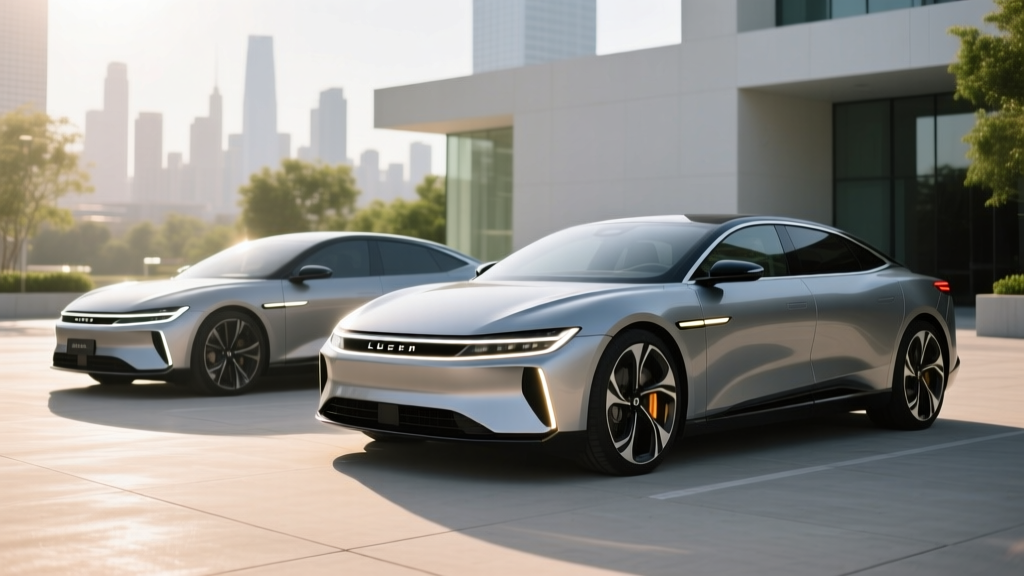
The Lucid Air entered the luxury electric sedan market with a singular promise: class-leading range backed by world-class efficiency. For 2026, the lineup has matured past early-production growing pains, and the question is no longer whether Lucid can build a competitive EV — it's whether the Air's engineering brilliance justifies its premium positioning against the Tesla Model S, Mercedes EQS, and BMW i7. After spending time with both the Pure and Grand Touring trims, the answer is nuanced. Lucid delivers on the metrics that matter most to efficiency-obsessed buyers, while leaving room for improvement in software polish and service infrastructure.
2026 Lucid Air Lineup at a Glance
Lucid offers the Air in three primary configurations for 2026: the single-motor Pure, the dual-motor Touring, and the flagship dual-motor Grand Touring. The Sapphire performance halo model continues as a limited, high-output variant. Below is the core specification matrix across the volume trims.
| Spec | Air Pure | Air Touring | Air Grand Touring |
|---|---|---|---|
| EPA Range | 419 mi | 425 mi | 512 mi |
| Battery (usable) | 88 kWh (LFP) | 112 kWh (NMC) | 112 kWh (NMC) |
| Drivetrain | RWD, single motor | AWD, dual motor | AWD, dual motor |
| Horsepower | 430 hp | 620 hp | 819 hp |
| 0-60 mph | 5.0 sec | 3.4 sec | 3.0 sec |
| Peak DC Charge Rate | 200 kW | 300 kW | 300 kW |
| 10-80% DCFC Time | ~30 min | ~22 min | ~22 min |
| Level 2 Rate | 19.2 kW (77 mi/hr) | 19.2 kW (77 mi/hr) | 19.2 kW (77 mi/hr) |
| EPA Efficiency | 146 MPGe / 23 kWh/100mi | 131 MPGe / 26 kWh/100mi | 131 MPGe / 25 kWh/100mi |
| Base MSRP | $69,900 | $87,400 | $125,600 |
Real-World Range: Where Lucid Delivers — and Where Physics Intervenes
The Grand Touring's 512-mile EPA estimate remains the highest of any production sedan sold in the United States for 2026, verified on fueleconomy.gov. But EPA testing uses a blended city/highway cycle with moderate temperatures, and real-world conditions rarely cooperate.
- EPA Sticker: 512 miles
- Mixed driving (70°F, 65 mph avg): ~440-470 miles
- Sustained highway (75-80 mph, 70°F): ~380-410 miles
- Cold weather (30°F, highway, heater on): ~310-350 miles
The Air's 900V+ architecture and miniaturized drive units yield genuinely best-in-class efficiency — roughly 4.0 mi/kWh on the highway in mild weather. However, the NMC pack's thermal management system works harder in sub-freezing temperatures than some competitors with dedicated heat-pump preconditioning loops. Expect 25-35% range reduction in sustained winter highway driving, consistent with most NMC-based EVs.
The Pure trim's LFP (lithium iron phosphate) battery trades energy density for longevity and cost. Its 419-mile EPA rating still outdistances most dual-motor competitors, and LFP chemistry tolerates regular 100% charging without degradation concerns — a practical advantage for daily commuters who want to charge to full without battery anxiety.
Charging Speed: 900V Architecture in Practice
Lucid's Wunderbox onboard charger and 900V+ electrical architecture remain a genuine engineering differentiator. The Touring and Grand Touring accept up to 300 kW at a DC fast charger, while the Pure peaks at 200 kW. But peak rate is not sustained rate — and the charge curve tells the full story.
| Charging Method | Rate | Miles Added per Hour | Notes |
|---|---|---|---|
| Level 1 (120V, 12A) | ~1.4 kW | ~5-6 mi/hr | Emergency/trickle only |
| Level 2 (240V, 80A) | 19.2 kW | ~77 mi/hr | Requires hardwired 100A circuit |
| Level 2 (240V, 48A) | 11.5 kW | ~46 mi/hr | Standard NEMA 14-50 outlet |
| DC Fast Charge (Pure) | Peak 200 kW | ~800 mi/hr (peak) | 10-80% in ~30 min; tapers above 60% |
| DC Fast Charge (Touring/GT) | Peak 300 kW | ~1,200 mi/hr (peak) | 10-80% in ~22 min; sustains >200 kW to ~55% |
The Grand Touring's charge curve holds above 200 kW from roughly 10% to 55% State of Charge before tapering. This means the headline 300 kW peak is useful but brief — you'll see it in the low SoC range, then the curve flattens. On a 350 kW Electrify America or Tesla Supercharger V4 stall, the Air GT can add approximately 200 miles in 15 minutes when starting from a low state of charge. Preconditioning the battery via the navigation-routed preconditioning feature is essential to hitting these numbers; arriving at a fast charger without preconditioning can cut peak rates by 30-40%.
For home charging, the 19.2 kW onboard charger is among the fastest in the segment, but it demands a 100-amp dedicated circuit and hardwired EVSE. Most residential panels can support this, but buyers in older homes should budget $1,500-$3,000 for a panel upgrade and dedicated line — consult a licensed electrician for a site assessment.
Performance and Driving Dynamics
Even the base Pure's 430 hp and 5.0-second 0-60 time would have been sports-car territory a decade ago. The Grand Touring's 819 hp and 3.0-second sprint place it in supercar territory, with instant torque delivery that makes the number feel even more violent than it reads. The dual-motor AWD system uses Lucid's proprietary miniaturized drive units — each roughly the size of a carry-on suitcase — which frees up interior space and reduces unsprung mass.
Ride quality in the Grand Touring with the available air suspension is compliant yet controlled, though the Pure's steel-spring setup transmits more road imperfection than expected in a $70K sedan. Steering feel is precise but light — this is a grand tourer, not a track car (the Sapphire fills that role). Regenerative braking offers moderate one-pedal-driving capability, though it doesn't bring the car to a complete hold without friction-brake blending at the final few mph.
Interior Space, Technology, and Drawbacks
The Air's cabin is its second major differentiator after the powertrain. Rear-seat legroom measures 37.6 inches — more than the Mercedes EQS and comparable to a long-wheelbase luxury sedan. The glass canopy roof creates an airy, open environment, though it lacks a manual shade and can increase cabin heat load in summer (the tinted glass blocks most UV, but solar gain is real).
Cargo Volume: 32.1 cu ft trunk (including the under-floor rear subtrunk) plus a 10.1 cu ft frunk. The trunk opening is narrow, limiting bulk loading compared to a hatchback like the Model S or Porsche Taycan Cross Turismo.
Infotainment: The 34-inch curved glass cockpit display is visually striking and responsive. However, Lucid's software ecosystem still trails Tesla's in app availability, over-the-air update frequency, and navigation-based route planning sophistication. Wireless Apple CarPlay and Android Auto are standard. The available Surreal Sound Pro audio system with 21 speakers is among the best in any production vehicle.
Driver Assistance: Lucid's DreamDrive Pro uses lidar, radar, and cameras for adaptive cruise, lane centering, and automatic lane changes. This is an SAE Level 2 system — the driver must remain engaged and supervise at all times. It performs competently on divided highways but does not approach hands-free capability in the way GM's Super Cruise or Ford's BlueCruise operate on mapped roads. Lucid has not yet deployed a supervised hands-free feature as of the 2026 model year.
Pricing, Tax Credits, and Total Cost
The 2026 Air Pure starts at $69,900 (including destination), positioning it against the Tesla Model S ($74,990), BMW i7 eDrive50 ($99,300), and Mercedes EQS 450+ ($104,400). The Touring lands at $87,400, and the Grand Touring commands $125,600 before options. A well-equipped Grand Touring with the Surreal Sound package, air suspension, and DreamDrive Pro can reach $138,000+.
| Trim | Base MSRP | §30D Credit Eligible? | Effective Price (if eligible) |
|---|---|---|---|
| Air Pure | $69,900 | Potentially up to $7,500 (see rules) | As low as ~$62,400 |
| Air Touring | $87,400 | Potentially up to $7,500 (see rules) | As low as ~$79,900 |
| Air Grand Touring | $125,600 | Not eligible (exceeds sedan MSRP cap) | $125,600 |
- MSRP Cap for Sedans: $55,000 — the Air Pure at $69,900 exceeds this cap and does NOT qualify for the new-vehicle §30D credit as of current IRS rules. (The Air is classified as a sedan, not an SUV, per IRS vehicle classifications.)
- Buyer Income Limits: AGI ≤ $150,000 (single), ≤ $300,000 (married filing jointly).
- Battery Sourcing: Critical minerals and battery component requirements phase in annually; check IRS.gov §30D guidance for current-year sourcing compliance.
- Point-of-Sale Transfer: Eligible credits can be transferred to the dealer at purchase for an immediate price reduction.
- Used EV Credit (§25E): A pre-owned Air may qualify for up to $4,000 (30% of sale price, capped) if purchased under $25,000 from a dealer — unlikely for current Air models but possible for early 2022-2023 examples in future years.
Tax credit eligibility is complex and subject to change. Consult a tax professional and verify current rules at IRS.gov before purchasing. This is not tax advice.
On total cost of ownership, the Air's efficiency advantage translates to meaningful savings: at $0.15/kWh national average electricity cost, the Grand Touring costs roughly $3.75 per 100 miles to charge at home — compared to approximately $12-14 per 100 miles for a comparable 22 MPG gas luxury sedan at $3.20/gallon. Over 5 years and 75,000 miles, that's a fuel savings of approximately $6,500-$8,000, partially offsetting the Air's higher purchase price and insurance premiums (expect 15-25% higher insurance than a gas equivalent, per industry data).
Pros, Cons, and Who Should Buy
- Class-leading 512-mile EPA range (Grand Touring)
- Best-in-class efficiency (4.0+ mi/kWh highway)
- 300 kW DC fast charging with strong sustained curve
- Massive rear-seat legroom and premium cabin materials
- 19.2 kW Level 2 onboard charger (fastest in segment)
- LFP battery option on Pure for longevity-minded buyers
- Exceeds §30D sedan MSRP cap on all trims
- Narrow trunk opening limits cargo versatility
- Software ecosystem and OTA updates lag Tesla
- No hands-free driver-assist feature yet (Level 2 only)
- Limited service center network vs. legacy luxury brands
- Glass roof lacks shade; solar heat gain in summer
Who the Lucid Air suits best: The Air is ideal for efficiency-driven luxury buyers who prioritize range and charging speed over badge prestige or autonomous-driving ambitions. Long-distance commuters covering 60+ miles daily will exploit the 512-mile envelope to charge just twice per week. Road-trippers who plan around DC fast chargers will appreciate the 22-minute 10-80% sessions. The Pure trim specifically targets buyers who want a premium EV sedan under $70K with LFP durability — a segment with few alternatives. Families needing maximum cargo flexibility or buyers who demand a mature service network should cross-shop the BMW i7 or Mercedes EQS.
Battery Warranty and Long-Term Ownership
Lucid covers the Air's battery and drive units with an 8-year/100,000-mile warranty, with a capacity retention threshold of 70% — meaning if the battery degrades below 70% of original capacity within the warranty period, Lucid will repair or replace it. This is consistent with industry norms (Tesla, BMW, and Mercedes use similar 70% thresholds).
The LFP battery in the Pure trim offers a theoretical longevity advantage: LFP cells typically endure 3,000+ full charge cycles before reaching 80% capacity, compared to approximately 1,500-2,000 cycles for NMC. For a buyer planning 10+ years of ownership, the Pure's LFP pack may outlast the vehicle itself. The NMC packs in the Touring and Grand Touring offer higher energy density but benefit from avoiding routine 100% charges — Lucid recommends daily charging to 80-90% for NMC trims, reserving 100% for road trips.
Replacement cost for an out-of-warranty Air battery pack has not been publicly disclosed by Lucid as a flat rate, but industry estimates for a 112 kWh NMC pack place it in the $20,000-$30,000 range based on current cell pricing and labor. This is comparable to other large-pack luxury EVs.
Frequently Asked Questions
What is the real-world range of the 2026 Lucid Air Grand Touring?
In mixed driving at moderate temperatures, expect approximately 440-470 miles. Sustained highway driving at 75-80 mph drops this to roughly 380-410 miles. In cold weather (below freezing) with cabin heating, plan for 310-350 miles. The Air's efficiency is genuinely best-in-class, but physics still applies — high speeds and low temperatures reduce range for every EV.
How fast does the Lucid Air charge at home and on the road?
At home on a 240V/80A hardwired Level 2 charger, the Air adds approximately 77 miles of range per hour at 19.2 kW — a full overnight session replenishes even the 112 kWh pack. On DC fast chargers, the Touring and Grand Touring peak at 300 kW and achieve 10-80% in approximately 22 minutes. The Pure peaks at 200 kW with a 10-80% time of about 30 minutes. Always precondition via navigation routing to hit these numbers.
Does the 2026 Lucid Air qualify for the federal EV tax credit?
Likely not. The IRS classifies the Air as a sedan, and the §30D new clean vehicle credit caps sedan MSRP at $55,000. Since the Air Pure starts at $69,900, it exceeds this threshold. The Touring and Grand Touring are also ineligible. Income limits and battery-sourcing rules add further restrictions. Always verify current eligibility at IRS.gov and consult a tax professional.
Is the Lucid Air worth buying over the Tesla Model S or Mercedes EQS?
If range and efficiency are your top priorities, the Air Grand Touring's 512-mile EPA rating and 4.0 mi/kWh efficiency have no equal. The Model S offers a more mature Supercharger network, hands-free-capable FSD (Supervised) on mapped routes, and a hatchback trunk. The EQS provides a more established dealer/service network and a quieter, more traditionally luxurious cabin. The Air wins on powertrain metrics; it cedes ground in software maturity and service footprint.
What are the biggest drawbacks of owning a Lucid Air?
Service infrastructure remains the most practical concern — Lucid has fewer service centers and mobile service technicians than Tesla or legacy luxury brands, which can mean longer wait times for repairs in some regions. The software experience, while improving, lacks the app ecosystem and OTA cadence of Tesla. The glass roof's lack of a shade is a frequent owner complaint in hot climates. And the Air's sedan classification eliminates federal tax credit eligibility for most buyers.
How long will the Lucid Air battery last?
Lucid warranties the battery for 8 years or 100,000 miles against degradation below 70% capacity. The LFP pack in the Pure trim is expected to outlast most ownership periods given LFP's 3,000+ cycle life. The NMC packs in higher trims will deliver well over 150,000 miles before approaching the 70% threshold under normal use. Avoiding routine 100% charges and minimizing DC fast charging in extreme heat will extend pack life.