Quick Verdict: The Efficiency King for Bay Area Commuters
The Lucid Air Pure—often configured in what dealers and buyers colloquially call the "Studio" base trim—remains one of the most energy-efficient luxury sedans on the road in 2026. For Millbrae and greater San Francisco Bay Area drivers, the combination of class-leading EPA range, a spacious cabin, and access to both the Tesla Supercharger network (via NACS adapter) and Electrify America's growing CCS corridor makes this a compelling daily driver. But with a starting MSRP near $70,000 and evolving federal tax-credit rules, the math requires careful scrutiny before you sign.
The Lucid Air Pure (RWD) carries an EPA-estimated 419 miles of range on its 88 kWh usable battery pack. In real-world Bay Area driving—mixed highway commuting on US-101 and I-280, moderate climate use, and mild Northern California winters—expect approximately 350–380 miles. On sustained 75+ mph highway runs toward Tahoe or LA, plan for roughly 320–340 miles before needing a charger. Cold-weather trips above 4,000 ft elevation can reduce range by 15–25%, bringing effective range closer to 290–310 miles.
Lucid Air Pure (Studio) Spec Sheet at a Glance
| Spec | 2026 Lucid Air Pure (RWD) |
|---|---|
| EPA Range | 419 miles |
| Battery (usable) | 88 kWh, NMC (nickel-manganese-cobalt) |
| Drivetrain | Rear-wheel drive (single motor) |
| Horsepower | 430 hp |
| 0–60 mph | 5.0 seconds |
| Top Speed | 145 mph |
| Efficiency (EPA) | 146 MPGe combined / 24 kWh/100 mi |
| Max DC Fast Charge | 200 kW peak (CCS via adapter); 250 kW (NACS native on newer builds) |
| 10–80% DC Charge Time | ~25 minutes (at 250 kW+ charger) |
| Level 2 Home Charging | 19.2 kW onboard (~72 mi/hr) |
| Cargo Volume | 32.0 cu ft (trunk) + 4.0 cu ft (frunk) |
| Rear Legroom | 41.4 inches |
| Base MSRP | $69,900 (before destination) |
| Battery Warranty | 8 years / 100,000 miles |
Range and Efficiency: Why Millbrae Drivers Get More Per kWh
Lucid's powertrain engineering—developed in-house with Formula E-derived motor and inverter technology—delivers an industry-leading efficiency of roughly 24 kWh per 100 miles (EPA combined). For context, the Tesla Model S Long Range uses about 28 kWh/100 mi, and the BMW i5 eDrive40 sits near 30 kWh/100 mi. That efficiency gap translates directly into fewer charging stops and lower electricity costs.
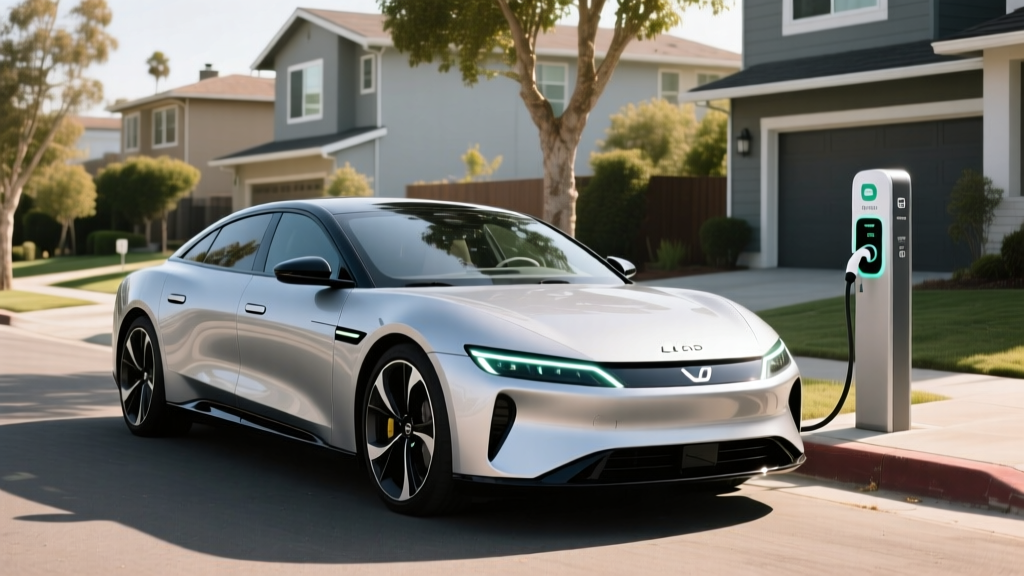
For a Millbrae commuter driving 40 miles round-trip on US-101 to downtown San Francisco or the Peninsula, the Air Pure requires roughly one full charge per week using a home Level 2 charger. Millbrae's Mediterranean climate (rarely below 40°F or above 75°F) is near-ideal for lithium-ion battery efficiency—expect minimal cold-weather range loss compared to Midwest or East Coast owners.
Sources: EPA Fuel Economy – Lucid Air Pure
Charging Speed and Infrastructure
The Air Pure's 900V electrical architecture enables fast DC charging that outpaces most 400V competitors. Here's how charging breaks down across levels:
| Charging Level | Power (kW) | Miles Added per Hour | Notes |
|---|---|---|---|
| Level 1 (120V household) | ~1.4 kW | ~5–6 mi/hr | Emergency/trickle only |
| Level 2 (240V home, 48A) | 11.5 kW | ~48 mi/hr | Typical home wall connector |
| Level 2 (240V, 80A) | 19.2 kW | ~72 mi/hr | Full onboard charger capacity |
| DC Fast (150 kW station) | 150 kW | ~300 mi in 30 min | Common EA/ChargePoint stalls |
| DC Fast (250+ kW station) | 200–250 kW peak | ~10–80% in ~25 min | Tesla Supercharger V4 / EA 350 kW |
Charging-curve reality: The Air Pure peaks near 250 kW only between roughly 10–40% state of charge. Above 60% SoC, the curve tapers significantly—expect 80–100 kW sustained through 80%, and a slow trickle above 90%. For road trips, plan your stops around 10–80% to minimize time at the charger.
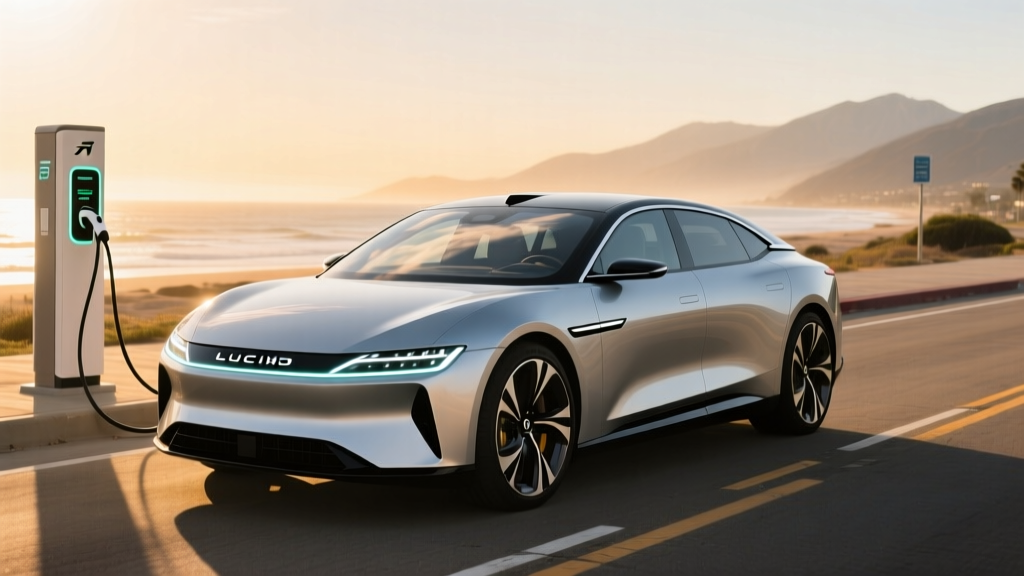
As of 2026, Lucid provides a NACS adapter enabling access to Tesla's Supercharger network (now open to non-Tesla EVs at many locations). This dramatically improves road-trip charging reliability along the I-5 corridor to Los Angeles and the US-50 corridor to Lake Tahoe.
Performance and Driving Impressions
With 430 horsepower routed to the rear wheels, the Air Pure hits 0–60 mph in a brisk 5.0 seconds. That's not supercar territory, but it's more than adequate for merging onto 101 or passing on I-280. The single-motor RWD layout keeps weight down and efficiency up—critical trade-offs that Lucid's engineering team clearly prioritized.
The steering is precise, the air suspension (standard on most trims) absorbs Bay Area potholes and speed bumps gracefully, and the cabin is remarkably quiet at highway speeds. Regenerative braking offers adjustable levels, though Lucid does not offer true one-pedal driving to a complete stop—expect to use the brake pedal at intersections.
Pricing, Trims, and Federal Tax Credit Eligibility
The 2026 Lucid Air Pure starts at $69,900 (MSRP before the $1,500 destination fee). The "Studio" designation refers to the base interior configuration—vegan leather, a minimalist dashboard, and Lucid's 34-inch curved glass cockpit display. Options like the Surreal Stealth interior package, larger 20-inch wheels, and ADAS upgrades can push the as-tested price to $78,000–$82,000.
| Item | Amount |
|---|---|
| Base MSRP (Air Pure RWD) | $69,900 |
| Destination Fee | $1,500 |
| As-Tested (with options) | ~$78,000 |
| Federal §30D Tax Credit (max) | Up to $7,500 (if eligible) |
| Effective Price (after max credit) | ~$63,900 – $70,500 |
IRS §30D Tax Credit Caveats (2026 rules):
- MSRP Cap: Sedans must have an MSRP at or below $55,000 to qualify. The Air Pure at $69,900 exceeds this cap, meaning it does not qualify for the new-vehicle §30D credit.
- Income Limits: Modified AGI must not exceed $150,000 (single) / $300,000 (joint) — moot if MSRP cap is already exceeded.
- Battery Sourcing: Critical-mineral and battery-component requirements apply; even if the price were under the cap, sourcing rules must be met.
- Point-of-Sale Transfer: Eligible buyers can transfer the credit to the dealer at purchase for an immediate price reduction — but only if the vehicle qualifies.
Bottom line on tax credits: The Lucid Air Pure's MSRP places it above the §30D sedan cap. Buyers seeking a federal credit will need to look at the used EV market (where a different credit of up to $4,000 may apply under §25E for pre-owned EVs priced under $25,000) or consider competitors under the $55,000 sedan cap. Always consult IRS.gov §30D guidance and a tax professional before purchasing.
Interior, Tech, and Cargo
The Air Pure's cabin is airy and minimalist, dominated by a curved 34-inch glass cockpit display that spans the driver's instrument cluster and infotainment. There is no traditional center stack—climate and media controls are embedded in the lower touchscreen. Wireless Apple CarPlay and Android Auto are standard.
DreamDrive Pro (Lucid's ADAS suite) includes adaptive cruise control, lane-centering, automated emergency braking, and blind-spot monitoring. This is a SAE Level 2 driver-assistance system—the driver must remain attentive with hands on the wheel at all times. It is not autonomous or "self-driving."
Cargo space is generous: 32.0 cubic feet in the trunk (larger than many midsize luxury sedans) plus a 4.0 cu ft frunk. Rear legroom measures 41.4 inches—ample for adults on longer trips. The glass canopy roof creates an open, airy feel, though some buyers note it increases cabin heat on sunny Peninsula afternoons.
Pros and Cons
Pros
- Class-leading efficiency (24 kWh/100 mi) and 419-mi EPA range
- Spacious cabin with 32 cu ft trunk and 41.4" rear legroom
- 19.2 kW onboard Level 2 charging (fastest in class for home)
- NACS adapter enables Tesla Supercharger access
- Quiet, composed ride with standard air suspension
- 900V architecture future-proofs DC charging
Cons
- MSRP exceeds §30D sedan cap — no federal new-EV credit
- Limited service centers; Millbrae owners rely on mobile service or South Bay/SoCal centers
- Infotainment learning curve (no physical buttons)
- No one-pedal driving to full stop
- Brand is young — long-term reliability data still limited
- DreamDrive Pro is Level 2 only, not competitive with FSD/BlueCruise feature depth
Who Should Buy the Lucid Air Pure (Studio)?
Choose the Lucid Air Pure if:
- You commute 30–80 miles daily on the Peninsula or into SF and want to charge once per week at home
- You value maximum range per kWh and want to minimize public-charging dependency
- You need rear-seat space for adults or car seats and a large trunk
- You want access to Tesla Superchargers for road trips to Tahoe, LA, or the Pacific Coast
Look elsewhere if:
- You require the $7,500 federal tax credit (MSRP cap disqualifies the Air Pure)
- You want a performance-focused dual-motor AWD (step up to Air Touring or Grand Touring)
- You need a nearby dealership for frequent service visits (Lucid's service footprint is still thin)
- You prefer physical buttons and a traditional infotainment layout
Frequently Asked Questions
What is the real-world range of the Lucid Air Pure?
The EPA estimates 419 miles. In real-world Bay Area commuting with moderate highway driving, expect 350–380 miles. Sustained 75+ mph highway driving reduces this to roughly 320–340 miles, and cold mountain passes can drop it to 290–310 miles.
How fast does the Lucid Air Pure charge at home and on DC fast chargers?
At home on a 48A Level 2 charger (240V), the Air Pure adds roughly 48 miles of range per hour. On a full 80A circuit, it can use its 19.2 kW onboard charger for about 72 mi/hr. On DC fast chargers, it peaks at 200–250 kW, achieving a 10–80% charge in approximately 25 minutes at a capable station.
Does the Lucid Air Pure qualify for the $7,500 federal EV tax credit?
No. Under current IRS §30D rules, new sedans must have an MSRP at or below $55,000 to qualify. The Air Pure starts at $69,900, exceeding this cap. Always verify current rules at IRS.gov and consult a tax professional.
Is the Lucid Air Pure worth it vs. the Tesla Model S or BMW i5?
It depends on priorities. The Air Pure wins on efficiency and range (419 mi vs. Model S's ~402 mi and i5's ~295 mi). The Model S offers more Supercharger-native convenience and a more mature service network. The BMW i5 is more traditional in layout but sacrifices ~120 miles of range. For Peninsula commuters who prioritize range and interior space over brand cachet, the Air Pure is a strong pick.
What is the battery warranty on the Lucid Air Pure?
Lucid covers the battery pack and powertrain for 8 years or 100,000 miles, whichever comes first. The warranty guarantees the battery will retain a minimum percentage of its original capacity (typically 70% or above, per Lucid's published terms).
Can I charge a Lucid Air Pure at Tesla Superchargers near Millbrae?
Yes. As of 2026, Lucid provides a NACS adapter that enables access to Tesla Supercharger stalls open to non-Tesla EVs. Millbrae is within range of several Supercharger locations in Burlingame, San Bruno, and South San Francisco. Confirm stall compatibility via the Tesla app before arriving.
Does the Lucid Air Pure have self-driving capabilities?
No. Lucid's DreamDrive Pro is an SAE Level 2 driver-assistance system. It provides adaptive cruise control and lane-centering, but the driver must remain fully engaged, hands on the wheel, and eyes on the road at all times. It is not autonomous driving.
Sources: EPA Fuel Economy, Lucid Motors Official Specs, IRS §30D Clean Vehicle Credits