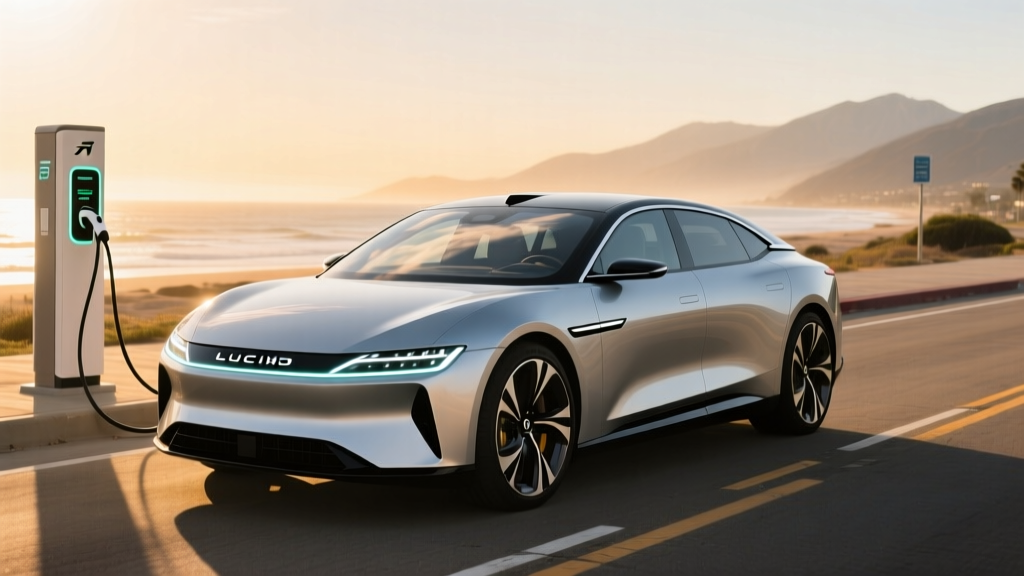
If you have been searching for information on the Lucid Lunar, you are likely encountering a name that has circulated in EV enthusiast forums and speculative renders but does not correspond to any officially announced, production, or even concept vehicle from Lucid Motors as of early 2026. Lucid's current lineup consists of the Air sedan, the Gravity SUV, and the upcoming midsize platform. The "Lucid Lunar" appears to be an unofficial name, a fan concept, or possibly a misremembered model designation.
At AutoEdgeView, we prioritize accuracy over hype. Rather than fabricate specifications for a vehicle that does not exist, this article clarifies the Lucid Lunar situation, profiles Lucid's actual 2026 lineup so you know what is genuinely available, and provides a framework for evaluating any future Lucid model announcement against real-world EV ownership criteria.
Lucid Lunar: What We Know (and Don't Know)
As of our 2026 editorial review, Lucid Motors has not announced, teased, or filed trademark applications for a vehicle called the "Lunar." The company's publicly confirmed roadmap includes:
- Lucid Air — the flagship luxury sedan (Pure, Touring, Grand Touring, Sapphire trims)
- Lucid Gravity — the three-row luxury SUV (began deliveries in late 2024, full production through 2025–2026)
- Midsize Platform — an upcoming, more affordable vehicle expected around 2026–2027, currently referred to only by internal project codes
The "Lunar" name may stem from confusion with the Gravity (both evoke space/celestial themes), fan-generated render projects, or AI-hallucinated content circulating on social media. If Lucid does announce a new model with this name in the future, we will update this page with verified specifications from official Lucid Motors press channels.
Lucid's Actual 2026 Lineup: Air and Gravity at a Glance
Since the Lunar is not a purchasable vehicle, here is a spec-driven look at what Lucid actually offers in 2026. These are the models you can test-drive, order, and take delivery on today.
| Spec | Air Pure | Air Grand Touring | Gravity Grand Touring |
|---|---|---|---|
| EPA Range | 419 mi | 516 mi | 440 mi |
| Battery (usable) | 88 kWh (NMC) | 112 kWh (NMC) | 112 kWh (NMC) |
| Drivetrain | RWD (single motor) | AWD (dual motor) | AWD (dual motor) |
| Horsepower | 500 hp | 819 hp | 828 hp |
| 0–60 mph | 5.0 sec | 3.0 sec | 3.5 sec |
| Max DC Fast Charge | ~200 kW | ~250 kW (900V+ arch) | ~250 kW (900V+ arch) |
| 10–80% DC Charge | ~25 min | ~20 min | ~22 min |
| Level 2 Home Rate | 19.2 kW (~75 mi/hr) | 19.2 kW (~75 mi/hr) | 19.2 kW (~65 mi/hr) |
| Efficiency | 146 MPGe / 23 kWh/100mi | 131 MPGe / 26 kWh/100mi | 112 MPGe / 30 kWh/100mi |
| Base MSRP | $69,900 | $125,600 | $94,900 |
| Battery Warranty | 8 yr / 100,000 mi | 8 yr / 100,000 mi | 8 yr / 100,000 mi |
Sources: EPA fueleconomy.gov, Lucid Air specifications, Lucid Gravity specifications. Specs reflect 2025–2026 model year data; verify with dealer for latest trim configurations.
Real-World Range: What EPA Stickers Don't Tell You
Lucid's EPA range figures are among the highest in the industry, thanks to the company's industry-leading powertrain efficiency and high battery-to-curb-weight ratios. But EPA tests use specific drive cycles that do not fully replicate sustained highway driving or extreme temperatures.
Lucid Air Grand Touring (EPA 516 mi): Expect approximately 400–440 miles on a sustained 70-mph highway run in moderate temperatures (60–80°F). In cold weather (below 32°F), range can drop to 340–380 miles due to battery resistance and cabin heating demands. Lucid's available heat pump mitigates some of this loss.
Lucid Gravity Grand Touring (EPA 440 mi): The SUV's larger frontal area and weight reduce highway efficiency. Expect ~350–380 miles at highway speeds in mild conditions, and ~290–330 miles in freezing temperatures.
Key variable: Lucid's 900V+ architecture and excellent thermal management mean range loss is less severe than many competitors, but physics still applies — cold + high speed = fewer miles.
If a future "Lucid Lunar" model is announced, apply these same real-world adjustment factors (roughly 15–20% reduction for highway driving, an additional 10–15% for cold weather) to whatever EPA figure is published.
Charging Speed: Lucid's 900V Architecture Advantage
Lucid uses a 900V+ electrical architecture (compared to the 400V systems in many mainstream EVs), which allows higher charging power with lower current — reducing heat and enabling faster charge times at compatible DC fast chargers.
| Level | Power (kW) | Miles Added per Hour | Notes |
|---|---|---|---|
| Level 1 (120V) | ~1.4 kW | ~4 mi/hr | Emergency/top-up only |
| Level 2 (240V, 80A) | 19.2 kW | 65–75 mi/hr | Requires 100A circuit; full overnight charge |
| DC Fast (CCS) | Up to 250 kW peak | ~300 mi in 20 min (Air GT) | 10–80% in ~20 min; tapers above 80% |
Charging curve reality check: Lucid's peak 250 kW rate is sustained roughly between 10–50% state of charge. Above 60%, the rate tapers progressively — by 80%, you may see 80–100 kW, and above 90%, it drops further to protect battery longevity. Plan road-trip stops around the 10–80% window for optimal time efficiency.
Lucid vehicles use the CCS1 connector natively. With the industry's ongoing transition to NACS (Tesla's connector), Lucid has indicated NACS adoption on future models. Current owners can use a CCS-to-NACS adapter at Tesla Superchargers where approved.
Pricing and Federal Tax Credit Eligibility
Lucid positions itself in the luxury segment, and pricing reflects that. Here is how the current lineup breaks down, including the complex federal tax credit picture under IRS §30D rules.
| Model/Trim | Base MSRP | Under §30D MSRP Cap? | Potential Credit |
|---|---|---|---|
| Air Pure | $69,900 | Yes (sedan cap: $55,000 — No) | Not eligible (exceeds sedan MSRP cap) |
| Air Touring | $87,400 | No (exceeds $55K sedan cap) | Not eligible |
| Gravity Pure (if avail.) | $79,900 | Yes (SUV cap: $80,000) | Up to $7,500 (if income + sourcing met) |
| Gravity Grand Touring | $94,900 | No (exceeds $80K SUV cap) | Not eligible |
Critical §30D caveats:
- MSRP caps: $55,000 for sedans; $80,000 for SUVs, vans, and trucks. Most Lucid models exceed these thresholds.
- Income caps: Modified AGI must not exceed $300,000 (joint), $225,000 (head of household), or $150,000 (single).
- Battery sourcing: The $7,500 credit splits into two $3,750 halves — one for critical minerals sourcing, one for battery component manufacturing. Sourcing requirements tighten annually.
- Point-of-sale transfer: Eligible buyers can transfer the credit to the dealer at purchase, reducing the purchase price upfront rather than waiting for a tax refund.
For a vehicle like the Gravity Pure (if it qualifies under the SUV MSRP cap and meets sourcing requirements), the effective price could drop from ~$79,900 to ~$72,400. Always verify current eligibility on the fueleconomy.gov tax credit tool and consult a tax professional.
Who Should Buy a Lucid — And Who Should Look Elsewhere
Even without a "Lunar" model, Lucid's current lineup serves specific buyer profiles well:
- Range-priority commuters: The Air Pure's 419 EPA miles means many commuters can drive a full week without charging.
- Luxury sedan buyers cross-shopping the Mercedes EQS or BMW i7: The Air offers superior range and efficiency at a lower starting price.
- Three-row EV families: The Gravity fills a gap left by the Tesla Model X's aging platform and the Rivian R1S's smaller third row.
- Tech-forward buyers: Lucid's miniaturized drive units, 900V architecture, and glass canopy roof represent genuine engineering differentiation.
- Budget is under $50,000: Lucid does not compete in the mainstream segment (yet).
- You need maximum charging network access: Tesla's Supercharger network remains more extensive; CCS reliability varies by region.
- You prioritize resale certainty: Lucid is a young brand; long-term depreciation data is limited compared to Tesla or legacy luxury OEMs.
- You want a compact or midsize sedan: The Air is a full-size luxury sedan; there is no smaller Lucid option until the midsize platform launches.
Evaluating Any Future Lucid Announcement: A Buyer's Checklist
If Lucid does announce a new model — whether called Lunar, or something else — here is the data-driven framework to apply before getting excited:
- EPA range vs. battery kWh: Divide the kWh by the range to get kWh/mile. Lucid's current vehicles achieve ~0.23–0.30 kWh/mile. A claimed 500-mile range with a 90 kWh battery would be implausible without a massive efficiency leap.
- Charging architecture: Does it retain the 900V+ system, or downshift to 400V for cost savings? This directly affects DC fast-charge speed.
- MSRP vs. §30D cap: Will it be priced under $55K (sedan) or $80K (SUV) to unlock the federal credit? This is a make-or-break value proposition.
- Production timeline: Lucid's Gravity was announced in 2022 but didn't reach meaningful production volume until late 2024. Add 12–18 months of buffer to any announced timeline.
- Service infrastructure: Lucid's service center network is growing but sparse outside major metros. Verify coverage in your area before committing.
Frequently Asked Questions
Is the Lucid Lunar a real vehicle I can buy?
No. As of early 2026, Lucid Motors has not announced any vehicle called the Lunar. The company's production lineup consists of the Air sedan and Gravity SUV. Any specifications, pricing, or availability attributed to a "Lucid Lunar" online are speculative or fabricated.
What is the cheapest Lucid I can buy in 2026?
The Lucid Air Pure starts at $69,900 (before any incentives). This is the RWD single-motor variant with 419 miles of EPA range and 500 horsepower. It does not qualify for the $7,500 federal tax credit because it exceeds the $55,000 MSRP cap for sedans under §30D rules.
Does any Lucid qualify for the federal EV tax credit?
Potentially the Gravity Pure (if priced at or below the $80,000 SUV MSRP cap), subject to the buyer's income limits, battery critical-mineral sourcing requirements, and battery component manufacturing rules. Most Lucid trims exceed the MSRP caps and are ineligible. Always verify on fueleconomy.gov and consult a tax professional before relying on credit eligibility.
How does Lucid's range compare to Tesla?
The Lucid Air Grand Touring's 516-mile EPA rating exceeds the Tesla Model S Long Range (~402 miles EPA). The Air Pure's 419 miles also beats the Model 3 Long Range (~363 miles). Lucid achieves this through higher battery capacity (112 kWh vs. Tesla's ~100 kWh) and superior efficiency (lower kWh/100mi), enabled by miniaturized drive units and advanced thermal management.
What connector does Lucid use for charging?
Current Lucid vehicles use the CCS1 connector for DC fast charging and J1772 for Level 2 AC charging. Lucid has committed to adopting NACS (Tesla's connector) on future vehicles, and current owners may access Tesla Superchargers using an approved CCS-to-NACS adapter where Tesla has enabled non-Tesla charging.
Is Lucid's driver-assist system self-driving?
No. Lucid's DreamDrive system is an SAE Level 2 driver-assistance feature, meaning the driver must remain fully engaged, hands on or near the wheel, and eyes on the road at all times. It offers adaptive cruise control, lane centering, and automated parking — but it is not autonomous driving. Only Level 4 services like Waymo operate without a human driver, and those are geofenced robotaxi operations, not consumer vehicles.
Editorial note: If you arrived at this page searching for the "Lucid Lunar," we recommend exploring our reviews of the Lucid Air and Lucid Gravity, or our best luxury EV roundup for comparable alternatives. We will update this page if Lucid officially announces a new model.