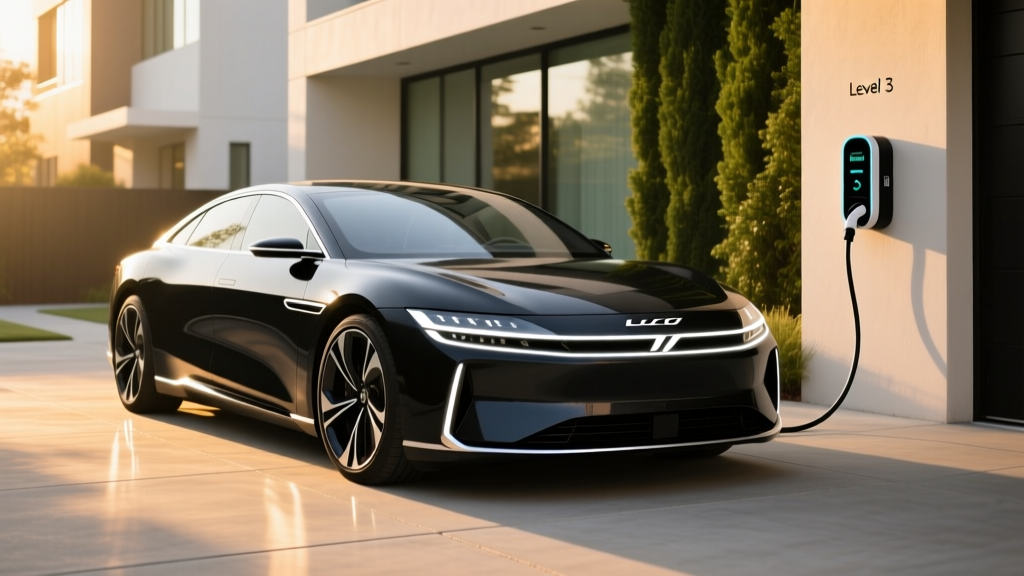
If you have been browsing luxury EV sedan listings, you have likely noticed Lucid Air lease deals surfacing with monthly payments that undercut the vehicle's six-figure sticker price by a wide margin. For 2026, Lucid Motors continues to position the Air as the efficiency and range benchmark in the luxury electric sedan segment, competing directly with the Tesla Model S, Mercedes-Benz EQS, and BMW i7. But leasing a Lucid Air is not the same transaction as leasing a conventional luxury car — the interplay of federal tax credits, residual values, and trim-level pricing requires careful analysis before you sign.
This review covers the 2026 Lucid Air lineup with exact numbers: EPA range, battery specs, charging speeds, real-world efficiency, and the math behind current lease structures. We will also clarify whether the Air qualifies for the IRS §30D federal tax credit and how that credit factors into a lease versus a purchase.
2026 Lucid Air Trim Lineup and Pricing
Lucid offers the Air across four primary trims for the 2026 model year. Pricing has shifted modestly as Lucid adjusts to competitive pressure and supply-chain stabilization. Here is the current MSRP breakdown before any incentives or dealer adjustments:
| Trim | Drivetrain | HP | EPA Range | Battery (usable) | Base MSRP |
|---|---|---|---|---|---|
| Air Pure | RWD | 430 hp | 419 mi | 88 kWh (NMC) | $69,900 |
| Air Touring | AWD Dual-Motor | 620 hp | 425 mi | 112 kWh (NMC) | $87,400 |
| Air Grand Touring | AWD Dual-Motor | 819 hp | 516 mi | 112 kWh (NMC) | $110,900 |
| Air Sapphire | AWD Tri-Motor | 1,234 hp | 427 mi | 118 kWh (NMC) | $249,000 |
The Air Pure remains the volume play and the trim most commonly featured in advertised lease deals. The Grand Touring is the range champion and the version most often cross-shopped against the Mercedes EQS 450+ and Tesla Model S Long Range. The Sapphire exists in a hypercar-performance tier with few direct electric rivals.
Real-World Range: What the EPA Number Does Not Tell You
EPA estimate: 516 miles (combined city/highway). Real-world expectation: ~420–460 miles on mixed highway driving at 70–75 mph; ~350–390 miles in freezing temperatures (below 32°F) with cabin heat active. The Air Pure's 419-mile EPA figure translates to roughly 340–370 miles highway in moderate weather.
Lucid's industry-leading efficiency — the Air Grand Touring achieves approximately 146 MPGe combined (per fueleconomy.gov) — is the result of a proprietary miniaturized drive unit, a 900V+ electrical architecture, and exceptional aerodynamics (a drag coefficient of 0.197). In city and suburban driving, owners frequently report matching or exceeding the EPA combined figure thanks to aggressive regenerative braking and low-speed efficiency.
However, highway driving at sustained speeds above 70 mph and cold-weather operation will reduce range meaningfully. The Air's heat pump (standard on all trims) mitigates cold-weather loss better than resistive heating systems, but expect a 15–25% reduction from the EPA sticker when temperatures drop below freezing. This is consistent with all lithium-ion EVs and is not unique to Lucid.
Efficiency measured in kWh per 100 miles tells the story more precisely: the Grand Touring consumes approximately 23 kWh/100 mi combined, while the Air Pure achieves roughly 24 kWh/100 mi. These figures are best-in-class for full-size luxury sedans.
Charging Speed: DC Fast Charging and Home Level 2
The Lucid Air's 900V+ architecture enables some of the fastest DC charging in production. Here is the complete charging picture:
| Charging Level | Power / Rate | Speed / Time | Connector |
|---|---|---|---|
| Level 1 (120V household) | ~1.4 kW | ~3–4 mi/hr | J1772 / NACS adapter |
| Level 2 (240V home, 48A) | 11.5 kW | ~38–42 mi/hr (full in ~10–12 hrs) | J1772 / NACS |
| Level 2 (240V home, 80A) | 19.2 kW | ~65–70 mi/hr (full in ~6–7 hrs) | J1772 / NACS |
| DC Fast Charge (peak) | Up to 300 kW | 10–80% in ~20 min (Grand Touring) | CCS / NACS (via adapter) |
| DC Fast Charge (sustained avg) | ~180–200 kW avg | ~200 mi added in 15 min | CCS / NACS |
A few important caveats on charging: the 300 kW peak rate applies primarily to the Grand Touring and Sapphire trims with the larger 112–118 kWh battery. The Air Pure, with its 88 kWh pack, peaks closer to 200–220 kW on DC fast chargers, with a 10–80% time of approximately 25 minutes.
Like all EVs, the Air's charge curve tapers significantly above 80% state of charge. Charging from 80–100% on DC can add another 15–20 minutes — plan your road-trip stops around the 10–80% window for maximum efficiency. On 50 kW CCS chargers (still common at older Electrify America and EVgo stations), expect roughly 150 mi/hr of charge speed, which is adequate but not exceptional.
For home charging, Lucid recommends a 60-amp circuit with a 48-amp charger for standard Level 2, but the Air's onboard charger supports up to 19.2 kW (80 amps) if your electrical panel can accommodate a 100-amp dedicated circuit. Most homes will require an electrical panel assessment before installing an 80A charger — budget $500–$2,000 for the installation depending on your panel capacity and run distance.
Performance, Interior Space, and Technology
The Air lineup spans a remarkable performance envelope. The Air Pure delivers a 0–60 mph time of 5.2 seconds, which is brisk for a rear-wheel-drive luxury sedan. The Grand Touring drops that to 3.0 seconds flat with its 819-hp dual-motor AWD setup. The Sapphire, Lucid's halo model, hits 60 mph in 1.89 seconds — making it one of the quickest production sedans ever built.
Interior space is a genuine differentiator. Despite the Air's sleek fastback silhouette, rear-seat legroom measures 36.4 inches, and the cabin offers a total of 32.0 cubic feet of cargo volume (trunk plus front trunk/frunk). The frunk alone provides approximately 8.5 cu ft — enough for a carry-on suitcase or charging cables. This cargo practicality exceeds the Tesla Model S (28.0 cu ft total) and rivals midsize luxury SUVs.
Technology highlights include:
- Lucid UX infotainment with a 34-inch curved glass cockpit display and a lower touchscreen for climate and vehicle controls
- DreamDrive Pro ADAS suite (SAE Level 2) with adaptive cruise, lane-centering, and automatic emergency braking — note: this is a driver-assist system requiring active supervision, not autonomous driving
- Over-the-air (OTA) updates that have added features like improved regen profiles and UI refinements post-delivery
- Surreal Sound Pro 21-speaker audio system (standard on Touring and above)
- Atmosphere feature with panoramic glass canopy roof (standard on Grand Touring, optional on Touring)
Notable drawbacks include the lack of Apple CarPlay and Android Auto — Lucid relies on its native infotainment with phone mirroring via a proprietary app, which some buyers find limiting. The DreamDrive Pro system, while competent, trails Tesla's Autopilot and GM's Super Cruise in hands-free highway capability and mapped-road coverage. Rear-seat headroom is also tighter than expected due to the sloping roofline, particularly for passengers over 6 feet.
Lucid Air Lease Deals: The Math and Tax Credit Reality
This is where the Lucid Air lease proposition gets nuanced. Here is the framework for understanding what you will actually pay:
| Requirement | Lucid Air Status | Details |
|---|---|---|
| MSRP Cap (sedans: $55,000) | ❌ Exceeds cap | Air Pure starts at $69,900 — above the $55K sedan cap for purchase credit |
| Buyer Income Cap | Varies | $150K single / $300K joint MAGI limit |
| Battery Sourcing / Critical Minerals | Partial compliance | Varies by production batch; check VIN-specific eligibility at fueleconomy.gov |
| Lease Loophole (Commercial Clean Vehicle Credit §45W) | ✅ Often applicable | Leased vehicles may qualify for $7,500 credit passed through by the lessor regardless of MSRP/income caps — confirm with dealer |
The critical insight for Lucid Air lease deals is the commercial clean vehicle credit (§45W). Under current IRS guidance, vehicles leased through a dealership's financing arm are classified as commercial clean vehicles. This means the $7,500 credit goes to the lessor (the financing company), who can — but is not required to — pass it through as a capitalized-cost reduction on your lease. This bypasses the §30D MSRP cap of $55,000 for sedans and the buyer income limits entirely.
In practice, many Lucid dealerships in 2026 are applying the $7,500 as a cap-cost reduction on Air Pure and Air Touring leases. However, this is a dealer-level decision, not a federal guarantee. Always ask the finance manager explicitly: "Is the $7,500 lease credit being applied as a cap-cost reduction on this deal?" before signing.
Typical 2026 Lucid Air Pure lease structures look approximately like this (36-month term, 10,000 miles/year, with $7,500 cap-cost reduction applied):
- Monthly payment: $749–$899 depending on region and dealer
- Due at signing: $3,500–$5,500 (first month + acquisition fee + down payment)
- Money factor: ~0.00225 (equivalent to ~5.4% APR)
- Residual value: ~52–55% at 36 months
Compared to purchasing the Air Pure at $69,900 (where the §30D credit is unavailable due to the MSRP cap), leasing effectively delivers a $7,500 advantage that you cannot access through a standard purchase. This makes leasing the financially rational path for most Air buyers in 2026, assuming you are comfortable with mileage limits and do not plan to keep the vehicle beyond the lease term.
How the Lucid Air Compares to Key Competitors
The luxury EV sedan market gives buyers several alternatives at similar price points. Here is how the Air stacks up on the metrics that matter:
| Spec | Lucid Air Grand Touring | Tesla Model S LR | Mercedes EQS 450+ | BMW i7 xDrive60 |
|---|---|---|---|---|
| EPA Range | 516 mi | 402 mi | 390 mi | 318 mi |
| Battery (usable) | 112 kWh NMC | ~95 kWh | 107.8 kWh NMC | 101.7 kWh NMC |
| DC Fast Charge Peak | 300 kW | 250 kW | 200 kW | 195 kW |
| 10–80% DC Time | ~20 min | ~27 min | ~31 min | ~34 min |
| 0–60 mph | 3.0 sec | 3.1 sec | 5.9 sec | 4.5 sec |
| Effic. (kWh/100mi) | 23 | 28 | 30 | 33 |
| Starting MSRP | $110,900 | $79,990 | $104,400 | $119,300 |
| Lease Credit (§45W) | Yes (via lessor) | Yes (via lessor) | Yes (via lessor) | Yes (via lessor) |
The Air Grand Touring's range and efficiency advantages are clear and substantial. No competitor comes within 100 miles of its EPA figure. The trade-off is the Air's higher starting price relative to the Model S and its less mature service network — Lucid has roughly 25 service centers nationwide as of 2026, compared to Tesla's 250+. For buyers in metro areas with a Lucid service center, this is manageable. For those in rural regions, it is a legitimate concern.
The Model S wins on price, Supercharger network access (though Lucid now offers NACS adapters for Supercharger access), and Autopilot capability. The EQS and i7 win on interior material quality, dealer service infrastructure, and brand prestige. The Air wins on range, efficiency, charging speed, and interior volume.
Warranty and Long-Term Battery Outlook
Lucid provides the following warranty coverage for the 2026 Air:
- Battery pack: 8 years / 100,000 miles (capacity retention threshold: 70% of original)
- Powertrain (motors, inverter, reduction gear): 8 years / 100,000 miles
- Vehicle limited warranty: 4 years / 50,000 miles
- Roadside assistance: 4 years / 50,000 miles
The battery warranty is competitive with Tesla and Mercedes but trails Hyundai/Kia's 10-year/100,000-mile coverage. The 70% capacity-retention threshold is industry-standard — if your battery degrades below 70% of its original usable capacity within the warranty period, Lucid will repair or replace it. Real-world degradation data on Lucid's NMC packs is still limited given the Air's 2021 launch, but early owner reports and third-party testing (notably by Recurrent Auto) suggest NMC packs in thermally managed systems like the Air's typically retain 90–93% capacity at 50,000 miles.
For lease buyers, the battery warranty is largely academic — a 36-month lease will not approach the 100,000-mile threshold. But if you plan to purchase at lease-end or buy outright, this data matters for long-term cost of ownership.
Pros and Cons of the 2026 Lucid Air
- Class-leading EPA range (516 mi Grand Touring) and real-world efficiency
- Up to 300 kW DC fast charging — among the fastest in production
- Generous interior volume: 32 cu ft cargo, 36.4" rear legroom
- Lease credit (§45W) can offset $7,500 despite high MSRP
- Smooth, quiet ride quality that rivals German luxury sedans
- Sapphire trim offers hypercar performance (1,234 hp, 1.89s 0–60)
- No Apple CarPlay or Android Auto — proprietary infotainment only
- Limited service network (~25 centers nationwide) vs. legacy brands
- DreamDrive Pro ADAS trails Tesla Autopilot and GM Super Cruise in capability
- Air Pure's smaller 88 kWh pack charges slower (peak ~220 kW)
- Rear headroom is tight for tall passengers due to fastback roof
- Depreciation uncertainty — residual values still establishing
Who Should Lease the Lucid Air?
The Lucid Air is best suited for:
- Long-distance commuters who need 400+ miles of real-world range and want to minimize charging stops
- Luxury sedan buyers who prioritize efficiency and range over brand cachet
- Families who need sedan-level cargo space (32 cu ft) without stepping into an SUV
- Tech-forward buyers who appreciate OTA updates and cutting-edge powertrain engineering
- Lease-oriented shoppers who can leverage the §45W commercial credit that purchase buyers cannot access
The Air is less ideal for buyers who need hands-free highway driving (look at GM Super Cruise vehicles), who prioritize infotainment integration (BMW i7 with iDrive and wireless CarPlay), or who live far from a Lucid service center and cannot tolerate mobile-service-only coverage.
Frequently Asked Questions
What is the real-world range of the Lucid Air?
The Air Grand Touring delivers an EPA-estimated 516 miles, but expect approximately 420–460 miles on mixed highway driving in moderate temperatures and 350–390 miles in freezing weather. The Air Pure's 419-mile EPA estimate translates to roughly 340–370 miles highway in fair conditions.
How fast does the Lucid Air charge at home and on DC fast chargers?
On a 48-amp Level 2 home charger (11.5 kW), the Air adds approximately 38–42 miles per hour, reaching a full charge in 10–12 hours. On DC fast chargers, the Grand Touring peaks at 300 kW and charges from 10–80% in approximately 20 minutes. The Air Pure peaks around 200–220 kW with a 10–80% time of roughly 25 minutes.
Does the Lucid Air qualify for the federal EV tax credit?
For outright purchase, the Air does not qualify for the §30D credit because all trims exceed the $55,000 MSRP cap for sedans. However, when leased, the vehicle may qualify under the §45W commercial clean vehicle credit, allowing the lessor to receive $7,500 and pass it through as a cap-cost reduction. Confirm with your dealer that this credit is being applied before signing.
How much does a Lucid Air lease cost per month in 2026?
Typical Air Pure leases run $749–$899/month on a 36-month term with 10,000 miles/year and $3,500–$5,500 due at signing, assuming the $7,500 lease credit is applied. Grand Touring leases typically range from $1,199–$1,499/month under similar terms. Exact pricing varies by region, dealer, and credit tier.
Is the Lucid Air worth leasing over a Tesla Model S or Mercedes EQS?
If range, efficiency, and charging speed are your top priorities, the Air Grand Touring has no peer in the luxury sedan segment. If you prioritize Autopilot capability and Supercharger convenience, the Model S is the stronger choice. If brand prestige, dealer service access, and interior material quality matter most, the EQS or i7 may be preferable. The lease credit availability across all four vehicles narrows the financial gap significantly.
What is the battery chemistry and will it last?
All Lucid Air trims use NMC (nickel manganese cobalt) lithium-ion cells. NMC offers higher energy density than LFP chemistry, enabling the Air's exceptional range in a compact pack. Early degradation data suggests 90–93% capacity retention at 50,000 miles with active thermal management. The battery is warranted for 8 years/100,000 miles with a 70% retention threshold.