The Lucid Air has always led with its powertrain efficiency, but what greets you from the driver's seat is equally defining: a sweeping 33.4-inch curved glass cockpit display that spans the entire upper dash. For 2026, Lucid has refined this signature interior screen with faster processing, an updated software stack, and a new lower touchscreen panel that handles climate and media controls. But does the Lucid Air interior screen deliver on usability, or is it form over function? We spent time with the 2026 lineup to find out — and evaluated the full vehicle package: range, charging, pricing, and tax-credit eligibility.
Quick Verdict: The Lucid Air's Glass Cockpit in Context
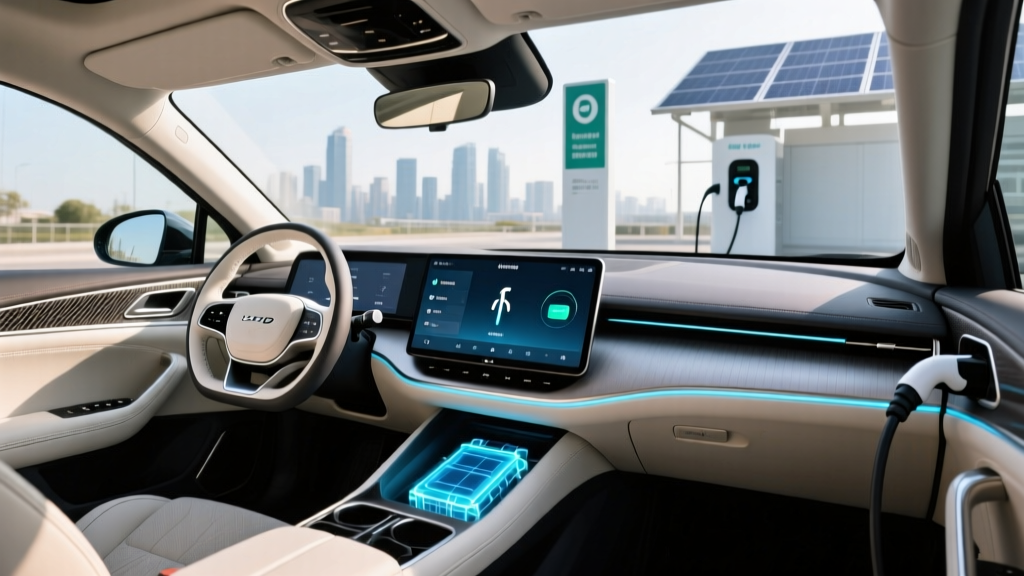
The 2026 Lucid Air remains the efficiency king of the luxury EV sedan segment. The 33.4-inch curved glass cockpit is not a single touchscreen — it's a fixed display housing three distinct zones (driver cluster, center infotainment, passenger info) rendered behind one seamless pane of glass. Below it sits a 17-inch retractable lower touchscreen (dubbed the "Pilot Panel" by Lucid) for climate, navigation input, and media. The result is a layered interface that keeps critical driving data always visible while relegating secondary controls to the lower screen that can retract into the dash when not needed.
What works: The glass cockpit's resolution is exceptional — crisp map rendering, legible at a glance in direct sunlight thanks to anti-glare coating, and the driver zone is angled toward you without being blocked by the steering wheel. The 2026 software update adds wireless Apple CarPlay and Android Auto with full-screen mirroring, addressing one of the most-requested features from early owners.
What doesn't: The lower Pilot Panel's haptic-touch buttons for climate control lack physical feedback that's easy to feel while driving. Some competitors — notably the Mercedes EQS with its Hyperscreen — offer a more intuitive split between driver and passenger zones. And while Lucid's native navigation is solid, the interface still has more menu depth than Tesla's minimalist approach.
2026 Lucid Air Specs at a Glance
| Spec | Pure RWD | Touring AWD | Grand Touring AWD | Sapphire |
|---|---|---|---|---|
| EPA Range | 419 mi | 425 mi | 516 mi | 427 mi |
| Battery (usable) | 88 kWh (NMC) | 112 kWh (NMC) | 112 kWh (NMC) | 118 kWh (NMC) |
| Horsepower | 430 hp | 620 hp | 819 hp | 1,234 hp |
| 0-60 mph | 5.0 sec | 3.4 sec | 3.0 sec | 1.89 sec |
| Drivetrain | RWD (single motor) | AWD (dual motor) | AWD (dual motor) | AWD (tri-motor) |
| Max DC Fast Charge | 200 kW | 250 kW | 300 kW | 300 kW |
| 10-80% DC Time | ~28 min | ~22 min | ~20 min | ~20 min |
| Level 2 Home Rate | 19.2 kW (~80 mi/hr) | 19.2 kW (~80 mi/hr) | 19.2 kW (~80 mi/hr) | 19.2 kW (~80 mi/hr) |
| EPA Efficiency | 146 MPGe / 23 kWh/100mi | 131 MPGe / 26 kWh/100mi | 131 MPGe / 25 kWh/100mi | 109 MPGe / 31 kWh/100mi |
| Base MSRP | $69,900 | $87,400 | $125,600 | $249,000 |
Sources: EPA fueleconomy.gov, Lucid Motors official specs.
The Lucid Air Interior Screen: A Deep Dive
33.4-Inch Curved Glass Cockpit
The headline feature of any Lucid Air cabin is the curved glass cockpit. Unlike Tesla's single floating center tablet or Mercedes' pillar-to-pillar Hyperscreen, Lucid's approach uses a single curved glass element mounted directly above the dash surface, positioned close to the driver's natural sight line. The display runs at a 6K resolution, which in practice means text and map details render without visible pixelation even on the far-right passenger zone.
The three functional zones break down as follows:
- Driver zone (left): Speed, range, drive mode, ADAS visualization, turn-by-turn navigation. Always visible, configurable via steering wheel controls.
- Center zone: Media, navigation map, phone, vehicle settings. This is the primary interactive area, responding to touch input.
- Passenger zone (right): Trip info, media controls, and in 2026, a new streaming entertainment mode that activates only when the vehicle is parked.
17-Inch Pilot Panel (Lower Touchscreen)
Below the glass cockpit, the Pilot Panel handles climate controls, seat heating/ventilation, and secondary navigation input. In 2026, Lucid added a "Quick Access" bar that lets you pin up to six functions for one-tap access — a meaningful improvement over the 2025 software, which required more taps for common adjustments. The screen can retract flush into the dash via a button press, which some owners prefer for a cleaner look during highway cruising when climate settings aren't changing.
DreamDrive Pro ADAS Integration
The interior screen's driver zone visualizes Lucid's DreamDrive Pro system — a Level 2 (SAE) driver-assistance suite using 32 sensors including LiDAR. The display renders a real-time 3D model of detected vehicles, lane markings, and pedestrians. It's one of the most detailed ADAS visualizations in any production vehicle, rivaling Tesla's FSD Supervised display. However, DreamDrive Pro requires active driver supervision at all times — this is not autonomous driving.
Range, Efficiency & Real-World Expectations
What makes the Lucid Air's efficiency remarkable is the combination of a low drag coefficient (0.197 Cd for the Grand Touring) and Lucid's proprietary miniaturized drive units. The Grand Touring achieves 131 MPGe combined — meaning it extracts more miles per kWh than nearly any luxury competitor. On a fueleconomy.gov comparison, the Grand Touring uses 25 kWh per 100 miles versus the BMW i7 xDrive60's 35 kWh per 100 miles.
Charging Speed: DC Fast & Home Level 2
| Charging Level | Power | Miles Added per Hour | Notes |
|---|---|---|---|
| Level 1 (120V household) | ~1.4 kW | ~3-4 mi/hr | Emergency/trickle only |
| Level 2 (240V home, 48A) | 11.5 kW | ~48 mi/hr | Standard home setup |
| Level 2 (240V home, 80A) | 19.2 kW | ~80 mi/hr | Requires 100A circuit; full overnight charge in ~6-7 hrs |
| DC Fast (Grand Touring/Sapphire) | Peak 300 kW | ~200 mi in 15 min | 10-80% in ~20 min; tapers significantly above 80% |
| DC Fast (Touring) | Peak 250 kW | ~170 mi in 15 min | 10-80% in ~22 min |
| DC Fast (Pure) | Peak 200 kW | ~140 mi in 15 min | 10-80% in ~28 min |
The Grand Touring's 900V+ electrical architecture enables its 300 kW peak DC fast-charge capability — among the fastest in production. On a compatible 350 kW Electrify America or Ionity station, the charge curve holds near peak from roughly 10% to 40% SoC, then gradually tapers. Expect 10-80% in approximately 20 minutes under ideal conditions (battery preconditioned, ambient temperature above 60°F).
At home, the Lucid Air supports up to 19.2 kW on Level 2 — but this requires an 80-amp hardwired EVSE on a 100-amp dedicated circuit. Most homes will need a panel upgrade to support this. A more typical 48-amp Level 2 installation (11.5 kW) adds roughly 48 miles per hour, meaning a full Grand Touring charge from empty takes about 10 hours. Most owners charging overnight from 20-80% will find 48 amps more than sufficient.
Connector note: The 2026 Lucid Air ships with a CCS1 charge port. Lucid provides a NACS (Tesla Supercharger) adapter in the box for 2026 models, enabling access to Tesla's Supercharger network — which now numbers over 25,000 stalls in North America.
Pricing, Tax Credits & Ownership Costs
| Trim | Base MSRP | Federal §30D Credit | Effective Price (if eligible) |
|---|---|---|---|
| Pure RWD | $69,900 | Up to $7,500* | ~$62,400 |
| Touring AWD | $87,400 | Up to $7,500* | ~$79,900 |
| Grand Touring AWD | $125,600 | Up to $7,500* | ~$118,100 |
| Sapphire | $249,000 | $0 (MSRP cap exceeded) | $249,000 |
*Federal tax credit eligibility under IRS §30D depends on multiple factors:
- MSRP cap: Sedans must be ≤$55,000 MSRP. However, the Lucid Air is classified as a sedan, which means the $55,000 cap applies — and no Lucid Air trim currently qualifies for the new-vehicle §30D credit because all trims exceed this cap. The Pure RWD at $69,900 is above the sedan threshold.
- Income cap: Modified AGI must not exceed $300,000 (joint), $225,000 (head of household), or $150,000 (individual).
- Battery sourcing: Critical minerals and battery component requirements must be met, which vary by model year and are subject to change under current trade policy.
- Point-of-sale transfer: If eligible, the credit can be transferred to the dealer at purchase for an immediate price reduction rather than waiting for tax filing.
Performance & Driving Dynamics
The Lucid Air lineup spans from comfortable luxury cruiser to hypercar-rivaling performance machine. The Pure RWD's 430 hp and 5.0-second 0-60 time are more than adequate for daily driving and highway merging. Step up to the Touring AWD and you get 620 hp with a 3.4-second sprint — firmly in sports-sedan territory.
The Grand Touring's 819 hp and 3.0-second 0-60 time make it one of the quickest production sedans ever sold, yet it still achieves 516 miles of EPA range — a combination no competitor matches. The Sapphire's 1,234 hp and 1.89-second 0-60 rival the Rimac Nevera, though at a $249,000 price point that puts it in hypercar territory.
All trims feature adaptive air suspension (standard on Touring and above, optional on Pure) that delivers a compliant ride in Comfort mode while firming up substantially in Sport. The steering is precise but light — Lucid tuned for grand-touring comfort rather than the communicative heaviness of a Porsche Taycan.
Interior Space, Cargo & Practicality
The Lucid Air's "Space Concept" architecture pushes the wheels to the corners and positions the battery pack low, creating surprisingly generous interior volume:
- Front legroom: 45.3 inches
- Rear legroom: 38.1 inches (competitive with the BMW 7 Series)
- Trunk (rear cargo): 32.0 cu ft (with rear seats up)
- Frunk (front trunk): 10.0 cu ft — large enough for a carry-on bag and charging cables
- Total cargo: 42.0 cu ft (seats up), expandable with 60/40 rear seat fold
The rear seat is genuinely comfortable for two adults on long trips — the floor is flat (no transmission tunnel), and the panoramic glass roof creates an airy feel. However, the sloping roofline limits rear headroom for passengers over 6'2", and the rear center seat is best reserved for short trips.
Warranty & Long-Term Ownership
- Basic vehicle warranty: 4 years / 50,000 miles
- Battery & powertrain warranty: 8 years / 100,000 miles (covers battery capacity below 70% of original)
- Roadside assistance: 4 years / 50,000 miles
Lucid's battery warranty aligns with the industry standard set by Tesla, BMW, and Mercedes. The 70% capacity retention threshold at 8 years/100,000 miles means Lucid will repair or replace the battery if it degrades beyond 30% within that period. Given that Lucid uses NMC chemistry with a sophisticated thermal management system, early owner data suggests degradation is tracking well — most high-mileage 2022-2023 Airs are showing 93-96% State of Health after 40,000-60,000 miles.
Pros, Cons & Who Should Buy
- Class-leading efficiency: 516-mile EPA range (Grand Touring) is unmatched
- 33.4-inch glass cockpit is visually stunning with excellent resolution and sunlight readability
- 900V architecture enables 300 kW peak DC charging (Grand Touring/Sapphire)
- Genuine rear-seat comfort and 42 cu ft total cargo
- NACS adapter included for 2026 — Supercharger access out of the box
- DreamDrive Pro with LiDAR is among the most capable Level 2 systems available
- No federal tax credit eligibility — all trims exceed $55,000 sedan MSRP cap
- Pilot Panel lower screen climate controls lack physical feedback
- Limited service center network compared to Tesla or BMW
- Insurance premiums run 15-25% higher than comparable gas sedans
- Resale values still unproven long-term (brand founded 2007, first deliveries 2021)
- Sapphire trim at $249,000 is niche; most buyers should target Touring or Grand Touring
Who the Lucid Air Suits Best
- Road-trip enthusiasts: 516-mile range (Grand Touring) plus 300 kW charging means fewer and shorter stops. A 600-mile day is realistic with one 20-minute charge.
- Tech-forward luxury buyers: The glass cockpit, DreamDrive Pro LiDAR visualization, and 19.2 kW home charging appeal to buyers who want cutting-edge EV tech.
- Commuters with home charging: Even the Pure RWD's 419-mile EPA range means charging once a week for a 40-mile round-trip commute.
- Not ideal for: Budget-conscious buyers (no tax credit, $69,900+ starting), those in areas without a Lucid service center, or anyone needing SUV cargo versatility.
Lucid Air vs. Key Competitors
| Attribute | Lucid Air Grand Touring | Tesla Model S Long Range | BMW i7 xDrive60 | Mercedes EQS 580 |
|---|---|---|---|---|
| EPA Range | 516 mi | 402 mi | 318 mi | 371 mi |
| Battery | 112 kWh NMC | 100 kWh (est.) | 101.7 kWh NMC | 108.4 kWh NMC |
| Max DC Charge | 300 kW | 250 kW | 195 kW | 200 kW |
| 0-60 mph | 3.0 sec | 3.1 sec | 4.5 sec | 4.1 sec |
| Base MSRP | $125,600 | $84,990 | $120,295 | $127,350 |
| Federal Credit | No (MSRP cap) | No (MSRP cap) | No (MSRP cap) | No (MSRP cap) |
| Interior Display | 33.4" glass + 17" lower | 17" center screen | 31" Theater Screen (rear) | 56" Hyperscreen |
The Lucid Air Grand Touring leads on range and charging speed by a significant margin. The Tesla Model S remains the value proposition in this segment with Supercharger network integration and a lower starting price, but its interior materials and ride refinement trail the Lucid. The BMW i7 prioritizes rear-seat luxury (available Executive Lounge seating) but sacrifices range. The Mercedes EQS Hyperscreen is the closest rival in screen real estate, though its 371-mile EPA range and 200 kW peak charging lag behind.
Frequently Asked Questions
What is the real-world range of the 2026 Lucid Air?
The Grand Touring AWD's 516-mile EPA estimate translates to approximately 420-450 miles in real-world highway driving at 70-75 mph, and 360-390 miles in cold weather (below freezing). The Pure RWD delivers roughly 340-370 real-world miles. Lucid's heat pump and aerodynamic efficiency help, but expect 15-25% reduction from EPA in winter or sustained high-speed driving.
How fast does the Lucid Air charge at home and on the road?
On a DC fast charger, the Grand Touring peaks at 300 kW, reaching 10-80% in about 20 minutes when the battery is preconditioned. At home on a 48-amp Level 2 charger (most common installation), you'll add roughly 48 miles per hour — enough to fully replenish overnight. An 80-amp hardwired setup unlocks 19.2 kW and ~80 miles per hour but requires a 100-amp circuit and likely a panel upgrade.
Does the Lucid Air qualify for the federal EV tax credit?
No. Under current IRS §30D rules, the federal new-vehicle EV tax credit has a $55,000 MSRP cap for sedans. All 2026 Lucid Air trims exceed this threshold ($69,900-$249,000), making none eligible. State incentives may still apply — check IRS.gov and your state energy office for details.
Is the Lucid Air interior screen better than the Tesla Model S or Mercedes EQS?
It depends on your priorities. The Lucid's 33.4-inch glass cockpit offers the highest resolution and the most natural driver sight line. Tesla's 17-inch center screen is the most responsive and has the deepest app ecosystem. Mercedes' 56-inch Hyperscreen provides the most total screen area and a dedicated passenger display. The Lucid wins on visual quality and integration; Tesla wins on software fluidity; Mercedes wins on sheer screen real estate.
Is the Lucid Air worth buying over a Tesla Model S?
The Lucid Air Grand Touring is worth the premium if range (516 vs. 402 EPA miles), interior material quality, and ride refinement are top priorities. The Model S wins on price ($40,000+ less), Supercharger network seamlessness (though Lucid now includes a NACS adapter), and over-the-air update frequency. For road-trip-heavy buyers, the Lucid's range advantage is transformative. For budget-conscious luxury EV shoppers, the Model S remains compelling.
What are the biggest drawbacks of the Lucid Air?
The primary concerns are: no federal tax credit eligibility due to MSRP caps; a still-growing service center network (check proximity before buying); higher-than-average insurance premiums; and the lower Pilot Panel's touch-only climate controls, which some drivers find distracting. Long-term resale value data is also limited compared to established luxury brands.