Who Makes Lucid Cars? The Company Behind the EV
Lucid Motors — formally Lucid Group, Inc. — is an American electric vehicle manufacturer headquartered in Newark, California. Originally founded in 2007 as Atieva, a battery technology company, Lucid pivoted to full vehicle manufacturing and rebranded in 2016. The company is publicly traded on NASDAQ under the ticker LCID and is backed significantly by Saudi Arabia's Public Investment Fund (PIF), which holds a majority stake.
Lucid's manufacturing takes place at its purpose-built AMP-1 (Advanced Manufacturing Plant 1) facility in Casa Grande, Arizona. This vertically integrated factory handles everything from powertrain assembly to final vehicle delivery, giving Lucid tight control over build quality. The company's engineering DNA traces back to Formula E racing — Lucid supplied battery packs to all Formula E teams from 2018 through 2022 — and that motorsport heritage shows in the efficiency and power density of their production vehicles.
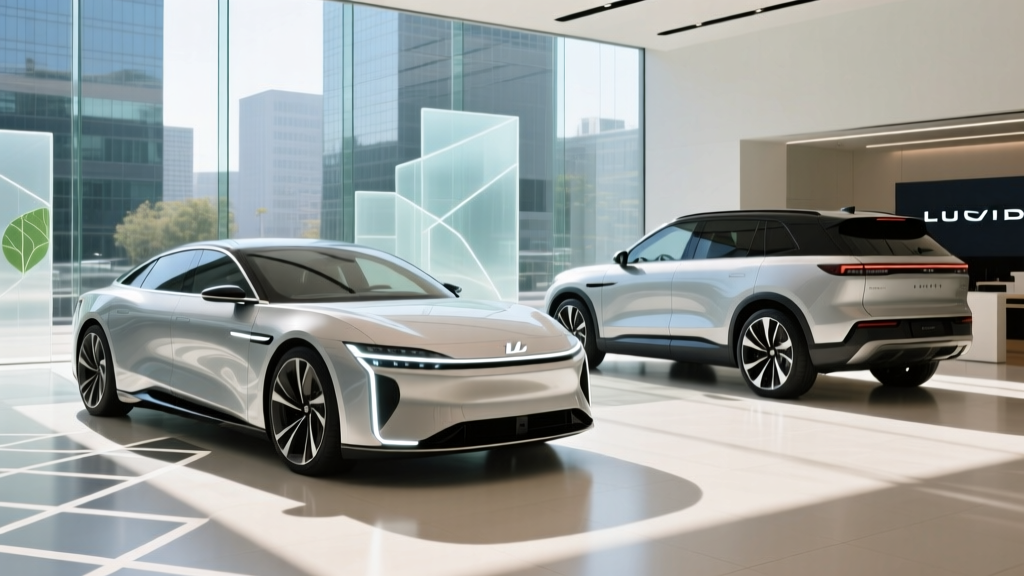
As of the 2026 model year, Lucid produces two vehicles: the Lucid Air luxury sedan and the Lucid Gravity three-row SUV. Both share Lucid's proprietary 900V+ electrical architecture, which enables class-leading charging speeds and efficiency figures that competitors still struggle to match.
2026 Lucid Air: Range, Efficiency, and Battery Tech
The Lucid Air remains the efficiency benchmark in the luxury EV sedan segment. The lineup spans from the single-motor Pure to the tri-motor Sapphire, with EPA range figures that top nearly every competitor.
| Spec | Air Pure | Air Touring | Air Grand Touring | Air Sapphire |
|---|---|---|---|---|
| EPA Range | 419 mi | 425 mi | 516 mi | 427 mi |
| Battery (usable) | 88 kWh (NMC) | 112 kWh (NMC) | 112 kWh (NMC) | 118 kWh (NMC) |
| Drivetrain | RWD (single motor) | AWD (dual motor) | AWD (dual motor) | AWD (tri-motor) |
| Horsepower | 430 hp | 620 hp | 819 hp | 1,234 hp |
| 0-60 mph | 5.0 sec | 3.4 sec | 3.0 sec | 1.89 sec |
| MPGe (combined) | 146 MPGe | 134 MPGe | 131 MPGe | 116 MPGe |
| Efficiency (kWh/100mi) | 23 | 25 | 26 | 29 |
| Base MSRP | $69,900 | $87,400 | $110,900 | $249,000 |
The Air Grand Touring's 516-mile EPA sticker is extraordinary, but real-world results depend on conditions. In mixed highway driving at 70-75 mph, expect approximately 400-440 miles. In cold weather (below 32°F), range drops 15-25%, landing around 340-380 miles. The Air Pure's 419-mile EPA figure translates to roughly 340-360 miles in highway-heavy commutes. Lucid's heat pump and thermal management system help mitigate cold-weather losses, but physics still applies.
All Air trims use nickel-manganese-cobalt (NMC) lithium-ion cells. Lucid's proprietary battery pack design uses a miniaturized cell format and advanced cooling channels that contribute to both the high energy density and the sustained power delivery. Unlike LFP chemistry found in some budget EVs, NMC delivers higher energy density — critical for achieving 500+ miles without an excessively heavy pack.
Charging Speed: 900V Architecture in Practice
Lucid's 900V+ electrical architecture is one of the highest-voltage platforms in production, rivaling Hyundai/Kia's E-GMP and exceeding most 400V competitors. Here is what charging looks like across all three levels:
| Charging Level | Power / Rate | Speed (Approx.) |
|---|---|---|
| Level 1 (120V household) | ~1.4 kW | ~5-6 miles per hour |
| Level 2 (240V home, 48A) | 11.5 kW | ~46 miles per hour |
| DC Fast Charge (peak) | Up to 300 kW (Grand Touring) | 10-80% in ~20 minutes |
| DC Fast Charge (Pure/Touring) | Up to 220-250 kW | 10-80% in ~25-30 minutes |
A critical nuance: peak kW is not sustained kW. The Grand Touring hits 300 kW only at a low state of charge (around 10-15%) on a compatible 350 kW charger, then tapers progressively. Average power from 10-80% is closer to 180-200 kW. Still, the 900V architecture means the taper is less severe than 400V vehicles, and the ~20-minute 10-80% time is genuinely competitive with the fastest-charging EVs on sale.
For home charging, the 11.5 kW onboard charger replenishes the 112 kWh pack from empty in roughly 10-11 hours. Most owners will plug in nightly and never deplete below 20%, making home Level 2 more than adequate. Preconditioning the battery before arriving at a DC fast charger — a feature built into the Air's navigation system — is essential for achieving peak charge speeds.
2026 Lucid Gravity: The Three-Row SUV Expansion
The Lucid Gravity, which began deliveries in late 2024 and is now in full production for 2026, extends Lucid's powertrain technology into a three-row luxury SUV. It targets the Tesla Model X, Rivian R1S, and BMW iX buyer who needs more space.
| Spec | Gravity Pure (est.) | Gravity Touring | Gravity Grand Touring |
|---|---|---|---|
| EPA Range | ~390 mi | 440 mi | 450+ mi |
| Battery (usable) | ~112 kWh (NMC) | 112 kWh (NMC) | 118 kWh (NMC) |
| Drivetrain | RWD | AWD (dual motor) | AWD (dual motor) |
| Horsepower | ~500 hp | 620 hp | 819 hp |
| 0-60 mph | ~5.5 sec | 3.5 sec | 3.0 sec |
| Cargo (behind 3rd row) | ~28 cu ft (all rows up) / ~80 cu ft (folded) | ||
| Base MSRP | ~$79,900 | $94,900 | $119,900 |
The Gravity shares the Air's 900V architecture, meaning DC fast-charging speeds are comparable. Its SUV form factor sacrifices roughly 50-70 miles of range versus an equivalently equipped Air due to increased weight and frontal area, but 440+ miles in a three-row electric SUV is still segment-leading.
Interior, Tech, and Driver Assistance
Lucid's interior design philosophy centers on what the company calls "post-luxury" — minimal ornamentation, expansive glass, and a focus on space efficiency. Key dimensions and features include:
- Lucid Air rear legroom: 36.6 inches (competitive with the Mercedes EQS and BMW i7)
- Lucid Air cargo: 32 cu ft (trunk + frunk combined)
- Gravity passenger capacity: 7 seats (standard), with optional 6-seat captain's chair configuration
- Gravity front trunk (frunk): ~12 cu ft — large enough for a full carry-on
The infotainment system uses a 34-inch curved glass cockpit display (dubbed the "Glass Canopy") supplemented by a lower retractable touchscreen for secondary controls. Lucid runs its own software stack rather than Android Automotive, which gives the company full update control but means no native Google Maps or Play Store integration — Apple CarPlay is supported wirelessly.
Lucid's DreamDrive Pro system is a Level 2 driver-assistance system per SAE classification. It includes adaptive cruise control, lane centering, automatic emergency braking, and blind-spot intervention. It is NOT autonomous or "self-driving" — the driver must remain attentive and keep hands on the wheel at all times. DreamDrive uses a lidar sensor (on Grand Touring and Sapphire trims) combined with cameras and radar, providing strong highway cruising support, but it does not match Tesla's FSD Supervised or GM's Super Cruise in hands-free operational design domain coverage.
Pricing, Tax Credit Eligibility, and Ownership Costs
Lucid positions itself firmly in the luxury segment, and pricing reflects that. However, the federal EV tax credit under IRS §30D introduces important eligibility nuances.
| Trim | Base MSRP | §30D Credit Eligible? | Effective Price (if eligible) |
|---|---|---|---|
| Air Pure | $69,900 | Yes (sedan MSRP cap: $55,000 — does NOT qualify) | $69,900 |
| Air Touring | $87,400 | No (exceeds $55,000 sedan cap) | $87,400 |
| Air Grand Touring | $110,900 | No (exceeds $55,000 sedan cap) | $110,900 |
| Air Sapphire | $249,000 | No | $249,000 |
| Gravity Pure | ~$79,900 | No (exceeds $80,000 SUV cap) | ~$79,900 |
| Gravity Touring | $94,900 | No (exceeds $80,000 SUV cap) | $94,900 |
| Gravity Grand Touring | $119,900 | No | $119,900 |
- Sedan MSRP cap: $55,000 — SUV/Van/Pickup cap: $80,000
- Buyer income cap: $150,000 single / $300,000 joint (modified AGI)
- Battery critical minerals and component sourcing requirements must be met
- Credit can be transferred to the dealer at point of sale as a price reduction
- Full rules at IRS.gov — consult a tax professional for your specific situation
The reality: no current Lucid model qualifies for the federal §30D new-vehicle tax credit because every trim exceeds the MSRP cap for its vehicle class. Buyers should check for state and local incentives (California's CVRP, for example, has its own income and price caps) and factor in Lucid's strong efficiency as a long-term offset — lower kWh/100mi means lower electricity costs over the vehicle's life.
Warranty and Long-Term Ownership
Lucid provides the following warranty coverage for the 2026 model year:
- Basic vehicle warranty: 4 years / 50,000 miles
- Battery and powertrain warranty: 8 years / 100,000 miles (capacity retention threshold: 70% minimum)
- Roadside assistance: 4 years / 50,000 miles
The 8-year/100,000-mile battery warranty with a 70% capacity floor is standard for the luxury EV segment (Tesla offers a similar 8-year structure with 120,000-150,000 miles depending on model). Lucid's NMC cells have demonstrated strong calendar and cycle-life performance in the Air fleet so far, with most high-mileage owners reporting degradation in the 5-8% range after 50,000+ miles, though long-term data beyond 100,000 miles is still accumulating.
Pros, Cons, and Who Should Buy a Lucid
- Best-in-class EPA range (Air Grand Touring: 516 mi)
- Outstanding efficiency (23 kWh/100mi on Air Pure)
- 900V architecture enables fast DC charging (~20 min 10-80%)
- Spacious interior with generous rear legroom
- Refined ride quality and quiet cabin
- Sapphire trim offers hypercar performance (1,234 hp, 1.89s 0-60)
- Strong over-the-air update cadence
- No federal tax credit eligibility (all trims above MSRP caps)
- Limited service center network vs. Tesla or legacy luxury brands
- DreamDrive is solid but behind Tesla FSD and GM Super Cruise in hands-free coverage
- No native Google Automotive — reliance on CarPlay for familiar nav
- Higher insurance premiums typical of luxury EVs
- Relatively new brand — long-term reliability data still maturing
- Resale value uncertain compared to established luxury marques
- Choose Lucid Air if: You prioritize maximum range and efficiency in a luxury sedan, want a distinctive alternative to the Tesla Model S or Mercedes EQS, and have reliable home charging access.
- Choose Lucid Gravity if: You need three rows and SUV practicality with 400+ miles of range, and you're cross-shopping the Rivian R1S, Tesla Model X, or BMW iX but want superior efficiency.
- Look elsewhere if: Federal tax credit eligibility is a dealbreaker (consider the Hyundai Ioniq 6, Tesla Model 3, or Chevrolet Equinox EV), you need a large service network, or you want hands-free highway driving (GM Super Cruise vehicles).
Frequently Asked Questions
Who makes Lucid cars and where are they built?
Lucid Group, Inc. designs and manufactures its vehicles at the AMP-1 factory in Casa Grande, Arizona. The company is headquartered in Newark, California, and is publicly traded (NASDAQ: LCID) with majority backing from Saudi Arabia's Public Investment Fund.
What is the real-world range of the Lucid Air?
The EPA rates the Air Grand Touring at 516 miles and the Air Pure at 419 miles. In real-world highway driving at 70-75 mph, expect approximately 400-440 miles for the Grand Touring and 340-360 miles for the Pure. Cold weather (below freezing) reduces these figures by 15-25%.
How fast does a Lucid charge at home and on the road?
At home on a 240V Level 2 charger (48A), the Air charges at 11.5 kW, adding roughly 46 miles of range per hour. On a DC fast charger, the Grand Touring peaks at 300 kW and achieves a 10-80% charge in approximately 20 minutes. The Pure and Touring trims peak at 220-250 kW with 10-80% times of 25-30 minutes.
Does the Lucid Air or Gravity qualify for the federal EV tax credit?
No. Under current IRS §30D rules, sedans must have an MSRP at or below $55,000 and SUVs at or below $80,000 to qualify. All Lucid trims exceed these caps. State incentives may still apply — check your local program.
Is the Lucid Air worth buying vs. the Tesla Model S or Mercedes EQS?
The Air Grand Touring offers more EPA range (516 mi vs. Model S's ~405 mi and EQS's ~390 mi) and better efficiency. The Model S benefits from the Supercharger network (though Lucid now has NACS access via adapter on newer models) and more mature Autopilot functionality. The EQS offers a more established dealer and service network. If range and efficiency are your top priorities, the Air leads the segment.
What battery chemistry does Lucid use?
Lucid uses NMC (nickel-manganese-cobalt) lithium-ion cells across all Air and Gravity trims. NMC provides higher energy density than LFP chemistry, enabling the Air's class-leading range without excessive pack weight. The trade-off is that NMC cells are more expensive and have slightly different long-term degradation characteristics, though Lucid's thermal management system mitigates this.
How does Lucid's service network compare to Tesla or legacy brands?
Lucid operates a growing network of service centers and mobile service vans, but coverage is significantly thinner than Tesla's or BMW's. Major metro areas (California, Texas, Florida, New York) have better coverage; rural buyers should verify proximity to a service location before purchasing. Lucid also partners with third-party collision repair networks.
Sources: fueleconomy.gov (EPA range and efficiency data), IRS.gov (§30D tax credit rules), Lucid Motors official specifications.