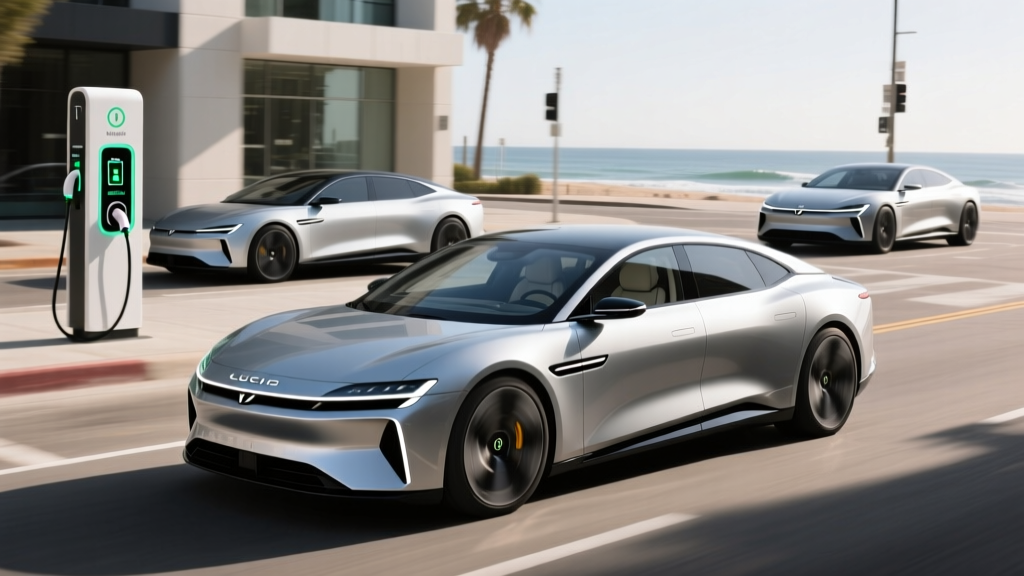
Lucid Motors entered 2026 with two production vehicles — the Air sedan and the newly launched Gravity SUV — and a sales trajectory that still trails Tesla, Hyundai/Kia, and even Rivian in volume. But for buyers researching Lucid sales, the more relevant question isn't how many units the company ships. It's whether these specific vehicles deliver on their spec-sheet promises in real-world driving, charging, and ownership costs.
This review breaks down the full 2026 Lucid lineup with the exact numbers that matter: EPA range versus highway reality, DC fast-charge curves, battery chemistry, §30D tax-credit eligibility, and total cost of ownership against key competitors.
2026 Lucid Air: Range, Efficiency, and Real-World Expectations
The Lucid Air remains one of the most range-efficient EVs ever built. The Air Pure (RWD) carries an 88 kWh usable battery pack (NMC lithium-ion) and achieves an EPA-estimated 419 miles of range. The Air Grand Touring (AWD, dual-motor) uses a 112 kWh usable pack and is EPA-rated at 516 miles — the highest of any production EV sold in the U.S.
| Trim | EPA Range | Battery (usable kWh) | Chemistry | MPGe (combined) | kWh/100 mi |
|---|---|---|---|---|---|
| Air Pure RWD | 419 mi | 88 | NMC | 146 | 23 |
| Air Touring AWD | 406 mi | 112 | NMC | 131 | 26 |
| Air Grand Touring AWD | 516 mi | 112 | NMC | 131 | 26 |
| Air Sapphire AWD | 427 mi | 118 | NMC | 121 | 28 |
Charging Speed: DC Fast Charge and Home Level 2
Lucid uses a 900V+ electrical architecture, which enables impressively fast DC charging — but the peak rate varies by trim. The Air Grand Touring peaks at approximately 300 kW on a compatible DC fast charger, adding roughly 200 miles of range in about 12 minutes. The Air Pure tops out near 200 kW.
| Metric | Air Pure | Air Grand Touring |
|---|---|---|
| Max DC Fast-Charge Rate | ~200 kW | ~300 kW |
| 10–80% DC Fast Charge | ~25 min | ~15 min |
| Level 2 Home Charging (kW) | 19.2 kW | 19.2 kW |
| Miles Added per Hour (L2) | ~58 mi/hr | ~58 mi/hr |
| Connector | NACS (native) | NACS (native) |
A critical nuance: peak kW is not sustained kW. The charge curve tapers significantly above 55–60% state of charge. On a road trip, you'll see 280–300 kW in the 10–30% SoC window on the Grand Touring, then a steady decline. This is normal for NMC chemistry, but it means the 10–80% time is a more honest metric than the headline peak rate.
At home, the Air's onboard charger supports up to 19.2 kW on a 48-amp (hardwired) Level 2 circuit — among the fastest in the industry. This means a full overnight charge from 20% to 100% takes roughly 5–6 hours on a properly installed 100-amp dedicated circuit. If your home panel can only support a 40-amp circuit (9.6 kW), expect roughly 29 miles of range per hour of charging.
Performance, Drivetrain, and Interior Space
The Air lineup spans from a refined commuter to a supercar-killer:
- Air Pure (RWD): 430 hp, 0–60 mph in 5.0 seconds
- Air Touring (AWD, dual-motor): 620 hp, 0–60 in 3.4 seconds
- Air Grand Touring (AWD): 819 hp, 0–60 in 3.0 seconds
- Air Sapphire (AWD, tri-motor): 1,234 hp, 0–60 in 1.89 seconds
Interior space is generous for a sedan. Rear legroom measures 37.3 inches — more than a Mercedes S-Class. Cargo volume is 32 cubic feet total (22 cu ft trunk plus 10 cu ft frunk), which rivals some midsize SUVs.
The infotainment system runs on a 34-inch curved glass cockpit display. Lucid's DreamDrive Pro ADAS suite includes adaptive cruise, lane centering, and automatic lane changes — but this is SAE Level 2 driver assistance, meaning you must remain fully engaged with hands on or near the wheel. It is not self-driving.
2026 Lucid Gravity: The SUV Enters the Lineup
The Lucid Gravity began customer deliveries in late 2025 and is Lucid's volume play for 2026. It shares the Air's 900V architecture and NMC battery technology but in a three-row SUV package.
| Trim | EPA Range | Battery (kWh) | HP | 0–60 mph | Max DC kW | 10–80% Time |
|---|---|---|---|---|---|---|
| Gravity Pure (RWD) | ~370 mi | 112 | 480 | 5.5 sec | ~250 kW | ~20 min |
| Gravity Grand Touring (AWD) | ~440 mi | 123 | 823 | 3.5 sec | ~300 kW | ~17 min |
The Gravity offers 105.9 cu ft of passenger volume and up to 112 cu ft of cargo space with both rear rows folded — competitive with the Tesla Model X and BMW iX. Towing capacity is rated at 6,000 pounds. Third-row seats accommodate adults on shorter trips, though legroom (30.5 inches) is tight for long journeys.
Pricing, Tax Credits, and Total Cost of Ownership
Lucid pricing positions the brand firmly in the luxury segment. Here's where each trim lands and how federal incentives factor in:
| Model/Trim | Base MSRP | §30D Credit Eligible? | Est. After-Credit Price |
|---|---|---|---|
| Air Pure | $69,900 | Yes (meets MSRP & sourcing caps) | $62,400 |
| Air Touring | $77,900 | No (sedan MSRP cap is $55,000) | $77,900 |
| Air Grand Touring | $94,900 | No (exceeds $55K sedan cap) | $94,900 |
| Air Sapphire | $249,000 | No | $249,000 |
| Gravity Pure | $79,900 | Yes (SUV MSRP cap is $80,000) | $72,400 |
| Gravity Grand Touring | $94,900 | No (exceeds $80K SUV cap) | $94,900 |
Critical caveats on the §30D federal tax credit: The $7,500 credit requires the buyer to meet income thresholds (AGI below $150,000 single / $300,000 joint), the vehicle must satisfy critical-mineral and battery-component sourcing requirements, and the MSRP must not exceed $55,000 for sedans or $80,000 for SUVs/vans/pickups. Only the Air Pure and Gravity Pure currently clear these bars. Lucid's point-of-sale credit transfer allows eligible buyers to apply the credit at purchase rather than waiting for a tax refund. Always verify current-year sourcing compliance with your dealer and consult a tax professional.
Warranty, Ownership Costs, and Competitor Comparison
Lucid provides an 8-year/100,000-mile battery and powertrain warranty, with a capacity-retention threshold of 70% during the warranty period. The basic vehicle warranty is 5 years/60,000 miles. This is competitive with Tesla (8-yr/120,000-mi on Model S) and slightly below Hyundai's 10-yr/100,000-mi coverage.
Insurance costs for the Air run 15–25% higher than comparable luxury sedans, reflecting repair-cost data and low parts availability. Annual maintenance is minimal — no oil changes, and brake pad life extends well past 80,000 miles thanks to regenerative braking.
- Class-leading EPA range (516 mi Grand Touring)
- Best-in-class efficiency (23 kWh/100 mi on Pure)
- 900V architecture enables fast DC charging
- Spacious interior with sedan-rivaling cargo volume
- 19.2 kW onboard L2 charger (fastest in class)
- Limited service center network outside major metros
- Higher insurance premiums than rivals
- Most trims ineligible for §30D tax credit
- Infotainment learning curve; no Apple CarPlay
- Resale values still uncertain vs. Tesla/Porsche
Who Should Buy a Lucid — and Who Shouldn't
- Choose Lucid Air if: You prioritize maximum range and efficiency above all else, drive long highway commutes, want luxury-sedan comfort without the Mercedes/EQS price premium, and can home-charge reliably.
- Choose Lucid Gravity if: You need three rows, want EV range north of 400 miles in an SUV, and are willing to trade some charging-network convenience (vs. Tesla) for superior interior space and ride quality.
- Look elsewhere if: You live far from a Lucid service center, you need maximum fast-charging network access (Tesla's Supercharger network remains denser), your budget is below $65,000, or you want proven long-term resale value.
Lucid Sales Outlook: What Volume Numbers Mean for Buyers
Lucid's 2025 deliveries were approximately 8,400 vehicles globally, and the company has targeted 20,000+ for 2026 with Gravity production ramping. Low sales volume means two things for buyers: first, you're unlikely to see another Lucid at every stoplight — exclusivity has value. Second, the limited service network (roughly 25 U.S. locations plus mobile service vans) is a genuine ownership constraint if you live outside a major metro. Lucid's mobile service handles many software and minor hardware issues, but collision repair and high-voltage battery work require a physical service center.
On the used market, Lucid Air resale values have depreciated 35–45% over the first two years — steeper than Tesla but in line with other luxury EV startups. This makes 2-year-old Air models an exceptional value for second buyers but a concern for new purchasers planning to sell within three years.
Frequently Asked Questions
What is the real-world range of the Lucid Air?
The EPA rates the Air Grand Touring at 516 miles and the Air Pure at 419 miles. In real-world highway driving at 70–75 mph, expect roughly 400–430 miles (Grand Touring) and 340–360 miles (Pure). Cold weather reduces these figures by 20–30%.
How fast does a Lucid charge at home and on the road?
On a DC fast charger, the Air Grand Touring peaks near 300 kW and charges 10–80% in about 15 minutes. At home on a 48-amp Level 2 station, all Air trims charge at up to 19.2 kW, adding approximately 58 miles of range per hour.
Does the Lucid Air qualify for the $7,500 federal tax credit?
Only the Air Pure ($69,900 MSRP) qualifies, and only if the buyer meets IRS income caps (under $150K single / $300K joint) and the vehicle meets critical-mineral and battery-component sourcing rules. Higher trims exceed the $55,000 sedan MSRP cap and are ineligible. Verify details at irs.gov.
Is the Lucid Air worth buying over a Tesla Model S or Mercedes EQS?
The Air beats the Model S on interior luxury, ride comfort, and efficiency. It beats the EQS on range and charging speed. The Tesla wins on Supercharger network access and software polish. The Mercedes wins on dealer service availability. If range and efficiency are your top priorities, the Air is the strongest choice in the segment.
What are the biggest risks of owning a Lucid?
Service-center proximity is the primary concern — if you're more than 90 minutes from a Lucid facility, collision or high-voltage repairs become logistically difficult. Insurance costs run higher than rivals, and long-term resale values remain unproven compared to established luxury brands.
Does the Lucid Gravity have three usable rows?
Yes, but the third row is best for children or adults on short trips. Third-row legroom is 30.5 inches. With all rows in use, cargo space behind the third row is limited to roughly 18 cu ft — enough for a few grocery bags or carry-on luggage.