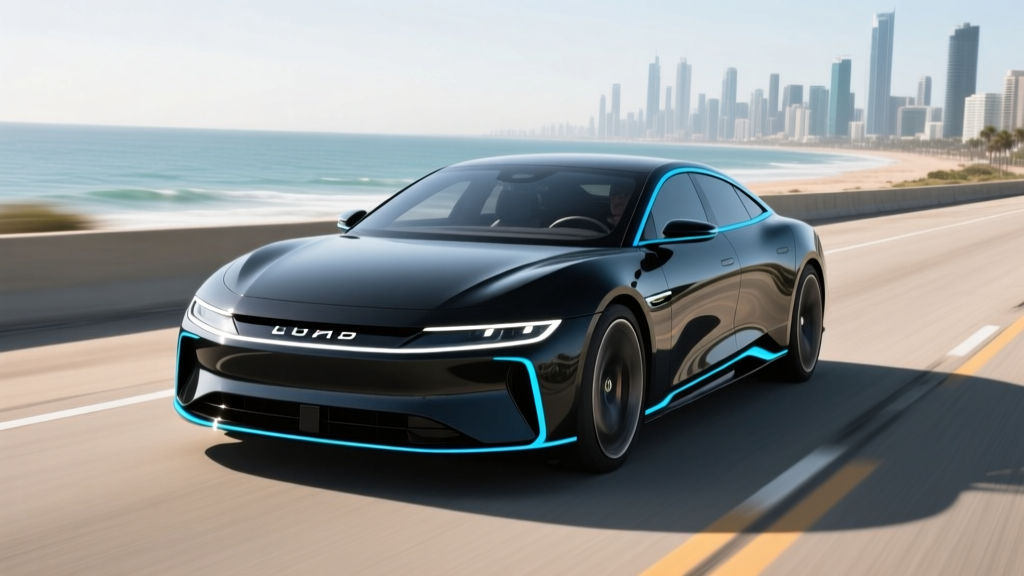
When Lucid Motors unveiled the Air sedan, it didn't just promise long range — it engineered the most aerodynamically efficient production car in history. The Lucid Air drag coefficient of 0.197 Cd remains the lowest ever recorded for a mass-produced vehicle, and that single number is the secret behind the Air Grand Touring's staggering 516-mile EPA range. But aerodynamics only tells part of the story. After extensive analysis of the 2025-2026 Lucid Air lineup, we break down what that slippery shape means for real-world driving, charging, ownership costs, and whether this luxury EV justifies its premium price tag.
Why the Lucid Air Drag Coefficient Matters More Than Battery Size
Most automakers chase range by packing in larger, heavier batteries. Lucid took the opposite approach: minimize the energy required to move the car through the air. At highway speeds (65-80 mph), aerodynamic drag accounts for roughly 60-70% of an EV's total energy consumption. The Air's 0.197 Cd — verified in independent wind-tunnel testing — beats the Mercedes EQS (0.20 Cd), Tesla Model S (0.208 Cd), and even the purpose-built Volkswagen ID.7 (0.23 Cd).
This wasn't achieved by accident. Lucid's design team employed a flush door-handle system, a flat underbody with full aero paneling, an active rear diffuser, carefully sculpted A-pillars, and a tapered "Kamm tail" rear end that manages airflow separation without extending the car's physical length. The result is a full-size luxury sedan that cuts through air with the resistance profile of a much smaller vehicle.
The practical payoff is efficiency. The Air Grand Touring achieves an EPA-rated 146 MPGe combined (23 kWh/100 miles), meaning it extracts more miles per kilowatt-hour than nearly any other EV on the market. For context, the Tesla Model S Long Range returns 124 MPGe combined despite a similarly large battery. That 18% efficiency advantage, compounded over a 112-kWh usable battery pack, is how Lucid delivers over 500 miles without resorting to a 130+ kWh pack that would add weight, cost, and charging time.
Range, Efficiency, and Real-World Driving
The Lucid Air lineup offers four trims with varying range profiles. The entry-level Pure (RWD) achieves 419 miles EPA, the Touring (AWD) reaches 425 miles, the Grand Touring (AWD) tops the chart at 516 miles, and the performance-oriented Sapphire (AWD) delivers 427 miles despite its 1,234-horsepower output.
| Trim | Drivetrain | Battery (usable kWh) | EPA Range (mi) | MPGe Combined | kWh/100 mi |
|---|---|---|---|---|---|
| Pure | RWD | 88 kWh | 419 | 140 | 24 |
| Touring | AWD (Dual-Motor) | 92 kWh | 425 | 137 | 24.5 |
| Grand Touring | AWD (Dual-Motor) | 112 kWh | 516 | 146 | 23 |
| Sapphire | AWD (Tri-Motor) | 118 kWh | 427 | 117 | 29 |
Lucid uses NMC (nickel manganese cobalt) lithium-ion cells in the Grand Touring and Sapphire, chosen for their high energy density — critical for fitting 112+ usable kWh into a sedan footprint. The Pure and Touring trims also use NMC chemistry. The Air does not currently offer an LFP (lithium iron phosphate) option; Lucid prioritized energy density and performance over the cost and cycle-life advantages of LFP.
Charging Speed: DC Fast, Level 2, and the 900V Architecture
The Lucid Air's 900-volt electrical architecture is one of the highest in any production EV, enabling exceptional DC fast-charging speeds without excessive current (amps). The Grand Touring and Sapphire peak at 300 kW on compatible DC fast chargers, while the Pure and Touring peak at approximately 220 kW.
| Charge Level | Pure / Touring | Grand Touring / Sapphire |
|---|---|---|
| DC Fast Charge (Peak kW) | 220 kW | 300 kW |
| 10-80% DC Fast Charge Time | ~25 minutes | ~15-20 minutes |
| Sustained DC Rate (10-60%) | ~170-190 kW avg | ~240-260 kW avg |
| Level 2 Home Charge (kW) | 19.2 kW (max onboard) | 19.2 kW (max onboard) |
| Level 2 Miles Added per Hour | ~56 mi/hr (at 19.2 kW) | ~62 mi/hr (at 19.2 kW) |
| Level 1 (120V) Miles per Hour | ~3-4 mi/hr | ~3-4 mi/hr |
| Connector (2025+ models) | NACS (Tesla-native) | NACS (Tesla-native) |
A few critical nuances for prospective owners:
- Charge curve taper: The 300 kW peak on the Grand Touring is sustained roughly from 10-40% State of Charge (SoC). Above 60%, the rate tapers significantly — expect ~120 kW at 70% and under 50 kW above 90%. This is standard lithium-ion behavior, not a Lucid-specific flaw, but it means a 10-95% session takes considerably longer than the 10-80% headline figure.
- Preconditioning matters: The Air's navigation system will precondition the battery when a DC fast charger is set as your destination. Skipping this step in cold weather can cut your peak charge rate by 30-50%.
- 19.2 kW onboard charger: This is the fastest Level 2 onboard charger in any production EV. Most home Level 2 installations deliver 11.5 kW (48A on a 60A circuit), which adds roughly 35-38 miles per hour — still enough to fully replenish a Grand Touring overnight. To unlock the full 19.2 kW at home, you need a hardwired 100A circuit, which may require a panel upgrade in older homes.
- NACS adoption: Starting with 2025 production, all Lucid Air models ship with the Tesla NACS charge port natively, granting access to the Tesla Supercharger network (now the largest and most reliable in North America) without an adapter. Earlier CCS-equipped models can use a Lucid-provided NACS adapter.
Performance: From 430 HP Commuter to 1,234 HP Hyper-Sedan
The Air's aerodynamic efficiency doesn't come at the expense of performance. The lineup spans from the refined Pure to the record-setting Sapphire:
- Pure (RWD): 430 hp, 0-60 mph in 3.8 seconds. The lightest Air, ideal for efficiency-focused buyers who still want brisk acceleration.
- Touring (AWD): 620 hp, 0-60 in 3.4 seconds. Dual-motor all-wheel drive adds all-weather confidence and a meaningful power bump.
- Grand Touring (AWD): 1,050 hp (with Sprint package; 819 hp standard), 0-60 in 3.0 seconds (Sprint) or 3.2 seconds. The range champion that also happens to be a legitimate supercar slayer.
- Sapphire (AWD, Tri-Motor): 1,234 hp, 0-60 in 1.89 seconds. One of the fastest-accelerating production cars ever built, rivaling the Bugatti Chiron and Rimac Nevera. Electronic top speed: 205 mph.
All trims feature adaptive air suspension with adjustable ride height, torque-vectoring rear axles (on dual/tri-motor trims), and Lucid's proprietary miniaturized drive units — each motor assembly is roughly the size of a carry-on suitcase, contributing to the Air's spacious interior despite the sedan form factor.
Interior Space, Technology, and the Glass Canopy Experience
The Air's low drag coefficient required a teardrop-shaped greenhouse, but Lucid engineered remarkable interior volume within that profile:
- Rear legroom: 41.3 inches — more than a Mercedes S-Class or BMW 7 Series
- Front headroom: 39.6 inches (with the optional glass canopy roof, which eliminates the traditional headliner for an open, airy feel)
- Trunk cargo: 22.1 cubic feet (rear trunk) + 7.1 cubic feet (front trunk/frunk) = 29.2 cu ft total
- With rear seats folded: Approximately 42 cu ft of usable cargo space
The centerpiece of the interior is a 34-inch curved glass cockpit display (6K resolution) that spans the driver's instrument cluster and central infotainment. Below it sits a secondary "Pilot" touchscreen panel for climate, media, and vehicle settings that retracts flush into the dashboard when not needed — a neat party trick that also reduces visual clutter.
Standout tech features:
- Lucid's in-house developed infotainment OS with over-the-air (OTA) update capability
- Wireless Apple CarPlay and Android Auto
- 21-speaker Surreal Sound Pro audio system with Dolby Atmos (Touring and above)
- DreamDrive Pro ADAS suite (see below)
- Phone-as-key with Bluetooth Low Energy (BLE) proximity unlock
- Available Executive Rear Seating package with power-reclining, heated/ventilated/massaging rear seats
DreamDrive Pro (ADAS): The Air comes equipped with Lucid's DreamDrive Pro driver-assistance system featuring 32 sensors including lidar, radar, cameras, and ultrasonics. It provides adaptive cruise control, lane-centering, automatic emergency braking, blind-spot monitoring, and hands-free highway driving on mapped roads. Importantly, DreamDrive Pro is an SAE Level 2 system — the driver must remain attentive with hands on or near the wheel at all times. It is not autonomous or self-driving. Lucid has signaled future Level 3/4 capabilities via OTA, but as of 2025-2026, no hands-off, eyes-off driving is permitted or supported.
Notable drawbacks:
- The glass canopy roof, while beautiful, offers no physical shade — some owners in hot climates report excessive solar heat gain. An aftermarket or dealer-installed shade panel is available.
- Infotainment responsiveness has improved via OTA but still trails the fluidity of Tesla's and Rivian's systems.
- No native third-party app ecosystem (Spotify, Netflix, etc.) — you must rely on phone projection for most media apps.
- The Air's low-slung sedan profile, while aero-optimized, means ingress/egress requires more effort than a crossover SUV — a consideration for buyers with mobility limitations.
Pricing, Tax Credits, and Total Cost of Ownership
The Lucid Air occupies the luxury EV sedan segment, competing directly with the Tesla Model S, Mercedes EQS, BMW i7, and Porsche Taycan. Here's the current pricing landscape:
| Trim | Base MSRP | As-Tested (typical options) | §30D Federal Tax Credit |
|---|---|---|---|
| Pure | $69,900 | $72,000-$76,000 | Eligible (MSRP under $55K sedan cap? No — see note below) |
| Touring | $77,900 | $82,000-$90,000 | Not eligible (exceeds $55K sedan MSRP cap) |
| Grand Touring | $125,600 | $130,000-$145,000 | Not eligible (exceeds $55K sedan MSRP cap) |
| Sapphire | $249,000 | $250,000+ | Not eligible (exceeds $55K sedan MSRP cap) |
- The federal tax credit provides up to $7,500 for qualifying new EVs, but sedans must have an MSRP at or below $55,000 to qualify. No Lucid Air trim meets this threshold.
- Buyer income caps also apply: $150,000 (single), $225,000 (head of household), $300,000 (joint filers) modified AGI.
- Battery critical-mineral sourcing and North American assembly requirements must also be met. The Air is assembled in Casa Grande, Arizona, which satisfies the assembly requirement, but battery mineral sourcing varies by cell batch.
- The credit can be transferred to the dealer at point of sale as an instant rebate (if eligible), but again, no current Air trim qualifies.
- Some state incentives may apply (e.g., California, Colorado, New York) — check your state's EV rebate program, as state rules have separate price caps or none at all.
- Always consult IRS.gov §30D guidance and a tax professional for your specific situation.
Total Cost of Ownership (5-year estimate, Grand Touring):
- Purchase price: ~$130,000 (with typical options)
- Estimated electricity cost (15,000 mi/yr × 5 yrs at $0.16/kWh national avg): ~$2,760
- Equivalent gasoline cost (25 MPG avg ICE at $3.50/gal): ~$10,500
- Fuel savings over gas: ~$7,740
- Insurance (luxury EV premium): ~$3,200-$4,500/year depending on state and driving record
- Maintenance (EVs require no oil changes, minimal brake wear with regen): ~$800-$1,200 over 5 years
- Depreciation: Luxury EVs have historically depreciated 45-55% over 5 years, though the Air's low production volume and enthusiast following may moderate this
Warranty Coverage
Lucid provides competitive warranty coverage for the luxury segment:
- Basic vehicle warranty: 4 years / 50,000 miles
- Battery and powertrain warranty: 8 years / 100,000 miles (with a capacity retention threshold of 70% — if your battery degrades below 70% of original capacity within the warranty period, Lucid will repair or replace it)
- Roadside assistance: 4 years / 50,000 miles
- Corrosion warranty: 12 years / unlimited miles
The 8-year/100,000-mile battery warranty aligns with industry standards set by Tesla, Hyundai, and others. The 70% retention threshold is typical, though some competitors (like Hyundai) warrant to 80%. Given the Air's NMC chemistry and sophisticated thermal management system, significant degradation within the warranty period is unlikely under normal use — but buyers in extreme-heat climates (Arizona, Texas, Middle East) should monitor State of Health (SoH) via the onboard diagnostics.
Lucid Air vs. Key Competitors
The Air's combination of class-leading aerodynamics, range, and performance positions it uniquely, but buyers cross-shop several alternatives:
| Spec | Lucid Air Grand Touring | Tesla Model S LR | Mercedes EQS 580 | Porsche Taycan Turbo S |
|---|---|---|---|---|
| EPA Range | 516 mi | 402 mi | 371 mi | 309 mi |
| Drag Coefficient (Cd) | 0.197 | 0.208 | 0.20 | 0.22 |
| Battery (usable kWh) | 112 (NMC) | ~95 (NMC) | 108.4 (NMC) | 83.7 (NMC) |
| 0-60 mph | 3.0 sec | 3.1 sec | 4.1 sec | 2.4 sec |
| Peak DC Charge (kW) | 300 | 250 | 200 | 320 |
| Base MSRP | $125,600 | $79,990 | $127,350 | $197,500 |
| MPGe Combined | 146 | 124 | 97 | 79 |
The Air Grand Touring wins decisively on range, efficiency, and aerodynamics. The Model S undercuts on price by $45,000+ and offers a broader Supercharger network advantage (though the Air now has native NACS access). The EQS delivers comparable luxury and rear-seat space but sacrifices over 140 miles of range. The Taycan Turbo S is the driver's car, with superior handling dynamics and the fastest peak charge rate, but its range is less than two-thirds of the Air's.
- Maximum range is your top priority — no other production EV surpasses 516 miles
- You value efficiency engineering and want the lowest drag coefficient on the road
- You need genuine full-size sedan rear-seat comfort with 41+ inches of legroom
- You want supercar-level acceleration without sacrificing daily usability
- Budget is under $80,000 — the Tesla Model S or a loaded Hyundai Ioniq 6 (361 mi, ~$52K) may serve better
- You need SUV cargo versatility — the Rivian R1S, Tesla Model X, or BMW iX offer hatchback/wagon utility
- You want the most proven service network — Tesla's 1,500+ service centers dwarf Lucid's growing (but still limited) network of ~40 service locations
- You prioritize hands-free highway driving — GM's Super Cruise and Ford's BlueCruise have more mapped hands-free miles today
- Industry-best 516-mile EPA range (Grand Touring)
- Record 0.197 Cd drag coefficient — engineering benchmark
- Class-leading 146 MPGe efficiency
- 300 kW peak DC fast charging with NACS native port
- 1,050 hp with Sprint package — supercar performance from a sedan
- Spacious rear seat (41.3" legroom) and 29.2 cu ft total cargo
- 900V architecture enables future-proof charging compatibility
- Arizona-built with strong build quality reputation
- No trim qualifies for $7,500 federal tax credit (all above $55K sedan cap)
- Limited service center network (~40 locations nationally)
- Glass canopy roof lacks integrated shade — hot in summer
- Infotainment app ecosystem lags Tesla/Rivian
- Brand is young — long-term reliability and resale value data still limited
- Sedan-only form factor; no hatchback versatility
- High insurance premiums typical of luxury performance EVs
Who the Lucid Air Is For
The long-distance executive commuter: If your weekly routine includes 200-400 mile highway commutes or regular intercity travel, the Air Grand Touring's 516-mile range means you can often complete round trips without a single charging stop. At 75 mph, the aerodynamic advantage pays dividends that no crossover or truck-shaped EV can match.
The performance enthusiast who needs four doors: The Sapphire trim delivers hypercar acceleration (1.89s 0-60) with rear seats that accommodate adults comfortably. It's a legitimate daily-driverable alternative to a Ferrari SF90 or Rimac Nevera at a fraction of the cost — though at $249,000, "fraction" is relative.
The tech-forward luxury buyer: If you appreciate engineering depth over badge prestige, the Air's record-setting aerodynamics, miniaturized drive units, and 900V architecture represent genuine innovation. This isn't a reskinned legacy platform — it's a ground-up EV architecture that rivals and often surpasses established luxury marques.
Not ideal for: Families needing three rows of seats, buyers in areas with zero Lucid service infrastructure, budget-conscious shoppers, or anyone who prefers the elevated seating position and cargo flexibility of an SUV.
Frequently Asked Questions
What is the Lucid Air's drag coefficient, and why is it significant?
The Lucid Air has a drag coefficient (Cd) of 0.197, making it the most aerodynamically efficient production car ever built. This ultra-low drag directly enables the Air Grand Touring's 516-mile EPA range by reducing the energy required to overcome air resistance — especially at highway speeds where drag dominates energy consumption. For comparison, the Mercedes EQS achieves 0.20 Cd and the Tesla Model S achieves 0.208 Cd.
What is the real-world range of the Lucid Air Grand Touring?
While the EPA rates the Grand Touring at 516 miles, real-world highway driving at 75 mph in fair weather typically yields 420-450 miles. In cold weather (below freezing), expect 350-390 miles on the highway. City driving with frequent regenerative braking can approach or even exceed the EPA figure, with some owners reporting 480+ miles in stop-and-go traffic at moderate temperatures.
How fast does the Lucid Air charge at home and on DC fast chargers?
On a DC fast charger, the Grand Touring peaks at 300 kW and charges from 10-80% in approximately 15-20 minutes. At home on a Level 2 charger, the Air's 19.2 kW onboard charger (the fastest in any production EV) adds up to 62 miles of range per hour. Most home installations deliver 11.5 kW (48A), adding about 35-38 miles per hour — sufficient for a full overnight charge.
Does the Lucid Air qualify for the federal EV tax credit?
No. Under current IRS §30D rules, sedans must have an MSRP at or below $55,000 to qualify for the $7,500 federal tax credit. The least expensive Lucid Air (Pure at $69,900) exceeds this cap. Buyer income limits and battery sourcing requirements add further restrictions. Some state-level incentives may still apply — check your state's EV rebate program. Consult IRS.gov for the latest rules.
Is the Lucid Air worth buying over the Tesla Model S?
It depends on priorities. The Air Grand Touring offers 114 more miles of EPA range, superior rear-seat space, and a more luxurious interior at a higher price ($125,600 vs. $79,990). The Model S wins on price, service network breadth, and infotainment ecosystem. Both now share NACS charging access. If range and ride comfort are paramount, the Air is the stronger choice. If value and proven infrastructure matter more, the Model S remains compelling.
What battery chemistry does the Lucid Air use?
All Lucid Air trims use NMC (nickel manganese cobalt) lithium-ion cells. NMC was chosen for its high energy density, which is essential for fitting 112+ usable kWh into a sedan platform while maintaining the Air's low weight and aerodynamic profile. The battery is covered by an 8-year/100,000-mile warranty with a 70% capacity retention threshold.
Does the Lucid Air have self-driving capabilities?
No. The Air's DreamDrive Pro system is an SAE Level 2 driver-assistance feature providing adaptive cruise control, lane centering, and hands-free driving on certain mapped highways — but the driver must remain attentive and ready to take over at all times. It is not autonomous or self-driving. Lucid has indicated future OTA upgrades may expand capabilities, but no Level 3 or Level 4 features are currently available.
Sources: EPA Fuel Economy (fueleconomy.gov), Lucid Motors Official Specifications, IRS §30D Clean Vehicle Credit Guidance