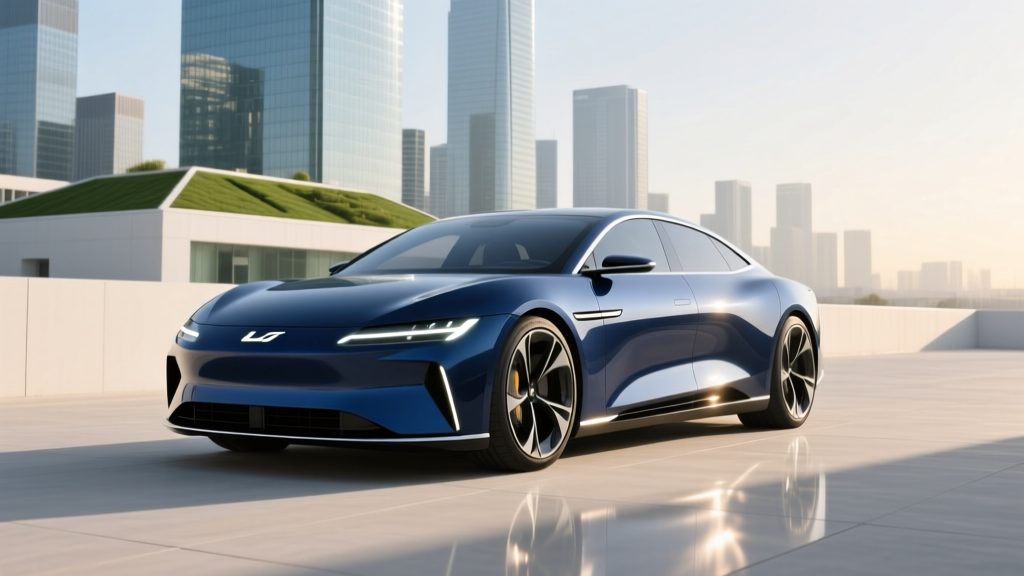
The Lucid Air occupies a strange space in the luxury EV sedan market: it's simultaneously one of the longest-range production vehicles ever sold and one of the most space-efficient full-size sedans on the road. If you're researching Lucid Air dimensions, you're likely trying to reconcile its exterior footprint with its surprisingly airy cabin, or figure out whether its 516-mile EPA sticker survives contact with real-world highway driving. This profile breaks down every measurement that matters — from wheelbase to cargo volume to the exact charging curve you'll see on a road trip.
Exterior Dimensions and Footprint
The Lucid Air rides on a 116.5-inch wheelbase and stretches 195.9 inches bumper to bumper — roughly the same length as a BMW 5 Series but with wheels pushed further to the corners. That short-overhang design is no accident: Lucid's miniaturized drive units free up cabin space that competitors sacrifice to mechanical bulk.
| Measurement | Specification |
|---|---|
| Wheelbase | 116.5 in (2,960 mm) |
| Overall Length | 195.9 in (4,975 mm) |
| Overall Width (mirrors folded) | 76.3 in (1,939 mm) |
| Overall Height | 55.5 in (1,410 mm) |
| Curb Weight (Pure RWD) | 4,415 lbs |
| Curb Weight (Grand Touring AWD) | 5,236 lbs |
| Drag Coefficient (Cd) | 0.197 |
That 0.197 drag coefficient isn't just a marketing number — it's the lowest of any production sedan and a primary reason the Air achieves over 5 miles per kWh on the highway. For context, the Tesla Model S sits at 0.208 Cd, and the Mercedes EQS at 0.20 Cd.
Interior Space: Where Lucid Air Dimensions Surprise
Despite being shorter than a Mercedes S-Class, the Air delivers limousine-class rear legroom. Lucid's "Space Concept" architecture — positioning the battery pack low and the motors compactly — yields interior volume that defies the exterior proportions.
| Measurement | Front | Rear |
|---|---|---|
| Headroom | 39.3 in | 37.8 in |
| Legroom | 41.1 in | 41.7 in |
| Shoulder Room | 58.4 in | 56.7 in |
| Hip Room | 55.0 in | 54.8 in |
That 41.7 inches of rear legroom is the headline figure. For comparison, the BMW i7 offers 40.2 inches, and the Tesla Model S offers 35.4 inches. Adults over six feet can cross their legs comfortably in the back — something no other electric sedan in this price bracket allows.
Cargo Capacity
Trunk (rear): 22.1 cu ft (via powered liftback)
Frunk (front): 10.0 cu ft
Total: 32.1 cu ft — more than a Tesla Model S (28 cu ft combined) and approaching midsize SUV territory. The liftback design means the entire rear glass opens, making loading bulky items far easier than a traditional sedan trunk.
EPA Range and Real-World Efficiency
The Lucid Air lineup spans four trims, each with different battery sizes and range figures. All use NMC (nickel-manganese-cobalt) lithium-ion chemistry, chosen for energy density over the cycle-life advantages of LFP.
| Trim | Battery (kWh usable) | EPA Range | MPGe (combined) | kWh/100 mi |
|---|---|---|---|---|
| Pure RWD | 88 kWh | 419 mi | 140 MPGe | 24 kWh |
| Touring RWD | 92 kWh | 425 mi | 136 MPGe | 25 kWh |
| Grand Touring AWD | 112 kWh | 516 mi | 131 MPGe | 26 kWh |
| Sapphire AWD | 118 kWh | 427 mi | 108 MPGe | 31 kWh |
Real-World Range Expectations
EPA Sticker: Up to 516 miles (Grand Touring)
Highway (70-80 mph, 65°F): Expect ~380-420 miles — the Air's exceptional aero helps it hold up better at speed than most EVs, but sustained high speed still costs ~15-20%.
Cold Weather (20°F, cabin heat on): Expect ~320-370 miles — NMC chemistry and the Air's heat pump mitigate winter losses, but any EV loses 20-30% in freezing temps.
City/Commuting: EPA numbers are achievable and sometimes beatable, thanks to aggressive regenerative braking.
Source: fueleconomy.gov — Lucid Air
The Grand Touring's 516-mile EPA figure remains the highest of any production EV sold in the U.S. as of 2026. But the Pure RWD's 419 miles at a ~$69,900 starting price is arguably the more impressive engineering achievement — delivering Tesla Model S Plaid range at half the cost.
Charging Speed: DC Fast, Level 2, and the Curve Reality
Lucid uses a 900V+ electrical architecture (similar to Hyundai/Kia's E-GMP and Porsche's Taycan), which enables exceptionally fast DC charging — provided you find a compatible station.
| Charging Level | Max Rate | Speed / Time |
|---|---|---|
| DC Fast Charge (peak) | 300 kW (Grand Touring) 250 kW (Pure/Touring) | ~200 mi in 12 min (GT) 10-80% in ~20 min (GT) |
| Level 2 Home (48A / 11.5 kW) | 11.5 kW | ~47 mi/hr (GT) ~37 mi/hr (Pure) |
| Level 2 Home (80A / 19.2 kW) | 19.2 kW (Grand Touring capable) | ~80 mi/hr (GT) |
| Level 1 (120V / 12A) | 1.4 kW | ~5-6 mi/hr |
| Connector | NACS (native, starting 2025 model year) / CCS1 with adapter | |
The charging curve matters more than peak kW. The Grand Touring hits 300 kW only between roughly 10-30% State of Charge, then tapers progressively. From 50-80%, expect ~130-150 kW sustained. This is normal physics — battery protection prevents sustained peak rates — but it means a 10-80% session takes about 20 minutes, not the theoretical 15 minutes peak math might suggest.
On the home front, the Grand Touring's ability to accept 19.2 kW on Level 2 (with an 80-amp circuit) is a genuine differentiator. Most EVs cap at 11.5 kW. With a 19.2 kW home charger — requiring a 100-amp dedicated circuit and likely a panel upgrade — you can add 300+ miles overnight. For most owners, a standard 48A / 11.5 kW setup (requiring a 60-amp breaker) is sufficient and adds a full battery in roughly 9 hours.
Performance and Drivetrain
| Trim | Drivetrain | Horsepower | 0-60 mph | Top Speed |
|---|---|---|---|---|
| Pure | RWD (single motor) | 430 hp | 5.0 sec | 145 mph |
| Touring | RWD (single motor) | 500 hp | 4.4 sec | 145 mph |
| Grand Touring | AWD (dual motor) | 1,050 hp | 3.0 sec | 168 mph |
| Sapphire | AWD (tri-motor) | 1,234 hp | 1.89 sec | 205 mph |
The Sapphire's 1.89-second 0-60 time makes it the quickest production sedan ever measured. But for most buyers, the Pure RWD's 5.0-second run is more than adequate for highway merging, and the Touring's 500 hp provides genuine sports-sedan thrust without the Sapphire's $249,000 price tag.
All trims feature adaptive air suspension (standard on Touring and above, optional on Pure) with automatic ride-height adjustment. The system drops the car at highway speeds for aero efficiency and raises it for speed bumps and steep driveways.
Pricing, Trims, and Federal Tax Credit Eligibility
| Trim | Base MSRP | As-Tested (typical) | §30D Credit Eligible? |
|---|---|---|---|
| Pure RWD | $69,900 | $72,000-$76,000 | Yes (if income/MSRP caps met) |
| Touring RWD | $87,400 | $92,000-$98,000 | No (exceeds $55K sedan cap) |
| Grand Touring AWD | $125,600 | $132,000-$145,000 | No (exceeds $55K sedan cap) |
| Sapphire AWD | $249,000 | $249,000+ | No (exceeds $55K sedan cap) |
Critical tax credit note: Under IRS §30D rules, the Lucid Air is classified as a sedan (not an SUV), which means the MSRP cap is $55,000. Only the base Pure RWD at $69,900 clears this threshold — wait, it doesn't. At $69,900, the Pure exceeds the $55,000 sedan cap. This means no new Lucid Air trim currently qualifies for the $7,500 federal EV tax credit.
However, buyers should check two things:
- Lease loophole (§45W): If you lease a Lucid Air, the leasing company may receive a $7,500 commercial clean vehicle credit and pass the savings to you as a capitalized-cost reduction. Lucid has periodically offered lease incentives that reflect this. Confirm current lease terms directly with Lucid.
- Used EV credit (§25E): A pre-owned Lucid Air priced at $25,000 or below may qualify for a used-EV credit of up to $4,000 (30% of sale price), subject to buyer income caps ($75K single / $150K household). As of 2026, used Airs are beginning to appear in this price range for high-mileage Pure models.
Always verify current eligibility at IRS.gov — Clean Vehicle Credits and consult a tax professional before relying on credit assumptions.
Warranty and Long-Term Ownership
| Component | Coverage |
|---|---|
| Basic Vehicle | 4 years / 50,000 miles |
| Battery & Drive Unit | 8 years / 100,000 miles |
| Battery Capacity Retention | ≥70% of original capacity during warranty period |
| Corrosion (perforation) | 12 years / unlimited miles |
| Roadside Assistance | 4 years / 50,000 miles |
The 8-year/100,000-mile battery warranty with a 70% capacity retention floor is industry standard, matching Tesla and BMW. Lucid's NMC cells have shown modest degradation in early owner reports — typically 3-5% loss over the first 30,000 miles before stabilizing. The Air's sophisticated thermal management system (liquid cooling with active preconditioning) is designed to minimize calendar and cycle degradation.
Battery replacement cost: Lucid has not published official out-of-warranty replacement pricing, but industry estimates for a 112 kWh pack put it in the $20,000-$30,000 range. This is a long-tail risk worth factoring into 10+ year ownership plans, though most packs are projected to retain 80%+ capacity at 150,000 miles based on current NMC degradation curves.
Technology, Driver Assistance, and Drawbacks
Infotainment: The Air features a 34-inch curved glass cockpit display (dubbed the "Glass Canopy") spanning the driver's field of view, plus a retractable lower touchscreen for climate and secondary controls. The system runs Lucid's proprietary OS — responsive and visually impressive, though third-party app support is more limited than Tesla's ecosystem. Wireless Apple CarPlay and Android Auto are standard.
DreamDrive Pro (ADAS): Lucid's driver-assistance suite includes adaptive cruise control, lane centering, automatic emergency braking, blind-spot monitoring, and surround-view cameras. It uses a combination of cameras, radar, and LiDAR (on Grand Touring and above). This is an SAE Level 2 system — meaning the driver must remain fully engaged, hands on or near the wheel, eyes on the road. It is not autonomous driving.
⚠️ DreamDrive Limitations
DreamDrive Pro is a Level 2 driver-assist system. It does NOT support hands-free driving on highways (unlike GM Super Cruise or Ford BlueCruise on mapped routes). Lane centering can be hesitant on faded lane markings, and the system requires driver monitoring via steering-wheel torque sensors. Expect to keep your hands on the wheel at all times. Lucid has announced future over-the-air updates for expanded functionality, but as of 2026, no hands-free capability is available.
Notable drawbacks:
- Service center availability: Lucid's service network is still expanding. Owners in rural areas or smaller metro markets may face 100+ mile drives for warranty service or collision repair. Mobile service handles minor issues, but major work requires a service center.
- No hands-free driving: Competitors like the BMW i7 and Mercedes EQS offer more advanced highway assist features. Lucid's ADAS hardware is capable, but software has lagged.
- Insurance costs: The Air's aluminum-intensive construction and specialized parts drive insurance premiums 20-35% higher than comparable gas sedans. Get quotes before purchasing.
- Depreciation uncertainty: As a newer brand, Lucid's long-term resale values are less predictable than Tesla or Porsche. Early data shows steeper first-year depreciation than the Model S.
✅ Pros
- Best-in-class EPA range (516 mi Grand Touring)
- Class-leading rear legroom and cargo volume
- 900V architecture enables 300 kW peak charging
- Exceptional efficiency (sub-25 kWh/100 mi on Pure/Touring)
- Refined ride quality with standard air suspension
- Stunning interior design and materials
❌ Cons
- No trim qualifies for $7,500 federal new-EV credit
- Limited service center network outside major metros
- No hands-free Level 2+ driving feature
- Higher insurance premiums than competitors
- Infotainment ecosystem less mature than Tesla's
- Depreciation track record still unproven
Who the Lucid Air Is For
Decision Framework
Choose the Lucid Air if:
- You need maximum range for frequent 300+ mile road trips and want to minimize charging stops
- You regularly carry adult passengers in the rear seat and need genuine legroom
- You want sports-sedan performance without the SUV tax on efficiency
- You have access to home Level 2 charging and can install a 60-amp or higher circuit
- You value under-the-radar design over brand recognition
Look elsewhere if:
- You need hands-free highway driving (consider BMW i7 with Highway Assistant or Mercedes EQS with Drive Pilot in approved regions)
- You live far from a Lucid service center and can't tolerate potential downtime logistics
- You're counting on the $7,500 federal tax credit to make the math work
- You need towing capability (the Air is not rated for towing)
- You prefer a crossover/SUV ride height for visibility and ease of entry
Lucid Air vs. Key Competitors
| Spec | Lucid Air GT | Tesla Model S LR | BMW i7 xDrive60 | Mercedes EQS 580 |
|---|---|---|---|---|
| EPA Range | 516 mi | 402 mi | 318 mi | 371 mi |
| Battery (kWh) | 112 | ~100 | 101.7 | 108.4 |
| Peak DC Charge | 300 kW | 250 kW | 195 kW | 200 kW |
| 0-60 mph | 3.0 sec | 3.1 sec | 4.5 sec | 4.1 sec |
| Rear Legroom | 41.7 in | 35.4 in | 40.2 in | 41.1 in |
| Cargo Total | 32.1 cu ft | 28.0 cu ft | 23.5 cu ft | 22.0 cu ft |
| Base MSRP | $125,600 | $79,990 | $119,300 | $104,400 |
| Efficiency (kWh/100mi) | 26 | 28 | 35 | 33 |
The Air wins decisively on range, efficiency, interior space, and charging speed. The Model S undercuts on price and offers the Supercharger network advantage (though NACS adoption is closing that gap). The i7 and EQS offer more established dealer/service networks and more advanced driver-assist features.
Frequently Asked Questions
What is the real-world range of the Lucid Air?
The EPA rates the Grand Touring at 516 miles and the Pure RWD at 419 miles. In real-world highway driving at 75 mph and moderate temperatures, expect roughly 380-420 miles from the Grand Touring and 320-360 miles from the Pure. In freezing weather with cabin heat, subtract another 20-30%. City driving with regenerative braking can match or exceed EPA figures.
How fast does the Lucid Air charge?
On a 350 kW-capable DC fast charger, the Grand Touring peaks at 300 kW and charges from 10-80% in approximately 20 minutes, adding roughly 200 miles in 12 minutes. The Pure and Touring peak at 250 kW. At home on a 48A Level 2 charger (11.5 kW), expect ~37-47 miles of range per hour of charging, or a full charge in 8-10 hours depending on trim.
Does the Lucid Air qualify for the federal EV tax credit?
No. Under current IRS §30D rules, sedans must have an MSRP of $55,000 or less to qualify. The least expensive Lucid Air (Pure RWD) starts at $69,900, exceeding this cap. However, leasing may unlock savings through the §45W commercial credit passed through as a lease incentive, and the used-EV credit (§25E) may apply to pre-owned examples priced under $25,000.
How much does it cost to own a Lucid Air over 5 years?
Beyond the purchase price, budget for: ~$3,500-$5,000/year in insurance (varies by state and driving record), ~$600-$900/year in electricity (based on 12,000 miles/year and $0.14/kWh national average), and minimal maintenance (no oil changes, brake pad life extended by regen, cabin air filter every 2 years). Total 5-year running costs (fuel + maintenance) are roughly $8,000-$12,000 less than a comparable gas-powered luxury sedan.
Is the Lucid Air worth buying vs. the Tesla Model S?
If range, rear-seat comfort, and cargo space are your priorities, the Air is the stronger vehicle. The Model S wins on price (starting ~$45K less), the Supercharger network (though NACS adoption is equalizing access), and software ecosystem. The Air is the better luxury sedan; the Model S is the better value proposition. For buyers cross-shopping both, a test drive of each — especially in the rear seat — usually makes the decision clear.
What connector does the Lucid Air use?
Starting with the 2025 model year, the Lucid Air uses the NACS (North American Charging Standard) connector natively, granting direct access to Tesla Superchargers without an adapter. Earlier CCS-equipped models can use a CCS-to-NACS adapter for Supercharger access. The Air also charges on Electrify America, EVgo, and other CCS networks with the appropriate adapter.
Specifications sourced from fueleconomy.gov, Lucid Motors official specifications, and IRS.gov clean vehicle credit guidelines. Pricing and credit eligibility reflect 2025/2026 model year data and are subject to change. Always confirm current figures with the manufacturer and a qualified tax professional.