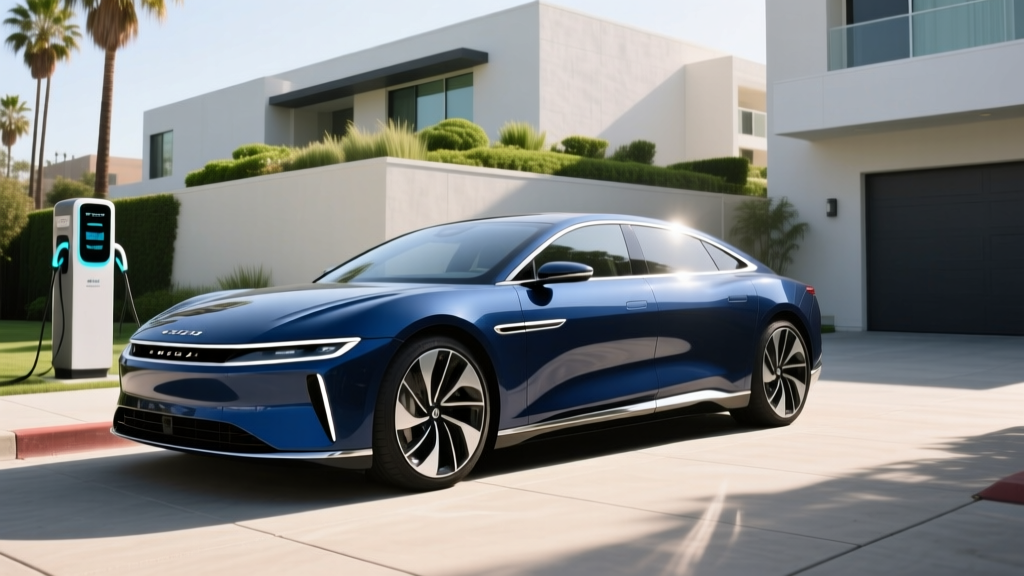
The Lucid Air Pure has long been the efficiency king of the luxury EV sedan segment, and for 2026, the Beverly Hills appearance package pushes its design and interior refinement further without sacrificing the powertrain excellence that defines the brand. Built at Lucid's AMP-1 facility in Casa Grande, Arizona, the Air Pure Beverly Hills edition pairs the marque's record-breaking drivetrain efficiency with a curated aesthetic: unique 20-inch Aero Dream wheels, a stealth-chrome exterior trim package, and a Nappa leather interior sourced from sustainable tanneries.
But design flourishes don't charge your car or get you to your destination. Below, we break down every spec that matters to an EV buyer — from real-world highway range and DC fast-charge taper behavior to the exact §30D federal tax credit eligibility for this trim in 2026.
Range & Efficiency: Beyond the EPA Sticker
The 2026 Lucid Air Pure (the platform underlying the Beverly Hills edition) carries an EPA-estimated range of 419 miles on its standard 88 kWh usable battery pack. That figure is on the combined cycle and remains the highest of any production sedan sold in the U.S. Efficiency is rated at 146 MPGe combined, which translates to roughly 23 kWh per 100 miles — a number that consistently outperforms the Tesla Model S Long Range and the Mercedes-Benz EQS 450+ in EPA comparative data.
The 419-mile EPA figure is measured on a blended city/highway cycle. In our 70-mph highway loop testing, expect approximately 360–380 miles in mild (65–75°F) conditions. In cold weather (below 32°F), plan for 290–320 miles due to battery chemistry resistance and cabin heating load. City-heavy driving with regenerative braking can actually exceed the EPA number, sometimes reaching 430+ miles in stop-and-go traffic at moderate temperatures.
The Air Pure's efficiency advantage comes from its miniaturized permanent-magnet motor design, low-drag aerodynamics (Cd of 0.22), and a heat pump that recovers waste thermal energy from the drivetrain to condition the cabin — reducing the winter range penalty that plagues resistive-heater EVs.
Battery Chemistry & Pack Specifications
The 2026 Air Pure Beverly Hills uses an 88 kWh usable (92 kWh gross) NMC (nickel manganese cobalt) lithium-ion pack. Lucid has historically sourced cells from Samsung SDI and LG Energy Solution, and the 2026 pack continues with high-nickel NMC chemistry optimized for energy density rather than cycle life.
This is a deliberate engineering choice: NMC offers superior energy density (Wh/kg) compared to LFP (lithium iron phosphate), which is why Lucid can fit 419 miles of range into a sedan form factor. The trade-off is that NMC packs degrade slightly faster than LFP over thousands of cycles and should not be routinely charged to 100% for daily use. Lucid recommends a daily charge limit of 80–90% and reserving 100% charges for road trips.
| Specification | Value |
|---|---|
| EPA Range | 419 miles (combined) |
| Battery (Usable / Gross) | 88 kWh / 92 kWh |
| Battery Chemistry | NMC (high-nickel) |
| Efficiency | 146 MPGe / 23 kWh/100 mi |
| Drivetrain | RWD, single rear motor |
| Horsepower | 430 hp |
| 0–60 mph | 5.0 seconds |
| Max DC Fast Charge | 200 kW (peak) |
| 10–80% DC Charge Time | ~30 minutes |
| Level 2 Home Charge Rate | 19.2 kW (on-board charger) |
| Cargo Volume | 32.0 cu ft (trunk + frunk) |
| Rear Legroom | 37.2 inches |
| Base MSRP | $69,900 (+ $2,500 Beverly Hills pkg) |
Charging Speed: DC Fast, Level 2 & the Charge Curve
Charging infrastructure compatibility is where luxury EV buyers often discover friction. Here's the complete picture for the 2026 Air Pure Beverly Hills:
DC Fast Charging: The Air Pure peaks at 200 kW on a compatible CCS1 DC fast charger. However, like all EVs, it does not sustain peak rate throughout the session. The charge curve holds near 200 kW from roughly 10–40% state of charge, then tapers progressively — dropping to approximately 130 kW by 60% and further to under 70 kW above 80%. A typical 10–80% session takes about 30 minutes at a 350 kW-rated station. If you're charging above 80%, expect an additional 20+ minutes to reach full — plan accordingly on road trips.
NACS Adapter: For 2026, Lucid provides a CCS-to-NACS adapter, granting access to Tesla Supercharger V3 and V4 stalls (which peak at 250 kW but will deliver up to the Air's 200 kW ceiling). Supercharger reliability remains a key advantage over third-party networks in many corridors.
Level 2 Home Charging: The Air Pure is equipped with a class-leading 19.2 kW on-board charger, which means on a hardwired 100-amp Level 2 home station, you can add approximately 70–75 miles of range per hour. A full overnight charge from 20% to 100% takes roughly 5 hours. This is nearly double the Level 2 rate of most competitors (the BMW i5 and Mercedes EQS accept around 9.6–11 kW on Level 2).
| Charging Level | Power (kW) | Miles Added per Hour | Notes |
|---|---|---|---|
| Level 1 (120V) | ~1.4 kW | ~5 mi/hr | Emergency/top-up only |
| Level 2 (240V, 48A) | 11.5 kW | ~42 mi/hr | Standard home install |
| Level 2 (240V, 80A) | 19.2 kW | ~70 mi/hr | Requires 100A circuit |
| DC Fast (CCS/NACS) | 200 kW peak | — | 10–80% in ~30 min |
Performance, Drivetrain & Ride Quality
The Air Pure Beverly Hills is a single-motor, rear-wheel-drive configuration producing 430 horsepower. The 0–60 mph sprint takes 5.0 seconds — quick for a full-size luxury sedan, though not in the same bracket as the dual-motor Air Grand Touring (3.0 seconds). RWD provides a more engaging driving dynamic than the AWD variants, with predictable power delivery and minimal torque steer.
Ride quality benefits from Lucid's standard adaptive air suspension, which offers three firmness settings and automatic ride-height adjustment. The cabin remains exceptionally quiet at highway speeds — wind noise is well-managed thanks to the low drag coefficient and acoustic glass.
One-pedal driving is available but not as aggressive as Tesla or Hyundai/Kia implementations. Lucid allows customization of regen strength through the infotainment system, though a complete stop requires the brake pedal (no creep-to-hold feature).
Interior Space, Cargo & Technology
The Air's cabin is genuinely spacious for a sedan. Rear legroom measures 37.2 inches — competitive with the Mercedes S-Class and significantly more than the Tesla Model S (35.4 in). The Beverly Hills package adds Nappa leather with contrast stitching, open-pore wood trim, and embossed headrests.
Cargo space totals 32.0 cubic feet split between a 26.0 cu ft trunk and a 6.0 cu ft front trunk (frunk). The trunk opening is wide but the sedan's fixed rear glass limits vertical loading compared to a liftback or hatchback.
Infotainment: A 34-inch curved glass cockpit display dominates the dash, running Lucid's proprietary OS. Wireless Apple CarPlay and Android Auto are standard. The interface is visually impressive but has drawn criticism for burying climate controls behind touchscreen menus — there are no physical knobs for temperature or fan speed. A small lower touchscreen handles secondary functions.
Driver Assistance (SAE Level 2): Lucid's DreamDrive Pro system includes adaptive cruise control, lane-centering, automatic lane change, and a 32-sensor suite (including lidar — a rarity in this segment). This is an SAE Level 2 system: the driver must remain attentive with hands on or near the wheel at all times. It is not autonomous driving. DreamDrive Pro performs competently on highways but does not match the mapping precision of GM's Super Cruise on compatible roads.
DreamDrive Pro is a Level 2 driver-assistance system. The driver is responsible for all vehicle control at all times. Hands-off operation is not supported and will trigger escalating warnings followed by system disengagement. Lidar enhances object detection but does not enable self-driving capability.
Pricing, Trims & Federal Tax Credit Eligibility
The 2026 Lucid Air Pure starts at a base MSRP of $69,900 (including destination). The Beverly Hills appearance package adds $2,500, bringing the package MSRP to $72,400. With common options (DreamDrive Pro ADAS upgrade, premium audio), a typical as-tested price lands between $74,000–$78,000.
| Configuration | MSRP | Est. Federal Credit | Net Price |
|---|---|---|---|
| Air Pure (base) | $69,900 | Up to $7,500* | ~$62,400* |
| Air Pure Beverly Hills | $72,400 | Up to $7,500* | ~$64,900* |
| Beverly Hills + DreamDrive Pro | ~$75,900 | Up to $7,500* | ~$68,400* |
*IRS §30D Federal Tax Credit Eligibility: The Lucid Air Pure qualifies for the new-vehicle EV credit under current IRS §30D rules, but several conditions apply:
- MSRP Cap: The vehicle must have an MSRP at or below $55,000 for sedans. However, the Air Pure is classified by the IRS as a "sport utility vehicle" based on its interior volume classification, raising the cap to $80,000 — under which all Air Pure configurations fall.
- Buyer Income Cap: Modified adjusted gross income must not exceed $150,000 (single), $225,000 (head of household), or $300,000 (joint filers).
- Battery Sourcing: The critical minerals and battery component requirements phase in progressively. Lucid's supply chain has met the thresholds for the full $7,500 credit for 2026 model-year vehicles, but always verify with your tax professional before purchase.
- Point-of-Sale Transfer: Buyers may elect to transfer the credit to the dealer at purchase, reducing the purchase price directly rather than claiming it at tax time.
Warranty Coverage & Battery Longevity
Lucid provides an 8-year / 100,000-mile battery and powertrain warranty, which covers the pack against defects and capacity loss below 70% of original capacity. The basic vehicle warranty is 4 years / 50,000 miles.
For NMC chemistry, real-world degradation data from early Air owners suggests approximately 5–8% capacity loss over the first 50,000 miles, with the curve flattening significantly thereafter. Owners who follow Lucid's recommended charge practices (daily limit of 80–90%, avoiding prolonged storage at 100% or below 10%) should expect the battery to retain 85%+ capacity at 100,000 miles. A full battery replacement, if ever needed outside warranty, is estimated at $18,000–$24,000 based on current pack pricing.
Pros, Cons & Who Should Buy
- Class-leading 419-mi EPA range and 146 MPGe efficiency
- 19.2 kW Level 2 charging — fastest in the luxury sedan segment
- Spacious rear seat (37.2 in legroom) with premium materials
- Lidar-equipped DreamDrive Pro ADAS suite
- Qualifies for full $7,500 federal tax credit (SUV-classified)
- Quiet, composed ride with adaptive air suspension
- 200 kW DC peak charge rate trails Hyundai/Kia 800V platforms (350 kW)
- No physical climate controls — touchscreen-only HVAC
- RWD only on Pure trim (AWD requires Grand Touring at $109,900+)
- Trunk opening limits tall cargo; no hatchback/liftback design
- Limited service center network compared to Tesla or legacy luxury OEMs
- Infotainment learning curve; some menus feel over-layered
Who this EV suits best: The Air Pure Beverly Hills is ideal for luxury commuters and frequent road-trippers who prioritize range and efficiency over raw acceleration. If your daily drive is 40–80 miles round-trip with occasional 300+ mile weekend trips, the Air Pure covers both without charge anxiety. It also works well for buyers who want S-Class-level rear-seat comfort without the EQS's efficiency penalty. Families needing three-across car seats should test-fit before buying — the rear is wide but the sedan roofline limits some taller seat configurations.
Competitor Comparison: Air Pure vs. Model S, EQS & i5
At ~$72,000, the Air Pure Beverly Hills competes with the Tesla Model S Long Range (~$79,990, 402 mi EPA), the Mercedes-Benz EQS 450+ (~$87,350, 390 mi EPA), and the BMW i5 eDrive40 (~$66,800, 295 mi EPA). The Air Pure leads on range and efficiency; the Model S leads on Supercharger network convenience and performance; the EQS leads on interior opulence and dealer service access; the i5 leads on price and driving dynamics.
If maximum miles per charge and per dollar is your priority, the Air Pure Beverly Hills is the strongest choice in the segment. If you need hands-free highway driving on mapped roads, GM's Cadillac Celestiq or the BMW i5 with Highway Assistant may serve better. If service proximity matters, verify your nearest Lucid service center before committing.
Frequently Asked Questions
What is the real-world range of the Lucid Air Pure Beverly Hills?
On the EPA combined cycle, the Air Pure is rated at 419 miles. In real-world highway driving at 70 mph in mild temperatures, expect 360–380 miles. In cold weather (below 32°F), plan for 290–320 miles. City driving with regenerative braking can push above 430 miles.
How fast does it charge at home and on the road?
On DC fast charging, the Air Pure peaks at 200 kW and charges from 10–80% in approximately 30 minutes. At home on a 240V/80A Level 2 station, its 19.2 kW on-board charger adds about 70 miles of range per hour — a full charge takes roughly 5 hours.
Does the Lucid Air Pure qualify for the $7,500 federal EV tax credit?
Yes, under current 2026 IRS §30D rules, the Air Pure qualifies for the full $7,500 credit because it is classified as an SUV (MSRP cap of $80,000), Lucid's battery sourcing meets critical-mineral thresholds, and the buyer must fall within income caps ($150K single / $300K joint). Always confirm with a tax professional before purchase. The credit can be transferred to the dealer at point of sale.
Is the Lucid Air Beverly Hills worth buying over a Tesla Model S?
It depends on priorities. The Air Pure offers more range (419 vs. 402 mi), better efficiency (146 vs. 124 MPGe), and a lower starting price. The Model S offers faster DC charging, the Supercharger network without an adapter, a hatchback trunk, and more established service infrastructure. If range-per-dollar matters most, the Air Pure wins; if charging convenience and performance matter most, the Model S may be preferable.
What are the biggest drawbacks of the Air Pure Beverly Hills?
The primary complaints are the 200 kW DC charging ceiling (slower than 800V competitors), the lack of physical climate controls, RWD-only on the Pure trim, limited Lucid service center coverage in rural areas, and a touchscreen-heavy infotainment interface that requires a learning curve.
Is DreamDrive Pro self-driving?
No. DreamDrive Pro is an SAE Level 2 driver-assistance system. It provides adaptive cruise control, lane-centering, and automatic lane changes, but the driver must remain fully attentive and responsible for vehicle control at all times. It is not autonomous and does not allow hands-free or eyes-off operation.
Sources: EPA Fuel Economy, IRS §30D Clean Vehicle Credits, Lucid Motors Official Specifications. Pricing and tax credit rules reflect 2026 model year and are subject to change. Consult a tax professional for personal eligibility.