The 2026 Lucid Air Lineup at a Glance
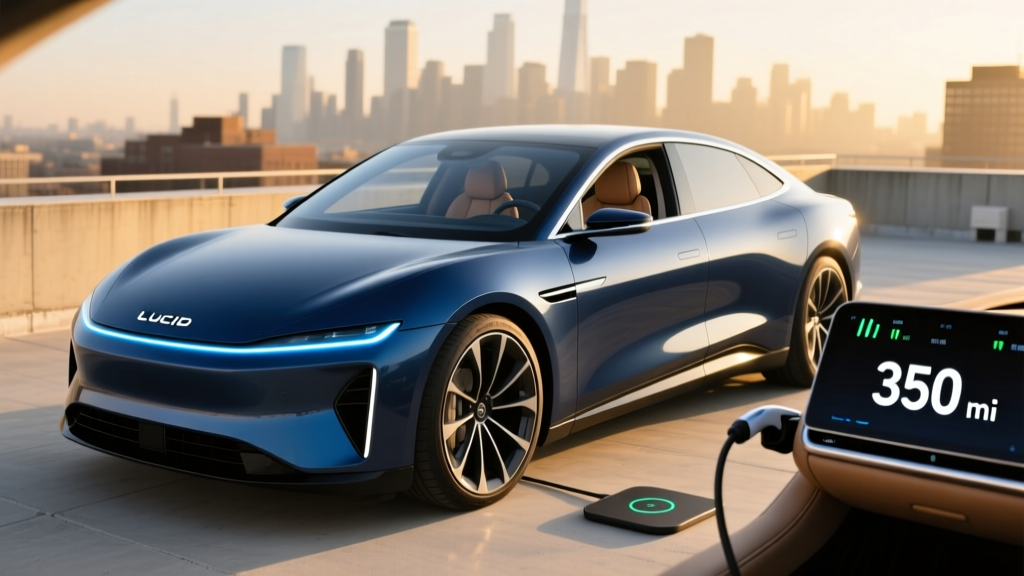
Lucid Motors positions the Air sedan as the efficiency benchmark among luxury EVs. For buyers browsing Lucid cars for sale in 2026, the lineup spans four trims — Pure, Touring, Grand Touring, and the performance flagship Sapphire — each built on Lucid's proprietary 900V+ architecture. That high-voltage platform is the engineering backbone enabling the Air's standout combination of range, charge speed, and interior volume in a sedan footprint.
This profile covers the exact specs, real-world range expectations, charging behavior, ownership costs, and federal tax credit rules you need before committing to a six-figure EV sedan.
EPA Range, Efficiency, and Real-World Expectations
The Lucid Air Grand Touring holds the production-sedan range crown with an EPA-estimated 516 miles on a full charge. But EPA stickers assume a mix of city and highway driving at moderate temperatures. Here is what each trim delivers on paper — and what to expect in practice.
EPA 516 mi (Grand Touring): Expect ~420–450 mi on highway-only road trips at 70–75 mph. In sub-freezing winter conditions, plan for 350–390 mi. The Air's heat pump and thermal management system mitigate cold-weather losses better than most competitors, but physics still applies.
EPA 419 mi (Pure RWD): Highway real-world sits around 340–370 mi; cold weather drops that to ~290–320 mi.
EPA 427 mi (Touring AWD): Expect ~350–380 mi highway; ~300–330 mi in winter.
| Trim | Drivetrain | Battery (usable kWh) | Chemistry | EPA Range | EPA MPGe (Combined) | kWh/100 mi |
|---|---|---|---|---|---|---|
| Pure | RWD | 88 kWh | NMC (21700 cells) | 419 mi | 146 MPGe | 23 |
| Touring | AWD (dual-motor) | 92 kWh | NMC (21700 cells) | 427 mi | 140 MPGe | 24 |
| Grand Touring | AWD (dual-motor) | 112 kWh | NMC (21700 cells) | 516 mi | 131 MPGe | 26 |
| Sapphire | AWD (tri-motor) | 118 kWh | NMC (21700 cells) | 427 mi | 110 MPGe | 30 |
Lucid uses nickel-manganese-cobalt (NMC) chemistry across the lineup, prioritizing energy density over the cycle-life advantages of LFP. For luxury-sedan buyers who charge at home nightly and rarely deep-cycle the pack, NMC is the appropriate choice — you get maximum range per kilogram of battery mass.
Charging Speed: DC Fast Charging and Home Level 2
The Air's 900V+ electrical architecture enables some of the fastest DC charging in the segment. Lucid quotes a peak charge rate of up to 300 kW on the Grand Touring and up to 250 kW on the Pure and Touring trims. But peak kW is not sustained kW — the charge curve tapers significantly as the battery fills.
| Metric | Pure | Touring | Grand Touring | Sapphire |
|---|---|---|---|---|
| Peak DC fast-charge rate | 250 kW | 250 kW | 300 kW | 300 kW |
| 10–80% DC time (est.) | ~25 min | ~25 min | ~20 min | ~22 min |
| Miles added in 15 min (DC) | ~160 mi | ~160 mi | ~200 mi | ~180 mi |
| Level 2 home rate (kW) | 19.2 kW | 19.2 kW | 19.2 kW | 19.2 kW |
| Miles per hour (Level 2) | ~60 mi/hr | ~58 mi/hr | ~55 mi/hr | ~50 mi/hr |
| Connector (2026) | NACS (native) | NACS (native) | NACS (native) | NACS (native) |
Charging-curve reality: The Grand Touring holds near-peak power (280–300 kW) from roughly 10% to 40% SoC, then tapers to ~180 kW through 60%, and drops further to ~90 kW by 80%. This is typical of NMC packs with aggressive thermal management. The 10–80% time of ~20 minutes is achievable at a 350 kW-rated station (such as Electrify America or Tesla Supercharger V4 stalls). At older 150 kW stations, expect 10–80% in ~35–40 minutes regardless of trim.
Home charging note: The Air's onboard charger supports up to 19.2 kW on Level 2 AC — that requires a 100-amp circuit and a hardwired wall connector. Most residential installations use a 60-amp circuit delivering 11.5 kW (~35–40 mi/hr). Budget $800–$2,500 for a professional Level 2 installation, or more if your panel needs an upgrade to 200A service. Always consult a licensed electrician for final specs.
Performance: 0–60 Times, Horsepower, and Drivetrains
The Air's performance envelope is broad — from efficient grand touring to supercar-rivaling acceleration in the Sapphire.
| Trim | Horsepower | 0–60 mph | Drivetrain | Top Speed |
|---|---|---|---|---|
| Pure | 430 hp | 5.0 sec | RWD (single motor) | 145 mph |
| Touring | 620 hp | 3.4 sec | AWD (dual motor) | 145 mph |
| Grand Touring | 819 hp | 3.0 sec | AWD (dual motor) | 168 mph |
| Sapphire | 1,234 hp | 1.89 sec | AWD (tri motor) | 205 mph |
The Pure RWD's 430 hp is more than adequate for daily driving and highway merging. The Grand Touring's 819 hp and 3.0-second 0–60 place it in Porsche Taycan Turbo S territory, while the Sapphire's sub-2-second sprint is hypercar-grade. All trims feature adaptive air suspension with adjustable ride height, and regenerative braking with multiple intensity settings — though the Air does not offer true one-pedal driving to a full stop in all conditions.
Interior Space, Cargo, and Standout Technology
The Air's "Space Concept" design philosophy pushes the cabin forward and minimizes mechanical intrusion, yielding interior volume that punches above its sedan class.
- Front legroom: 46.2 inches
- Rear legroom: 40.9 inches (class-leading for a luxury sedan)
- Cargo (trunk): 22.1 cu ft
- Frunk (front trunk): 10.0 cu ft
- Total cargo: 32.1 cu ft — more than some midsize SUVs
Tech highlights:
- 34-inch curved glass cockpit display (5K resolution) spanning the driver's instrument cluster and center infotainment
- Retractable lower "Pilot" touchscreen panel for climate and secondary controls
- DreamDrive Pro ADAS suite — 32 sensors including lidar, cameras, and radar (SAE Level 2 driver assistance; not self-driving — the driver must remain engaged at all times)
- Over-the-air (OTA) software updates for powertrain, infotainment, and ADAS refinement
- Surreal Sound Pro: 21-speaker Dolby Atmos audio system (Grand Touring and Sapphire)
- Available Executive Rear Seating with reclining, heated/ventilated/massaging rear seats (Grand Touring)
Notable drawbacks: The dual-screen layout draws criticism from buyers who prefer physical knobs for volume and climate. The infotainment system, while visually impressive, has a learning curve and occasional lag reported in early-build cars (improved via OTA). Rear headroom is slightly tighter than a BMW i7 due to the sloping roofline. The Air also lacks a traditional head-up display, relying instead on the large instrument cluster.
- Best-in-class EPA range (516 mi Grand Touring)
- Exceptional efficiency (23 kWh/100 mi Pure)
- Massive interior and cargo volume for a sedan
- Ultra-fast DC charging on 900V architecture
- Standard NACS connector — native Supercharger access
- Ride quality and cabin quietness rival the Mercedes EQS
- Base price still starts above $69,900 (Pure) before options
- No federal tax credit on most trims (see below)
- Service center network is still limited outside major metros
- Infotainment learning curve; no physical knobs
- No head-up display
- Limited towing capability (not rated for towing)
Pricing, Trims, and Federal Tax Credit Eligibility
Lucid's pricing places the Air firmly in the luxury segment. Here is where each trim lands for 2026:
| Trim | Base MSRP | As-Tested (typical) | §30D Federal Credit | Effective Price (after credit) |
|---|---|---|---|---|
| Pure | $69,900 | $72,000–$76,000 | $0 (exceeds sedan MSRP cap) | $69,900+ |
| Touring | $87,400 | $90,000–$95,000 | $0 | $87,400+ |
| Grand Touring | $125,600 | $130,000–$140,000 | $0 | $125,600+ |
| Sapphire | $249,000 | $249,000+ | $0 | $249,000 |
Why no federal tax credit? Under IRS §30D rules, new EV sedans must have an MSRP at or below $55,000 to qualify for the up-to-$7,500 credit. Every Lucid Air trim exceeds that cap. Additionally, buyer income limits apply ($150,000 single / $300,000 joint MAGI), and battery component and critical mineral sourcing requirements must be met. Even if the Pure's MSRP were within range, sourcing rules may disqualify it. Always verify current-year eligibility with a tax professional before relying on any credit in your purchase decision.
- Sedan MSRP must not exceed $55,000 (vans/SUVs/pickups: $80,000)
- Buyer MAGI: ≤ $150,000 (single) / ≤ $300,000 (joint)
- Battery components must meet North American manufacturing thresholds
- Critical minerals must meet US/FTA-sourced percentages
- Credit can be transferred to dealer at point of sale for an upfront price reduction
- Vehicle must undergo final assembly in North America
State incentives: Some states offer their own rebates or tax credits that are not subject to the federal MSRP cap. Check your state's energy office or DMV for current programs — amounts and eligibility vary widely by jurisdiction.
Warranty Coverage and Ownership Considerations
Lucid backs the Air with warranty coverage that matches or exceeds German luxury competitors:
- Basic vehicle warranty: 4 years / 50,000 miles
- Battery and powertrain warranty: 8 years / 100,000 miles (capacity retention threshold: 70% of original capacity)
- Roadside assistance: 4 years / 50,000 miles
Service network reality: Lucid operates a growing network of service centers and mobile service vans, but coverage outside the top 20 US metro areas remains sparse. Buyers in rural or mid-size metro areas should confirm the nearest service location before purchasing. Mobile service handles many software-related and minor hardware issues, but major battery or drivetrain work requires a physical service center.
Insurance costs: Luxury EV sedans carry higher insurance premiums. Expect annual premiums in the $3,000–$5,500 range depending on trim, driving record, and state. The Sapphire, given its $249,000 price and 1,234 hp, will push premiums significantly higher.
Who Should Buy a Lucid Air — and Who Should Look Elsewhere
- You want maximum range in a luxury sedan and regularly drive 300+ miles between charges
- You value interior space and ride comfort for long-distance grand touring
- You have access to reliable home Level 2 charging and want ultra-fast DC road-trip charging
- You prefer a sedan's driving dynamics over a crossover's ride height
- You want native NACS / Tesla Supercharger access without an adapter
- Your budget is under $65,000 — consider the Tesla Model 3 Long Range, Hyundai Ioniq 6, or Chevrolet Blazer EV
- You need towing capability — the Air is not rated for towing; look at the Rivian R1S, BMW iX, or Tesla Model X
- You live far from a Lucid service center and cannot tolerate mobile-service-only coverage
- You rely on the $7,500 federal tax credit to make the math work — the Air does not qualify
- You prefer physical controls and a simpler infotainment interface
Lucid Air vs. Key Competitors
| Spec | Lucid Air Grand Touring | Tesla Model S LR | BMW i7 eDrive50 | Mercedes EQS 580 |
|---|---|---|---|---|
| EPA Range | 516 mi | 402 mi | 318 mi | 371 mi |
| Battery (kWh) | 112 | ~100 | 101.7 | 108.4 |
| Peak DC Charge | 300 kW | 250 kW | 195 kW | 200 kW |
| 10–80% DC | ~20 min | ~27 min | ~34 min | ~31 min |
| 0–60 mph | 3.0 sec | 3.1 sec | 4.5 sec | 4.1 sec |
| Horsepower | 819 | 670 | 455 | 536 |
| Base MSRP | $125,600 | ~$79,990 | ~$105,700 | ~$104,400 |
| Cargo (total cu ft) | 32.1 | 28.0 | ~22.0 | ~22.0 |
| §30D Credit | $0 | $0 (sedan cap) | $0 (sedan cap) | $0 (sedan cap) |
The Air Grand Touring leads on range, charge speed, and cargo volume. The Model S undercuts on price and offers the Supercharger network (though the Air now has native NACS access to the same network). The i7 and EQS offer more traditional luxury brand cachet and dealer service networks, but trail significantly on efficiency and range. The IIHS and NHTSA ratings should be checked for the latest crash-test results before purchase.
Frequently Asked Questions
What is the real-world range of the Lucid Air?
The Grand Touring's EPA rating is 516 miles. In real-world highway driving at 70–75 mph, expect 420–450 miles. In cold weather (below 32°F), plan for 350–390 miles. The Pure RWD delivers roughly 340–370 miles highway and 290–320 miles in winter. These are among the best real-world numbers in the EV market, but the gap between EPA and reality is meaningful on long road trips.
How fast does the Lucid Air charge at home and on DC fast chargers?
On a 350 kW DC fast charger, the Grand Touring peaks at 300 kW and charges from 10–80% in approximately 20 minutes, adding up to 200 miles of range in 15 minutes. At home on a 60-amp Level 2 circuit (11.5 kW), expect roughly 35–40 miles of range per hour — a full overnight charge from 20% to 100% takes about 8–10 hours depending on trim. A 100-amp circuit unlocks the full 19.2 kW onboard charger for ~55–60 mi/hr.
Does the Lucid Air qualify for the $7,500 federal EV tax credit?
No. Under current IRS §30D rules, sedans must have an MSRP at or below $55,000 to qualify. The least expensive Air Pure starts at $69,900 — well above the cap. Buyer income limits, battery sourcing rules, and North American final assembly requirements also apply, but the MSRP cap alone disqualifies every Air trim. Consult a tax professional for your specific situation.
Is the Lucid Air worth buying over a Tesla Model S or BMW i7?
If range and efficiency are your top priorities, the Air Grand Touring's 516-mile EPA rating and 300 kW charging are unmatched in the segment. The Model S costs less and offers comparable performance, but with ~114 fewer miles of range. The BMW i7 and Mercedes EQS offer stronger dealer networks and traditional luxury branding but sacrifice significant range and charge speed. Your decision should weigh range needs, service-center proximity, and brand preference.
What is the battery warranty, and how long will the Lucid Air battery last?
Lucid covers the battery for 8 years or 100,000 miles, guaranteeing at least 70% of original capacity retention. NMC chemistry typically degrades 10–15% over the first 100,000 miles under normal use (daily charging to 80%, occasional DC fast charging). Full battery replacement costs are not publicly listed by Lucid but industry estimates for a 112 kWh NMC pack range from $18,000 to $28,000 out of warranty — a figure to factor into long-term ownership planning.
Can the Lucid Air use Tesla Superchargers?
Yes. Starting with 2025 model-year production, Lucid Air vehicles are equipped with a native NACS charge port, granting direct access to Tesla's Supercharger network without an adapter. Earlier CCS-equipped Air models can use Superchargers via a Lucid-approved CCS-to-NACS adapter.