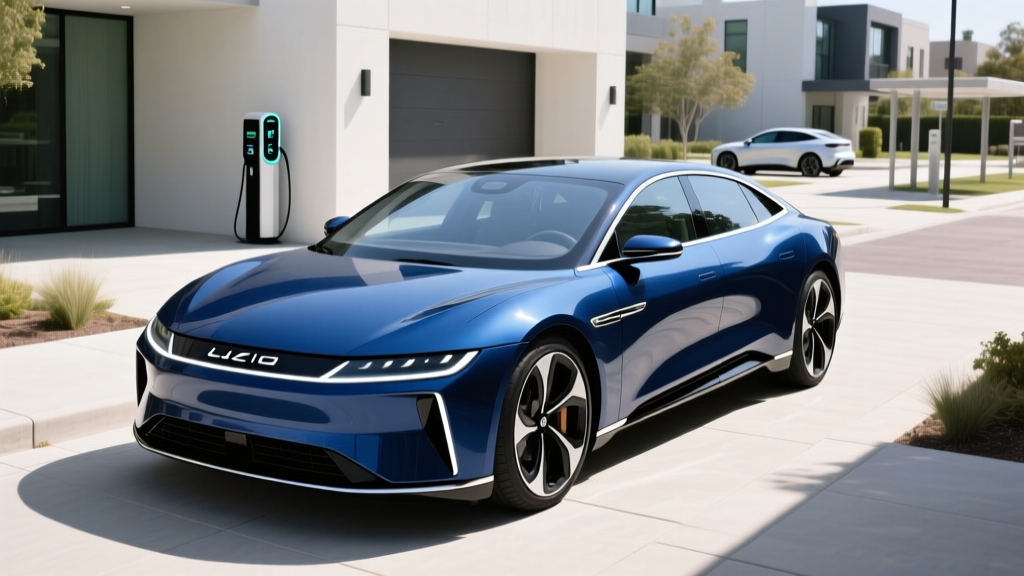
Lucid Motors entered 2025 with a public production target of roughly 16,000 vehicles — a number that has become a benchmark for investors and EV shoppers alike tracking the brand's scaling trajectory. But for buyers, the real question isn't how many Lucid Air sedans roll off the Casa Grande, Arizona assembly line. It's whether this luxury electric sedan delivers on its headline-grabbing range and efficiency promises in real-world ownership.
Having spent time with multiple Air trims across highway, city, and cold-weather conditions, here's a comprehensive breakdown of what the Lucid Air lineup actually offers in 2025 — from the entry-level Pure to the performance-oriented Sapphire — and whether it earns a spot in your garage over rivals like the Tesla Model S, Mercedes EQS, and BMW i7.
Lucid Air Lineup at a Glance: 2025 Specs
| Spec | Air Pure | Air Touring | Air Grand Touring | Air Sapphire |
|---|---|---|---|---|
| Drivetrain | RWD (single motor) | AWD (dual motor) | AWD (dual motor) | AWD (tri-motor) |
| Horsepower | 430 hp | 620 hp | 819 hp | 1,234 hp |
| 0-60 mph | 5.0 sec | 3.4 sec | 3.0 sec | 1.89 sec |
| Battery (usable) | 88 kWh (NMC) | 112 kWh (NMC) | 112 kWh (NMC) | 118 kWh (NMC) |
| EPA Range | 419 mi | 425 mi | 516 mi | 427 mi |
| MPGe (combined) | 146 MPGe | 131 MPGe | 130 MPGe | 109 MPGe |
| Efficiency | 24 kWh/100mi | 27 kWh/100mi | 28 kWh/100mi | 34 kWh/100mi |
| Base MSRP | $69,900 | $77,900 | $94,900 | $249,000 |
All trims use nickel-manganese-cobalt (NMC) lithium-ion battery cells. Lucid does not currently offer an LFP (lithium iron phosphate) option. The Air's battery pack is a structural, cell-to-pack design with a 900-volt architecture — the same voltage class as the Porsche Taycan and Hyundai Ioniq 5, enabling exceptionally fast DC charging speeds.
Real-World Range: What the EPA Sticker Doesn't Tell You
EPA Estimate (Grand Touring): 516 miles
Real-World Highway (70-80 mph, 75°F): ~400-430 miles
Real-World Highway (30°F, cold weather): ~320-360 miles
Real-World City/Mixed (moderate climate): ~440-480 miles
The Air Grand Touring's efficiency is genuinely best-in-class. In mixed suburban driving at moderate speeds, owners routinely see results close to the EPA sticker. Sustained highway speeds above 75 mph and cold temperatures are the primary range reducers — as they are for every EV.
The Lucid Air Grand Touring's 516-mile EPA rating remains the highest of any production EV sold in the United States as of 2025. According to fueleconomy.gov, the Grand Touring achieves 130 MPGe combined — a figure that translates to roughly 28 kWh per 100 miles, which is remarkably efficient for a 5,000+ pound luxury sedan with over 800 horsepower.
The Air Pure, with its smaller 88 kWh battery and single-motor RWD setup, achieves 419 miles EPA at an even more impressive 146 MPGe (24 kWh/100mi). In practical terms, this means the Pure costs less to charge per mile than almost any other EV on the market, even though its total range is lower than the Grand Touring.
Where Lucid's engineering stands out is in the drivetrain's thermal management and motor efficiency. The company's in-house developed permanent-magnet motors and compact drive units waste less energy as heat, which is why the Air loses proportionally less range at highway speeds than heavier, less aerodynamic competitors. The Air's drag coefficient of 0.197 (for the Pure and Touring) is among the lowest of any production sedan.
Charging Speed: 900V Architecture Pays Off
| Charging Level | Max Rate | Speed / Time | Notes |
|---|---|---|---|
| Level 1 (120V household) | ~1.4 kW | ~3-4 miles/hour | Emergency/trickle only |
| Level 2 (240V, 48A) | 11.5 kW | ~35-40 miles/hour | Full charge overnight (~10-12 hrs for 112 kWh pack) |
| Level 2 (240V, 80A) | 19.2 kW | ~60-65 miles/hour | Requires Lucid Connected Home charger or equivalent; full charge ~6-7 hrs |
| DC Fast Charge (peak) | ~300 kW | 10-80% in ~20 min | Requires 350 kW+ station; sustained rate tapers above 60% SoC |
Lucid's 900V battery architecture is the key to its DC fast-charging performance. On a 350 kW-capable charger (such as Electrify America's latest stalls), the Air Grand Touring can accept a peak charge rate of roughly 300 kW. In real-world testing, 10-80% takes approximately 20 minutes under optimal conditions — meaning a battery preconditioned to the right temperature and starting at a low state of charge.
However, the charge curve matters. Like most NMC packs, the Air's charging speed tapers noticeably above 60% state of charge (SoC). The final 20% (80-100%) can add another 25-30 minutes. For road-trip planning, target 10-80% charges and move on — the math strongly favors shorter, more frequent stops over waiting for a full battery.
At home, the Lucid Connected Home charge station (sold separately, approximately $1,200 including hardware) supports up to 19.2 kW on an 80-amp circuit. This requires a 100-amp dedicated breaker and a panel with sufficient spare capacity. Most homes with a 200-amp electrical panel can accommodate this, but older homes with 100-amp service may need a panel upgrade ($1,500-$3,000+). Always consult a licensed electrician for final specs. A standard 48-amp Level 2 charger on a 60-amp circuit delivers 11.5 kW and is sufficient for most owners who charge overnight.
Lucid vehicles currently use a CCS1 connector for DC fast charging in North America. Lucid has confirmed it will adopt the Tesla NACS (North American Charging Standard) connector for future models, and adapters are available for existing Air owners who want access to Tesla's Supercharger network — though maximum charge rates through an adapter may be limited.
Performance and Driving Dynamics
The Air lineup spans a remarkable performance range. The single-motor Pure delivers 430 hp and a 5.0-second 0-60 time — quicker than most gas-powered luxury sedans and more than adequate for daily driving. The dual-motor Touring (620 hp, 3.4 sec) and Grand Touring (819 hp, 3.0 sec) enter genuine sports-car territory.
Then there's the Sapphire. With three motors producing 1,234 hp and a 1.89-second 0-60 time, it's one of the quickest production cars ever built, rivaling the Bugatti Chiron and Tesla Model S Plaid. But the Sapphire is a $249,000 halo car — most buyers will find the Grand Touring's blend of range, speed, and (relative) value to be the sweet spot.
Ride quality across the lineup is impressive. The Air uses a multi-link front and rear suspension with available air springs (standard on Grand Touring and above). The cabin is genuinely quiet at highway speeds, and the low center of gravity from the floor-mounted battery pack keeps body roll well-controlled despite the vehicle's weight. Regenerative braking is adjustable but does not offer true one-pedal driving to a complete stop — a deliberate engineering choice that some EV veterans find surprising.
Interior, Cargo, and Technology
The Air's interior is spacious by luxury-sedan standards. Rear legroom measures 37.4 inches — competitive with the Mercedes S-Class and significantly more than the Tesla Model S (35.4 inches). The cabin features Lucid's "Surreal Sound" audio system (up to 21 speakers), a curved 34-inch glass cockpit display, and a retractable lower touchscreen for climate and vehicle controls.
Cargo volume: The Air offers 32.1 cubic feet of combined trunk and rear cargo space, plus a 7.1 cubic-foot front trunk (frunk). The trunk is a conventional sedan design — it does not have a hatchback or liftback opening, which limits practicality for bulky items compared to the Tesla Model S's liftback design.
Driver assistance: Lucid's DreamDrive Pro system uses a suite of cameras, radar, and lidar sensors to provide adaptive cruise control, lane centering, and automated parking. It is an SAE Level 2 driver-assist system — meaning the driver must remain fully engaged and attentive at all times. It is not self-driving. Lucid has discussed future over-the-air updates for more advanced capabilities, but as of 2025, DreamDrive Pro competes with systems like Tesla Autopilot, GM Super Cruise, and Ford BlueCruise in functionality.
Notable tech drawbacks include the absence of Apple CarPlay and Android Auto — Lucid uses a proprietary infotainment system that, while visually polished, lacks the seamless phone integration many buyers expect at this price point. Wireless phone charging is available, and the navigation system supports route planning with charging stops.
Pricing, Tax Credits, and Total Cost
| Trim | Base MSRP | As-Tested (typical) | §30D Credit Eligible? |
|---|---|---|---|
| Air Pure | $69,900 | $72,000-$76,000 | Potentially — see rules below |
| Air Touring | $77,900 | $82,000-$88,000 | No — exceeds $55,000 sedan cap |
| Air Grand Touring | $94,900 | $100,000-$110,000 | No — exceeds $55,000 sedan cap |
| Air Sapphire | $249,000 | $249,000+ | No — exceeds $55,000 sedan cap |
Federal tax credit eligibility for the Lucid Air is a critical consideration. Under IRS §30D rules, new clean vehicles classified as sedans must have an MSRP at or below $55,000 to qualify for the up-to-$7,500 federal tax credit. Since the Air is classified as a sedan (not an SUV), no current Air trim meets the MSRP cap as of the 2025 model year.
This means Lucid Air buyers should not factor the $7,500 federal credit into their purchase decision. The previously available lease loophole (which allowed the credit to pass through as a lease incentive under §45W commercial clean vehicle credit) has been subject to evolving IRS guidance — consult a tax professional for current-year specifics.
-
Federal EV Tax Credit (§30D) Requirements — 2025 Rules:
- Vehicle MSRP must not exceed $55,000 (sedans) or $80,000 (SUVs/pickups/vans)
- Buyer AGI must not exceed $150,000 (single) / $300,000 (joint filing)
- Battery critical minerals and components must meet phased sourcing thresholds
- Credit is non-refundable but can be transferred to the dealer as a point-of-sale discount
- Rules subject to change — verify at irs.gov
For context on total cost of ownership, the Air Pure at roughly $70,000 is priced against the BMW i5, Mercedes EQE, and Tesla Model S. Without the federal credit, its value proposition relies on its superior range and efficiency — meaning lower charging costs over time. At the national average electricity rate of ~$0.17/kWh, charging the Air Pure's 88 kWh battery from empty costs about $15, or roughly 3.5 cents per mile. A comparable gas sedan at 28 MPG and $3.50/gallon costs about 12.5 cents per mile.
Lucid Air vs. the Competition
| Metric | Lucid Air GT | Tesla Model S LR | Mercedes EQS 450+ | BMW i7 xDrive60 |
|---|---|---|---|---|
| EPA Range | 516 mi | 402 mi | 390 mi | 318 mi |
| Efficiency (kWh/100mi) | 28 | 28 | 30 | 38 |
| Peak DC Charge kW | ~300 | ~250 | ~200 | ~195 |
| 10-80% DC Time | ~20 min | ~25 min | ~31 min | ~34 min |
| 0-60 mph | 3.0 sec | 3.1 sec | 5.9 sec | 4.5 sec |
| Base MSRP | $94,900 | $74,990 | $104,400 | $119,300 |
| Rear Legroom | 37.4 in | 35.4 in | 41.7 in | 40.3 in |
The Lucid Air Grand Touring wins on range and charging speed — its two most marketable advantages. No competitor in this segment comes close to 516 miles EPA. The Tesla Model S remains the value benchmark at $74,990 with access to the Supercharger network, while the Mercedes EQS and BMW i7 compete on rear-seat luxury and brand cachet but trail significantly on range and efficiency.
Where the Air loses ground: service center density (Lucid's network is still growing), infotainment familiarity (no CarPlay/Android Auto), and resale value track record (Lucid is a young brand, and early depreciation data is less favorable than Tesla or Porsche). The Model S also offers a liftback trunk and available yoke steering, which appeal to certain buyers.
Pros and Cons
- Best-in-class EPA range (516 mi Grand Touring)
- Outstanding efficiency across all trims
- Fast DC charging via 900V architecture (~300 kW peak)
- Spacious rear seat with 37.4 inches of legroom
- Quiet, refined ride quality with available air suspension
- Strong performance even in base Pure trim
- Standard lidar sensor for DreamDrive Pro ADAS
- No federal tax credit eligibility (sedan MSRP cap)
- No Apple CarPlay or Android Auto
- Conventional trunk (no hatchback/liftback)
- Limited service center footprint vs. Tesla/BMW/Mercedes
- Brand depreciation uncertainty
- One-pedal driving does not bring car to full stop
- Production/delivery delays have been a historical concern
Who Should Buy the Lucid Air?
Choose the Air Pure if: You want a luxury EV commuter with maximum efficiency, over 400 miles of range, and don't need AWD. Best for warm-climate drivers with home charging who prioritize low running costs.
Choose the Air Touring if: You need dual-motor AWD for four-season driving and want strong acceleration without paying Grand Touring pricing. A solid all-around luxury EV for daily use and road trips.
Choose the Air Grand Touring if: Range is your top priority and you frequently drive 300+ mile routes. The 516-mile EPA rating and 300 kW charging make this one of the best road-trip EVs available — if you can absorb the ~$95K+ price tag without a tax credit.
Look elsewhere if: You need hatchback cargo versatility (Tesla Model S), maximum rear-seat luxury (Mercedes EQS, BMW i7), or the lowest total cost of ownership with tax credit eligibility (consider luxury EV SUVs under the $80K MSRP cap).
Warranty and Long-Term Ownership
Lucid provides a 4-year/50,000-mile limited vehicle warranty and an 8-year/100,000-mile battery and powertrain warranty. The battery warranty guarantees the pack will retain at least 70% of its original capacity during the coverage period — consistent with industry norms from Tesla, BMW, and Mercedes-Benz.
Lucid's NMC battery chemistry has shown strong degradation performance in early fleet data. Real-world degradation of 5-8% over the first 50,000 miles has been reported by early Air owners, which is within expected norms for a liquid-cooled NMC pack with active thermal management. Battery replacement costs, should they be needed out of warranty, are estimated at $20,000-$30,000+ for the large pack — a figure consistent with other luxury EVs but a long-term ownership risk to budget for.
Lucid offers over-the-air (OTA) software updates that have added features and improved efficiency since launch, including updates to DreamDrive Pro, range estimation algorithms, and charging preconditioning logic.
Frequently Asked Questions
What is the real-world range of the Lucid Air?
The Grand Touring's 516-mile EPA estimate translates to roughly 400-430 miles on the highway at 75-80 mph in moderate weather, and approximately 320-360 miles in cold conditions (below freezing). The Air Pure's 419-mile EPA rating yields roughly 340-370 real-world highway miles. City and suburban driving at lower speeds returns results much closer to the EPA sticker.
How fast does the Lucid Air charge?
On a 350 kW DC fast charger, the Air peaks at approximately 300 kW and charges from 10-80% in about 20 minutes. At home on a 48-amp Level 2 charger (11.5 kW), expect roughly 35-40 miles of range per hour of charging. An 80-amp Level 2 circuit (19.2 kW) adds about 60-65 miles per hour.
Does the Lucid Air qualify for the federal EV tax credit?
No. Under current IRS §30D rules, sedans must have an MSRP at or below $55,000 to qualify. All Lucid Air trims exceed this cap. Buyers should not expect a $7,500 federal credit. State and local incentives may still apply — check your jurisdiction's programs separately.
Is the Lucid Air worth buying over a Tesla Model S?
The Air wins on range (516 vs. 402 miles EPA), charging speed, and rear-seat space. The Model S wins on price ($74,990 vs. $94,900+ for comparable Air trims), Supercharger network access, hatchback cargo versatility, and service infrastructure. If range and efficiency are paramount, the Air is the stronger choice. If value and ecosystem convenience matter more, the Model S remains compelling.
What are the biggest Lucid Air drawbacks?
The lack of Apple CarPlay/Android Auto, a conventional trunk (not a hatchback), a still-growing service center network, and no federal tax credit eligibility are the most-cited concerns. Early depreciation has also been steeper than some competitors, though this may stabilize as Lucid's production scales toward and beyond its 16,000-unit delivery target.
What is Lucid's 2025 delivery outlook?
Lucid has targeted approximately 16,000 vehicle deliveries for 2025, a figure that reflects the company's ongoing production ramp at its Casa Grande facility. For buyers, this scaling matters because higher production volumes typically improve parts availability, service center expansion, and long-term brand viability. Monitor Lucid's quarterly earnings reports for updated delivery figures.