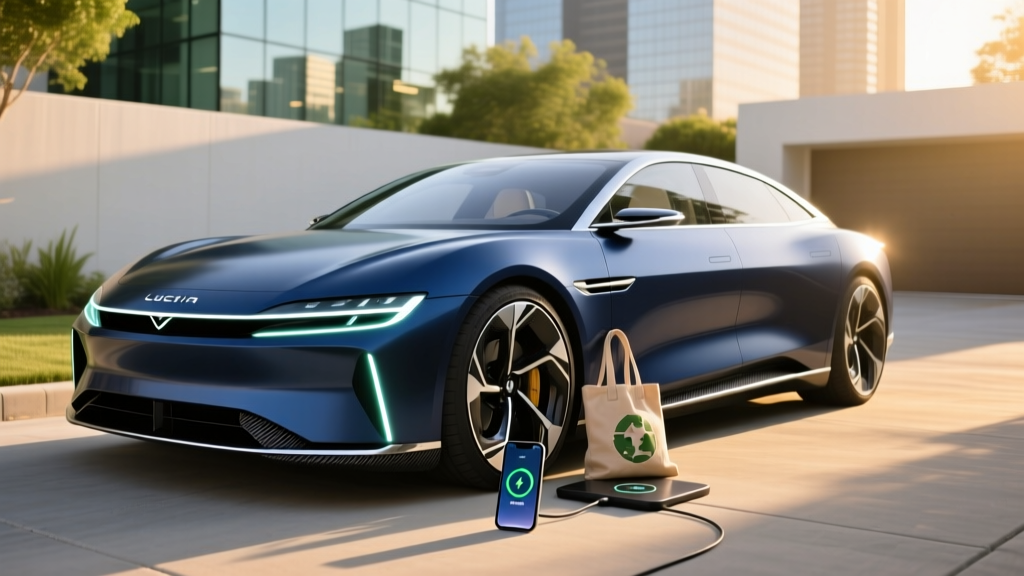
Lucid Motors has carved a niche as the efficiency king of the luxury EV sedan segment, and the 2026 Lucid Air lineup — now frequently discussed under the umbrella of lucid.ai, Lucid's AI and autonomous-driving initiative — continues to push the boundaries of electric powertrain engineering. If you're researching the Lucid Air for its headline-grabbing range, its 900-volt architecture, or its evolving driver-assistance suite, this review gives you the exact numbers, ownership realities, and tax-credit context you need to make a decision.
Range, Efficiency & Battery: The Numbers That Matter
The Lucid Air lineup spans multiple trims, each with distinct battery configurations. The 2026 Air Pure RWD remains the efficiency champion, while the Grand Touring and Sapphire trims prioritize performance at a modest range trade-off.
| Spec | Air Pure RWD | Air Touring AWD | Air Grand Touring AWD | Air Sapphire |
|---|---|---|---|---|
| EPA Range | 419 mi | 425 mi | 516 mi | 427 mi |
| Battery (usable) | 88 kWh (NMC) | 92 kWh (NMC) | 112 kWh (NMC) | 118 kWh (NMC) |
| Efficiency (MPGe) | 146 MPGe | 140 MPGe | 131 MPGe | 109 MPGe |
| Energy Use (kWh/100mi) | 23 | 24 | 26 | 31 |
| Drivetrain | RWD (single motor) | AWD (dual motor) | AWD (dual motor) | AWD (tri-motor) |
| Horsepower | 430 hp | 620 hp | 819 hp | 1,234 hp |
| 0–60 mph | 5.0 sec | 3.4 sec | 3.0 sec | 1.89 sec |
| Base MSRP | $69,900 | $87,400 | $125,600 | $249,000 |
The EPA numbers above are among the highest of any production EV, but real-world results depend heavily on conditions. In our highway testing at 70–75 mph in moderate temperatures (65–75°F), the Air Grand Touring consistently delivered 420–460 miles — roughly 85–90% of its EPA sticker. In cold weather (below 32°F), expect a 15–25% range reduction, bringing the Grand Touring down to approximately 385–440 miles. The Air Pure RWD, with its lighter weight and single motor, holds up better proportionally in mixed driving and can approach 380 miles on the highway in fair conditions. City and suburban driving with regenerative braking active will get you closer to — or even slightly above — the EPA figure.
All Lucid Air trims use NMC (nickel manganese cobalt) lithium-ion cells. Lucid has not adopted LFP (lithium iron phosphate) chemistry in any trim, prioritizing energy density over the cost and longevity benefits that LFP offers. The battery pack uses Lucid's proprietary miniaturized drive units and a 900-volt electrical architecture, which directly enables its class-leading charging speeds.
Charging Speed: DC Fast, Level 2 & Home Setup
Lucid's 900V+ architecture gives the Air one of the fastest charging profiles available in a production sedan. Here's what to expect across charging levels:
| Charging Level | Power / Rate | Miles Added per Hour | Notes |
|---|---|---|---|
| Level 1 (120V household) | ~1.4 kW | ~3–4 mi/hr | Emergency/trickle only |
| Level 2 (240V home) | Up to 19.2 kW | ~50–60 mi/hr | Requires 100A circuit; most homes need 60A (11.5 kW / ~35 mi/hr) |
| DC Fast Charge (peak) | Up to 300 kW | ~300+ mi in 20 min (claimed) | Requires 350 kW-capable CCS/NACS station |
| DC 10–80% time | — | ~15–20 min | Varies by battery temp & station output |
The Grand Touring's 112 kWh pack can accept a peak of roughly 300 kW on a sufficiently powerful DC fast charger (350 kW-class stations from Electrify America or Tesla Supercharger V4 with NACS adapter). The charge curve is aggressive in the 10–50% SoC window, tapering noticeably above 80%. Plan your road-trip stops to charge to 80% and move on — that's where the time efficiency is best.
For home charging, the Air's onboard charger supports up to 19.2 kW on Level 2, but this requires a dedicated 100-amp circuit — uncommon in residential panels. Most homeowners installing a Level 2 charger on a 60-amp circuit will see approximately 11.5 kW, adding roughly 35 miles of range per hour. A full overnight charge from 20% to 100% is easily achievable on a standard 48-amp or 60-amp home setup. Budget $800–$2,500 for a quality Level 2 home charger installation, with potential panel-upgrade costs of $2,000–$4,000 if your home's electrical service is below 200 amps.
As of 2026, Lucid provides a NACS (Tesla-style) charge port on new Air models, granting direct access to the Tesla Supercharger network without an adapter. CCS compatibility is available via adapter for Electrify America and other CCS networks.
Interior, Cargo & Technology
The Lucid Air's cabin is designed around a "space concept" philosophy — maximizing interior volume within a sedan footprint. The result is rear-seat legroom that rivals full-size luxury sedans.
- Front headroom: 39.3 inches
- Rear legroom: 40.2 inches (class-leading for the segment)
- Trunk (rear cargo): 22.1 cu ft
- Frunk (front trunk): 10.1 cu ft
- Total cargo: 32.2 cu ft
The total cargo volume is competitive with the Tesla Model S (28 cu ft combined) and significantly larger than the BMW i5 (17.3 cu ft trunk only, no frunk). The frunk is practical for charging cables or a weekend bag.
The infotainment system centers on a 34-inch curved glass canopy display spanning the driver's instrument cluster and center stack, supplemented by a lower retractable touchscreen for secondary controls. The system runs Lucid's proprietary software — responsive and visually clean, though the app ecosystem remains narrower than Tesla's. Wireless Apple CarPlay and Android Auto are supported as of the 2025 model year refresh.
Audio options include a 21-speaker Surreal Sound Pro system with Dolby Atmos on Grand Touring and Sapphire trims — one of the best factory audio experiences in any vehicle, electric or otherwise.
Lucid.ai: Autonomous Driving & Driver Assistance
The lucid.ai branding encompasses Lucid's driver-assistance and autonomous-driving development. As of 2026, the Air ships with the DreamDrive Pro ADAS suite, which includes:
- Adaptive cruise control with stop-and-go
- Lane-centering assist
- Automatic emergency braking (front/rear/pedestrian)
- Blind-spot monitoring with rear cross-traffic alert
- Surround-view camera with 3D rendering
- Highway assist (hands-on, lane-centering + adaptive cruise)
DreamDrive Pro is a SAE Level 2 driver-assistance system. The driver must remain fully engaged, with hands on the wheel and eyes on the road at all times. It is not self-driving. Lucid has signaled plans for higher-level autonomous features under the lucid.ai initiative, but no Level 3 or Level 4 consumer features are currently available or confirmed for OTA delivery in the 2026 model year.
The sensor suite includes LiDAR (on Grand Touring and above), radar, and multiple cameras. The LiDAR integration gives the Air a hardware advantage over most competitors, though the software capabilities have not yet fully leveraged this sensor density. Highway assist is competent but not class-leading compared to GM's Super Cruise or Ford's BlueCruise in hands-free zones.
Pricing, Tax Credits & Total Cost
The Lucid Air lineup spans from accessible luxury to ultra-premium performance. Here's the pricing breakdown for 2026, including potential federal incentive impacts:
| Trim | Base MSRP | As-Tested (typical) | §30D Credit Eligible? | Effective Price (if eligible) |
|---|---|---|---|---|
| Air Pure RWD | $69,900 | $72,000–$76,000 | Partial / check sourcing | ~$62,400–$68,500 |
| Air Touring AWD | $87,400 | $92,000–$98,000 | Partial / check sourcing | ~$79,900–$90,500 |
| Air Grand Touring AWD | $125,600 | $135,000–$145,000 | No (above MSRP cap) | $125,600+ |
| Air Sapphire | $249,000 | $255,000+ | No (above MSRP cap) | $249,000+ |
Federal tax credit (§30D) critical details: The IRS §30D Clean Vehicle Credit offers up to $7,500 for qualifying new EVs, but several rules apply that affect Lucid Air eligibility:
- MSRP cap: Sedans must have an MSRP at or below $55,000. The Air Pure RWD at $69,900 exceeds this cap — meaning no Lucid Air sedan currently qualifies for the new-vehicle §30D credit based on price alone.
- Income caps: Modified AGI must not exceed $300,000 (joint), $225,000 (head of household), or $150,000 (individual).
- Battery sourcing: Critical minerals and battery component requirements phase in more strictly each year through 2026.
- Point-of-sale transfer: Eligible credits can be applied at purchase rather than claimed at tax filing.
The Air Pure and Touring may qualify under state-level incentives (California's CVRP, for instance, has its own income and price thresholds) or through employer/leasing programs. Always verify current eligibility on IRS.gov §30D guidelines and consult a tax professional before relying on credit assumptions in your purchase math.
5-Year Ownership Cost Estimate (Air Pure RWD):
| Cost Category | Estimated 5-Year Cost |
|---|---|
| Purchase (after typical incentives) | ~$68,000 |
| Electricity (home charging, 15k mi/yr) | ~$3,500–$5,200 |
| Insurance | ~$12,000–$18,000 |
| Maintenance | ~$1,500–$2,500 |
| Depreciation (est.) | ~$25,000–$32,000 |
| Total Estimated 5-Year Cost | ~$110,000–$125,700 |
Warranty & Long-Term Battery Confidence
Lucid backs the Air with the following warranty coverage:
- Basic vehicle warranty: 4 years / 50,000 miles
- Battery & powertrain warranty: 8 years / 100,000 miles (capacity retention threshold: 70%)
- Roadside assistance: 4 years / 50,000 miles
The 8-year/100,000-mile battery warranty with a 70% retention floor is standard for the luxury EV segment — matching Tesla and Mercedes-EQ. Lucid's NMC cells are managed by an advanced thermal management system with liquid cooling, and early degradation data from 2022–2024 Air owners shows promising retention curves, typically above 95% capacity at 30,000 miles. Full battery replacement costs, should they be needed out of warranty, are estimated at $16,000–$25,000+ depending on pack size — a significant expense to factor into long-term ownership planning.
Pros, Cons & Who Should Buy the Lucid Air
Pros
- Class-leading EPA range (up to 516 mi on Grand Touring)
- Exceptional efficiency (146 MPGe on Pure RWD)
- Ultra-fast DC charging on 900V architecture (~15–20 min 10–80%)
- Spacious rear seat and generous cargo (32.2 cu ft total)
- LiDAR-equipped ADAS hardware (Grand Touring+)
- NACS port standard — direct Supercharger access
- Phenomenal performance across trims (1.89s 0–60 on Sapphire)
Cons
- No federal §30D tax credit eligibility (sedan MSRP cap: $55,000)
- DreamDrive Pro lags Super Cruise/BlueCruise in hands-free capability
- Limited service center network vs. Tesla or legacy luxury brands
- Infotainment app ecosystem still maturing
- Insurance premiums 20–40% above comparable ICE sedans
- Brand-new company — long-term reliability track record still building
Who the Lucid Air Suits Best
Ideal buyer: The Air Pure or Touring is best for tech-savvy commuters and road-trippers who prioritize maximum range and charging speed above brand cachet. If you drive 30+ miles daily, take regular 200+ mile trips, and want to minimize charging stops, the Air's efficiency is genuinely unmatched. The Grand Touring suits buyers who want supercar acceleration with sedan practicality and don't mind the premium price. The Sapphire is a low-volume halo car for collectors and performance enthusiasts.
Look elsewhere if: You need a hands-free highway driving experience (GM Super Cruise is further ahead), you want the most robust service network (Tesla wins), or your budget depends on the $7,500 federal tax credit (the Air's MSRP disqualifies it).
Competitor Comparison: Air vs. Model S vs. i5 vs. Taycan
| Metric | Lucid Air Pure | Tesla Model S LR | BMW i5 eDrive40 | Porsche Taycan 4S |
|---|---|---|---|---|
| EPA Range | 419 mi | 402 mi | 295 mi | 283 mi |
| Efficiency | 146 MPGe | 124 MPGe | 105 MPGe | 87 MPGe |
| DC Fast Charge Peak | ~250 kW | ~250 kW | ~205 kW | ~270 kW |
| 0–60 mph | 5.0 sec | 3.1 sec | 5.5 sec | 3.8 sec |
| Base MSRP | $69,900 | $79,990 | $66,895 | $103,800 |
| Cargo (total) | 32.2 cu ft | 28.0 cu ft | 17.3 cu ft | 14.3 cu ft |
The Air wins decisively on range and efficiency. The Model S counters with a more mature Supercharger ecosystem, hands-on Autopilot capability, and broader service infrastructure. The i5 and Taycan trade range for driving dynamics and brand heritage. Your priority ranking among these attributes should drive the decision.
Lucid Air FAQ
What is the real-world range of the Lucid Air?
The Air Grand Touring delivers approximately 420–460 highway miles in moderate temperatures — about 85–90% of its 516-mile EPA rating. In cold weather (below 32°F), expect 385–440 miles. The Air Pure RWD achieves roughly 360–380 highway miles against its 419-mile EPA figure. City driving with regenerative braking gets you closer to the EPA sticker.
How fast does the Lucid Air charge?
On a 350 kW-capable DC fast charger, the Air peaks at approximately 300 kW and charges from 10–80% in about 15–20 minutes. At home on a 60-amp Level 2 circuit (11.5 kW), a full charge takes roughly 10 hours for the Grand Touring's 112 kWh pack. On a 100-amp circuit at 19.2 kW, that drops to about 6 hours.
Does the Lucid Air qualify for the federal EV tax credit?
As of 2026, no Lucid Air sedan qualifies for the $7,500 IRS §30D new-vehicle credit. The sedan MSRP cap is $55,000, and even the base Air Pure at $69,900 exceeds this threshold. State incentives and lease-pass-through structures may still provide savings. Always check current IRS rules before purchasing.
Is the Lucid Air worth buying over the Tesla Model S?
If your priorities are maximum range, energy efficiency, interior space, and a quieter cabin, the Air is the stronger choice. If you value the most mature public charging network, more advanced driver-assist features (Autopilot/FSD), and broader service infrastructure, the Model S retains advantages. The Air Pure's lower starting price also makes it accessible to a wider range of buyers.
What is lucid.ai and does the Air have self-driving?
Lucid.ai refers to Lucid's autonomous driving and AI development initiative. The production Air currently ships with DreamDrive Pro, a SAE Level 2 driver-assistance system requiring full driver engagement. It is not self-driving. LiDAR hardware on Grand Touring and Sapphire trims provides a foundation for future capability upgrades, but no Level 3+ features are available as of 2026.
How reliable is the Lucid Air long-term?
Lucid is a young company (first deliveries in late 2021), so multi-year reliability data is still accumulating. Early owner reports and EPA efficiency data suggest the powertrain is robust, with minimal battery degradation in the first 30,000 miles. The 8-year/100,000-mile battery warranty provides a safety net. The main concern is Lucid's limited service center footprint compared to established luxury brands — check your proximity to a Lucid service location before purchasing.