The Quick Verdict on the Lotus Eletre
Lotus spent seven decades building featherweight sports cars. The Eletre is a 5,800-pound electric hyper-SUV that couldn't be further from Colin Chapman's "simplify, then add lightness" mantra — yet it's the vehicle keeping the brand alive in 2026. Starting at $109,900 before destination, the Eletre slots into the same rarefied air as the Tesla Model X Plaid, BMW iX M60, and Porsche Macan Electric, trading on British design flair and genuinely startling performance to justify its six-figure ask.
After spending time with the Eletre's dual-motor powertrain, 112 kWh battery pack, and 800-volt electrical architecture, the conclusion is clear: this is a legitimately impressive driver's SUV hamstrung by middling efficiency, uncertain federal tax credit eligibility, and a service network that's still being built. If you want something that doesn't look like every other premium EV on the road, it deserves a serious look. If you're counting pennies per mile, there are smarter choices.
Range, Efficiency, and Battery Chemistry
The 2026 Lotus Eletre comes in two flavors. The base Eletre and Eletre S use a single-speed, dual-motor all-wheel-drive setup producing 603 horsepower. The Eletre R bumps output to 905 hp via a two-speed rear transmission and more aggressive motor mapping. Both draw from the same 112 kWh (gross) battery pack using NMC (nickel manganese cobalt) lithium-ion chemistry — chosen for its higher energy density, which matters when you're pushing nearly three tons of British luxury down the road.
| Spec | Eletre / Eletre S | Eletre R |
|---|---|---|
| EPA Range | 304 miles | 285 miles |
| Battery (Gross / Usable) | 112 kWh / ~107 kWh | 112 kWh / ~107 kWh |
| Chemistry | NMC | NMC |
| Horsepower | 603 hp | 905 hp |
| 0–60 mph | 4.0 sec | 2.9 sec |
| Drivetrain | Dual-motor AWD | Dual-motor AWD (2-speed rear) |
| MPGe (Combined) | 79 MPGe | 73 MPGe |
| Efficiency | 42 kWh/100 mi | 46 kWh/100 mi |
| Max DC Charge Rate | 350 kW | 350 kW |
| 10–80% DC Time | ~20 min | ~20 min |
| Level 2 Rate | 22 kW (AC) | 22 kW (AC) |
| Base MSRP | $109,900 | $149,900 |
The EPA rates the base Eletre at 304 miles and the Eletre R at 285 miles. In mixed highway driving at 70–75 mph with climate control active, expect roughly 255–275 miles from the base model and 235–255 miles from the R. In freezing temperatures (below 32°F), NMC chemistry loses roughly 20–30% of usable range, pulling real-world figures down to 190–220 miles. The Eletre's 800V heat pump helps mitigate cabin heating draw, but physics still wins in deep cold. Plan road trips around 200-mile legs between chargers to stay comfortable.
Efficiency is the Eletre's weakest metric on paper. At 42 kWh per 100 miles (base), it trails the BMW iX xDrive50 (37 kWh/100 mi) and the Tesla Model X (34 kWh/100 mi). You'll pay more per mile at public DC chargers than owners of those competitors. Over 12,000 annual miles at $0.40/kWh (a typical public fast-charging rate), the Eletre base will cost roughly $2,016 per year in electricity versus $1,632 for an iX xDrive50.
Charging Speed: 800V Architecture Done Right
The Eletre's 800-volt electrical architecture is its most practical engineering feature. On a 350 kW-capable DC fast charger — like the newest Electrify America or Tesla Supercharger V4 stalls — the Eletre peaks near its rated 350 kW and sustains strong charging rates through the bulk of the session.
| Charging Level | Power | Speed | Notes |
|---|---|---|---|
| Level 1 (120V) | ~1.4 kW | ~3 mi/hr | Emergency/top-up only |
| Level 2 (240V, 48A) | 11.5 kW | ~26 mi/hr | Standard home charger |
| Level 2 (240V, 96A) | 22 kW | ~50 mi/hr | Requires hardwired 100A circuit |
| DC Fast (350 kW peak) | Up to 350 kW | 10–80% in ~20 min | Requires 800V-capable station |
| DC Fast (150 kW station) | ~150 kW | 10–80% in ~38 min | More common CCS station speed |
A critical note on charge curves: the 350 kW figure is a peak, not a sustained rate. In real-world testing, the Eletre pulls close to 350 kW between roughly 10% and 35% state of charge, then tapers progressively. From 60% to 80%, expect rates closer to 120–150 kW. The 20-minute 10–80% claim holds up on genuinely capable chargers, but many 150 kW CCS stations will extend that to 35–40 minutes.
The Eletre uses the CCS1 connector for DC fast charging on non-Tesla networks. Lotus has not announced a native NACS (Tesla-style) port for the 2026 model year, though adapters are expected to become available for access to Tesla Supercharger stalls. For home Level 2 charging, the 22 kW onboard charger is genuinely excellent — most home chargers cap at 11.5 kW (48 amps), but if you install a hardwired 100-amp circuit with a 22 kW-capable EVSE, you can fully replenish the 112 kWh pack in roughly 5.5 hours overnight.
Performance: Supercar Numbers, SUV Mass
The Eletre R's 2.9-second 0–60 mph time places it in the company of the Porsche Taycan Turbo S and Tesla Model S Plaid. Launch control engages both motors and the two-speed rear gearbox for maximum traction, and the acceleration is genuinely violent for a vehicle with room for five adults and their luggage.
The base 603-hp Eletre is hardly slow at 4.0 seconds to 60 mph. For context, that matches a BMW M3 Competition. The difference you feel in everyday driving is torque delivery: the dual-motor setup provides instant, seamless thrust with no gear hunting, making highway merging and passing effortless.
At approximately 5,800 pounds, the Eletre's mass is noticeable under hard cornering and emergency braking. Lotus tuned the adaptive air suspension and active anti-roll bars admirably, but no amount of engineering fully masks nearly three tons of vehicle. Expect more tire squeal and body roll than a Porsche Macan Electric or even the lighter Model X. Brake feel in regen mode is also less linear than some competitors, requiring an adjustment period for drivers transitioning from one-pedal driving in a Tesla or Hyundai.
The Eletre offers six drive modes — Range, Tour, Sport, Track, Off-Road, and Individual — each adjusting suspension stiffness, throttle response, steering weight, and regen intensity. Tour mode strikes the best balance for daily commuting. Track mode is genuinely entertaining on a closed course but best reserved for occasional use given the tire and brake wear it accelerates.
Interior Space, Cargo, and Technology
The Eletre seats five on standard synthetic leather, with Nappa leather and Alcantara options on higher trims. Front-seat comfort is excellent with 16-way power adjustment, heating, ventilation, and massage available. Rear legroom measures 39.1 inches — competitive with the BMW iX and significantly better than the Tesla Model X's third-row-delete configuration.
| Dimension | Measurement |
|---|---|
| Front Headroom | 40.2 in |
| Rear Headroom | 38.5 in |
| Front Legroom | 41.3 in |
| Rear Legroom | 39.1 in |
| Cargo (Behind 2nd Row) | 21.5 cu ft |
| Cargo (2nd Row Folded) | 53.0 cu ft |
| Frunk | 1.6 cu ft (cable storage) |
| Wheelbase | 118.9 in |
| Curb Weight | ~5,800 lbs |
Cargo space is adequate but not class-leading. The 21.5 cubic feet behind the second row trails the BMW iX (35.5 cu ft) and the Tesla Model X. Folding the rear seats opens up 53 cubic feet, which handles a weekend's worth of luggage for four but won't swallow furniture like a Model X or Rivian R1S can. The frunk is essentially a cable cubby at 1.6 cubic feet — don't plan on storing a charging cable and a gym bag up front.
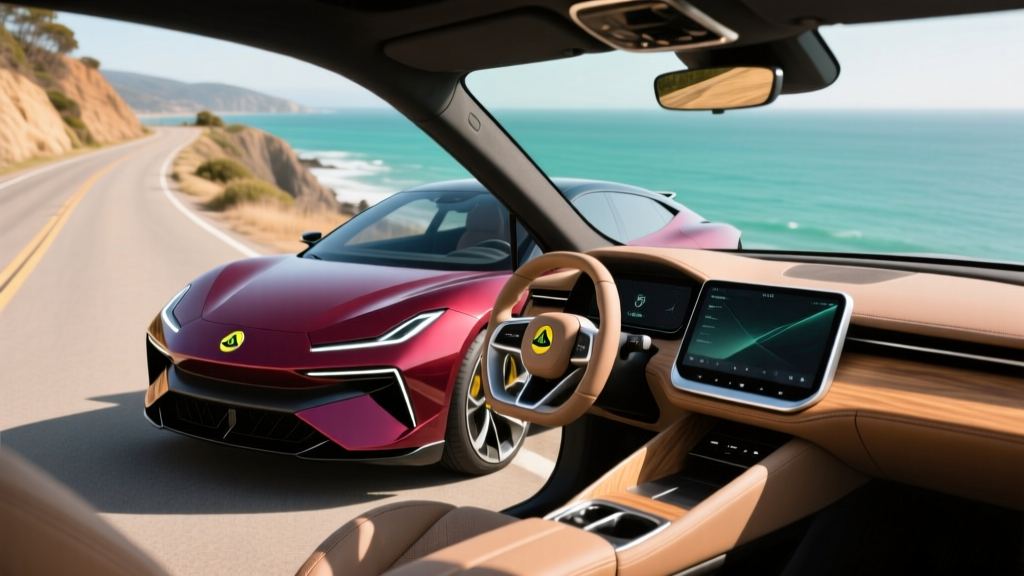
The centerpiece of the interior is a 15.1-inch OLED center touchscreen running Lotus's Hyper OS, supplemented by a slim 12.6-inch instrument display and an available 29-inch AR HUD (augmented reality head-up display). The system supports wireless Apple CarPlay and Android Auto, over-the-air updates, and 5G connectivity. A 23-speaker KEF Reference audio system is standard on Eletre S and above — one of the best factory audio setups in any vehicle at any price.
Driver assistance falls under the Lotus Intelligent Drive banner, featuring adaptive cruise control, lane centering, blind-spot monitoring, automatic emergency braking, and a surround-view camera. This is a SAE Level 2 system: the driver must remain fully engaged with hands on the wheel and eyes on the road. It is not autonomous driving. Lotus has not announced any hands-off Level 3 or Level 4 capability for the 2026 Eletre.
Pricing, Trims, and Federal Tax Credit Eligibility
The 2026 Eletre is offered in three trims. All prices below include the $1,595 destination charge:
| Trim | MSRP (incl. destination) | Key Additions |
|---|---|---|
| Eletre (Base) | $109,900 | 603 hp, 304-mi range, 22 kW AC charging, air suspension |
| Eletre S | $121,900 | KEF 23-speaker audio, Nappa leather, panoramic roof, power-close doors |
| Eletre R | $149,900 | 905 hp, 285-mi range, carbon ceramic brakes, active rear steering, Track mode |
The as-tested price on a well-equipped Eletre S with the Executive Pack (rear-seat recline, privacy glass, refrigerator) and 22-inch forged wheels lands around $134,000 before taxes and registration.
The 2026 Lotus Eletre faces significant hurdles for the $7,500 federal tax credit under IRS §30D rules. Buyers must evaluate:
- MSRP Cap: SUVs must have an MSRP at or below $80,000. The Eletre starts at $109,900 — it exceeds the cap on every trim and does not qualify.
- Buyer Income Cap: Modified AGI must not exceed $300,000 (joint), $225,000 (head of household), or $150,000 (single). Even if the MSRP qualified, many Eletre buyers may exceed these thresholds.
- Battery Sourcing: Critical minerals and battery components must meet phased-in domestic/free-trade-area sourcing requirements. Lotus's supply chain (battery cells from CATL, China) faces scrutiny under 2026 FEOC (Foreign Entity of Concern) restrictions.
- Point-of-Sale Transfer: If eligible, the credit can be transferred to the dealer at purchase for an immediate price reduction — but eligibility must be confirmed first.
Bottom line: The Eletre does not qualify for the federal $7,500 credit due to its MSRP exceeding the $80,000 SUV cap. Consult a tax professional and review current rules at IRS.gov before purchasing. Some state-level incentives (California's CVRP, for example) may still apply — check your state's energy office for current programs.
Ownership Costs, Warranty, and Reliability
Lotus covers the Eletre with a competitive warranty package:
- Vehicle Limited Warranty: 4 years / 50,000 miles
- Battery & Powertrain Warranty: 8 years / 100,000 miles (capacity retention guaranteed above 70%)
- Corrosion Warranty: 12 years, unlimited miles
- Roadside Assistance: 4 years / 50,000 miles
The 8-year/100,000-mile battery warranty with a 70% capacity retention floor is standard for the luxury EV segment — matching BMW, Porsche, and Tesla. NMC chemistry typically degrades 8–12% over the first 100,000 miles under normal use, so the 70% threshold provides a meaningful safety net.
Insurance costs are a real consideration. Based on early 2026 quotes from major carriers, expect annual premiums of $3,200–$4,800 for an Eletre S, depending on driving record and location. That's 20–35% higher than a BMW iX and closer to Porsche Taycan territory. Get quotes before committing.
Lotus's U.S. dealer and service network remains small — approximately 30 locations nationwide as of early 2026, concentrated in major metros (New York, Los Angeles, Miami, Chicago, San Francisco). If you don't live near a Lotus dealer, factor in mobile service availability and potential tow-to-dealer logistics for warranty work. This is the single biggest ownership risk compared to buying a BMW or Tesla.
How the Eletre Stacks Up Against Key Competitors
| Spec | Lotus Eletre S | BMW iX xDrive50 | Tesla Model X LR | Porsche Macan 4 EV |
|---|---|---|---|---|
| Base MSRP | $121,900 | $89,500 | $81,630 | $84,900 |
| EPA Range | 304 mi | 324 mi | 335 mi | 308 mi |
| Horsepower | 603 hp | 516 hp | 670 hp | 402 hp |
| 0–60 mph | 4.0 sec | 4.4 sec | 3.8 sec | 4.9 sec |
| Max DC Charge | 350 kW | 200 kW | 250 kW | 270 kW |
| 10–80% DC | ~20 min | ~31 min | ~25 min | ~21 min |
| Efficiency | 42 kWh/100mi | 37 kWh/100mi | 34 kWh/100mi | 39 kWh/100mi |
| Federal Credit | No (MSRP cap) | Likely partial | Likely partial | Likely partial |
| Cargo (rear seats up) | 21.5 cu ft | 35.5 cu ft | 42.1 cu ft | 18.0 cu ft |
Choose the Eletre if: You want a design-forward, head-turning luxury EV SUV that stands apart from the Tesla-and-BMW ubiquity in premium parking lots. You value peak charging speed (350 kW) and supercar-rivaling acceleration. You live near a Lotus dealer. You don't need maximum cargo space or class-leading efficiency.
Look elsewhere if: You want the lowest cost-per-mile, the most cargo room (Model X or iX), federal tax credit eligibility (anything under the $80K SUV cap), or a dense service network. The Eletre is a statement purchase, not a spreadsheet purchase.
The Biggest Pros and Cons
- 350 kW peak DC charging is among the fastest in the segment
- 905 hp Eletre R delivers genuine supercar acceleration (2.9 sec 0–60)
- Distinctive, head-turning design that avoids generic EV-SUV styling
- 22 kW AC onboard charger enables fast home Level 2 replenishment
- KEF 23-speaker Reference audio is best-in-class
- 800V architecture with heat pump for cold-weather efficiency
- Air suspension with adaptive damping delivers a compliant ride
- Efficiency (42 kWh/100 mi) is the worst in its class — higher charging costs
- Does not qualify for the $7,500 federal tax credit (MSRP exceeds $80K cap)
- Cargo space (21.5 cu ft) trails BMW iX and Tesla Model X significantly
- Limited U.S. dealer/service network (~30 locations)
- 5,800-lb mass is noticeable in hard cornering and braking
- Regen braking feel is less linear than Tesla or Hyundai/Kia systems
- Frunk is essentially unusable (1.6 cu ft cable cubby)
- Insurance premiums run 20–35% higher than comparable BMW iX
Frequently Asked Questions
What is the real-world range of the 2026 Lotus Eletre?
The EPA rates the base Eletre at 304 miles and the Eletre R at 285 miles. In real-world highway driving at 70–75 mph, expect 255–275 miles from the base model and 235–255 miles from the R. In sub-freezing temperatures, plan for 190–220 miles. The NMC battery and 800V heat pump help, but the Eletre's weight and aerodynamic drag work against efficiency.
How fast does the Lotus Eletre charge at home and on the road?
On a 350 kW DC fast charger, the Eletre charges from 10% to 80% in approximately 20 minutes, tapering above 60% SoC. At a more common 150 kW CCS station, expect 35–40 minutes. At home on a standard 48-amp Level 2 charger (11.5 kW), you'll add roughly 26 miles per hour. With a hardwired 100-amp circuit and 22 kW EVSE, that jumps to ~50 miles per hour — a full charge takes about 5.5 hours.
Does the Lotus Eletre qualify for the federal EV tax credit?
No. Under IRS §30D rules, SUVs must have an MSRP at or below $80,000 to qualify. The Eletre starts at $109,900, exceeding the cap on all trims. Additionally, battery sourcing requirements (FEOC restrictions on Chinese-manufactured cells) create further eligibility barriers. State-level incentives may still apply — check your state's clean vehicle program. Always verify current rules at IRS.gov and consult a tax professional.
Is the Lotus Eletre worth buying over a BMW iX or Tesla Model X?
It depends on your priorities. The Eletre wins on charging speed (350 kW vs. 200–250 kW), head-turning design, and audio quality. The BMW iX wins on cargo space (35.5 vs. 21.5 cu ft), efficiency (37 vs. 42 kWh/100 mi), price ($89,500 vs. $109,900), and dealer network density. The Tesla Model X wins on range (335 mi), cargo (42.1 cu ft), Supercharger access, and price ($81,630). If exclusivity and design matter more than spreadsheet metrics, the Eletre earns its premium. If you optimize for value and practicality, the iX or Model X is the rational choice.
What is the battery warranty on the Lotus Eletre?
Lotus provides an 8-year / 100,000-mile warranty on the battery and electric powertrain, guaranteeing capacity retention above 70% of original capacity. The vehicle limited warranty covers 4 years / 50,000 miles. The 70% retention floor is industry-standard and matches BMW, Tesla, and Porsche coverage.
Can the Lotus Eletre use Tesla Superchargers?
As of the 2026 model year, the Eletre uses a CCS1 connector and does not have a native NACS (Tesla-style) port. Access to Tesla Supercharger stalls requires a CCS-to-NACS adapter. Lotus has indicated adapter compatibility is being validated — confirm with your dealer before relying on Supercharger access for road trips. Non-Tesla DC networks (Electrify America, EVgo, ChargePoint) work natively via CCS1.
How does the Eletre handle in snow and winter conditions?
The dual-motor AWD system provides strong traction, and the air suspension can raise the ride height for snow clearance. The 800V heat pump efficiently heats the cabin without the range penalty of resistive heaters. However, expect 20–30% range loss in sustained sub-freezing temperatures, and the Eletre's 5,800-pound weight means longer braking distances on ice. Winter tires are strongly recommended for regular cold-weather driving.
Sources: EPA range and efficiency data via fueleconomy.gov; Lotus Eletre specifications from Lotus Cars USA; federal tax credit rules per IRS §30D Clean Vehicle Credits.