Quick Verdict: What Lexus Electric Car Finance Actually Looks Like in 2026
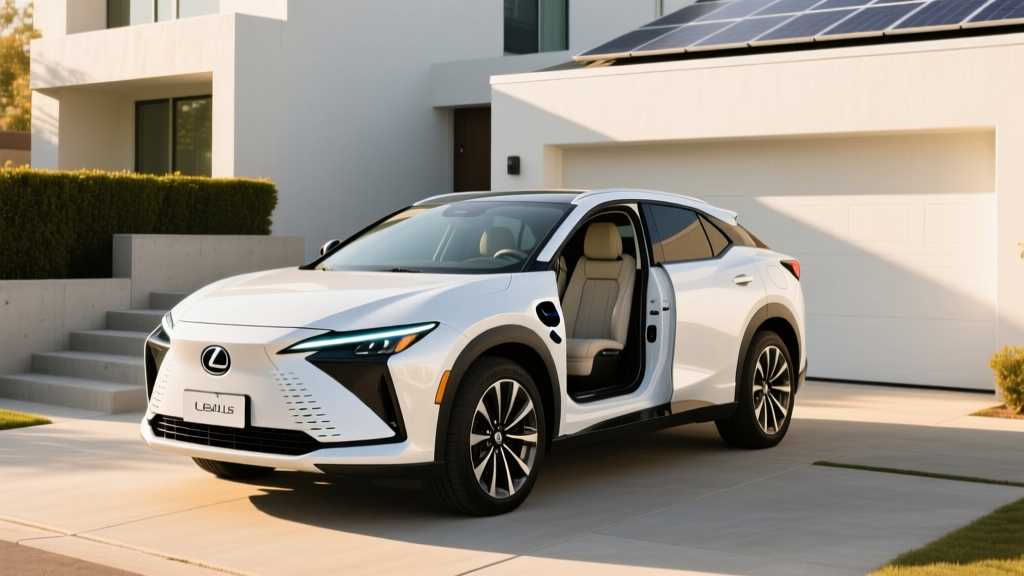
Financing a Lexus RZ 450e+ in 2026 means navigating a $54,000 starting MSRP, a federal tax credit that may or may not apply depending on your income and the vehicle's battery sourcing, and ownership economics that diverge sharply from a gas-powered Lexus RX. The RZ remains Lexus's only all-electric offering, and buyers researching Lexus electric car finance need to see the full five-year picture — not just the monthly payment, but charging costs, insurance premiums, maintenance savings, and the depreciation curve that has punished early luxury EVs.
This guide runs the numbers on the 2026 Lexus RZ 450e+ using real EPA data, current IRS §30D rules, and realistic insurance and charging assumptions. We'll show you exactly where the money goes — and where it comes back.
2026 Lexus RZ 450e+ at a Glance: Specs That Drive the Finance Math
| Spec | 2026 Lexus RZ 450e+ (AWD) |
|---|---|
| Base MSRP (Premium trim) | $54,000 |
| Luxury trim MSRP | $59,000 |
| EPA range | 220 miles (est.; 196 mi on 20-in. wheels) |
| Battery capacity | 71.4 kWh usable (NMC lithium-ion) |
| Peak DC fast charge rate | 150 kW |
| 10–80% DC charge time | ~30 minutes |
| Level 2 onboard charger | 7.7 kW (~25 mi/hr) |
| Horsepower | 308 hp (DIRECT4 AWD) |
| 0–60 mph | 5.0 seconds |
| MPGe (combined) | 102 MPGe |
| Battery warranty | 8 years / 100,000 miles |
| Basic warranty | 4 years / 50,000 miles |
Five-Year Total Cost of Ownership: The Full Breakdown
Below is a five-year TCO model assuming 15,000 miles per year (75,000 miles total), financing at 6.5% APR over 60 months with $5,000 down, and home Level 2 charging at the U.S. average residential electricity rate. We compare the RZ 450e+ against the closest gas alternative, the 2026 Lexus RX 350 AWD (MSRP ~$52,000, 24 MPG combined).
| Cost Category | Lexus RZ 450e+ (EV) | Lexus RX 350 AWD (Gas) | Notes |
|---|---|---|---|
| Purchase price (MSRP) | $54,000 | $52,000 | Before incentives |
| Federal tax credit (§30D) | –$3,750 to $7,500* | $0 | *See eligibility below |
| Finance interest (60 mo @ 6.5%) | $9,360 | $9,015 | $5,000 down payment |
| Fuel / electricity (75k mi) | $4,050 | $9,375 | $0.15/kWh vs $3.50/gal |
| Insurance (5 years) | $12,500 | $10,000 | EV premiums ~20–25% higher |
| Maintenance (5 years) | $1,800 | $4,500 | No oil changes; regen saves brakes |
| Depreciation (est.) | $24,300 (45%) | $18,200 (35%) | Luxury EVs depreciate faster |
| Total 5-year cost | $57,710 – $61,460** | $74,690 | **Range depends on tax credit |
The RZ can break even or beat the RX 350 over five years, but the margin depends almost entirely on whether you capture the full $7,500 federal credit and whether your state adds further incentives. Without the credit, the higher insurance and steeper depreciation narrow the gap significantly.
Federal Tax Credit: Do You Qualify Under Current §30D Rules?
The IRS §30D Clean Vehicle Credit offers up to $7,500, split into two halves — $3,750 for critical-minerals sourcing and $3,750 for battery-component manufacturing. As of 2026, the RZ 450e+ qualifies for one or both halves depending on Toyota's evolving supply chain, but your personal eligibility also depends on strict income and MSRP caps.
- MSRP cap: SUVs/crossovers must be ≤ $80,000. The RZ 450e+ qualifies (MSRP $54,000–$59,000).
- Income cap (modified AGI): $300,000 joint / $225,000 head of household / $150,000 single. Exceed these and the credit phases out entirely.
- Battery sourcing: $3,750 requires critical minerals extracted or processed in the U.S. or a free-trade-agreement country. $3,750 requires battery components manufactured or assembled in North America.
- Point-of-sale transfer: You can transfer the credit to the dealer at purchase, reducing your financed amount upfront — a major advantage for Lexus electric car finance structuring.
- FEOC exclusion: Vehicles with battery components from a "foreign entity of concern" (e.g., certain Chinese suppliers) are disqualified. Supply-chain details shift annually — verify at fueleconomy.gov before signing.
Because battery-sourcing rules tighten each year, the credit amount available for the RZ can change between model years. Always confirm the exact credit on the IRS clean vehicle credit page or ask your Lexus dealer for the current manufacturer certification letter before finalizing your finance terms.
Charging vs. Gas: The Per-Mile Cost Math
The single biggest operational savings in any EV finance calculation is fuel. Here's the concrete math for the RZ 450e+ versus the RX 350, using the RZ's combined efficiency of roughly 3.3 kWh per mile (derived from its 102 MPGe rating) and the RX's 24 MPG combined.
| Metric | Lexus RZ 450e+ | Lexus RX 350 AWD |
|---|---|---|
| Energy/fuel efficiency | 3.3 kWh/mi (102 MPGe) | 24 MPG combined |
| Cost per unit | $0.15/kWh (home avg.) | $3.50/gallon (national avg.) |
| Cost per mile | $0.050/mi | $0.146/mi |
| Annual cost (15,000 mi) | $750 | $2,190 |
| 5-year cost (75,000 mi) | $3,750 | $10,950 |
Home vs. public charging matters enormously. The $0.15/kWh figure assumes primarily home Level 2 charging. If you rely on DC fast charging at networks like Electrify America or EVgo, rates typically run $0.35–$0.55/kWh, which pushes the RZ's per-mile cost to $0.12–$0.18 — nearly erasing the fuel savings advantage. Buyers without home charging access should factor public-charging costs into their finance model before committing.
For a complete breakdown of home charger installation costs and Level 2 options, see our DOE charging technology overview.
Maintenance Savings: Where the RZ Earns Back Dollars
EV powertrains have far fewer moving parts than internal-combustion engines, and the maintenance savings are real — though not as dramatic as some marketing suggests. Here's a five-year comparison based on manufacturer-recommended service intervals and typical dealer pricing:
| Service Item | RZ 450e+ (EV) | RX 350 (Gas) |
|---|---|---|
| Oil changes (5 yr / 75k mi) | $0 | $750 (10 changes @ $75) |
| Brake pad replacement | $0–$300 (regen extends life) | $600–$900 (2 sets) |
| Coolant / fluid service | $200 | $400 |
| Cabin air filter | $250 | $250 |
| Tire rotation & replacement | $1,800 (EV tires wear faster) | $1,500 |
| Transmission fluid | $0 | $200 |
| Miscellaneous (wipers, 12V battery) | $350 | $400 |
| Total 5-year maintenance | $2,600–$2,900 | $4,100–$4,400 |
The RZ saves roughly $1,500–$1,800 in maintenance over five years. One caveat: EVs are heavier and deliver instant torque, which accelerates tire wear. Budget for a tire replacement around year 3 or 4, and consider EV-specific tire compounds (e.g., Michelin Pilot Sport EV) that are engineered for the weight and torque profile.
Insurance Reality: The Cost Buyers Overlook
EV insurance premiums run 20–25% higher than comparable gas vehicles, and the RZ is no exception. Expect annual premiums of $2,200–$2,800 depending on your state, driving record, and coverage level, compared to $1,800–$2,200 for the RX 350.
Why EVs cost more to insure:
- Higher repair costs: Battery pack damage in a collision often requires full-pack replacement ($15,000–$25,000 for a 71.4 kWh NMC pack), and insurers price this risk into premiums.
- Specialized labor: High-voltage system repairs require certified EV technicians, and fewer shops have that certification, driving up labor rates.
- Higher vehicle values: Comprehensive and collision coverage is based on vehicle value, and the RZ's MSRP sits higher than many gas equivalents.
- Parts availability: EV-specific body panels and structural components can have longer lead times, increasing rental-car costs during claims.
Shop quotes from at least three insurers before signing your finance agreement. Some carriers (Geico, Progressive, State Farm) offer specific EV discounts or bundle incentives that can narrow the premium gap to 10–15%.
Depreciation and Resale Value: The Elephant in the Finance Sheet
Luxury EVs have depreciated faster than their gas counterparts over the past three years, and the RZ has been caught in this trend. Based on current market data:
- Lexus RZ 450e+: Projected 45% depreciation over 5 years (retaining ~55% of MSRP, or roughly $29,700 on a $54,000 purchase).
- Lexus RX 350: Projected 35% depreciation over 5 years (retaining ~65% of MSRP, or roughly $33,800 on a $52,000 purchase).
This ~$6,100 resale-value gap is the single largest headwind in Lexus electric car finance calculations. Several factors contribute:
- Battery degradation uncertainty: While Lexus warranties the battery for 8 years/100,000 miles at 70% capacity retention, secondhand buyers still discount EVs due to perceived replacement risk.
- Rapid tech obsolescence: Newer EVs with longer range and faster charging make 220-mile-range models feel dated quickly.
- Tax credit effect: When new buyers can get $7,500 off at point of sale, used prices must drop to remain competitive.
- Tesla price wars: Aggressive new-EV pricing since 2023 has compressed used EV values across the segment.
If you plan to keep the RZ past year 5, depreciation matters less — you'll eventually drive past the steepest part of the curve. But if you're structuring a 36- or 48-month lease or planning to trade in, factor the sharper drop into your monthly-equivalent cost.
State, Local, and Utility Incentives: Check Your Region
- California: CVRP rebate up to $2,000 (income-dependent) plus potential utility off-peak charging credits.
- Colorado: State EV tax credit up to $5,000 for vehicles under $80,000 MSRP.
- New York: Drive Clean Rebate up to $2,000 (point-of-sale).
- Utility rebates: Many utilities (PG&E, ConEdison, Xcel Energy, etc.) offer $250–$1,500 for home Level 2 charger purchase or installation, plus time-of-use rates that can cut charging costs by 30–50%.
- HVAC/charger bundles: Some utilities rebate panel upgrades if you install a Level 2 charger simultaneously.
Structuring Your Lexus Electric Car Finance: Practical Tips
With the numbers laid out, here's how to structure the actual financing:
- Use the point-of-sale transfer. If you qualify for the §30D credit, transfer it to the dealer at signing. This reduces the financed principal directly, lowering both your monthly payment and total interest paid. On a $54,000 RZ with a $7,500 credit and $5,000 down, you finance $41,500 instead of $49,000.
- Target a 60-month term maximum. EVs depreciate faster; a 72- or 84-month loan risks putting you underwater (owing more than the car's value) by year 3. A shorter term means higher monthly payments but protects your equity position.
- Get pre-approved before visiting the dealer. Credit unions often beat dealer-arranged financing by 1–2 percentage points. At $49,000 financed, a 5.5% vs. 6.5% rate saves roughly $1,400 over 60 months.
- Budget for the charger install. A Level 2 home charger (e.g., ChargePoint Home Flex or Emporia Vue) costs $500–$700 for equipment plus $800–$2,500 for electrician installation, depending on panel capacity and run length. Factor this into your drive-off cost.
- Insure before you sign. Get a binding insurance quote on the exact VIN before finalizing the purchase. Some buyers discover their premium is $300+/month higher than expected, blowing up the monthly budget.
Frequently Asked Questions
How much does it really cost to own a Lexus RZ 450e+ over 5 years?
Between $57,710 and $61,460 depending on your federal tax credit eligibility, assuming 15,000 miles per year, home charging at $0.15/kWh, and average insurance rates. Without the federal credit, the five-year cost rises to roughly $65,000. Compare this to the gas-powered RX 350 at approximately $74,690 over the same period — the EV wins on operating costs but gives back some ground on insurance and depreciation.
Do I qualify for the federal EV tax credit on the Lexus RZ?
You may qualify for up to $7,500 under IRS §30D if your modified AGI is under $300,000 (joint), $225,000 (head of household), or $150,000 (single), and the vehicle meets battery-sourcing requirements. The RZ's MSRP is under the $80,000 SUV cap. However, the exact credit amount ($3,750 or $7,500) depends on Toyota's current battery-component and critical-mineral sourcing certifications. Verify at fueleconomy.gov before purchase.
How much do I save on fuel and maintenance with the RZ 450e+?
Approximately $7,200 in fuel and $1,500–$1,800 in maintenance over five years (75,000 miles), assuming home charging at $0.15/kWh and gas at $3.50/gallon. Total operational savings: roughly $8,700–$9,000. These savings shrink if you rely primarily on public DC fast charging at $0.35–$0.55/kWh.
Are EVs more expensive to insure than gas cars?
Yes, typically 20–25% more. For the RZ 450e+, expect $2,200–$2,800 annually versus $1,800–$2,200 for the RX 350. Higher premiums reflect costlier collision repairs (especially battery replacement), specialized technician requirements, and the vehicle's higher MSRP. Shop multiple insurers and ask about EV-specific discounts.
How well does the Lexus RZ hold its value?
The RZ is projected to retain approximately 55% of its MSRP after five years, compared to roughly 65% for the gas RX 350. This steeper depreciation is driven by rapid EV technology advancement, battery-health uncertainty in the used market, and aggressive new-EV pricing compressing used values. If you plan to own the vehicle 7–10 years, the depreciation curve flattens and matters less to your overall cost.
Can I lease the RZ and still get a tax benefit?
Leased EVs may qualify for the commercial clean vehicle credit (§45W), which the leasing company can pass through as a capitalized-cost reduction (effectively a "lease cash" discount). This credit has fewer sourcing restrictions than §30D and no income cap, making leasing an attractive path for buyers who exceed the §30D income limits. Ask your Lexus dealer how the current lease credit is being applied to RZ lease terms.