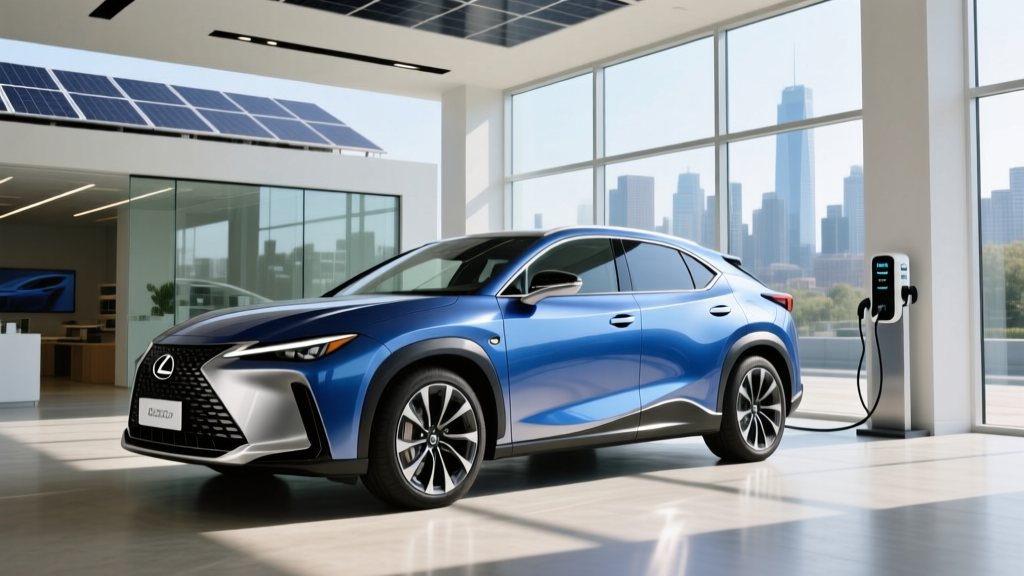
Lexus entered the battery-electric arena cautiously, but the 2026 lineup — anchored by the RZ 450e crossover and the newly introduced electric sedan offerings — presents a compelling luxury EV proposition. For buyers weighing a Lexus EV lease against purchasing outright, the math hinges on federal incentives, charging economics, insurance premiums, and long-term depreciation. This guide dissects every cost factor so you can decide whether electrifying your garage with a Lexus makes financial sense.
The 2026 Lexus EV Lineup at a Glance
Before running the numbers, here is what Lexus currently offers in the all-electric space for the 2026 model year:
| Spec | RZ 450e (Premium) | RZ 450e (Luxury) |
|---|---|---|
| EPA Range | 220 mi (20" wheels) / 196 mi (18" AWD) | 196 mi (20" AWD) |
| Battery | 72.8 kWh usable, NMC | 72.8 kWh usable, NMC |
| Powertrain | Dual-motor AWD, 308 hp | Dual-motor AWD, 308 hp |
| 0–60 mph | 5.0 sec | 5.0 sec |
| DC Fast Charge (peak) | 150 kW (CCS), 10–80% ~30 min | 150 kW (CCS), 10–80% ~30 min |
| Level 2 Charge | ~11 kW, ~7.5 hr full charge | ~11 kW, ~7.5 hr full charge |
| MPGe (combined) | 102 MPGe | 97 MPGe |
| Base MSRP | $55,850 | $60,850 |
| Battery Warranty | 8 yr / 100,000 mi | 8 yr / 100,000 mi |
Federal Tax Credit: Do You Qualify for Up to $7,500?
The IRS §30D Clean Vehicle Credit remains the single largest financial incentive for going electric. However, eligibility is not automatic — it depends on your income, the vehicle's MSRP, and battery-sourcing requirements. Here is the current checklist:
- Income Caps: Modified AGI must not exceed $150,000 (single), $225,000 (head of household), or $300,000 (married filing jointly).
- MSRP Caps: Vans, SUVs, and pickup trucks: $80,000. Sedans and other vehicles: $55,000. The RZ 450e qualifies as an SUV under IRS classification, so the $80,000 cap applies.
- Battery Sourcing: To receive the full $7,500, the vehicle must meet both the critical-minerals requirement ($3,750 portion) and the battery-components requirement ($3,750 portion). These thresholds tighten each year — check IRS §30D guidelines for current-year sourcing rules.
- Point-of-Sale Transfer: As of 2024, you can transfer the credit to the dealer at purchase, reducing your out-of-pocket cost immediately rather than waiting for tax filing.
- Assembly: Final assembly must occur in North America. The RZ 450e is assembled in Japan, which disqualifies it from the purchase credit under §30D.
5-Year Total Cost of Ownership Breakdown
Below is a realistic 5-year / 60,000-mile ownership projection for the RZ 450e Premium ($55,850 MSRP) compared to a similarly priced gas-powered Lexus NX 350 AWD ($44,350 MSRP). This assumes purchase (not lease), home Level 2 charging, and current national averages.
| Cost Category | RZ 450e (EV) | NX 350 AWD (Gas) |
|---|---|---|
| Purchase Price (MSRP) | $55,850 | $44,350 |
| Federal Tax Credit | $0 (Japan assembly)* | $0 |
| Effective Purchase Price | $55,850 | $44,350 |
| Energy/Fuel (5 yr / 60k mi) | $4,200 (at $0.14/kWh) | $9,600 (at $3.50/gal, 25 MPG) |
| Maintenance (5 yr) | $1,800 | $4,500 |
| Insurance (5 yr) | $12,600 | $10,200 |
| Depreciation (5 yr) | $27,925 (~50%) | $19,958 (~45%) |
| Total 5-Year Cost | $102,375 | $78,608 |
| Cost Per Mile | $1.71 | $1.31 |
*If leasing and the lessor passes through the §45W credit (typically $7,500), the effective purchase price drops to ~$48,350 and total 5-year cost to ~$94,875 — narrowing the gap substantially.
Charging vs. Gas: The Per-Mile Math
The RZ 450e consumes roughly 33 kWh per 100 miles (EPA combined). Here is what that means in real dollars depending on how and where you charge:
| Charging Scenario | Cost per kWh | Cost per 100 mi | Cost per Mile |
|---|---|---|---|
| Home Level 2 (national avg residential) | $0.14 | $4.62 | $0.046 |
| Home with solar | $0.06 | $1.98 | $0.020 |
| Public DC fast ( Electrify America avg) | $0.42 | $13.86 | $0.139 |
| Gas NX 350 (25 MPG, $3.50/gal) | — | $14.00 | $0.140 |
At home on grid power, you are paying roughly one-third the per-mile cost of gasoline. The savings compound: over 12,000 miles per year, that is ~$554 in electricity versus ~$1,680 in gas — a $1,126 annual fuel savings. If you have rooftop solar, the gap widens to over $1,400 per year.
However, if you rely exclusively on public DC fast charging at $0.40+/kWh, the cost advantage essentially disappears. Home charging access is a prerequisite for EV economics to work in your favor.
Maintenance Savings: Where EVs Quietly Win
Electric drivetrains have far fewer moving parts than internal combustion engines. Here is what you will never pay for on the RZ 450e:
| Maintenance Item | Gas Vehicle (NX 350) | Lexus RZ 450e |
|---|---|---|
| Oil changes (every 5k–10k mi) | $60–$120 each (~$480 over 60k mi) | Not required |
| Transmission fluid | $150–$250 service | Not required |
| Spark plugs | $200–$400 replacement | Not required |
| Brake pads | $300–$500 per axle (2–3 replacements) | $0–$200 (regen braking extends pad life to 80k+ mi) |
| Engine air filter | $30–$60 each | Not required (cabin filter only) |
| Exhaust system | $500–$1,500 (muffler, catalytic converter) | Not required |
| Coolant flush | $100–$150 every 30k mi | Every 5 yr / 60k mi (battery thermal loop) |
Over 5 years and 60,000 miles, expect to spend roughly $1,800 on the RZ 450e (cabin air filters, tire rotations, brake fluid checks, wiper blades, and a potential coolant service) versus $4,500+ on the gas NX. That is a $2,700 maintenance savings — significant, though not enough alone to offset the higher purchase price.
Insurance Reality: Why EVs Cost More to Insure
National data from the Insurance Information Institute and major carriers shows that EVs typically carry insurance premiums 15–25% higher than comparable gas vehicles. For the RZ 450e, expect annual premiums in the $2,200–$2,800 range depending on your state, driving record, and coverage level, versus $1,800–$2,200 for the NX 350.
The reasons are structural:
- Higher repair costs: Battery pack replacement or repair after collision damage is expensive. Even minor rear-end impacts can trigger battery-safety protocols requiring full inspection.
- Specialized labor: Fewer body shops are certified for high-voltage EV repair, driving up labor rates.
- Higher vehicle value: Insurers base premiums partly on replacement cost, and the RZ's MSRP is higher than a gas equivalent.
- Total-loss thresholds: Battery damage can push repair costs past the total-loss threshold more easily, increasing insurer payout risk.
Shop quotes from at least three carriers before committing. Some insurers (Geico, Progressive, State Farm) offer EV-specific discounts or bundled home-charger coverage that partially offset the premium gap.
Depreciation and Resale Value Trends
EV depreciation has been a pain point. According to iSeeCars and Kelley Blue Book data, luxury EVs have depreciated 45–55% over five years on average — steeper than gas luxury crossovers at 40–48%. The RZ 450e, being a relatively new nameplate, carries some uncertainty.
Factors working against EV resale:
- Battery degradation concerns: Even though the 72.8 kWh NMC pack is warrantied for 8 years/100,000 miles (covering capacity below 70%), used buyers remain wary.
- Rapid tech advancement: Newer models with longer range and faster charging make older EVs feel dated quickly.
- Tesla price cuts ripple effect: Aggressive EV pricing from competitors compresses the used market.
- Tax credit shifts: Changes to incentive eligibility affect new-vehicle pricing, which cascades to used values.
Factors working in favor:
- Lexus brand equity: Lexus consistently ranks at or near the top of J.D. Power dependability studies, supporting stronger resale than many luxury EV rivals.
- Toyota/Lexus reliability reputation: The e-TNGA platform and conservative battery management may yield better-than-average degradation curves.
- NACS transition: Lexus has committed to adopting the NACS connector for future models, which may affect CCS-equipped 2024–2026 RZ resale — though adapters mitigate this.
For a 5-year ownership horizon, project approximately 50% depreciation on the RZ 450e ($27,925 loss on a $55,850 purchase). This is the single largest cost line item and the main reason leasing — where depreciation risk sits with the lessor — appeals to many luxury EV buyers.
Lease vs. Buy Decision Framework
Choose a Lexus EV lease if:
- The lessor passes through the §45W commercial credit ($7,500), lowering effective cost
- You want to avoid depreciation risk on a rapidly evolving tech product
- You plan to upgrade every 3 years to access newer range and charging tech
- Your daily driving fits within the RZ's 170–200 real-world mile range
- You have home Level 2 charging access
Choose to purchase if:
- You qualify for the full §30D credit (future North American-assembled Lexus EVs may qualify)
- You drive 15,000+ miles per year (lease mileage penalties add up)
- You plan to keep the vehicle 7+ years, well past the depreciation cliff
- You want to modify the vehicle (wraps, wheels, accessories)
- You have solar and can drive fuel cost to near zero
Frequently Asked Questions
How much does it really cost to own a Lexus RZ 450e over 5 years?
Approximately $102,000 all-in at MSRP with no tax credit, or roughly $95,000 if a $7,500 lease-cash credit applies. That breaks down to about $1.58–$1.71 per mile including depreciation, energy, insurance, and maintenance. For comparison, a gas Lexus NX 350 runs about $79,000 over the same period at $1.31 per mile. The EV costs more overall today, primarily due to higher purchase price and steeper depreciation.
Does the Lexus RZ 450e qualify for the $7,500 federal tax credit?
Not under the §30D purchase credit, because it is assembled in Japan (Motomachi plant), failing the North American final assembly requirement. However, if you lease, the leasing company may claim the §45W commercial credit and pass savings to you as reduced monthly payments. Confirm this with the dealer before signing — it is not automatic.
How much do I save on fuel and maintenance with a Lexus EV?
With home charging at the national average of $0.14/kWh, you will spend about $840/year on electricity versus $1,680/year on gas for a comparable NX 350 — saving ~$840 annually on fuel. Maintenance savings add another ~$540/year. Combined, that is roughly $1,380 per year in operational savings, or $6,900 over 5 years.
Are Lexus EVs more expensive to insure?
Yes, typically 15–25% more than equivalent gas models. Expect $2,200–$2,800/year for the RZ 450e versus $1,800–$2,200 for the NX 350. Higher repair costs, specialized labor, and elevated replacement values drive the difference. Always get personalized quotes before committing.
How well does the Lexus RZ 450e hold its value?
Project roughly 50% depreciation over 5 years — steeper than gas Lexus models but in line with luxury EV averages. Lexus's reliability reputation provides a floor that many EV competitors lack, but rapid technology advancement and battery degradation perception suppress resale. Leasing transfers this risk to the lessor.
What home charging setup do I need for the RZ 450e?
A Level 2 home charger (240V, 48-amp circuit) will fully recharge the 72.8 kWh battery in about 7.5 hours — ideal for overnight charging. Installation costs range from $800 to $2,500 depending on your electrical panel capacity and run length. If your panel is at capacity, a 200-amp service upgrade adds $1,500–$3,000. Consult a licensed electrician for a site-specific quote.