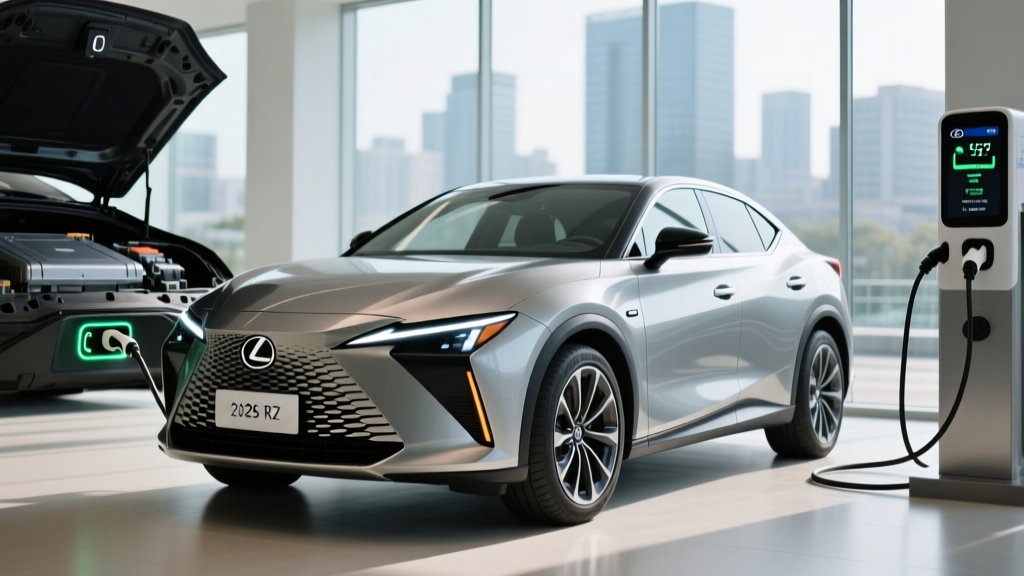
If you're considering a Lexus electric vehicle in 2026, the RZ 450e remains the brand's core all-electric offering — a luxury crossover with 220 miles of EPA range (220-mm wheelbase variant with 18-inch wheels), 308 horsepower, and starting at $59,650. It's a compelling choice for current Lexus owners who value refinement and reliability, but its moderate range and limited DC fast-charging speed mean it works best for buyers with home charging and commutes under 150 miles. If you regularly drive 300+ miles between charges or live in a cold climate without garage parking, a Lexus hybrid like the RX 500h may serve you better.
Quick Verdict: Who Should Buy a Lexus EV?
Buy the RZ 450e if: You want luxury-crossover comfort, have Level 2 home charging, drive mostly under 150 miles daily, and value Lexus build quality over maximum range.
Consider a Lexus hybrid instead if: You take frequent road trips exceeding 250 miles, live in a charging desert, lack home charging access, or regularly face sub-freezing winters.
2026 Lexus RZ 450e: The Current Electric Lineup
Lexus entered the dedicated EV space with the RZ 450e, built on Toyota's e-TNGA platform shared with the Toyota bZ4X and Subaru Solterra. For 2026, the RZ 450e continues with two battery and drivetrain configurations that buyers need to understand before signing a purchase agreement.
| Spec | RZ 450e (FWD) | RZ 450e AWD |
|---|---|---|
| EPA Range | 220 mi (18" wheels) | 196 mi (20" wheels) |
| Battery (usable) | 71.4 kWh, NMC lithium-ion | 71.4 kWh, NMC lithium-ion |
| Horsepower | 201 hp | 308 hp |
| 0-60 mph | 7.4 sec | 5.0 sec |
| Peak DC Fast Charge | 150 kW (CCS1) | 150 kW (CCS1) |
| 10-80% DC Charge Time | ~30 min | ~30 min |
| Level 2 Charge Rate | 7.2 kW | 7.2 kW |
| MPGe (combined) | 115 MPGe | 102 MPGe |
| Base MSRP | $59,650 | $62,150 |
| Battery Warranty | 8 yr / 100,000 mi | 8 yr / 100,000 mi |
The range difference between FWD and AWD is significant — 24 miles separates them, largely due to the dual-motor AWD system's added weight and rolling resistance from standard 20-inch wheels. If range is your priority, the FWD Premium trim with 18-inch wheels is the efficiency play.
Real-World Range Expectations
EPA sticker: 220 miles (FWD) / 196 miles (AWD)
Highway driving (70-80 mph): Expect ~175-190 miles (FWD), ~155-170 miles (AWD)
Cold weather (below 32°F): Expect 15-25% reduction — roughly 165-185 miles (FWD)
Mixed suburban commute: Close to EPA estimates, especially with regenerative braking on moderate terrain
The RZ 450e's thermal management system includes a heat pump, which helps mitigate cold-weather losses compared to EVs without one. However, the 71.4 kWh battery is smaller than competitors like the Genesis Electrified GV70 (77.4 kWh) or BMW iX (105.2 kWh), which limits the ceiling for real-world range.
Lexus EV vs. Lexus Hybrid: Data-Driven Comparison
Lexus built its reputation on hybrid dominance, and many buyers cross-shop the RZ 450e against the RX 500h or NX 450h+. Here's how the numbers actually compare.
| Metric | RZ 450e AWD | RX 500h (Hybrid) |
|---|---|---|
| Powertrain | Dual-motor BEV | 2.4L turbo hybrid |
| EPA Range / Tank | 196 mi | ~440 mi (19.8 gal tank) |
| Fuel/Charging Cost per Mile | ~$0.045/mi (home charging) | ~$0.14/mi (premium, $3.50/gal) |
| 0-60 mph | 5.0 sec | 5.5 sec |
| Base MSRP | $62,150 | $63,550 |
| Federal Tax Credit (§30D) | Up to $7,500 (if eligible) | $0 (not a BEV or qualifying PHEV) |
| Annual Maintenance (est.) | ~$400 | ~$700 |
| 5-Year Fuel/Energy Cost | ~$2,700 | ~$8,400 |
The RZ 450e's energy cost advantage is dramatic — roughly $5,700 less over five years at 12,000 miles per year with home Level 2 charging at $0.14/kWh. After factoring in a potential $7,500 federal tax credit, the RZ can actually undercut the RX 500h on effective purchase price for eligible buyers. But the RX 500h's 440-mile range eliminates any refueling logistics concern entirely.
Total Cost of Ownership: What You'll Actually Spend
Let's break down the real five-year ownership costs for the RZ 450e AWD, assuming 12,000 miles per year, home charging, and eligibility for the full federal tax credit.
| Category | Cost | Notes |
|---|---|---|
| Purchase Price (base) | $62,150 | AWD Premium trim |
| Federal Tax Credit (§30D) | -$7,500 | If income/sourcing rules met; point-of-sale |
| Effective Purchase | $54,650 | Before state incentives or dealer fees |
| Home Level 2 Charger Install | $800–$2,000 | 240V/40A circuit; varies by panel condition |
| 5-Year Energy Cost | ~$2,700 | At $0.14/kWh, 2.8 kWh/mi |
| 5-Year Maintenance | ~$2,000 | Tires, cabin filter, wipers, brake fluid check |
| 5-Year Insurance (avg.) | ~$12,500 | $2,500/yr avg for luxury EV crossover |
| Estimated Depreciation | ~$22,000 | ~40% over 5 years (luxury EV segment avg) |
| Total 5-Year Cost | ~$93,850 | Includes purchase net of credit |
Insurance is the hidden cost that catches many first-time EV buyers off guard. Luxury EV crossovers typically carry premiums 15-25% higher than their gas counterparts due to higher repair costs and specialized parts. Get a quote before committing.
Federal Tax Credit Eligibility (§30D)
The RZ 450e may qualify for up to $7,500 under the IRS §30D clean vehicle credit, but eligibility is not guaranteed. Current rules require:
- MSRP cap: Vehicle MSRP must not exceed $80,000 for SUVs (RZ qualifies)
- Buyer income cap: AGI ≤ $150,000 (single) or $300,000 (joint)
- Battery sourcing: Critical minerals and battery components must meet phased-in domestic/free-trade requirements — verify the specific VIN with the dealer and IRS
- Point-of-sale transfer: You can apply the credit as a down-payment reduction at purchase rather than waiting for tax filing
Battery sourcing rules tighten annually. Always confirm credit eligibility for your specific delivery VIN with the dealer and your tax professional before finalizing the purchase.
Charging the RZ 450e: Home and Public Realities
The RZ 450e uses a CCS1 connector for DC fast charging and a J1772 inlet for Level 2 AC charging. With the industry's ongoing shift to NACS (Tesla's connector), Lexus has announced future NACS adoption, but 2026 RZ models still ship with CCS1. Adapters are available for Tesla Supercharger access.
| Level | Power | Miles Added per Hour | Use Case |
|---|---|---|---|
| Level 1 (120V) | ~1.4 kW | ~5 mi/hr | Emergency/overnight trickle only |
| Level 2 (240V/32A) | 7.2 kW | ~25 mi/hr | Home daily charging; full charge in ~10 hrs |
| DC Fast (CCS1) | Peak 150 kW | ~180 mi/hr at peak | Road trips; 10-80% in ~30 min |
The 150 kW peak DC charge rate is the RZ's most debated limitation. Competitors like the Hyundai Ioniq 5 (peak 240 kW, 10-80% in ~18 min) and Kia EV6 (peak 240 kW) charge substantially faster. On a road trip, you'll spend 30 minutes at a DC fast charger for a 10-80% fill, versus roughly 18 minutes in the fastest-charging rivals. For most daily driving with home charging, this is irrelevant — but it matters if you road-trip frequently.
Home charging setup: A Level 2 home charger on a 240V/40A circuit will replenish the RZ's 71.4 kWh battery from empty to full in approximately 10 hours. Most owners plug in overnight and wake to a full charge. Budget $800-$2,000 for professional installation depending on your electrical panel's capacity and the distance from panel to charger location. A 200-amp panel is typically sufficient; older homes with 100-amp service may require a panel upgrade ($1,500-$3,000+).
Common Misconceptions About Lexus EVs
| Myth | Fact |
|---|---|
| "Lexus EVs have the same battery warranty as their hybrids" | Lexus covers the RZ's battery at 8 years/100,000 miles against defects and capacity loss below 70%. Lexus hybrid battery warranties differ by model year — don't conflate them. |
| "I can use Tesla Superchargers directly" | The 2026 RZ 450e uses CCS1. You'll need a NACS-to-CCS adapter (such as those from Lectron or A2Z) for Supercharger access. Native NACS ports are expected on future models. |
| "220 miles of range isn't enough" | For 90%+ of daily driving (average US commute is ~37 miles round trip per FHWA data), 220 miles is ample with home charging. Range limitations surface on road trips and in extreme cold. |
| "EVs need no maintenance" | EVs eliminate oil changes, spark plugs, and transmission fluid. But you'll still rotate tires (EVs wear tires faster due to instant torque and weight), replace cabin air filters, check brake fluid, and eventually replace the 12V auxiliary battery. |
| "The federal tax credit is automatic" | Credit eligibility depends on your income, the vehicle's battery sourcing compliance, and MSRP. Verify before purchase — not after. |
Decision Framework: Is a Lexus Electric Vehicle Right for You?
If/Then Buying Guide
IF you have a garage or driveway with 240V outlet access and your daily driving is under 100 miles
THEN the RZ 450e works well — you'll charge at home nightly and rarely visit a public charger.
IF you take 3+ road trips per year exceeding 250 miles one-way
THEN the RZ's 196-220 mile range and 30-minute charge stops will test your patience. Consider the RX 500h hybrid or wait for a longer-range Lexus EV.
IF you live in a region with harsh winters (sustained below 20°F) and lack garage parking
THEN expect 20-25% range loss in deep cold. Your 220-mile FWD RZ becomes ~165-175 miles. A plug-in hybrid like the NX 450h+ (37 miles electric-only, then hybrid) may be more practical.
IF you qualify for the full $7,500 federal credit and your state offers additional EV incentives
THEN the RZ 450e's effective price drops meaningfully, making it competitive with the BMW iX (pricier) and Genesis Electrified GV70 (shorter range).
IF you rely exclusively on apartment living with no charging access
THEN any EV ownership is challenging. Map public chargers near your home and workplace on PlugShare or ChargePoint before committing. If reliable daily access isn't available, a Lexus hybrid eliminates the charging dependency entirely.
What First-Time Lexus EV Buyers Should Know
Preconditioning matters. The RZ 450e can precondition its battery for faster DC charging when you navigate to a fast charger in the infotainment system. This warms the battery to optimal temperature, enabling closer-to-peak charge rates. Skipping preconditioning in cold weather can add 10-15 minutes to your charge stop.
The charge curve tapers above 80%. Like all lithium-ion EVs, the RZ charges fastest between 10-50% SoC. Charging from 80-100% takes nearly as long as 10-80%. On road trips, charge to 80% and drive — it's faster overall than waiting for a full battery.
Regenerative braking settings. The RZ offers adjustable regen via paddle shifters. Max regen enables near one-pedal driving in city traffic, reducing brake wear and recapturing energy. On the highway, lower regen settings allow more efficient coasting.
Lexus Safety System+ 3.0 is standard on all RZ trims, including adaptive cruise, lane-keeping, and pre-collision braking. This is a SAE Level 2 driver-assistance system — it assists but does not replace an attentive driver. Your hands must remain on the wheel and eyes on the road at all times.
FAQ: Lexus Electric Vehicles
Does Lexus make a fully electric car?
Yes. The RZ 450e is Lexus's dedicated battery-electric crossover, built on the e-TNGA platform. It's the only fully electric Lexus model currently available in the US market. Lexus also offers several plug-in hybrids (NX 450h+) and conventional hybrids across its lineup.
How long does the Lexus RZ battery last?
Lexus warrants the RZ's high-voltage battery for 8 years or 100,000 miles against defects and capacity loss below 70%. Based on NMC chemistry degradation data from similar Toyota/Lexus platforms, expect 10-15% total capacity loss over 100,000 miles under normal use — meaning a 220-mile RZ might deliver ~187-198 miles of range at that point. Battery replacement, if needed out of warranty, is estimated at $12,000-$18,000 based on current parts pricing for similar-capacity packs.
Is the Lexus RZ eligible for the $7,500 tax credit?
It may be, but eligibility depends on your adjusted gross income (≤$150K single / ≤$300K joint), the vehicle's battery sourcing compliance for the delivery year, and the MSRP cap (≤$80K for SUVs — the RZ qualifies). Battery sourcing requirements tighten annually under IRS §30D rules. Confirm eligibility for your specific VIN with the dealer and a tax professional before purchase.
How does the Lexus RZ compare to the Toyota bZ4X?
They share the e-TNGA platform and 71.4 kWh battery, but the RZ features a more premium interior, standard Lexus Safety System+ 3.0, unique suspension tuning, and different styling. The bZ4X starts roughly $17,000 lower. If luxury materials and dealership experience matter, the RZ justifies the premium. If value is paramount, the bZ4X delivers similar range and charging at a fraction of the cost.
Can I charge a Lexus RZ at Tesla Superchargers?
Not natively. The 2026 RZ 450e uses a CCS1 connector. However, you can purchase a NACS-to-CCS adapter (typically $200-$400) to access Tesla's Supercharger network, which is the largest and most reliable DC fast-charging network in the US. Verify adapter compatibility with your specific model year before purchasing.