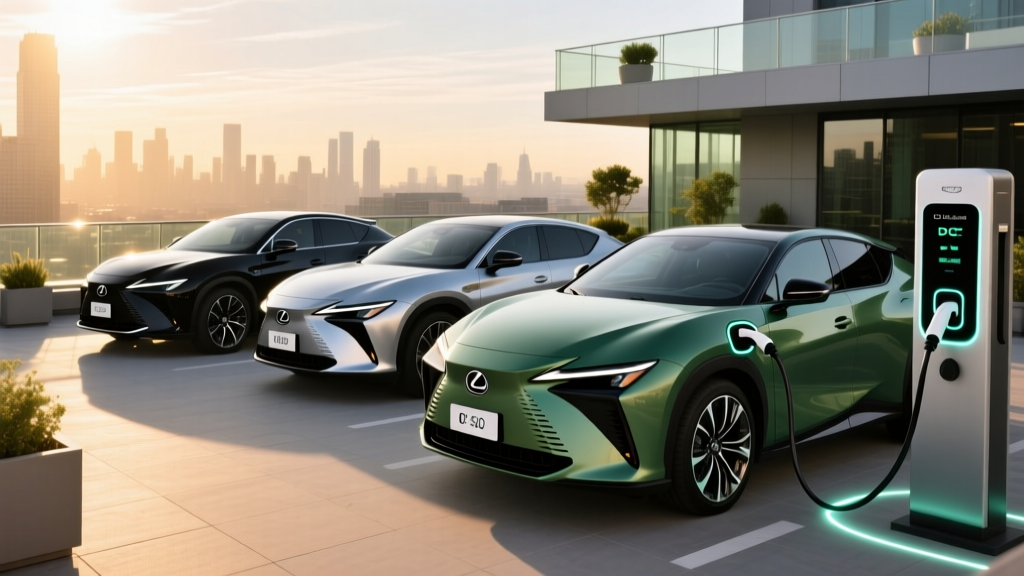
If you're searching for a Lexus all-electric vehicle in 2026, your options center on the Lexus RZ family — specifically the front-wheel-drive RZ 300e and the dual-motor all-wheel-drive RZ 450e. The RZ 300e delivers up to an EPA-estimated 266 miles of range starting around $43,000, while the RZ 450e offers up to 220 miles and 308 horsepower starting near $54,000. Both use a 72.8 kWh lithium-ion battery and can accept up to 150 kW of DC fast-charging power, reaching 10–80% in roughly 30 minutes. Federal tax credit eligibility under IRS §30D varies by battery sourcing and your income — check the latest rules before you buy.
Quick Answer: Is a Lexus All-Electric SUV Right for You?
Yes, if you prioritize a quiet, refined luxury cabin, strong build quality, and moderate daily range needs (under 200 miles round-trip). Think twice if you regularly road-trip beyond 200 miles in cold weather, need 300+ miles of EPA range, or lack access to reliable Level 2 home charging. The RZ trades best-in-class range for Lexus-level fit and finish.
The 2026 Lexus RZ Lineup: Trims, Specs, and Pricing
Lexus offers the RZ on Toyota's e-TNGA platform, shared with the Toyota bZ4X and Subaru Solterra. For the 2026 model year, the lineup includes two powertrains across multiple trims:
| Specification | RZ 300e (FWD) | RZ 450e (AWD) |
|---|---|---|
| Drivetrain | Front-Wheel Drive | Dual-Motor All-Wheel Drive (DIRECT4) |
| Horsepower | 201 hp | 308 hp |
| 0–60 mph | ~7.4 sec | ~5.0 sec |
| Battery (Usable) | 72.8 kWh (Lithium-Ion) | 72.8 kWh (Lithium-Ion) |
| EPA Range (Max) | 266 miles | 220 miles |
| MPGe (Combined) | 115 MPGe | 102 MPGe |
| Max DC Fast Charge | 150 kW | 150 kW |
| 10–80% DC Fast Charge | ~30 minutes | ~30 minutes |
| Level 2 Charging (240V) | ~9.5 hours (full) | ~9.5 hours (full) |
| Starting MSRP | ~$43,000 | ~$54,000 |
| Battery Warranty | 8 yr / 100,000 mi | 8 yr / 100,000 mi |
The RZ 300e's 266-mile EPA rating applies to the Premium trim with 18-inch wheels; stepping up to 20-inch wheels drops it to approximately 239 miles. The RZ 450e's 220-mile figure similarly reflects 18-inch wheels, falling to roughly 196 miles on the larger option. These are modest figures in a segment where competitors like the Hyundai Ioniq 5 (305 mi) and Tesla Model Y Long Range (310+ mi) push further on comparable or larger battery packs.
Real-World Range Expectations
EPA Sticker: 266 mi (RZ 300e) / 220 mi (RZ 450e)
Highway driving (70–75 mph): Expect ~210–230 mi (300e) / ~175–190 mi (450e)
Cold weather (below 30°F): Reduce estimates by 15–25%, yielding ~170–200 mi (300e) / ~140–165 mi (450e)
Bottom line: The RZ is a strong daily commuter and regional road-tripper, but plan charging stops carefully on trips over 200 miles in winter.
Charging Speed and Infrastructure: What to Expect
The RZ's 150 kW peak DC fast-charging rate is adequate but not class-leading. Many rivals now accept 200–350 kW on 800-volt architectures. Here's the practical breakdown:
| Charging Level | Power | Miles Added Per Hour | Best Use Case |
|---|---|---|---|
| Level 1 (120V household) | ~1.4 kW | ~4–5 miles | Overnight top-up, emergencies |
| Level 2 (240V home/public) | ~7.7 kW | ~25–30 miles | Daily home charging |
| DC Fast Charge | Up to 150 kW | ~200+ miles (peak) | Road trips, quick top-ups |
Charging curve reality: The RZ peaks near 150 kW at low state of charge (10–20%) but tapers significantly above 60%. Expect an average rate closer to 80–100 kW across a 10–80% session. That's why the 30-minute 10–80% figure, while reasonable, isn't exceptional. If you frequently road-trip, the taper matters — you'll spend more time at chargers than you would in an Ioniq 5 or Porsche Macan EV.
The RZ uses the CCS1 connector for DC fast charging. As of 2026, Lexus has not transitioned to the NACS (Tesla) connector on the RZ, though adapters are available for Supercharger access in many regions. Check Lexus.com for the latest connector and network compatibility information for your model year.
Lexus All-Electric vs. Gas and Hybrid: Cost Comparison
Many Lexus shoppers cross-shop the RZ against the NX 350 (gas) and NX 450h+ (plug-in hybrid). Here's how the numbers stack up over a realistic 5-year ownership period at 12,000 miles per year:
| Cost Category (5 Years) | RZ 450e (AWD EV) | NX 350 (Gas AWD) | NX 450h+ (PHEV AWD) |
|---|---|---|---|
| Purchase Price (MSRP) | ~$54,000 | ~$42,000 | ~$58,000 |
| Est. Federal Tax Credit | $0–$7,500* | $0 | $0–$7,500* |
| Fuel/Energy Cost | ~$3,800 | ~$9,500 | ~$5,200 |
| Maintenance | ~$1,200 | ~$3,500 | ~$2,800 |
| Insurance (Est.) | ~$8,500 | ~$7,000 | ~$7,800 |
| Estimated 5-Year Total | ~$60,000–$67,500 | ~$62,000 | ~$66,300–$73,800 |
* Federal tax credit eligibility under IRS §30D depends on battery component sourcing, critical mineral requirements, buyer income caps ($150K single / $300K joint), and MSRP caps ($80K for SUVs). Credit may be applied at point of sale. Always confirm eligibility with your tax professional before purchase.
The RZ's energy cost advantage is significant. At a national average of $0.16/kWh and 3.0 miles/kWh, you'll spend roughly $760/year charging at home — compared to about $1,900/year fueling the NX 350 at $3.50/gallon and 25 MPG combined. The gap widens further if you have access to off-peak utility rates or solar panels.
Maintenance savings are also real. EVs eliminate oil changes, transmission fluid, spark plugs, and exhaust system service. Brake pad life extends dramatically thanks to regenerative braking — many EV owners report 80,000+ miles on original pads.
Tax Credit Eligibility: What You Actually Need to Know
The federal EV tax credit is not a guaranteed $7,500 for every buyer. Under current §30D rules, eligibility hinges on multiple factors:
- Buyer income cap: Modified AGI must not exceed $150,000 (single), $225,000 (head of household), or $300,000 (joint filers)
- MSRP cap: Vehicle base price must be at or below $80,000 for SUVs (the RZ qualifies)
- Battery sourcing: Battery components must be manufactured or assembled in North America (phasing percentages increase annually); critical minerals must be sourced from the US or free-trade-agreement partners
- Point-of-sale transfer: Eligible buyers can transfer the credit to the dealer for an immediate price reduction at purchase
- Foreign entity of concern (FEOC): Vehicles with battery components from certain foreign entities are disqualified
The RZ's eligibility has shifted across model years as Lexus adjusted battery sourcing. As of early 2026, confirm the current status on fueleconomy.gov or ask your dealer for the IRS-compliant vehicle certification before signing.
Common Misconceptions About the Lexus RZ
| Myth | Fact |
|---|---|
| "The RZ has the same range as competitors." | The RZ's 220–266 miles trails the Ioniq 5 (305 mi), Model Y (310+ mi), and EV6 (310 mi). That's a real trade-off for Lexus refinement. |
| "I can charge at Tesla Superchargers natively." | The RZ uses CCS1, not NACS. You'll need an adapter (often included or available from Lexus) for Supercharger access in most regions. |
| "EVs are more expensive to own over 5 years." | With lower fuel and maintenance costs, the RZ can match or beat the NX 350 gas model on total cost — especially if you qualify for the tax credit. |
| "The battery will need replacing soon." | Lexus warrants the battery for 8 years/100,000 miles against degradation below 70% capacity. Real-world data shows most lithium-ion packs lose only 10–15% over 150,000+ miles. |
| "I need a 200-amp electrical panel upgrade to charge at home." | Most homes with a 100-amp or higher panel can support a 40-amp Level 2 circuit. A licensed electrician can confirm — panel upgrades cost $1,500–$3,000 only if needed. |
Real-World Ownership: What First-Time EV Buyers Must Know
Buying a Lexus all-electric RZ is not the same as buying a gas NX. Here are the practical realities that affect daily satisfaction:
Home Charging Is Non-Negotiable for Most Owners
Level 2 home charging (240V, 32–48 amp circuit) is the backbone of EV ownership. Without it, you'll rely on public DC fast chargers or slow Level 1 (120V) charging, which adds only ~4–5 miles per hour. A Level 2 home charger installation typically costs $800–$2,500 depending on your electrical panel proximity and local permitting. Budget for this upfront.
Cold Weather Cuts Range — Plan Accordingly
If you live in the upper Midwest, Northeast, or mountain states, expect 15–25% range loss in sustained sub-freezing temperatures. The RZ 450e's 220-mile EPA rating could shrink to 165–185 miles in a Minnesota January. The RZ includes a battery preconditioning feature for DC fast charging, but it does not have a dedicated heat pump (some competitors do), which can increase cabin-heating energy draw.
Insurance Costs Trend Higher for EVs
EV insurance premiums run 15–25% higher than comparable gas vehicles, driven by higher repair costs and specialized parts. Get quotes from your insurer before purchasing — the $8,500 five-year estimate in our table is a national average; your actual cost may vary.
Public Charging Reliability Is Improving but Inconsistent
Networks like Electrify America, EVgo, and ChargePoint have expanded, but uptime and connector availability remain uneven in some regions. Apps like PlugShare and A Better Routeplanner help you plan, but if your area has sparse DC fast-charging infrastructure, the RZ's 150 kW peak rate and range may feel limiting on longer trips.
Decision Framework: Should You Buy the Lexus RZ?
Choose the Lexus RZ 300e If:
- Your daily commute is under 80 miles round-trip
- You have Level 2 home charging or can install it
- You prioritize cabin quietness, Lexus build quality, and dealership service experience
- You rarely drive more than 200 miles one-way in cold weather
- You want the lowest entry price in the Lexus EV lineup (~$43K)
Choose the Lexus RZ 450e If:
- You need all-wheel drive for snow, rain, or mountain roads
- You want stronger acceleration (5.0 sec 0–60 mph)
- Your daily driving stays under 150 miles round-trip (accounting for cold-weather loss)
- You value the DIRECT4 torque-vectoring system for handling confidence
Consider a Competitor If:
- You need 300+ miles of EPA range (look at Ioniq 5, EV6, Model Y, or BMW iX)
- You road-trip frequently in winter and need faster charging (Ioniq 5/EV6 at 800V charge to 80% in ~18 min)
- You want native NACS/Supercharger access without an adapter (Tesla Model Y, or upcoming NACS-native models)
- You need three rows of seating (Kia EV9, Rivian R1S)
Frequently Asked Questions
Does Lexus make a fully electric car?
Yes. As of 2026, Lexus offers the RZ 300e (FWD) and RZ 450e (AWD) as fully electric SUVs. Lexus has announced plans to expand its all-electric lineup in the coming years, including a potential electric sedan and larger SUV, but the RZ family is the current production offering.
What is the real-world range of the Lexus RZ 450e?
The EPA rates the RZ 450e at up to 220 miles (18-inch wheels). In real-world highway driving at 70–75 mph, expect roughly 175–190 miles. In cold weather below 30°F, that drops to approximately 140–165 miles. The RZ 300e FWD achieves better efficiency, with real-world highway range of about 210–230 miles in mild conditions.
How long does it take to charge the Lexus RZ at home?
On a Level 2 (240V) home charger at 7.7 kW, a full 0–100% charge takes approximately 9.5 hours. Most owners charge from 20–80% overnight, which takes about 5.5–6 hours. A standard 120V outlet (Level 1) adds only ~4–5 miles per hour and is not practical as a primary charging method.
Is the Lexus RZ eligible for the $7,500 federal tax credit?
Eligibility varies by model year and current IRS sourcing rules. The RZ's MSRP falls under the $80,000 SUV cap, but battery component and critical mineral sourcing requirements determine whether it qualifies for the full $7,500, partial credit, or none. Always verify on fueleconomy.gov and consult a tax professional before purchase.
How does the Lexus RZ compare to the Toyota bZ4X?
Both share the e-TNGA platform and 72.8 kWh battery. The RZ offers a more premium interior, standard features, and Lexus dealership experience, but at a $5,000–$8,000 price premium. Range and charging speeds are nearly identical. If luxury branding and cabin materials matter, the RZ justifies the cost. If value is the priority, the bZ4X delivers similar EV performance for less.
What is the battery replacement cost for the Lexus RZ?
Out-of-warranty battery replacement is estimated at $12,000–$18,000 including labor, though this figure may decrease as battery costs continue to decline. However, the 8-year/100,000-mile warranty covers defects and capacity loss below 70%, and most EV batteries retain 85–90% capacity well beyond 150,000 miles based on current degradation data.