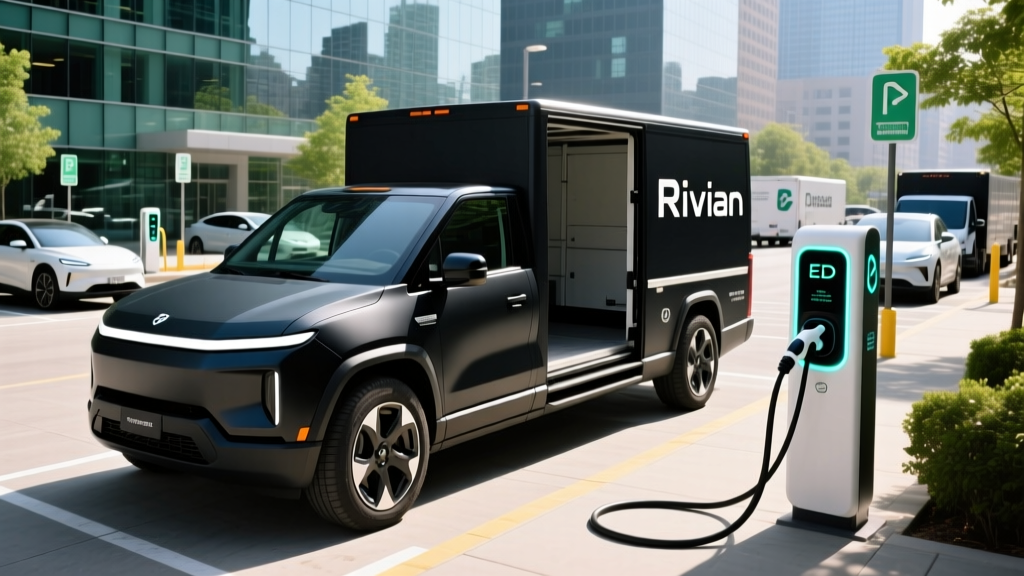
The Rivian EDV: Purpose-Built for Last-Mile Delivery
The Rivian EDV (Electric Delivery Van) isn't something you'll find on a dealer lot or configure on Rivian's consumer website. It exists because Amazon ordered 100,000 of them, making it one of the most consequential commercial electric vehicles ever produced. But as Rivian expands its commercial sales beyond its anchor customer — opening orders to fleets through its Rivian Commercial division — independent operators, logistics companies, and small fleet managers are asking the same question: does the Rivian commercial van actually pencil out against diesel and gasoline alternatives?
This review breaks down the EDV's real-world range, charging behavior, battery chemistry, cargo specs, and total cost of ownership. We'll also address the §30D commercial tax credit landscape and whether this van makes sense for your fleet in 2026.
EPA Estimated: ~150 miles (EDV-700 variant)
Real-World Highway/Loaded: Expect 110–130 miles with a full cargo load at sustained 55–65 mph speeds
Cold Weather (below 30°F): Anticipate a 20–30% reduction, yielding ~95–115 miles usable range
Urban Stop-and-Go (Empty/Light Load): Regen-heavy driving can push range to 155–165 miles
Spec Sheet: Rivian EDV at a Glance
| Specification | EDV-700 (Standard) | EDV-900 (Extended) |
|---|---|---|
| EPA Range | ~150 miles | ~161 miles |
| Battery Capacity (Usable) | ~89 kWh | ~122 kWh |
| Battery Chemistry | LFP (Lithium Iron Phosphate) | LFP |
| Peak DC Fast Charge | 150 kW | 150 kW |
| 10–80% DC Charge Time | ~45 minutes | ~55 minutes |
| Level 2 Charge Rate | 11.5 kW (~28 mi/hr) | 11.5 kW (~28 mi/hr) |
| Horsepower | ~275 hp (single rear motor) | ~275 hp |
| 0–60 mph | ~7.0 seconds (empty) | ~7.0 seconds (empty) |
| Drivetrain | RWD (rear-axle mounted) | RWD |
| Cargo Volume | ~660 cu ft | ~840 cu ft |
| Payload Capacity | ~2,553 lbs | ~2,500 lbs |
| Efficiency | ~1.8 kWh/mile (loaded) | ~2.0 kWh/mile (loaded) |
Battery Chemistry and Longevity: Why LFP Matters Here
The EDV uses LFP (lithium iron phosphate) cells, a deliberate choice for commercial duty cycles. LFP sacrifices some energy density compared to NMC (nickel manganese cobalt) — meaning a heavier, bulkier pack for the same kWh — but delivers critical advantages for fleet operators:
- Cycle life: LFP cells typically sustain 3,000–5,000 full charge cycles before hitting 80% capacity retention. For a van charged once daily, that's 8–13+ years before meaningful degradation.
- Thermal stability: LFP is inherently more resistant to thermal runaway, reducing fire risk in dense urban depot environments.
- 100% SoC tolerance: Unlike NMC, LFP can be routinely charged to 100% without accelerating degradation. Fleet managers don't need to baby the state of charge — plug in at end of shift, wake up to a full van.
- No cobalt or nickel: Simplifies supply chain and may improve eligibility for certain incentive structures tied to critical-mineral sourcing.
Rivian warrants the EDV battery and electric powertrain for 8 years or 100,000 miles (whichever comes first), with a capacity retention threshold of 70% — consistent with industry norms. For a delivery van averaging 25,000–35,000 miles/year, the warranty covers roughly 3–4 years of intensive use. Amazon's early EDV fleet data (vans deployed since late 2022) suggests degradation has been modest, with most units retaining above 90% capacity through 60,000+ miles of stop-and-go urban routes.
Charging Infrastructure: What Fleet Depots Need to Know
| Charge Level | Power (kW) | Miles Added per Hour | Full Charge Time | Use Case |
|---|---|---|---|---|
| Level 1 (120V) | ~1.4 kW | ~3 mi/hr | ~50+ hours | Emergency only |
| Level 2 (240V, 48A) | 11.5 kW | ~28 mi/hr | ~8–10 hours | Overnight depot charging |
| DC Fast Charge | 150 kW peak | ~140 mi/hr (peak) | 10–80% in ~45 min | Mid-shift top-up |
Charging curve reality: The EDV hits its 150 kW peak only between roughly 10–40% state of charge. Above 60%, the curve tapers significantly — expect ~80–90 kW through the 60–80% window, and under 40 kW above 80%. For fleet scheduling, plan DC fast-charge stops around the 10–80% window to avoid wasting time at low charge rates.
Depot charging math: At 11.5 kW Level 2, an overnight 10-hour charge session adds roughly 280 miles of range — far more than the EDV's battery can hold. In practice, a van returning at 20% SoC will be fully charged in about 6.5 hours. This aligns perfectly with typical overnight fleet schedules (return by 8 PM, deploy by 6 AM).
Infrastructure cost note: Installing 10–20 Level 2 chargers at a fleet depot typically costs $5,000–$12,000 per stall (equipment + electrical work + permits), with potential panel upgrades adding $15,000–$40,000 for larger installations. Commercial fleets should consult a licensed electrician and investigate utility demand-charge structures, which can significantly affect per-kWh cost at high-volume depots.
Cargo, Usability, and Driver Experience
The EDV was designed with direct input from Amazon delivery drivers, and the usability details show. The EDV-700 offers approximately 660 cubic feet of cargo space (the EDV-900 stretches to ~840 cu ft), with a flat load floor, a low step-in height (~18 inches), and a bulkhead separating the cab from the cargo area.
Notable design features:
- Three-door access: Rear roll-up door plus a curbside sliding door and a driver-side entry, enabling rapid package retrieval from multiple angles.
- Low cargo floor: The skateboard-style platform places the battery under the floor, keeping the load height manageable for heavy parcels.
- Camera-based mirrors: The EDV uses exterior cameras feeding interior displays, improving visibility in rain and reducing blind spots — critical for dense urban delivery routes.
- Integrated navigation: Route optimization software is built into the 15-inch touchscreen, with real-time battery-aware routing that factors in load, terrain, and weather.
Driver assists: The van includes Rivian's driver-assistance suite — adaptive cruise control, lane-keeping assist, automatic emergency braking, and a 360-degree camera system. This is SAE Level 2 driver assistance: the driver must remain engaged and hands on (or near) the wheel at all times. It is not autonomous driving.
Drawbacks worth noting:
- Ride quality (unloaded): The stiff rear suspension, tuned for heavy payloads, makes the EDV feel bouncy and harsh when running empty or lightly loaded.
- Ground clearance: At ~7 inches, the EDV is not suited for unpaved roads, steep driveways, or snow-plowed routes with high berms.
- Charging port location: Positioned on the driver's side front fender — functional for depot charging but awkward at some public DC fast-charging stations with short cables.
- Regen braking aggression: One-pedal driving mode is strong, which some drivers appreciate but others find jerky, especially when the cargo area is empty and the van is light.
Pricing, Tax Credits, and Fleet Economics
Rivian does not publish consumer-facing MSRPs for the EDV the way it does for the R1T or R1S. Pricing is negotiated through fleet sales agreements and varies with volume, configuration, and service contracts. Based on industry reporting and fleet procurement disclosures, the estimated pricing is:
| Model | Est. Base Price | Est. As-Tested (Loaded) | §30D Credit Eligibility |
|---|---|---|---|
| EDV-700 | ~$70,000–$75,000 | ~$80,000–$85,000 | Up to $7,500 (see rules below) |
| EDV-900 | ~$80,000–$85,000 | ~$90,000–$95,000 | Up to $7,500 (see rules below) |
Federal tax credit rules (§30D / §45W): Commercial EVs purchased for business use may qualify under IRC §45W (the commercial clean vehicle credit), which offers up to $7,500 for vehicles under 14,000 lbs GVWR and up to $40,000 for heavier vehicles. Unlike the consumer §30D credit, §45W is claimed by the business entity and does not have buyer income caps, but it does require that the vehicle be assembled in North America and meet battery-component and critical-mineral sourcing thresholds that phase in annually. The EDV is assembled at Rivian's Normal, Illinois facility, satisfying the domestic assembly requirement. Battery sourcing compliance varies by model year — consult IRS guidance on qualified commercial clean vehicles and a tax professional before finalizing a purchase.
Operating cost comparison (per mile):
- EDV (electricity at $0.14/kWh commercial rate): ~$0.25–$0.28/mile
- Diesel Sprinter (at $4.10/gal, 18 MPG): ~$0.23/mile (fuel only)
- Gasoline Ford E-Transit competitor: N/A — Ford offers the E-Transit as the direct electric rival
- Maintenance savings: Electric drivetrains eliminate oil changes, transmission fluid, and exhaust system repairs. Fleet data suggests 30–50% lower maintenance costs vs. diesel equivalents over 100,000 miles.
The per-mile electricity cost is comparable to diesel on a fuel-only basis, but the EDV's advantage compounds through lower maintenance, fewer scheduled service visits, and potential demand-charge optimization at depot-scale charging. According to fueleconomy.gov, electric commercial vehicles typically achieve 2–3× the energy efficiency of their internal-combustion counterparts on a BTU-per-mile basis.
Competitor Comparison: EDV vs. Ford E-Transit vs. BrightDrop Zevo
The Rivian EDV doesn't exist in a vacuum. Fleet buyers cross-shop it against two primary competitors:
- Ford E-Transit: 126-mile EPA range, 68 kWh battery (NMC), 115 kW DC fast charge, ~$45,000–$55,000 base price. Shorter range but significantly cheaper; better suited for shorter urban routes with guaranteed daily return-to-base charging.
- GM BrightDrop Zevo 600: ~250-mile estimated range, ~$75,000+ base, larger cargo volume. More range but higher price and less proven fleet deployment track record as of early 2026.
The EDV occupies a middle ground: more range and cargo volume than the E-Transit, at a higher price point, but with a more mature real-world deployment record (thanks to Amazon's 10,000+ van fleet). For routes consistently under 100 miles, the E-Transit's lower entry cost may dominate. For 120–150-mile routes with variable conditions, the EDV's LFP battery and driver-experience refinements justify the premium.
Pros
- LFP battery: 100% SoC charging, long cycle life, no cobalt
- Purpose-built for delivery: low step-in, camera mirrors, bulkhead
- 150+ mile real-world range sufficient for most last-mile routes
- Regenerative braking extends range in stop-and-go traffic
- Rivian's over-the-air updates continuously improve the platform
- Strong driver-assist suite reduces fatigue on long routes
Cons
- Pricing not publicly listed; requires fleet sales negotiation
- 150 kW peak DC charge rate trails some 2026 competitors at 200+ kW
- Harsh ride quality when unloaded
- Low ground clearance limits use on rough or unplowed roads
- Availability constrained by Amazon's priority allocation
- No AWD option — RWD only, limiting snow/ice capability
Who Should Buy the Rivian EDV?
Buy the Rivian EDV if:
- You operate last-mile delivery routes averaging 80–140 miles/day
- Your fleet returns to a depot nightly for Level 2 charging
- You value driver retention — the EDV's cab ergonomics and tech are a recruiting advantage
- You need 600+ cu ft of cargo volume with a low load floor
- You want LFP battery longevity for high-mileage, multi-year fleet service
Look elsewhere if:
- Your routes regularly exceed 150 miles without mid-day charging access
- You need AWD or high ground clearance for rural or winter routes
- You're a single-van operator who needs transparent, published pricing
- Your daily mileage is under 60 miles — the Ford E-Transit may offer better ROI at lower cost
Frequently Asked Questions
What is the real-world range of the Rivian EDV commercial van?
The EDV-700 carries an EPA-estimated ~150 miles of range. In real-world loaded delivery use (stop-and-go urban routes with 1,500–2,000 lbs of cargo), expect 120–140 miles. Highway driving at sustained 65 mph with a full load drops that to ~110–130 miles. In cold weather below 30°F, plan for 95–115 miles of usable range.
How fast does the Rivian EDV charge?
At a DC fast charger, the EDV peaks at 150 kW, reaching 10–80% state of charge in approximately 45 minutes (EDV-700). The charge curve tapers significantly above 60%, so plan mid-shift top-ups around the 10–80% window. At a Level 2 depot charger (11.5 kW), a full overnight session takes ~8–10 hours, easily covering next-day range needs.
Does the Rivian commercial van qualify for the federal EV tax credit?
The EDV is assembled in Normal, Illinois, meeting the North American assembly requirement. For commercial (business) purchases, the relevant credit is IRC §45W, which offers up to $7,500 for vehicles under 14,000 lbs GVWR. Battery-component and critical-mineral sourcing requirements apply and change annually. Consult IRS commercial clean vehicle guidance and a tax professional to confirm eligibility for your specific model year and purchase structure.
Is the Rivian EDV worth buying vs. the Ford E-Transit?
It depends on your route length and cargo needs. The E-Transit offers ~126 miles of range at a significantly lower price (~$45K–$55K vs. ~$70K–$85K for the EDV). If your routes are under 100 miles and budget is the primary constraint, the E-Transit wins. If you need 140+ miles of real-world range, a larger cargo area (660+ cu ft vs. ~487 cu ft), and the longevity benefits of an LFP battery, the EDV justifies its premium.
What battery chemistry does the Rivian EDV use, and why does it matter?
The EDV uses LFP (lithium iron phosphate) cells. LFP offers longer cycle life (3,000–5,000 cycles to 80% capacity), superior thermal stability, and the ability to charge to 100% daily without accelerating degradation — all critical for fleet duty cycles. The trade-off is lower energy density, meaning a heavier pack for the same range, but for a depot-charged delivery van, this is an acceptable compromise.
Can I buy a Rivian EDV as an individual or small business?
Rivian has begun opening EDV sales beyond Amazon, but allocation is limited and sales are handled through the Rivian Commercial division. Small fleet operators and independent contractors should contact Rivian Commercial directly for availability and pricing. As of early 2026, the EDV is not sold through consumer channels or traditional dealerships.