Quick Answer: Does Lexus Offer a 3-Row Electric SUV in 2026?
As of the 2026 model year, Lexus does not sell a fully electric (BEV) 3-row SUV. The closest option is the Lexus TX 550e+ plug-in hybrid (PHEV), which pairs a turbocharged V6 with an 18.5 kWh battery for approximately 33 miles of electric-only range before the gas engine engages. If you need a pure battery-electric 3-row SUV from a premium brand, you'll need to look at rivals like the Rivian R1S, Tesla Model X, or the upcoming Cadillac Escalade IQ. The TX 550e+ remains the only electrified 3-row Lexus, starting around $72,000 before incentives.
What the Lexus TX 550e+ Actually Is
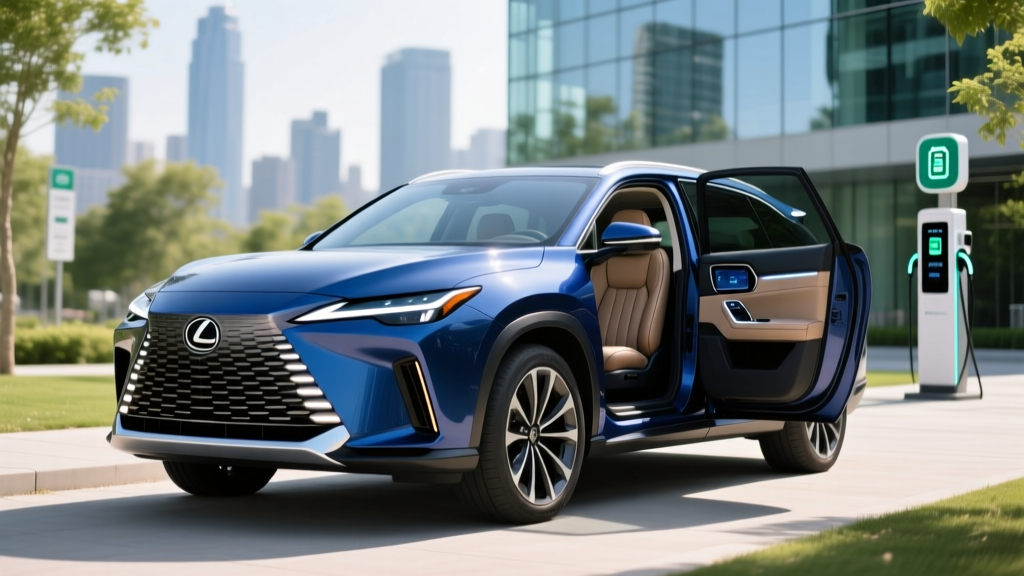
The Lexus TX is the brand's first purpose-built 3-row SUV, replacing the aging GX for family-hauling duty. For 2026, the electrified variant is the TX 550e+, a plug-in hybrid that bridges the gap between conventional gas power and full electrification. It is not a BEV — it has a gas engine, a fuel tank, and a tailpipe. But it does offer meaningful electric-only driving for daily errands and school runs.
| Spec | Value |
|---|---|
| Powertrain | 2.4L turbo 4-cyl + electric motors (PHEV) |
| Combined Output | ~375 hp |
| Battery Capacity | 18.5 kWh (usable ~16 kWh) |
| Battery Chemistry | Lithium-ion (NMC) |
| EPA Electric-Only Range | ~33 miles |
| EPA Combined MPG (gas mode) | ~34 MPG combined |
| Level 2 Charge Rate | ~6.6 kW onboard charger |
| Level 2 Full Charge Time | ~3 hours (0–100%) |
| DC Fast Charging | Not available |
| 0–60 mph | ~6.0 seconds |
| Seating | 6 or 7 passengers (3 rows) |
| Cargo (behind 3rd row) | ~20 cu ft |
| Towing Capacity | ~5,000 lbs |
| Base MSRP (TX 550e+) | ~$72,000 |
| Drivetrain Warranty | 6 years / 70,000 miles |
| Hybrid Battery Warranty | 10 years / 150,000 miles |
Note: Specs reflect manufacturer estimates for the 2026 model year. Always verify final EPA figures on fueleconomy.gov before purchasing.
TX 550e+ vs. Fully Electric 3-Row SUVs: A Realistic Comparison
Since Lexus doesn't yet offer a BEV 3-row, buyers cross-shopping the TX 550e+ are typically also considering pure-electric alternatives. Here's how the numbers stack up:
| Attribute | Lexus TX 550e+ (PHEV) | Rivian R1S (Dual-Motor) | Tesla Model X (LR) |
|---|---|---|---|
| Powertrain | PHEV (gas + electric) | BEV | BEV |
| EPA Electric Range | 33 mi (EV only) | ~340 mi (full BEV) | ~335 mi (full BEV) |
| Total Range (gas+EV) | ~420 mi combined | ~340 mi | ~335 mi |
| Battery kWh | 18.5 kWh | ~128 kWh (Max Pack) | ~100 kWh |
| Peak DC Charge Rate | N/A (no DCFC) | ~200 kW | ~250 kW |
| 10–80% DC Charge | N/A | ~30 min | ~25 min |
| 0–60 mph | ~6.0 sec | ~5.0 sec | ~3.8 sec |
| Base MSRP | ~$72,000 | ~$82,000 | ~$82,000 |
| Federal Tax Credit (§30D) | Up to $7,500* | Up to $7,500* | Up to $7,500* |
| 3rd-Row Usability | Good (adults short trips) | Tight (kids best) | Tight (kids best) |
*§30D credit eligibility depends on MSRP caps, buyer income limits, battery sourcing, and point-of-sale transfer rules. Verify current requirements at irs.gov.
Real Costs: What You'll Actually Spend Over 5 Years
The sticker price is just the starting point. Here's a realistic 5-year / 75,000-mile ownership cost breakdown comparing the TX 550e+ against a gas-only 3-row SUV and a full BEV. Assumes 12,000 miles/year, 70% of PHEV miles driven on electricity.
| Cost Category | Lexus TX 550e+ (PHEV) | Gas 3-Row SUV (e.g., Acura MDX) | Full BEV (e.g., Rivian R1S) |
|---|---|---|---|
| Purchase Price (after credit) | ~$64,500 | ~$58,000 | ~$74,500 |
| Fuel / Electricity (5 yrs) | ~$4,200 | ~$9,500 | ~$3,600 |
| Maintenance (5 yrs) | ~$3,000 | ~$4,500 | ~$1,800 |
| Insurance (5 yrs avg) | ~$12,000 | ~$10,500 | ~$13,500 |
| Estimated Depreciation | ~$28,000 | ~$24,000 | ~$35,000 |
| Total 5-Yr Cost | ~$111,700 | ~$106,500 | ~$128,400 |
| Cost Per Mile | ~$1.49 | ~$1.42 | ~$1.71 |
Key takeaways: The PHEV saves substantially on fuel versus gas (~$5,300 over 5 years) but carries a higher purchase price. The full BEV has the lowest running costs but the highest depreciation and upfront price. Your local electricity rate, annual mileage, and charging habits shift these numbers significantly.
Real-World Ownership: What First-Time Electrified Buyers Must Know
Home Charging Is Non-Negotiable for PHEV Value
The TX 550e+ only has a 33-mile electric range. If you can't charge at home every night, you're essentially driving a heavy, expensive hybrid — and losing the fuel-cost advantage. A Level 2 home charger (240V, ~32A) costs between $800 and $2,500 installed, depending on whether your electrical panel needs an upgrade. The TX's 6.6 kW onboard charger means a full home charge takes about 3 hours — easy to complete overnight.
Cold Weather Shrinks Electric Range by 20–30%
In sub-freezing temperatures, expect the TX 550e+'s electric-only range to drop from 33 miles to roughly 22–26 miles. The gas engine will kick in sooner and more often. If you live in the upper Midwest or Northeast, plan for more gas consumption in winter.
No DC Fast Charging on the PHEV
The TX 550e+ does not support DC fast charging. You cannot plug into a 150 kW Electrify America or Tesla Supercharger station and add range quickly. Public charging is limited to Level 2 (J1772 connector), which adds roughly 20–25 miles of range per hour. This is a deliberate engineering choice — PHEVs with small batteries don't benefit from DCFC architecture — but it means road trips are gas-powered.
Common Misconceptions: Myths vs. Facts
| Myth | Fact |
|---|---|
| "The TX 550e+ is a fully electric Lexus." | It's a plug-in hybrid. It has a gas engine, fuel tank, and tailpipe emissions when the battery is depleted. |
| "I'll get $7,500 off no matter what." | The §30D credit has MSRP caps ($80,000 for SUVs), buyer income limits ($300K joint / $150K single), and battery critical-mineral sourcing rules. Verify at irs.gov before assuming eligibility. |
| "33 miles of EV range isn't enough to matter." | The average American drives ~37 miles/day. With nightly home charging, the TX 550e+ covers most weekday commutes on electricity alone — saving $1,000+ per year on fuel. |
| "PHEV batteries degrade quickly and cost a fortune to replace." | Lexus warranties the hybrid battery for 10 years / 150,000 miles. Real-world data from Toyota/Lexus PHEVs shows ~10–15% degradation over 100K miles — manageable for a 33-mile range pack. |
| "I can DC fast-charge it on road trips." | No DC fast-charging port exists on the TX 550e+. Road trips run on gasoline. Level 2 public charging is available but slow (~3 hours for a full charge). |
Decision Framework: Is the TX 550e+ Right for You?
Choose the Lexus TX 550e+ (PHEV) If:
- You have home charging (garage or driveway with 240V access) and can plug in nightly.
- Your daily commute is under 35 miles round-trip, so most weekday driving is electric.
- You take regular road trips and want zero range anxiety — the gas engine provides ~400+ miles of total range.
- You value Lexus reliability and dealer network over cutting-edge EV tech.
- You need a genuine adult-usable 3rd row — the TX's 3rd row is roomier than the Model X or R1S.
- You're not ready to go full BEV due to apartment living, unreliable public charging, or frequent towing.
Look Elsewhere (Full BEV) If:
- You want zero tailpipe emissions and true electric-only operation at all times.
- Your daily drive exceeds 40 miles — you'll burn gas frequently in the PHEV.
- You want DC fast charging for road-trip convenience (10–80% in 25–30 minutes).
- You want the lowest possible fuel cost — a full BEV at $0.04/mile (home charging) beats the PHEV's blended ~$0.08/mile.
- You prefer EV-specific tech (frunk, one-pedal driving, OTA performance upgrades, V2L capability).
Wait If:
- Lexus has announced a dedicated BEV platform (e-TNGA large SUV) but hasn't confirmed a production 3-row BEV for 2026–2027. If you can wait 1–2 years, a true Lexus electric 3-row may arrive.
Frequently Asked Questions
Will Lexus release a fully electric 3-row SUV?
Lexus parent company Toyota has announced multiple next-generation BEVs on a dedicated EV platform, but as of early 2026, no production 3-row electric Lexus SUV has been confirmed with a firm on-sale date. Industry analysts expect one could arrive for the 2027–2028 model year. Until then, the TX 550e+ PHEV is the most electrified 3-row option in the Lexus lineup.
Does the Lexus TX 550e+ qualify for the $7,500 federal tax credit?
Potentially. The §30D credit for PHEVs requires the vehicle's MSRP to be at or below $80,000 (SUV cap), the buyer's AGI to fall within income limits, and the battery to meet critical-mineral and component sourcing thresholds. Credit can now be transferred to the dealer at point of sale as a purchase-price reduction. Always verify current eligibility on irs.gov and consult a tax professional.
How much does it cost to charge the TX 550e+ at home?
Charging the ~16 kWh usable battery from empty costs roughly $2.00–$2.50 at the national average residential electricity rate of ~$0.16/kWh. That works out to approximately $0.06–$0.08 per electric mile — roughly 60–70% cheaper per mile than gasoline at $3.50/gallon in a comparable 22 MPG gas SUV.
Can I tow with the Lexus TX 550e+?
Yes. The TX 550e+ is rated for approximately 5,000 lbs of towing capacity when properly equipped. However, towing will drastically reduce electric-only range (expect 15–18 miles EV at most while towing) and increase gas consumption significantly.
What happens when the battery runs out of charge?
The gas engine seamlessly takes over, and the TX 550e+ operates as a conventional hybrid, achieving roughly 34 MPG combined. You don't need to plug in to drive — but you lose the fuel-cost benefit of electric-only operation. The vehicle will also use regenerative braking to recapture small amounts of energy during deceleration.
How does the TX 550e+ compare to the Toyota Grand Highlander Hybrid?
The Grand Highlander Hybrid is a conventional (non-plug-in) hybrid starting around $52,000, with ~36 MPG combined and no electric-only mode. It's cheaper and simpler but can't run emission-free. The TX 550e+ offers a more premium interior, electric-only commuting, and the Lexus dealer experience — at a ~$20,000 price premium.
Sources: EPA fueleconomy.gov, IRS §30D Credit Guidance, Lexus USA press materials.