If you've typed "level 3 charging at home" into a search bar, you're not alone. The idea of pulling into your garage and adding 200 miles of range in 20 minutes sounds like the ultimate EV ownership hack. But here's the data-driven reality: true Level 3 DC fast charging at home is technically possible for a tiny fraction of homeowners — and wildly impractical for the other 99%. This guide breaks down exactly what each charging level delivers, what your electrical panel can actually handle, and how to maximize your home charging setup without spending $40,000 on utility upgrades.
What "Level 3 Charging at Home" Actually Means
In EV terminology, Level 3 refers to DC fast charging (DCFC) — the high-power stations you find along highways delivering 50 kW to 350+ kW directly to your battery. Level 1 is standard 120V household outlet charging. Level 2 is 240V charging — the same voltage as your electric dryer — and is what virtually every home EV charger uses.
The confusion arises because some marketers and forums loosely refer to 240V Level 2 home chargers as "Level 3." They aren't. A true Level 3 charger requires 480V three-phase power, industrial-grade equipment, and utility infrastructure that residential neighborhoods simply don't have.
kW (kilowatt) = the rate of power delivery (how fast energy flows, like water pressure from a hose).
kWh (kilowatt-hour) = the total amount of energy stored or delivered (like gallons of water in a bucket).
A 10 kW Level 2 charger running for 8 hours delivers 80 kWh of energy — roughly enough to fully charge a Tesla Model Y Long Range (75 kWh usable battery).
| Level | Voltage | Power (kW) | Miles of Range/Hour | Home Feasible? |
|---|---|---|---|---|
| Level 1 | 120V AC | 1.0–1.4 kW | 3–5 mi/hr | ✅ Any outlet |
| Level 2 | 240V AC | 3.3–19.2 kW | 12–75 mi/hr | ✅ Most homes (with 240V circuit) |
| Level 3 (DCFC) | 400–800V DC | 50–350+ kW | 150–1,200+ mi/hr | ❌ Not practical for residential |
Why True Level 3 DC Fast Charging at Home Isn't Realistic
Installing a genuine DC fast charger in your garage faces three hard barriers:
1. Electrical Service Requirements: A 50 kW DC fast charger draws roughly 60–70 amps at 480V three-phase power. Most US homes have 200-amp, 240V single-phase service. Upgrading to three-phase 480V requires a utility transformer replacement, new service lines, and commercial-grade switchgear — a project that typically costs $20,000–$80,000+ before you even buy the charger.
2. Equipment Cost: Residential DC fast chargers (like the discontinued Bosch EV800 or commercial units from ABB and Tritium) cost $15,000–$50,000 for the hardware alone. Compare that to a high-quality Level 2 home charger at $400–$800.
3. Utility Demand Charges: Commercial DCFC sites often pay utility demand charges of $10–$25 per kW per month on top of energy costs. A 50 kW charger could add $500–$1,250/month in demand charges — more than most homeowners spend on all electricity combined.
How Fast Will Each Charging Level Add Range?
Here's what real charging looks like across common battery sizes. These times assume charging from 10% to 80% state of charge (SoC), which is the practical daily range most owners use to preserve battery health.
| Battery Size | Example Vehicle | Level 1 (1.4 kW) | Level 2 (11.5 kW / 48A) | Level 2 (19.2 kW / 80A) | DCFC (150 kW) |
|---|---|---|---|---|---|
| 60 kWh usable | Chevy Equinox EV | ~30 hours | ~3.7 hours | ~2.2 hours | ~22 min |
| 75 kWh usable | Tesla Model Y LR | ~37 hours | ~4.6 hours | ~2.7 hours | ~25 min |
| 84 kWh usable | Ford F-150 Lightning | ~42 hours | ~5.1 hours | ~3.1 hours | ~30 min |
| 100 kWh usable | GMC Sierra EV | ~50 hours | ~6.1 hours | ~3.6 hours | ~35 min |
Notice that a 48-amp Level 2 charger (11.5 kW) handles overnight charging for any EV on the market. Even the largest truck batteries recharge fully during a typical 8–10 hour sleep window. You simply don't need Level 3 speeds when you charge while you sleep.
Real-world charging curve note: DC fast chargers don't sustain peak kW for the entire session. A vehicle rated for "250 kW peak" may only hold that rate from 10–30% SoC before tapering to 150 kW, then 80 kW, then 30 kW above 80%. This is why the 10–80% metric matters more than peak kW claims.
Electrical Requirements: What Your Home Needs for Level 2
Here's what a proper Level 2 home installation requires:
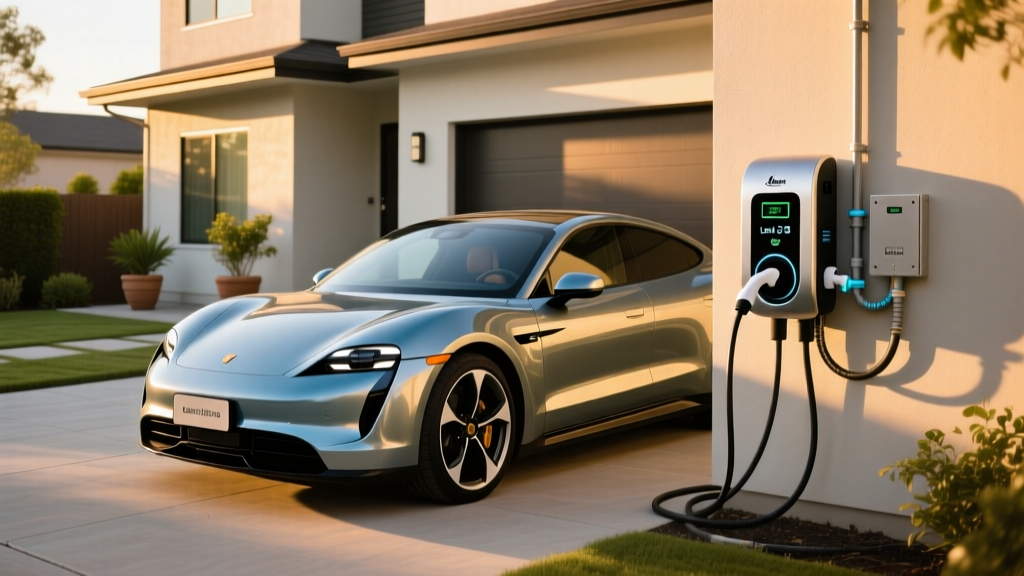
Circuit and Amperage: A 48-amp charger requires a dedicated 60-amp circuit (National Electrical Code requires circuits be loaded to only 80% of their rating for continuous loads). A 40-amp charger needs a 50-amp circuit. Hardwired installations are preferred over plug-in NEMA 14-50 outlets for reliability and code compliance in many jurisdictions.
Voltage: Standard 240V split-phase — the same as an electric range or dryer. Your home almost certainly already has this available at the panel.
Panel Capacity: This is where older homes hit a wall. A 60-amp EV circuit adds significant continuous load. Homes with 100-amp panels (common in pre-1990 construction) will likely need a panel upgrade to 200 amps to safely support EV charging alongside existing loads like HVAC, electric range, and water heater.
Permit: Most municipalities require an electrical permit for a new 240V circuit. Your electrician pulls this, and a city/county inspector verifies the work. Skipping the permit risks insurance denial in the event of an electrical fire.
Installation Cost Breakdown
| Item | Low End | High End | Notes |
|---|---|---|---|
| Level 2 Charger (Equipment) | $350 | $800 | 40A–48A smart charger, 25ft cable |
| Electrician Labor | $500 | $2,500 | Depends on panel-to-garage distance, conduit runs |
| Electrical Permit | $50 | $300 | Varies by municipality |
| Panel Upgrade (if needed) | $1,500 | $4,500 | 100A → 200A service upgrade |
| Total (No Panel Upgrade) | $900 | $3,600 | Most homes with 200A panels |
| Total (With Panel Upgrade) | $2,400 | $8,100 | Older homes needing service upgrade |
According to data from the U.S. Department of Energy, the average Level 2 home installation runs $1,200–$2,500 when no panel upgrade is required. The IRS Residential Clean Energy Credit (§25D) does not cover EV chargers as of 2026 (the §30C Alternative Fuel Infrastructure Tax Credit expired for residential use), so budget the full amount out of pocket. Always get at least three quotes from licensed electricians.
Which Connector Is Compatible With Your EV?
The North American charging connector landscape has consolidated significantly. Here's what you need to know for 2026-model vehicles:
| Connector | Brands Using It | Notes |
|---|---|---|
| NACS (Tesla) | Tesla, Ford, GM, Rivian, Volvo, Polestar, Hyundai, Kia, BMW, Toyota, Subaru | Now the dominant standard; SAE J3400 |
| CCS1 | Legacy VW/Audi models, some Stellantis models, older BMW/Hyundai/Kia | Being phased out; adapters available |
| CHAdeMO | Nissan Leaf (remaining stock), Mitsubishi Outlander PHEV | Effectively discontinued for new models |
Adapter needs: If you own a CCS1-equipped EV (like a 2023–2024 Hyundai Ioniq 5 or VW ID.4), you can purchase a CCS-to-NACS adapter ($150–$250) to access Tesla Supercharger stations. Tesla owners buying a non-Tesla charger need a NACS-compatible unit or a Tesla-to-J1772 adapter for Level 2 charging. For home Level 2, most new chargers now ship with NACS connectors or offer them as an option.
Level 2 Home Charger Recommendations
These are the chargers we recommend based on power output, build quality, cable management, smart features, and real-world reliability:
ChargePoint Home Flex
Power: Up to 12 kW (50A) @ 240V
Connector: NACS or J1772 (configurable)
Cable: 23 ft
Smart Features: Wi-Fi, app scheduling, Alexa, load sharing
Price: ~$550–$650
Best for: Flexible amperage settings (can dial from 16A to 50A to match your circuit)
Tesla Wall Connector
Power: Up to 11.5 kW (48A) @ 240V
Connector: NACS (native Tesla)
Cable: 24 ft
Smart Features: Wi-Fi, OTA updates, power sharing with multiple units
Price: ~$475
Best for: Tesla and NACS-equipped owners; cleanest install aesthetic
Grizzl-E Smart
Power: Up to 9.6 kW (40A) @ 240V
Connector: J1772 (NACS adapter included)
Cable: 24 ft
Smart Features: OCPP-compatible, app control, built-in load balancing
Price: ~$450–$550
Best for: Budget-conscious buyers wanting smart features; extreme cold rated (-40°F)
Ford Charge Station Pro
Power: Up to 19.2 kW (80A) @ 240V
Connector: NACS (CCS adapter available)
Cable: 25 ft
Smart Features: Wi-Fi, FordPass integration, V2H capable (with Home Integration System)
Price: ~$1,200–$1,300
Best for: F-150 Lightning owners wanting max Level 2 speed and vehicle-to-home backup
For most homeowners, a 40A or 48A charger on a 50A or 60A circuit is the optimal balance of charge speed and installation cost. Only spring for an 80A charger if you have a very large battery (90+ kWh) and your panel has the headroom.
Charging Cost Per Mile: Home vs. Public vs. Gas
This is where EV ownership economics get compelling — and where the "level 3 charging at home" fantasy gets put in perspective. You don't need DCFC speeds when home electricity costs a fraction of public fast charging.
| Scenario | $/kWh | Cost Per Mile* | Notes |
|---|---|---|---|
| Home (off-peak utility rate) | $0.08–$0.14 | $0.025–$0.045 | Best case: time-of-use plan, overnight |
| Home (standard rate, no TOU) | $0.14–$0.22 | $0.045–$0.07 | Average US residential rate ~$0.17/kWh |
| Public Level 2 (ChargePoint, etc.) | $0.25–$0.49 | $0.08–$0.16 | Varies widely by location and network |
| DC Fast Charging (EA, EVgo, Tesla) | $0.32–$0.56 | $0.10–$0.18 | Some networks charge per minute above certain thresholds |
| Gas vehicle (28 MPG avg, $3.40/gal) | — | $0.12 | EPA combined average new vehicle |
*Based on an EV efficiency of 3.0 miles/kWh (approximately 112 MPGe), which is typical for a midsize crossover like the Tesla Model Y or Hyundai Ioniq 5. Per fueleconomy.gov data.
At home off-peak rates, an EV costs roughly $0.03–$0.04 per mile to fuel — about one-third to one-quarter the cost of a gas vehicle. Even at standard residential rates without time-of-use optimization, home charging undercuts gasoline. Public DC fast charging, meanwhile, often costs more per mile than gas — which is exactly why home Level 2 is the economic foundation of EV ownership.
Safety, Code, and Installation Best Practices
A Level 2 charger pulls significant current for hours at a time — this is a continuous load, not a brief surge like a microwave. Proper installation isn't optional:
- Dedicated circuit: Your EV charger must be on its own dedicated breaker — never shared with other appliances.
- GFCI protection: NEC 2023 and later require GFCI protection for 240V receptacles in garages. Hardwired chargers may be exempt in some jurisdictions — ask your electrician.
- Outdoor rating: If your charger is mounted outside or in an unsealed garage, ensure it carries a NEMA 4 (weatherproof) rating. Most quality chargers (ChargePoint, Tesla, Grizzl-E) are rated for outdoor use.
- Cable management: A 24-foot cable coiled on a garage floor is a trip hazard and degrades the cable over time. Use a wall-mounted holster or retractable cable management system.
- Load management: If your panel is near capacity, consider a charger with built-in load monitoring (like the ChargePoint Home Flex or Emporia Vue integration) that dynamically adjusts charging amperage to avoid tripping the main breaker.
- Inspection: Always get the installation inspected. An unpermitted, uninspected EV charger installation can void homeowner's insurance coverage in the event of an electrical fire.
Frequently Asked Questions
Can I install a Level 3 DC fast charger in my home garage?
Technically, yes — if you have 480V three-phase power or are willing to pay $20,000–$80,000+ for a utility service upgrade, commercial-grade switchgear, and a $15,000–$50,000 DCFC unit. For 99%+ of homeowners, this is neither feasible nor necessary. A 48-amp Level 2 charger on a 60-amp 240V circuit fully recharges any EV overnight for under $3,000 installed.
How much does it cost to install a home EV charger?
A typical Level 2 installation with a 200-amp panel already in place runs $900–$3,600 (equipment + electrician + permit). If your home needs a panel upgrade from 100A to 200A service, add $1,500–$4,500. Always get multiple quotes from licensed electricians and verify permit requirements with your local building department.
Is a NEMA 14-50 outlet or hardwired installation better?
Hardwired is generally preferred for reliability and code compliance. A NEMA 14-50 outlet offers portability (you can unplug the charger and take it when you move) but some jurisdictions now require GFCI breakers for 240V receptacles in garages, which can cause nuisance tripping with some chargers. Hardwired installations avoid this issue and typically allow higher amperage (up to 80A) versus the 50A limit of a 14-50 outlet.
Will charging at home increase my electric bill significantly?
Yes, but less than you'd spend on gas. Charging a Tesla Model Y (75 kWh battery) from empty to full at $0.15/kWh costs about $11.25. Driving the same distance (roughly 225 miles) in a 28-MPG gas vehicle at $3.40/gallon costs about $27.30. Most EV owners see a $30–$60/month increase in their electric bill while eliminating $120–$200/month in gas purchases. A time-of-use plan from your utility can further reduce charging costs by shifting to off-peak overnight rates.
Do I need a smart charger, or is a basic unit fine?
A basic "dumb" charger will charge your car just fine. Smart features — Wi-Fi scheduling, app monitoring, energy tracking, and utility demand-response programs — are worth the $100–$200 premium if you want to optimize for off-peak rates, track charging costs, or participate in utility rebate programs that can offset the charger cost. Many utilities offer $250–$500 rebates specifically for Wi-Fi-enabled smart chargers.