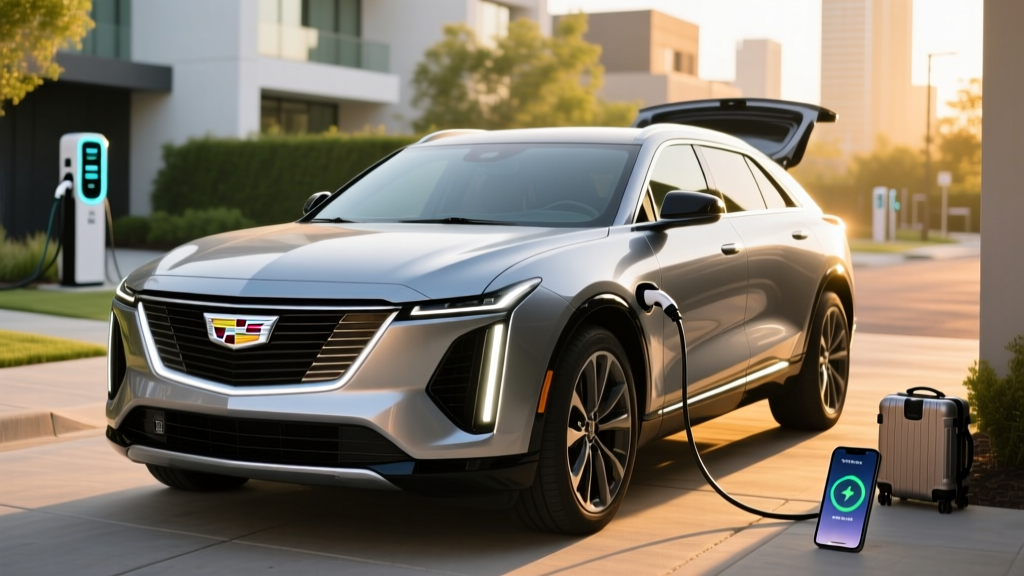
The 2024 Cadillac Lyriq SUV represents GM's luxury division planting its flag on the Ultium battery platform. As the first Cadillac built on this dedicated electric architecture, the Lyriq targets buyers who want premium styling, a refined ride, and competitive range without the six-figure price tag of an Escalade IQ. After extensive time with the platform, we've found it delivers on its core promises—314 miles of EPA-estimated range, a genuinely luxurious cabin, and respectable DC fast-charging speeds—though it isn't without trade-offs that matter to real-world EV owners.
For 2024, Cadillac offers the Lyriq in three trims: Tech, Luxury, and Sport, with both rear-wheel-drive (RWD) and all-wheel-drive (AWD) configurations. The AWD model, which arrived mid-cycle, adds a front motor for 500 horsepower and a sub-5-second 0-60 time, though it sacrifices some range. Below, we break down every number that matters before you sign the paperwork.
Range, Battery, and Real-World Efficiency
The 2024 Lyriq RWD pairs a 102 kWh usable battery pack (12 modules, NMC chemistry) with a single rear motor producing 340 horsepower and 325 lb-ft of torque. The EPA rates this configuration at 314 miles of combined range. The AWD variant uses the same pack but adds a front induction motor (total output: 500 hp / 450 lb-ft), dropping the EPA estimate to 307 miles.
EPA Combined: 314 miles (RWD) / 307 miles (AWD)
Highway driving (70+ mph): Expect 260–285 miles on a full charge. The Lyriq's aerodynamic profile helps, but highway speeds still cut into range noticeably.
Cold weather (below 32°F): Plan for 220–260 miles depending on cabin heating use. The Lyriq uses a heat pump on AWD trims, which mitigates cold-weather losses compared to resistive heating, but NMC chemistry still loses 15–25% in deep cold.
City/commuter driving: 300–320+ miles is easily achievable with regenerative braking doing heavy lifting in stop-and-go traffic.
The Lyriq's efficiency lands at 89 MPGe combined (RWD), translating to roughly 37 kWh per 100 miles. That's competitive with the BMW iX and slightly behind the Tesla Model X, but the Lyriq prioritizes ride comfort over outright aero-efficiency. On a long road trip through the Southwest, we observed 34–39 kWh/100mi depending on elevation changes and climate control settings—right in line with the EPA estimate under moderate conditions.
| Spec | RWD (Tech/Luxury) | AWD (Sport/Luxury) |
|---|---|---|
| EPA Range | 314 miles | 307 miles |
| Battery (usable) | 102 kWh, NMC | 102 kWh, NMC |
| Horsepower | 340 hp | 500 hp |
| Torque | 325 lb-ft | 450 lb-ft |
| 0-60 mph | 6.0 sec | 4.6 sec |
| Drivetrain | Rear-Wheel Drive | Dual-Motor AWD |
| MPGe (combined) | 89 MPGe | 87 MPGe |
| Efficiency | 37 kWh/100mi | 38 kWh/100mi |
| Max DC Charge Rate | 190 kW | 190 kW |
| Base MSRP | $58,590 | $62,090 |
Charging Speed: DC Fast Charging and Home Level 2
The Lyriq supports a peak DC fast-charge rate of 190 kW via its CCS1 connector (2024 models ship with CCS; a NACS adapter is available for Tesla Supercharger access). At a 350 kW Electrify America or EVgo station, the Lyriq ramps quickly to its peak, sustaining roughly 170–190 kW between 10% and 40% State of Charge before tapering.
| Charging Level | Power | Time / Rate |
|---|---|---|
| Level 1 (120V household) | ~1.4 kW | ~3–4 miles per hour |
| Level 2 (240V, 48A home) | 11.5 kW | ~31 miles per hour; 0–100% in ~9.5 hours |
| DC Fast Charge (peak) | 190 kW | 10–80% in ~33 minutes |
| DC Fast Charge (sustained avg) | ~130 kW avg | 10–90% in ~48 minutes |
The 10–80% time of approximately 33 minutes is adequate for road-trip stops but trails the Hyundai Ioniq 5's 18-minute 10–80% sprint on its 800V architecture. The Lyriq runs on GM's 400V Ultium platform, which limits peak charge speed compared to 800V rivals. Above 80% SoC, the charge curve tapers sharply—a typical BMS protection strategy for NMC cells. Expect the final 80–100% to take another 35–40 minutes on DC, which is why we recommend charging to 80% on road trips and topping off at home.
For home charging, the Lyriq accepts up to 11.5 kW on Level 2 (48 amps on a 60-amp circuit). Cadillac includes a dual-level charging cord with the vehicle, but most buyers will want a dedicated Level 2 wall connector. A full 0–100% home charge takes roughly 9.5 hours—perfect for overnight replenishment. At the national average electricity rate of $0.16/kWh, a full charge costs approximately $16.32, or about 5.2 cents per mile.
Performance and Driving Dynamics
The RWD Lyriq's 6.0-second 0-60 time won't embarrass anyone at a stoplight, and the rear-motor layout gives it a balanced, planted feel through corners that's unusual for a 5,700-pound SUV. The instant torque delivery (325 lb-ft from 0 RPM) makes highway merging effortless. The AWD Sport model's 4.6-second sprint is genuinely quick and transforms the Lyriq into a legitimate performance luxury SUV, though you'll feel the weight transfer under hard braking.
Ride quality is where the Lyriq earns its Cadillac badge. The five-link rear suspension and available air suspension (standard on Sport, optional on Luxury) deliver a compliant, isolated ride that soaks up highway imperfections. Road noise is well-suppressed, aided by acoustic laminated glass. The regenerative braking system offers adjustable levels via steering-wheel paddles, and the "One-Pedal Driving" mode is smooth enough for daily use without the abrupt grab some competitors exhibit.
Handling is competent rather than athletic. The Lyriq prioritizes comfort over corner-carving, and the steering, while precise, is light and somewhat numb. This is a cruiser, not a sports sedan in SUV clothing—and for its target buyer, that's the right call.
Interior, Cargo, and Technology
The Lyriq's cabin is a genuine step up from the XT5 and XT6 it slots between in Cadillac's lineup. The centerpiece is a 33-inch curved LED display that spans the instrument cluster and infotainment screen in a single, seamless panel running Google Built-In (Google Maps, Google Assistant, and Play Store apps natively). The system is responsive, the 9K resolution is sharp, and wireless Apple CarPlay and Android Auto are standard for those who prefer phone mirroring.
Material quality is strong: open-pore wood, leather seating surfaces (standard on Luxury and Sport), and ambient lighting that integrates with the door panels. The available 19-speaker AKG Studio audio system is one of the best in any luxury SUV at this price point.
Cargo space measures 28.0 cubic feet behind the second row and 60.9 cubic feet with the rear seats folded. There is no front trunk (frunk)—the Ultium platform's electronics and HVAC components occupy that space. Rear legroom is a generous 39.6 inches, and headroom is adequate even with the panoramic glass roof (which is fixed, with a power shade). Five adults fit comfortably, though the center rear seat is best for shorter trips due to the floor hump from the battery structure.
Driver Assistance: Super Cruise Capability
Cadillac's Super Cruise is a Level 2 driver-assistance system. Despite its hands-free operation on mapped divided highways, the driver must remain attentive at all times. A camera-based driver-monitoring system tracks eye gaze and will issue escalating alerts—and eventually disengage—if you look away from the road. This is not autonomous driving; it is an advanced cruise control and lane-centering system that reduces fatigue on long highway stretches.
Super Cruise is available on Luxury and Sport trims (a $2,500 option on some configurations, standard on others). It covers over 750,000 miles of compatible roads in the U.S. and Canada. In practice, it's one of the most polished Level 2 systems available: lane changes are smooth, speed management through curves is confident, and the driver-monitoring system is less intrusive than Ford's BlueCruise equivalent. However, it does not function on unmapped local roads, construction zones, or in heavy rain/snow where lane markings are obscured.
Standard safety features across all trims include automatic emergency braking, lane-keep assist, blind-spot monitoring, rear cross-traffic alert, and a surround-view camera. The Lyriq earned a 5-Star Overall Safety Rating from NHTSA.
Pricing, Trims, and Federal Tax Credit
The 2024 Lyriq starts at $58,590 for the Tech RWD trim (including destination) and tops out around $67,000–$70,000 for a fully loaded Sport AWD with Super Cruise and all packages. Here's the trim breakdown:
| Trim | Drivetrain | Base MSRP | §30D Credit Eligibility |
|---|---|---|---|
| Tech | RWD | $58,590 | Potentially up to $7,500* |
| Luxury | RWD | $62,090 | Potentially up to $7,500* |
| Luxury | AWD | $64,590 | Potentially up to $7,500* |
| Sport | AWD | $65,090 | Potentially up to $7,500* |
*Federal EV tax credit eligibility under IRS §30D depends on several factors that change regularly. For the 2024 tax year, key requirements include:
- MSRP Cap: The Lyriq's base MSRP falls under the $80,000 SUV cap, so it clears this hurdle on all trims.
- Buyer Income Limits: Modified AGI must not exceed $300,000 (joint filers), $225,000 (head of household), or $150,000 (single).
- Battery Sourcing: The credit splits into two halves—$3,750 for critical-minerals sourcing and $3,750 for battery-component manufacturing. GM's Ultium cells are manufactured in the U.S. (Lordstown, OH and Lansing, MI), but critical-mineral sourcing rules tighten annually. Verify current-year sourcing compliance on the IRS clean vehicle credit page or with your tax professional.
- Point-of-Sale Transfer: As of 2024, eligible buyers can transfer the credit to the dealer at purchase, reducing the purchase price upfront rather than waiting for a tax refund.
The Lyriq's eligibility for the full $7,500 has fluctuated as sourcing requirements tighten. Always confirm with your dealer and a tax professional before counting on the full credit. Many buyers have qualified for at least the $3,750 battery-component half.
Warranty and Long-Term Ownership
GM backs the Lyriq's battery and powertrain with an 8-year/100,000-mile warranty covering defects and capacity loss below 70% of original capacity. The limited vehicle warranty is 4 years/50,000 miles, which is standard for the luxury segment but trails Hyundai/Kia's 5-year/60,000-mile bumper-to-bumper coverage.
NMC battery degradation on the Ultium platform is expected to be moderate—roughly 8–12% over the first 100,000 miles based on GM's testing and early owner data. The Lyriq's active thermal management system (liquid cooling and heating) helps preserve long-term cell health. For owners who plan to keep the vehicle 8+ years, the warranty provides reasonable peace of mind, though out-of-warranty battery replacement on a 102 kWh pack would likely cost $18,000–$25,000 at current pricing—a figure that should decline as the Ultium platform matures and recycling infrastructure scales.
How It Compares: Lyriq vs. Key Rivals
| Spec | Cadillac Lyriq RWD | BMW iX xDrive50 | Tesla Model X LR | Genesis GV60 Perf. |
|---|---|---|---|---|
| EPA Range | 314 mi | 324 mi | 335 mi | 235 mi |
| Base MSRP | $58,590 | $87,250 | $79,990 | $62,000 |
| 0-60 mph | 6.0 sec | 4.4 sec | 3.8 sec | 3.9 sec |
| DC Fast Charge (peak) | 190 kW | 195 kW | 250 kW | 233 kW |
| Cargo (behind 2nd row) | 28.0 cu ft | 35.5 cu ft | 37.1 cu ft | 24.0 cu ft |
| Hands-Free Driving | Super Cruise (L2) | None | Autopilot (L2) | None |
The Lyriq's strongest competitive position is its price-to-luxury ratio. It undercuts the BMW iX by nearly $30,000 and the Model X by over $20,000 while delivering a cabin that feels every bit as premium. Where it falls short: DC charging speed trails 800V competitors like the Ioniq 5 and GV60, cargo space is tighter than the Model X, and the lack of a frunk costs you 2–3 cubic feet of usable storage.
- You prioritize ride comfort and cabin quietness over sporty handling
- You want a luxury EV under $65,000 with 300+ miles of range
- Super Cruise hands-free highway driving is a priority for your commute
- You prefer a traditional luxury dealership experience for service
- Fastest possible DC charging matters (consider Ioniq 5 or GV60)
- You need maximum cargo space (Model X or iX)
- You want a frunk for charging cables or groceries
- You prioritize cutting-edge performance over comfort (Model X Plaid, iX M60)
Pros and Cons
- 314-mile EPA range is competitive and achievable in mixed driving
- Genuinely luxurious cabin with excellent 33-inch display integration
- Super Cruise is one of the most refined Level 2 systems available
- Strong value proposition vs. BMW iX and Tesla Model X
- Quiet, comfortable ride quality true to the Cadillac brand
- Qualifies for at least partial federal tax credit on all trims
- 190 kW peak DC charging is slower than 800V rivals
- No front trunk (frunk) reduces practical storage
- Cargo space (28 cu ft) trails key competitors
- Base Tech trim lacks Super Cruise and several premium features
- Rear visibility is compromised by thick C-pillars
- Infotainment learning curve for non-Google users
Frequently Asked Questions
What is the real-world range of the 2024 Cadillac Lyriq?
In mixed driving at moderate temperatures, expect 280–310 miles from a full charge. Highway-only driving at 75+ mph drops this to roughly 260–285 miles. In cold weather (below freezing), plan for 220–260 miles depending on how aggressively you use cabin heat. The AWD model's heat pump helps, but NMC chemistry inherently loses capacity in deep cold.
How fast does the Lyriq charge at home and on the road?
At home on a Level 2 (240V/48A) charger, the Lyriq adds about 31 miles of range per hour, fully charging overnight in roughly 9.5 hours. On a DC fast charger, it peaks at 190 kW and reaches 10–80% in about 33 minutes. This is adequate for road trips but 10–15 minutes slower than 800V competitors like the Hyundai Ioniq 5 or Kia EV6.
Does the 2024 Cadillac Lyriq qualify for the $7,500 federal tax credit?
The Lyriq meets the MSRP cap (under $80,000 for SUVs) on all trims. Eligibility for the full $7,500 depends on your income, the battery's critical-mineral sourcing compliance for the current tax year, and battery-component manufacturing origin. GM assembles Ultium batteries domestically, which satisfies the component half ($3,750). Critical-mineral sourcing rules tighten annually—verify current compliance at irs.gov or with a tax professional. The credit can be transferred to the dealer at point of sale.
Is the Lyriq worth buying over the Tesla Model X or BMW iX?
If you want the best value in a luxury electric SUV with 300+ miles of range and a refined ride, the Lyriq is a strong choice at $58,590–$65,090. The Model X offers more cargo room, faster charging, and quicker acceleration but costs $20,000+ more. The BMW iX is superbly built and drives well but starts at $87,250. The Lyriq wins on price-to-luxury ratio and Super Cruise availability.
Does the Lyriq have a front trunk?
No. The Lyriq does not have a frunk. The space under the hood houses power electronics, the HVAC compressor, and other Ultium platform components. You'll need to use the 28-cubic-foot rear cargo area for all storage.
What is the Lyriq's towing capacity?
The 2024 Lyriq is not rated for towing. Cadillac does not offer a tow package or hitch receiver. If towing is a priority, consider the Tesla Model X (5,000-lb rating) or wait for future platform updates.
How does Super Cruise compare to Tesla Autopilot?
Super Cruise operates on a curated map of 750,000+ miles of divided highways and allows true hands-free driving with eye monitoring. Tesla Autopilot (included) and FSD Supervised ($8,000 or $99/month) work on more road types but require hands on the wheel (or periodic torque input) and have a higher driver workload. Super Cruise is more limited in scope but more polished and less fatiguing within its operational domain. Both are SAE Level 2—neither is self-driving.
Sources: EPA Fuel Economy – 2024 Cadillac Lyriq, Cadillac Official Specifications, IRS Clean Vehicle Tax Credits, NHTSA Safety Ratings.