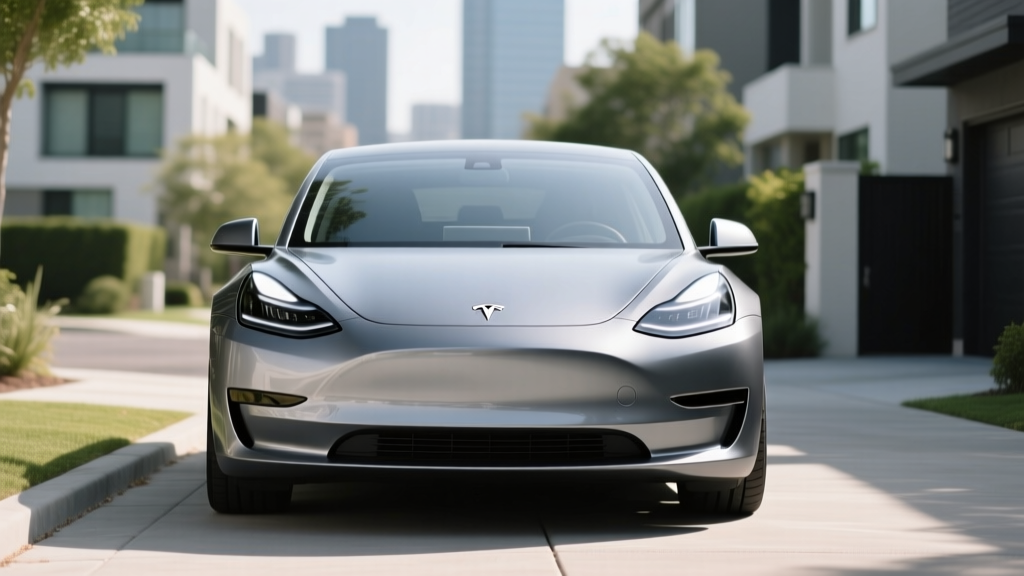
If you're searching for the least expensive Tesla car you can buy new today, the answer remains the Tesla Model 3 Rear-Wheel Drive (RWD). For 2026, Tesla continues to offer the base Model 3 as its entry point into the electric vehicle market, undercutting the Model Y crossover and the premium Model S and Model X by a wide margin. But "least expensive" doesn't mean compromised. The current-generation Model 3 (internally known as the "Highland" refresh introduced in late 2023 and carried forward) is a fundamentally different car than the pre-2024 version — with improved ride quality, a quieter cabin, ventilated seats, and a more refined interior.
This review covers everything a buyer needs to know: real-world range beyond the EPA sticker, charging speeds at home and on the road, federal tax credit eligibility under IRS §30D rules, and how the base Model 3 stacks up against similarly priced competitors like the Hyundai Ioniq 6, Chevrolet Equinox EV, and BMW i4.
2026 Tesla Model 3 RWD: Core Specifications
| Specification | 2026 Tesla Model 3 RWD |
|---|---|
| Base MSRP | $38,990 (before incentives) |
| EPA Estimated Range | 363 miles |
| Battery Capacity | ~60 kWh usable (LFP chemistry) |
| Drivetrain | Rear-Wheel Drive (single motor) |
| Horsepower | 271 hp |
| 0–60 mph | 5.8 seconds |
| Top Speed | 125 mph |
| MPGe (Combined) | 132 MPGe |
| Energy Consumption | 25 kWh/100 mi |
| Max DC Fast Charge Rate | 170 kW (peak) |
| 10–80% DC Fast Charge Time | ~25 minutes |
| Level 2 Home Charging | 11.5 kW (~44 mi/hr) |
| Cargo Volume | 23 cu ft (rear trunk + frunk combined) |
| Rear Legroom | 35.3 inches |
| Battery Warranty | 8 years / 100,000 miles (70% retention) |
| Vehicle Warranty | 4 years / 50,000 miles (bumper-to-bumper) |
Real-World Range: What the EPA Sticker Doesn't Tell You
Real-World Highway (70–75 mph): ~290–310 miles
Real-World City/Mixed: ~330–350 miles
Cold Weather (below 32°F): ~250–280 miles (30–35% reduction)
Hot Weather with A/C (above 95°F): ~310–330 miles
The Model 3 RWD's 363-mile EPA rating is genuinely impressive for a base-trim EV at this price point. According to fueleconomy.gov, this places the RWD trim among the most efficient sedans in its class. However, EPA range is measured under controlled laboratory conditions that don't reflect sustained highway driving, extreme temperatures, or hilly terrain.
In real-world highway testing at sustained speeds of 70–75 mph, expect between 290 and 310 miles before needing to charge. This is consistent with independent testing from multiple EV outlets and aligns with the physics of aerodynamic drag, which increases with the square of velocity. The Model 3's low 0.219 drag coefficient helps, but highway driving still consumes significantly more energy than the EPA's mixed-cycle test suggests.
Cold weather is the bigger range killer. Lithium iron phosphate (LFP) batteries, which the RWD uses, are more susceptible to cold-weather range loss than NMC chemistries. In sub-freezing conditions, the battery management system must spend energy heating the pack, and the cabin heater draws from the same 60 kWh pool. The Model 3 RWD does not include a heat pump as standard equipment in all markets — check your specific build configuration, as Tesla has adjusted this across model years. Where equipped, a heat pump can reduce cold-weather energy waste by roughly 10–15% compared to resistive heating.
For context, a 300-mile round-trip road trip in mild weather is achievable without stopping, but a winter highway drive of the same distance will require at least one fast-charge stop.
Charging Speed: DC Fast Charging and Home Level 2
Understanding the difference between kW (kilowatts — the rate of energy flow, like water pressure) and kWh (kilowatt-hours — the total energy stored, like the size of the tank) is essential here. The Model 3 RWD's battery stores roughly 60 kWh of usable energy. How quickly you refill it depends on the charger's kW output.
| Charging Level | Power (kW) | Miles Added per Hour | Notes |
|---|---|---|---|
| Level 1 (120V household outlet) | ~1.4 kW | ~5–6 mi/hr | Emergency/trickle only; 60+ hours for full charge |
| Level 2 (240V home, 48A) | 11.5 kW | ~44 mi/hr | Full charge in ~5.5 hours; ideal for daily use |
| DC Fast Charge (V3 Supercharger) | 170 kW peak | Up to ~175 mi in 15 min | 10–80% in ~25 min; tapers above 80% |
| DC Fast Charge (CCS adapter, 150 kW station) | ~150 kW | Varies | Requires Tesla CCS adapter (included with newer models) |
The Model 3 RWD peaks at approximately 170 kW on a V3 Tesla Supercharger (250 kW capable), but that peak is only sustained at low states of charge (roughly 5–25% SoC). Like all EVs, the charge curve tapers significantly as the battery fills. Expect the rate to drop to around 80–100 kW by 50% SoC, and below 40 kW once you pass 80%. This is why the industry standard metric is 10–80% time — and for the Model 3 RWD, that's approximately 25 minutes under optimal conditions (preconditioned battery, warm weather, V3 Supercharger).
One important note about the LFP battery: Tesla recommends charging the Model 3 RWD to 100% at least once per week to allow the battery management system to accurately calibrate the state of charge. This is different from NMC-based Long Range and Performance trims, where daily charging to 80% is recommended to prolong battery life. If you're a buyer who prefers to set a charge limit and forget about it, this is a behavioral difference worth understanding.
For home Level 2 charging, the Model 3 RWD accepts up to 11.5 kW (48 amps) on a 240V circuit. This requires a 60-amp dedicated circuit installed by a licensed electrician. A full charge from near-empty takes about 5.5 hours — easily done overnight. Most owners who charge at home every night never need to use a public fast charger for daily driving.
LFP Battery Chemistry: What It Means for Longevity
The Model 3 RWD uses a lithium iron phosphate (LFP) battery pack, sourced primarily from CATL. This is a deliberate trade-off compared to the nickel manganese cobalt (NMC) packs used in the Long Range and Performance variants.
LFP advantages:
- Longer cycle life — LFP cells can handle more charge/discharge cycles before significant degradation
- Can be charged to 100% daily without accelerated wear
- No cobalt, reducing supply chain and ethical concerns
- Lower cost, contributing to the RWD's lower MSRP
LFP trade-offs:
- Lower energy density — hence ~60 kWh in the same physical pack size that holds ~82 kWh in NMC form
- Greater cold-weather range loss compared to NMC
- Less precise state-of-charge estimation (the BMS needs periodic 100% charges to recalibrate)
Tesla's battery warranty covers the RWD's LFP pack for 8 years or 100,000 miles, whichever comes first, with a minimum 70% capacity retention threshold. Based on historical Tesla data and third-party fleet studies, most Model 3 packs retain 90%+ capacity at 100,000 miles. The 70% warranty floor is a conservative guarantee, not an expected outcome.
Pricing, Trims, and Federal Tax Credit Eligibility
The 2026 Tesla Model 3 is available in three trims. Here's the pricing breakdown:
| Trim | MSRP | Est. After §30D Credit* | Drivetrain | EPA Range |
|---|---|---|---|---|
| RWD (Base) | $38,990 | ~$31,490 | Single Motor RWD | 363 mi |
| Long Range AWD | $47,740 | ~$40,240 | Dual Motor AWD | 341 mi |
| Performance | $54,990 | ~$47,490 | Dual Motor AWD | 315 mi |
*Tax credit estimates assume full $7,500 eligibility under IRS §30D. Actual eligibility depends on multiple factors — see below.
The RWD trim's $38,990 starting price is the lowest of any Tesla vehicle. Destination fees add approximately $1,390, and common options like alternate paint colors ($1,000–$2,000), larger wheels ($1,500), and Full Self-Driving (Supervised) capability ($8,000) increase the final price. A typical as-tested Model 3 RWD with metallic paint and no other add-ons lands around $41,000–$42,000 before incentives.
Does the Model 3 RWD Qualify for the $7,500 Federal Tax Credit?
The short answer: it depends on your income, the vehicle's battery sourcing, and current IRS rules. Under IRS §30D, the federal clean vehicle credit provides up to $7,500, split into two halves:
- $3,750 — Battery Components: A percentage of battery components must be manufactured or assembled in North America. This threshold increases annually.
- $3,750 — Critical Minerals: A percentage of critical minerals in the battery must be sourced from the U.S. or free-trade-agreement countries. This threshold also increases annually.
- Buyer Income Caps: Modified adjusted gross income (MAGI) must not exceed $150,000 (single), $225,000 (head of household), or $300,000 (joint filing).
- MSRP Cap: The vehicle's MSRP must not exceed $55,000 for sedans (the Model 3 qualifies in all trims).
- Point-of-Sale Transfer: As of 2024, eligible buyers can transfer the credit to the dealer at purchase, receiving the discount upfront rather than waiting for tax filing.
The Model 3 RWD's LFP battery has historically drawn cells from CATL (China), which has complicated critical-minerals and battery-component sourcing requirements. Tesla has been shifting supply chains to meet §30D thresholds, but eligibility can change quarter to quarter. Always verify current eligibility on the IRS website or with a tax professional before purchasing. As of early 2026, Tesla lists the Model 3 RWD as eligible for at least partial credit — confirm the exact amount at the time of purchase.
Performance, Interior, and Technology
The single-motor RWD produces 271 horsepower and hits 60 mph in 5.8 seconds. That's not sports-car territory, but it's brisk for a daily commuter and quicker than most gasoline sedans in the $35,000–$45,000 range. Instant electric torque means the Model 3 RWD feels responsive around town, even if it lacks the dual-motor punch of the Long Range or Performance variants.
The Highland-refresh interior is a significant step up from the pre-2024 Model 3. Notable improvements include:
- Ventilated front seats (a first for Model 3)
- Ambient lighting throughout the cabin
- Rear 8-inch touchscreen for rear-seat passengers (climate, media, navigation)
- Improved acoustic glass — noticeably quieter at highway speeds
- Stalkless turn signals — integrated into the steering wheel (controversial; takes adaptation)
- 15.4-inch center touchscreen handling all vehicle controls, media, and navigation
The infotainment system remains one of the best in the EV market — fast, responsive, and packed with features including Netflix/YouTube streaming (while parked), a built-in web browser, and over-the-air (OTA) software updates that add features over time. However, the lack of Apple CarPlay and Android Auto is a dealbreaker for some buyers. Tesla's native navigation and media apps are robust, but if you rely on Apple Maps or Spotify's CarPlay interface, you'll need to adjust.
Cargo space totals approximately 23 cubic feet (rear trunk plus front trunk/frunk). Rear legroom at 35.3 inches is adequate for average-height adults but tighter than a midsize sedan like the Hyundai Ioniq 6 or the Chevrolet Equinox EV. The Model 3 is a compact sedan — if you regularly carry rear-seat passengers, test-fit them before committing.
Driver Assistance: Autopilot and FSD (Supervised)
Every Model 3 includes Basic Autopilot — a suite of Level 2 driver-assistance features including adaptive cruise control, lane centering, and automatic emergency braking. This is competitive with systems like Toyota Safety Sense and Honda Sensing, though Tesla's lane-centering tends to be more confident on highways.
The optional Full Self-Driving (Supervised) package costs $8,000 (or $99/month as of 2026 pricing). Whether it's worth the premium is a personal decision — it's a capable highway companion and has improved significantly in urban environments, but it remains a supervised system that can require intervention at any moment.
How the Model 3 RWD Compares to Key Competitors
At roughly $39,000 before incentives, the Model 3 RWD competes with a growing field of EVs. Here's how it stacks up against three key rivals:
| Spec | Tesla Model 3 RWD | Hyundai Ioniq 6 SE LR | Chevrolet Equinox EV 2LT | BMW i4 eDrive35 |
|---|---|---|---|---|
| MSRP | $38,990 | $42,450 | $43,400 | $52,200 |
| EPA Range | 363 mi | 361 mi | 319 mi | 301 mi |
| Battery (kWh) | ~60 (LFP) | 77.4 (NMC) | 85 (NMC) | 70.3 (NMC) |
| Max DC Charge kW | 170 kW | 240 kW | 190 kW | 180 kW |
| 0–60 mph | 5.8 sec | 6.1 sec | 7.8 sec | 5.6 sec |
| Supercharger Access | Native | via NACS adapter | via NACS adapter | via NACS adapter |
The Model 3 RWD's key advantages are its combination of range, price, and native Supercharger access. The Supercharger network remains the most reliable and widespread DC fast-charging network in the U.S., and while competitors are gaining access via NACS adapters, the native integration (navigation routes through Superchargers, automatic preconditioning, plug-and-charge billing) is still a meaningful convenience advantage.
The Ioniq 6 charges faster (240 kW peak), and the Equinox EV offers more interior space. The BMW i4 brings premium badge cachet and driving dynamics but at a significantly higher price. None of these competitors match the Model 3 RWD's specific combination of sub-$40K MSRP, 360+ mile range, and Supercharger access.
Pros and Cons at a Glance
Pros
- Lowest MSRP of any Tesla — and one of the best range-per-dollar ratios in the EV market
- 363-mile EPA range from a ~60 kWh pack is remarkably efficient (25 kWh/100 mi)
- Native Tesla Supercharger access with best-in-class charging network reliability
- Highland refresh significantly improves ride comfort, cabin quietness, and seat quality
- LFP battery supports 100% daily charging without degradation concerns
- Strong OTA update track record — the car improves over time
- Class-leading infotainment system with regular feature additions
- Competitive safety ratings (IIHS Top Safety Pick+; 5-star NHTSA)
Cons
- 170 kW peak DC charge rate is slower than rivals (Ioniq 6: 240 kW)
- LFP battery suffers greater cold-weather range loss than NMC alternatives
- No Apple CarPlay or Android Auto support
- Rear seat legroom (35.3 in.) is tighter than some competitors
- Stalkless turn signals and gear selector require a learning curve
- FSD (Supervised) at $8,000 is expensive for a Level 2 system
- Tax credit eligibility can shift based on battery sourcing rules
- Minimalist interior lacks physical buttons — not for everyone
Who Should Buy the Model 3 RWD?
Choose the Tesla Model 3 RWD if:
- You want the most range per dollar in a compact EV sedan
- You have access to home Level 2 charging (or can install it)
- You value Supercharger network reliability for road trips
- You're a commuter or solo driver who doesn't need expansive rear-seat space
- You're comfortable with a touchscreen-centric interface and no CarPlay
- You want a vehicle that improves over time via OTA updates
Look elsewhere if:
- You live in a very cold climate and need maximum cold-weather range (consider the Long Range AWD with NMC + heat pump)
- You regularly carry rear-seat passengers who need generous legroom
- You prioritize the fastest possible DC charging (the Ioniq 6 is ~30% faster at peak)
- You depend on Apple CarPlay or Android Auto
- You need AWD for snow/ice traction (the RWD is rear-wheel drive only)
For a solo commuter or couple who charges at home and takes occasional road trips, the Model 3 RWD is the least expensive Tesla car that doesn't feel like a compromise. Its 363-mile range eliminates range anxiety for nearly all daily driving, the Supercharger network makes longer trips practical, and the post-Highland interior quality has closed the gap with competitors that used to outclass it on refinement.
Frequently Asked Questions
What is the least expensive Tesla car available in 2026?
The 2026 Tesla Model 3 Rear-Wheel Drive (RWD) at a base MSRP of $38,990 (plus destination). It is the lowest-priced vehicle in Tesla's lineup, followed by the Model Y RWD at approximately $44,990.
What is the real-world range of the Tesla Model 3 RWD?
The EPA rates it at 363 miles. In real-world highway driving at 70–75 mph, expect 290–310 miles. In cold weather (below freezing), range can drop to 250–280 miles. City and mixed driving in mild conditions will get you closest to the EPA sticker, around 330–350 miles.
How fast does the Model 3 RWD charge?
On a Tesla V3 Supercharger, it peaks at 170 kW and charges from 10–80% in approximately 25 minutes. At home on a Level 2 (240V, 48A) charger, it adds about 44 miles of range per hour, reaching a full charge in roughly 5.5 hours.
Does the Model 3 RWD qualify for the $7,500 federal EV tax credit?
Eligibility depends on IRS §30D rules including buyer income limits (MAGI ≤$150K single / $300K joint), vehicle MSRP caps (≤$55K for sedans — the Model 3 qualifies), and battery component/critical mineral sourcing requirements. The LFP battery's sourcing has historically complicated eligibility. Verify current status at irs.gov or with a tax professional before purchasing.
Is the Tesla Model 3 RWD worth buying over competitors?
It depends on your priorities. The Model 3 RWD offers the best range-per-dollar ratio in its class and unmatched Supercharger network access. However, the Hyundai Ioniq 6 charges faster, the Chevrolet Equinox EV offers more interior space, and the BMW i4 delivers a more traditional premium experience. If range, efficiency, and charging infrastructure are your top priorities, the Model 3 RWD is hard to beat at its price.
What battery does the Model 3 RWD use, and how long will it last?
The RWD uses a ~60 kWh LFP (lithium iron phosphate) battery pack. LFP cells are known for long cycle life and the ability to be charged to 100% regularly without accelerated degradation. Tesla warranties the pack for 8 years or 100,000 miles with at least 70% capacity retention. Fleet data suggests most packs retain 90%+ capacity well beyond 100,000 miles.
Does the Model 3 RWD have all-wheel drive?
No. The RWD trim is rear-wheel drive with a single motor. If you need AWD for snow or traction, you'll need to step up to the Long Range AWD ($47,740) or Performance ($54,990) trims, both of which use dual motors.
Is Tesla's Full Self-Driving worth the $8,000 cost?
FSD (Supervised) is a Level 2 driver-assistance system — it is not self-driving and requires full driver attention at all times. It adds city-street navigation, traffic-light recognition, and more confident highway driving. Some owners find it valuable for long commutes; others feel the $8,000 price (or $99/month subscription) isn't justified for a supervised system. Try the subscription option first before committing to a full purchase.