Quick Verdict: Is the Tesla Model X Worth Leasing in 2026?
The 2026 Tesla Model X remains one of the few three-row electric SUVs that can credibly tow 5,000 pounds, seat up to seven, and still crack 330 miles of EPA range. For families who need serious cargo space and access to the Supercharger network without committing to a $80,000+ purchase, leasing can be a smart way to drive the latest hardware while sidestepping depreciation risk. But the Model X is no longer the only premium electric SUV in town — the Rivian R1S, BMW iX, and Mercedes EQS SUV all compete aggressively on build quality, ride comfort, or off-road capability. This review gives you the exact numbers you need to decide whether leasing a Tesla Model X makes financial and practical sense in 2026.
2026 Tesla Model X: Core Specifications at a Glance
| Spec | Long Range AWD | Plaid (Tri-Motor AWD) |
|---|---|---|
| Base MSRP | $79,990 | $94,990 |
| EPA Range | 335 mi (20" wheels) | 326 mi (21" wheels) |
| Battery (usable) | ~100 kWh, NMC | ~100 kWh, NMC |
| Max DC Fast Charge | 250 kW (CCS/NACS) | 250 kW (CCS/NACS) |
| 10–80% DCFC Time | ~32 minutes | ~32 minutes |
| Level 2 Charge Rate | 11.5 kW (~34 mi/hr) | 11.5 kW (~34 mi/hr) |
| 0–60 mph | 3.8 sec | 2.5 sec |
| Horsepower | 670 hp | 1,020 hp |
| Drivetrain | Dual-Motor AWD | Tri-Motor AWD |
| MPGe (combined) | 101 MPGe | 98 MPGe |
| Efficiency | 33 kWh/100 mi | 34 kWh/100 mi |
| Towing Capacity | 5,000 lb | 5,000 lb |
| Cargo (behind 3rd row) | ~15 cu ft | ~15 cu ft |
| Cargo (all seats folded) | ~85 cu ft | ~85 cu ft |
| Seating | 5, 6, or 7 | 5, 6, or 7 |
| Battery Warranty | 8 yr / 150,000 mi | 8 yr / 150,000 mi |
Source: EPA fueleconomy.gov and Tesla Model X specs. Figures reflect 2026 model-year data; confirm with Tesla for the latest trims.
Real-World Range: What the EPA Sticker Doesn't Tell You
The Long Range AWD carries an EPA rating of 335 miles, but real-world driving rarely matches the sticker. Expect ~270–295 miles on highway trips at 70–75 mph, and ~220–250 miles in freezing temperatures where battery chemistry and cabin heating sap energy. City driving with heavy regenerative braking can push close to or slightly above the EPA number.
The Model X uses an NMC (nickel manganese cobalt) battery pack with roughly 100 kWh of usable capacity. NMC chemistry delivers strong energy density — critical in a heavy, three-row SUV — but it's more temperature-sensitive than LFP. In our experience and consistent with independent testing, cold-weather range loss of 20–30% is typical for NMC packs when ambient temps drop below 32°F, especially without preconditioning.
For road-trip planning, budget 250 miles of usable range per charge leg in mixed conditions. That leaves a comfortable buffer to reach the next Supercharger without white-knuckle hypermiling. The trip planner in Tesla's navigation automatically factors in elevation, wind, and temperature, which is one of the better route-planning tools in the EV market.
Charging Speed: DC Fast Charging and Home Level 2
The Model X peaks at 250 kW on DC fast chargers (compatible with both NACS and CCS via adapter). At a V3 or V4 Supercharger, the 10–80% session takes approximately 32 minutes. However, peak kW is not sustained kW — the charge curve tapers significantly above 60% state of charge (SoC). You'll see 250 kW only in a narrow band roughly between 10–30% SoC; by 70%, the rate typically drops to 80–100 kW, and above 85% it slows further to protect the battery.
This means the last 10% of a charge (80–90%) can add as many minutes as the first 30%. For road trips, the efficient move is to charge to 80% and go, unless you specifically need maximum range to reach a distant charger.
| Charging Level | Power (kW) | Miles Added per Hour | Typical Use Case |
|---|---|---|---|
| Level 1 (120V household) | ~1.4 kW | ~4 mi/hr | Emergency / overnight trickle |
| Level 2 (240V home, 48A) | 11.5 kW | ~34 mi/hr | Daily home charging |
| DC Fast (Supercharger V3/V4) | Up to 250 kW | ~200+ mi in 15 min | Road trips, quick top-ups |
At home on a 48-amp Level 2 circuit (such as a Tesla Wall Connector on a 60-amp breaker), the Model X adds roughly 34 miles of range per hour. A full overnight session from 20% to 90% takes about 8–9 hours — sufficient for most daily routines. Preconditioning the battery before a fast-charge session (the car does this automatically when a Supercharger is set as your nav destination) is critical for hitting peak charge rates, especially in cold weather.
Performance and Driving Dynamics
The Long Range dual-motor setup delivers 670 horsepower and a 3.8-second 0–60 mph time — brisk for a 5,200-pound SUV. The Plaid variant's tri-motor layout pushes 1,020 hp and a 2.5-second sprint, which is supercar territory in a vehicle that can carry seven people and their luggage.
Ride quality has improved over earlier model years with the adaptive air suspension, but the Model X still favors firmness over plushness. Compared to a Mercedes EQS SUV or BMW iX, the Tesla's cabin isolation and seat comfort trail noticeably at highway speeds. The yoke steering wheel remains optional (a conventional round wheel is standard), and while it's a conversation piece, many drivers find the round wheel more practical for low-speed maneuvers and parking.
Handling is competent for the segment, with a low center of gravity thanks to the floor-mounted battery pack. But at 5,200+ pounds, the laws of physics are clear — this is a grand tourer, not a canyon carver. The 5,000-pound towing capacity is genuine and class-competitive, though expect range to drop to 150–200 miles when towing a loaded trailer at highway speeds.
Interior, Cargo, and Technology
The Model X offers three seating configurations: five-seat (two rows), six-seat (captain's chairs in the second row with a center aisle), and seven-seat (bench second row). The six-seat layout is the most practical for adults in the third row, as the walk-through aisle improves access. Third-row legroom is tight for adults on longer trips — children and teens fare better.
Cargo space behind the third row is approximately 15 cubic feet, adequate for a few suitcases or groceries. Fold the second and third rows and you unlock roughly 85 cubic feet — competitive with midsize SUVs. The front trunk (frunk) adds about 6.5 cubic feet for charging cables or a small bag.
The 17-inch center touchscreen runs Tesla's proprietary infotainment, which is responsive and feature-rich but lacks Apple CarPlay and Android Auto. Navigation, media, and vehicle controls all funnel through this screen, including the glovebox release and mirror adjustments — a love-it-or-hate-it design choice. The rear-seat 8-inch touchscreen is useful for climate controls and entertainment on longer trips.
Driver Assistance: Tesla's Autopilot (standard) and Full Self-Driving Supervised (FSD, $8,000 add-on or $99/month subscription) are SAE Level 2 systems. This means they provide lane-centering and adaptive cruise control, but the driver must remain fully attentive and keep hands on the wheel at all times. FSD can navigate on-ramps, handle traffic lights, and assist with parking, but it is not autonomous driving. Tesla's camera-only vision approach (no LiDAR or radar) has drawn scrutiny — check NHTSA for the latest safety investigation updates before purchasing FSD.
Pricing, Lease Economics, and Federal Tax Credit
The 2026 Model X Long Range starts at $79,990 (destination included), while the Plaid begins at $94,990. Popular options like FSD, premium interior colors, and 22-inch wheels can push a Long Range build past $90,000 before incentives.
Federal Tax Credit (§30D): The Model X qualifies for up to $7,500 in federal EV tax credits, but eligibility depends on several factors under current IRS rules:
- MSRP cap: SUVs must be at or below $80,000 MSRP. The Long Range base qualifies; the Plaid ($94,990) does not.
- Buyer income cap: Modified AGI must not exceed $150,000 (single), $225,000 (head of household), or $300,000 (joint filers).
- Battery sourcing: Critical minerals and battery components must meet phased-in domestic/free-trade-partner sourcing thresholds. Tesla has generally met these requirements, but confirm at point of sale.
- Point-of-sale transfer: The credit can be applied as a down-payment reduction at the dealer, lowering your upfront cost immediately.
Always verify current eligibility at IRS.gov — sourcing rules and eligible vehicle lists update periodically.
| Trim | MSRP | §30D Credit | Net Effective Price | Est. Monthly Lease (36 mo, 10K mi/yr) |
|---|---|---|---|---|
| Long Range AWD | $79,990 | Up to $7,500 | ~$72,490 | ~$900–$1,150 |
| Plaid AWD | $94,990 | $0 (over MSRP cap) | $94,990 | ~$1,300–$1,550 |
Leasing vs. Buying: When you lease, the leasing company (Tesla's finance arm or a third party) technically claims the §30D credit, but most EV lessors pass it through as a capitalized-cost reduction, effectively lowering your monthly payment. Confirm this explicitly in your lease agreement. Leasing also insulates you from the Model X's steep depreciation — three-year-old Model X vehicles have historically lost 40–55% of their value, a significant risk that lessees don't bear. On the flip side, lease mileage caps (typically 10,000–15,000 miles/year) and wear-and-tear charges can sting if you drive heavily or tow frequently.
How the Model X Stacks Up Against Competitors
The premium three-row EV SUV segment has grown considerably. Here's how the Model X compares on key metrics:
| Vehicle | EPA Range | Base MSRP | Max DCFC | Seating | Towing |
|---|---|---|---|---|---|
| Tesla Model X LR | 335 mi | $79,990 | 250 kW | 5/6/7 | 5,000 lb |
| Rivian R1S (Dual-Motor) | 352 mi | $79,900 | ~200 kW | 7 | 7,700 lb |
| BMW iX xDrive50 | 324 mi | $87,250 | 200 kW | 5 | 3,500 lb |
| Mercedes EQS 580 SUV | 305 mi | $105,550 | 200 kW | 5/7 | 3,500 lb |
| Kia EV9 GT-Line AWD | 270 mi | $73,900 | 210 kW | 6/7 | 5,000 lb |
The Rivian R1S is the closest rival on capability — it tows more, offers genuine off-road chops, and matches the Model X on price. The BMW iX and Mercedes EQS SUV win on interior luxury and ride refinement but sacrifice the third row (BMW) or charge a steep premium (Mercedes). The Kia EV9 undercuts all of them on price with solid range and three rows, though it doesn't carry the Tesla badge or Supercharger exclusivity.
Pros and Cons of Leasing the Model X
- 335-mile EPA range leads the three-row EV SUV class
- Access to Tesla's 20,000+ Supercharger network
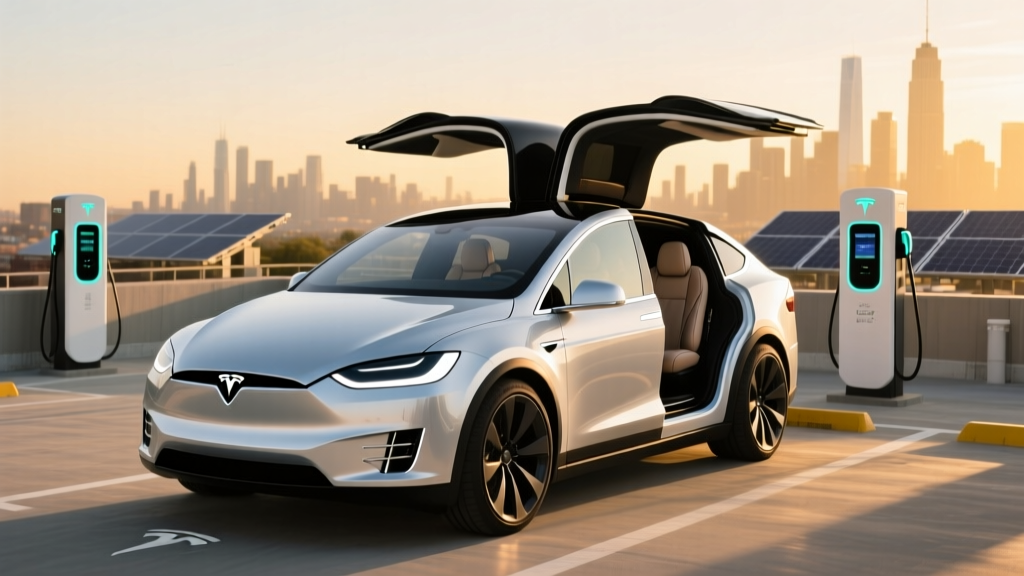
- Falcon-wing rear doors make third-row access uniquely easy in tight spaces
- Over-the-air updates continuously add features
- Lease shields you from steep EV depreciation
- 5,000-lb towing with integrated trailer brake controller
- Cabin build quality and noise insulation trail German rivals
- No Apple CarPlay or Android Auto
- Plaid trim exceeds the $80K MSRP cap — no federal tax credit
- FSD ($8K or $99/mo) adds cost without delivering autonomy
- Third-row space is tight for adults on long trips
- Repair wait times can be long; Tesla service center coverage is uneven
Who Should Lease the Tesla Model X?
The Model X is best suited for families who need three rows, want maximum EV range, and value the Supercharger network for road trips. If you regularly drive 200+ mile routes with kids and cargo, the combination of range, charging infrastructure, and falcon-wing convenience is hard to beat. It's also a strong pick for buyers who want to tow a camper or boat without dropping to a pickup truck.
Leasing makes particular sense if: (1) you want to avoid the Model X's historical depreciation curve, (2) you plan to upgrade to a next-gen platform (like a potential refreshed Model X or a Rivian R2) in three years, or (3) you want the §30D credit applied upfront without navigating the tax-filing complexity.
Skip the Model X if: interior luxury is your top priority (look at the BMW iX or Mercedes EQS SUV), you need serious off-road ability (Rivian R1S), or your budget is tighter (the Kia EV9 delivers three rows and 270 miles for $6,000 less).
Frequently Asked Questions
What is the real-world range of the Tesla Model X?
The EPA rates the Long Range AWD at 335 miles. In real-world highway driving at 70–75 mph, expect 270–295 miles. In freezing weather, range can drop to 220–250 miles. City driving with regenerative braking can approach or slightly exceed the EPA figure.
How fast does the Model X charge at home and on the road?
On a 48-amp Level 2 home charger, the Model X charges at 11.5 kW, adding about 34 miles per hour (a full overnight charge). On a 250 kW DC fast charger (Supercharger V3/V4), 10–80% takes approximately 32 minutes, with peak rates only sustained between roughly 10–30% SoC.
Does the Tesla Model X qualify for the $7,500 federal EV tax credit?
The Long Range trim ($79,990 MSRP) qualifies, provided the buyer meets IRS income caps ($150K single / $300K joint) and battery-sourcing requirements are met. The Plaid ($94,990) exceeds the $80,000 SUV MSRP cap and does not qualify. Always verify at IRS.gov before purchasing.
Is leasing the Model X better than buying?
Leasing protects you from the Model X's steep depreciation (historically 40–55% over three years) and often passes the $7,500 tax credit through as a capitalized-cost reduction. However, you're limited by annual mileage caps and won't build equity. If you drive under 15,000 miles/year and plan to upgrade in three years, leasing is often the more economical choice.
How does the Model X compare to the Rivian R1S?
The Rivian R1S matches the Model X on price (~$79,900), beats it on range (352 miles EPA), and tows significantly more (7,700 lb vs. 5,000 lb). The Model X counters with Supercharger access, a more mature software ecosystem, and slightly faster DC charging (250 kW vs. ~200 kW). The R1S offers better off-road capability; the Model X offers better road-trip charging infrastructure.
What's the battery warranty on the Model X?
Tesla covers the Model X battery and drive unit for 8 years or 150,000 miles, whichever comes first, with a guaranteed minimum 70% capacity retention over that period. This is one of the stronger battery warranties in the EV market and provides peace of mind for lessees (though you'll return the vehicle before the warranty expires in a typical 36-month lease).