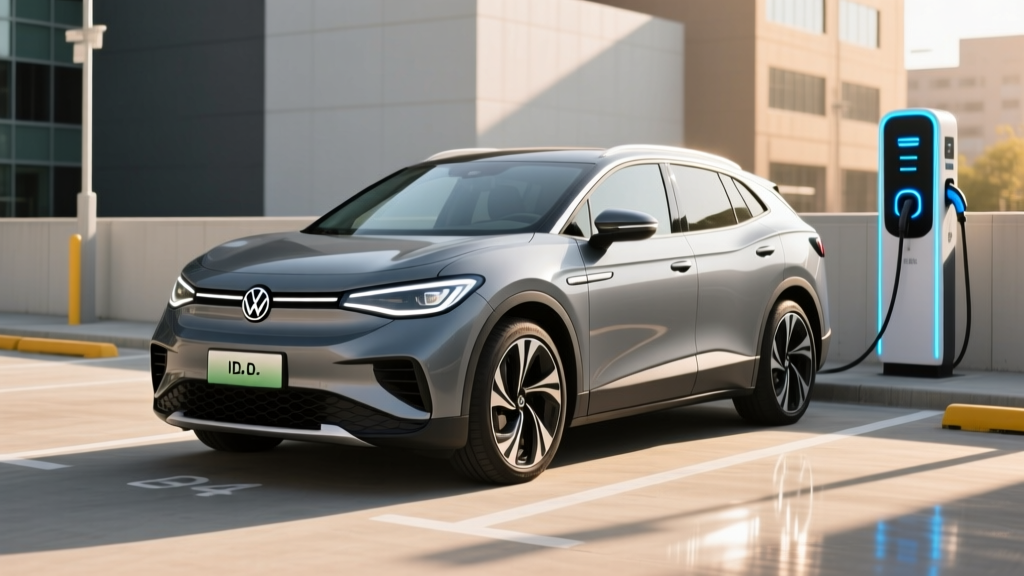
The Volkswagen ID.4 occupies a rare spot in the EV market: a mainstream electric SUV that undercuts rivals on price while delivering competitive range and practicality. For 2026, the ID.4 continues with its 82 kWh (usable) battery pack, a refined infotainment system, and aggressive leasing incentives that make it one of the most affordable ways into a long-range electric crossover. But does the math actually work in your favor?
We've driven the ID.4 across multiple model years, charged it on everything from 50 kW Electrify America stalls to 350 kW CCS towers, and tracked its real-world efficiency in both summer heat and winter cold. Here's the data-driven case for leasing — or skipping — the ID.4 in 2026.
2026 VW ID.4: Core Specs at a Glance
| Spec | ID.4 RWD (Pro S) | ID.4 AWD (Pro S) |
|---|---|---|
| EPA Range | 275 mi | 263 mi |
| Usable Battery | 82 kWh (NMC) | 82 kWh (NMC) |
| Powertrain | Single-motor RWD, 282 hp | Dual-motor AWD, 335 hp |
| 0–60 mph | 7.7 sec | 5.4 sec |
| Max DC Fast Charge | 170 kW (CCS) | 170 kW (CCS) |
| 10–80% DC Charge | ~30 min | ~30 min |
| Level 2 Home Charge | 11 kW (~37 mi/hr) | 11 kW (~37 mi/hr) |
| MPGe (combined) | 107 MPGe | 101 MPGe |
| Efficiency | 31 kWh/100 mi | 33 kWh/100 mi |
| Cargo (rear seats up) | 30.3 cu ft | 30.3 cu ft |
| Cargo (seats folded) | 64.2 cu ft | 64.2 cu ft |
| Base MSRP (Pro) | $39,735 | $43,475 |
| As-Tested (Pro S w/ Grad. Pkg) | $46,335 | $49,575 |
| Battery/Powertrain Warranty | 8 yr / 100,000 mi | 8 yr / 100,000 mi |
Sources: EPA fueleconomy.gov, Volkswagen USA.
Real-World Range: What the 275-Mile EPA Sticker Actually Means
EPA Estimated: 275 miles (RWD) / 263 miles (AWD)
Real-World Expectation: 230–260 mi highway; 200–235 mi in cold weather (below 32°F)
The ID.4's 82 kWh NMC (nickel-manganese-cobalt) battery delivers its EPA-rated 275 miles most reliably in mixed city/suburban driving with moderate climate use. In our experience, highway driving at 70–75 mph drops efficiency to roughly 2.8–3.0 mi/kWh, yielding about 230–245 miles of usable range before you'd want to stop.
Cold weather is the bigger penalty. At temperatures below freezing, expect a 20–30% reduction, bringing realistic range to 190–220 miles. The ID.4 does include a heat pump on 2026 Pro S and above trims (standard on AWD), which mitigates cabin-heating losses, but the battery itself still suffers from reduced chemical efficiency in cold. Preconditioning the battery while plugged in — using the VW Car-Net app to warm the cabin and pack before departure — recovers significant range on winter mornings.
For context, the Hyundai Ioniq 5 (318 mi EPA, Long Range RWD) and Tesla Model Y (308 mi EPA, Long Range) both outpace the ID.4 on paper and in real-world highway testing. The ID.4's efficiency of 31 kWh/100 mi is adequate but not class-leading.
Charging Speed: 170 kW Peak, But Watch the Curve
| Charging Level | Power / Rate | Speed | Notes |
|---|---|---|---|
| Level 1 (120V) | ~1.4 kW | ~4 mi/hr | Emergency/top-up only |
| Level 2 (240V, 48A) | 11 kW | ~37 mi/hr | Full charge in ~8.5 hrs |
| DC Fast (CCS) | Peak 170 kW | 10–80% in ~30 min | Tapers sharply above 80% SoC |
The ID.4's 170 kW peak DC fast-charge rate puts it in the middle of the pack. On a 150 kW or 350 kW Electrify America station (VW includes 3 years of complimentary EA charging, though terms vary by model year), you'll see the charge rate climb quickly to around 150–165 kW between 10–40% state of charge, then gradually taper. The 10–80% charge takes approximately 30 minutes — competitive with the Ford Mustang Mach-E (~29 min at 150 kW peak) but noticeably slower than the Hyundai Ioniq 5's 18-minute 10–80% run on an 800V architecture.
Above 80% SoC, the ID.4's charge rate drops steeply, often to below 40 kW. This is normal for NMC chemistry managed conservatively to protect long-term battery health, but it means topping from 80–100% at a DC charger is painfully slow. Plan to charge to 80% and drive; save 100% fills for overnight Level 2 sessions.
At home on a 240V / 48A Level 2 circuit (the most common residential install), the ID.4 accepts up to 11 kW, adding roughly 37 miles of range per hour. A full 10–100% home charge takes about 8–9 hours, making overnight replenishment straightforward.
Lease Economics: The $7,500 Credit Advantage
Here's where the "lease ID.4" search intent gets interesting. Under current IRS rules, the §30D federal EV tax credit has strict requirements for purchased vehicles: buyer income caps ($150K single / $300K joint), vehicle MSRP caps ($55K for SUVs), and battery critical-mineral and component sourcing thresholds that have disqualified many models.
However, when you lease an EV, the $7,500 commercial clean vehicle credit (§45W) passes to the leasing company (the legal owner), and most automakers — Volkswagen included — pass that savings directly to the lessee as a "lease cash" incentive or capitalized-cost reduction. This bypasses the buyer income and battery-sourcing requirements entirely.
| Scenario | MSRP | Federal Incentive | Effective Starting Price |
|---|---|---|---|
| Purchase (if eligible for §30D) | $44,735 | Up to $7,500 (income + sourcing rules apply) | ~$37,235 |
| Lease (via §45W lease cash) | $44,735 | $7,500 applied as cap-cost reduction (no income cap) | ~$37,235 effective cap cost |
| Purchase (if ineligible for §30D) | $44,735 | $0 | $44,735 |
Bottom line: If your income exceeds §30D limits, or if the specific ID.4 build doesn't meet battery-sourcing requirements for a purchase credit, leasing is the most reliable way to capture the full $7,500 benefit. Typical 36-month ID.4 leases in early 2026 have been advertised in the $249–$349/month range with $2,500–$3,500 due at signing, depending on region and dealer. Always confirm the lease cash is reflected in the capitalized cost before signing.
Check current IRS guidance at irs.gov/credits-deductions/new-vehicles for the latest eligibility rules, as sourcing requirements and credit availability change frequently.
Driving, Tech & Everyday Practicality
Performance
The RWD ID.4's 282 hp and 7.7-second 0–60 time are adequate for merging and passing but won't thrill anyone coming from a Tesla Model Y Performance (3.5 sec). The AWD dual-motor variant, at 335 hp and 5.4 seconds, closes the gap meaningfully and adds confident traction in rain and snow. Both versions ride on VW's MEB platform with a low center of gravity, and the suspension tuning favors comfort over sportiness — body roll is noticeable in corners but highway ride quality is excellent.
Interior & Cargo
The ID.4's cabin is one of its strongest selling points for families. Rear-seat legroom measures 37.6 inches — competitive with the Toyota RAV4 and significantly roomier than the Ioniq 5's rear bench. Cargo volume is 30.3 cu ft behind the rear seats and 64.2 cu ft with them folded, enough for a week's groceries or two large suitcases plus a stroller.
The 12.9-inch touchscreen (Pro S and above) runs VW's ID. Software 4.0, which has improved dramatically over the launch-era 3.x firmware. Response times are quicker, the navigation includes accurate EV route planning with charging stops, and wireless Apple CarPlay/Android Auto are standard. The haptic-touch steering wheel controls remain a common complaint — they're easy to accidentally trigger and lack tactile feedback.
Driver Assistance
The ID.4 comes standard with VW's IQ.DRIVE suite, which includes adaptive cruise control with stop-and-go, lane-centering assist, automatic emergency braking, and blind-spot monitoring. This is a SAE Level 2 driver-assist system — meaning you must keep your hands on the wheel and eyes on the road at all times. It does not offer hands-free driving like Ford's BlueCruise or GM's Super Cruise. The Travel Assist lane-centering works well on divided highways but can hunt in faded lane markings.
Notable Drawbacks
- No front trunk (frunk) — the MEB platform's front compartment houses electronics, not cargo.
- Rear drum brakes on RWD models (regenerative braking handles most deceleration, but drum brakes feel dated on a $45K vehicle).
- CCS1 connector only — no native NACS (Tesla Supercharger) access without an adapter. VW has confirmed NACS adoption for future model years, but 2026 ID.4s still ship with CCS.
- Infotainment, while improved, still lags behind Tesla, Rivian, and Hyundai/Kia interfaces in speed and polish.
How the ID.4 Stacks Up Against Key Competitors
If you're cross-shopping the ID.4 lease, you're likely also considering these alternatives:
- Hyundai Ioniq 5 (Long Range RWD): 318 mi EPA, 800V architecture (18-min 10–80%), NACS port for 2026. Faster charging, more range, slightly less rear-seat room. MSRP starts ~$42,600.
- Tesla Model Y (Long Range): 308 mi EPA, Supercharger network access, 11.5-kW Level 2. Best charging infrastructure and efficiency, but higher starting price (~$44,990) and panel gaps remain a concern.
- Ford Mustang Mach-E (Extended Range RWD): 320 mi EPA, 150 kW peak DC charge, BlueCruise hands-free available. Sportier to drive, but cargo space trails the ID.4.
- Kia EV6 (Long Range RWD): 310 mi EPA, 800V fast charging, NACS for 2026. Shares the Ioniq 5's platform with a more aggressive design. Starts ~$42,900.
The ID.4 wins on value — particularly when the $7,500 lease credit is applied — and on interior space. It loses on charging speed (no 800V), range (30–45 miles less than rivals), and Supercharger access. If your daily commute is under 60 miles round-trip and you charge at home, the ID.4's range deficit is largely academic. For frequent road-trippers, the Ioniq 5 or Model Y are stronger choices.
Warranty & Long-Term Battery Outlook
Volkswagen covers the ID.4's battery and powertrain for 8 years or 100,000 miles, with a capacity-retention threshold of 70% — meaning if your battery drops below 70% of its original 82 kWh usable capacity within that window, VW will repair or replace it. The bumper-to-bumper warranty is 4 years / 50,000 miles.
NMC batteries in the ID.4 have shown modest degradation in real-world fleet data: typically 5–8% loss over the first 50,000 miles, leveling off afterward. This is consistent with industry norms for liquid-cooled NMC packs. If you lease for 36 months and under 36,000 miles, battery degradation is effectively a non-issue — you'll return the vehicle well within the healthy portion of the degradation curve.
Who Should Lease the ID.4 — And Who Shouldn't
Lease the ID.4 if:
- You want a spacious electric SUV under $350/month after incentives.
- Your income exceeds §30D purchase-credit limits but you still want the $7,500 benefit via lease cash.
- You charge primarily at home and your daily driving is under 80 miles.
- You value ride comfort and rear-seat space over sporty handling.
- You plan to return the vehicle after 3 years and avoid long-term battery ownership risk.
Skip the ID.4 if:
- You regularly road-trip 300+ miles and need the fastest possible DC charging (look at Ioniq 5/EV6 with 800V).
- You want Tesla Supercharger network access without adapters.
- You want a frunk or hands-free highway driving capability.
- You plan to keep the vehicle 7+ years and want maximum range headroom as the battery ages.
Pros & Cons Summary
Pros
- Aggressive lease pricing with $7,500 lease cash
- Spacious rear seat and strong cargo volume (30.3 / 64.2 cu ft)
- Comfortable, compliant ride quality
- Improved ID. Software 4.0 infotainment
- Standard IQ.DRIVE safety suite
- 3 years complimentary Electrify America charging
Cons
- 275-mi EPA range trails Ioniq 5, Model Y, Mach-E
- 170 kW peak DC charge — no 800V fast-charge capability
- CCS1 port only — no native NACS/Supercharger access
- No front trunk (frunk)
- Haptic steering controls frustrate many drivers
- Rear drum brakes on RWD trims
Frequently Asked Questions
What is the real-world range of the 2026 VW ID.4?
The EPA rates the RWD ID.4 at 275 miles and the AWD at 263 miles. In real-world highway driving at 70–75 mph, expect 230–260 miles. In freezing temperatures, plan for 190–220 miles. Preconditioning and using the heat pump (Pro S and above) help mitigate cold-weather losses.
How fast does the ID.4 charge at home and on DC fast chargers?
On DC fast charging, the ID.4 peaks at 170 kW and charges from 10–80% in approximately 30 minutes. At home on a 240V Level 2 charger, it accepts up to 11 kW, adding about 37 miles of range per hour and fully charging overnight in roughly 8.5 hours.
How much does the ID.4 cost after tax credits when leasing?
With the $7,500 federal lease credit applied as a capitalized-cost reduction, a 2026 ID.4 Pro S RWD (MSRP $44,735) effectively starts around $37,235 for lease calculations. Monthly payments of $249–$349 with $2,500–$3,500 due at signing have been typical in early 2026, varying by region and dealer.
Does the VW ID.4 qualify for the federal EV tax credit?
For purchases, §30D eligibility depends on your income (under $150K single / $300K joint), the vehicle's MSRP (under $55K for SUVs — the ID.4 qualifies), and battery-sourcing requirements that change periodically. For leases, the $7,500 credit passes through the leasing company under §45W rules, bypassing income and sourcing restrictions. Always verify current rules at irs.gov.
Is the ID.4 worth leasing vs. the Hyundai Ioniq 5 or Tesla Model Y?
If value and interior space are your top priorities, the ID.4 lease is hard to beat. If you need maximum range, the fastest DC charging, or Supercharger access, the Ioniq 5 or Model Y are stronger choices — but typically at a higher monthly lease cost.
What are the biggest pros and cons of the ID.4?
Top pros: low lease cost with incentives, roomy interior, comfortable ride, and complimentary Electrify America charging. Top cons: below-average EPA range for the class, 170 kW peak charge rate (no 800V), CCS-only port, and no frunk.
What is the ID.4's battery warranty?
Volkswagen covers the ID.4's high-voltage battery and electric powertrain for 8 years or 100,000 miles, guaranteeing at least 70% capacity retention during that period.