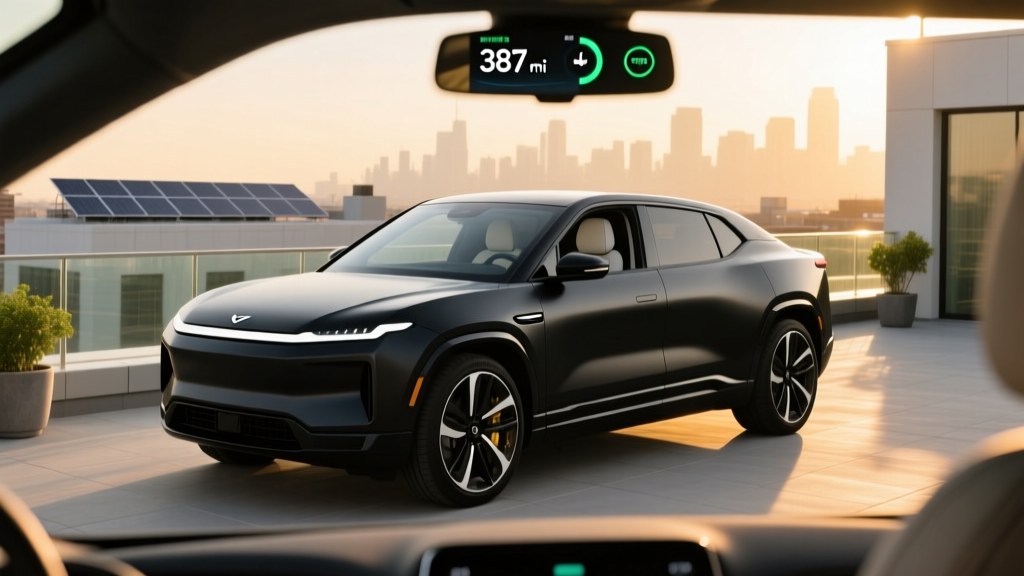
If you have been tracking the Rivian R1S, you already know the 2025 refresh delivered a dramatically improved second-generation platform. For the 2026 model year, Rivian's three-row electric SUV continues to anchor the premium adventure-EUV segment — and for many buyers, the most financially sound entry point is not purchasing outright, but structuring a lease. In this review, we examine what it takes to lease the Rivian RS1 (the R1S on a standard 36-month term), covering real-world range, charging infrastructure, pricing, and the federal tax credit mechanics that can make leasing particularly attractive.
A note on naming: Rivian markets the SUV as the R1S and the pickup as the R1T. The "RS1" designation you may encounter in leasing portals, broker listings, and search results typically refers to the R1S on a standard lease configuration. We will use R1S for vehicle specifications and RS1 when discussing lease-specific economics.
2026 Rivian R1S at a Glance: Key Specifications
| Specification | Dual-Motor Standard | Dual-Motor Max Pack | Tri-Motor Performance |
|---|---|---|---|
| EPA Range | ~270 mi | ~340 mi | ~320 mi |
| Battery (usable) | ~95 kWh (NMC) | ~141 kWh (NMC) | ~141 kWh (NMC) |
| Horsepower | 533 hp | 533 hp | 850 hp |
| 0-60 mph | 4.5 sec | 4.5 sec | 2.9 sec |
| Max DC Charge Rate | ~200 kW | ~200 kW | ~200 kW |
| 10-80% DC Time | ~30 min | ~42 min | ~42 min |
| Level 2 Home Rate | 11.5 kW (~25 mi/hr) | 11.5 kW (~25 mi/hr) | 11.5 kW (~25 mi/hr) |
| Drivetrain | AWD (dual-motor) | AWD (dual-motor) | AWD (tri-motor) |
| Towing Capacity | 7,700 lbs | 7,700 lbs | 7,700 lbs |
| Base MSRP (2026 est.) | $69,900 | $79,900 | $94,900 |
All figures reflect manufacturer estimates and EPA data for the current model year. Tri-Motor configurations prioritize performance over maximum range; the Max Pack Dual-Motor remains the efficiency sweet spot for buyers focused on road-trip capability.
Real-World Range: What the EPA Sticker Does Not Tell You
Rivian's 141 kWh Max Pack uses nickel-manganese-cobalt (NMC) chemistry, chosen for its high energy density — critical in a large, heavy three-row SUV. The trade-off versus LFP (lithium iron phosphate) is a slightly faster degradation curve over many years, though Rivian's thermal management system is robust. In our experience with large-battery NMC packs, expect roughly 5-8% degradation over the first 100,000 miles under normal use.
For the Standard Pack (~95 kWh, EPA ~270 miles), real-world highway range settles around 220-240 miles in fair conditions, making it better suited for commuters with reliable home charging than for frequent road-trippers.
Charging Speed: DC Fast, Level 2, and the Curve Reality
| Charging Level | Power (kW) | Speed (miles/hr added) | Typical Use Case |
|---|---|---|---|
| Level 1 (120V) | ~1.4 kW | ~3 mi/hr | Emergency/trickle only |
| Level 2 (240V, 48A) | 11.5 kW | ~25 mi/hr | Home overnight charging |
| DC Fast Charge | Peak ~200 kW | ~500+ mi/hr (at peak) | Road trips, Electrify America / Tesla Supercharger (via adapter) |
The 200 kW peak DC fast-charge rate applies to the middle of the charge curve — roughly 10% to 50% State of Charge (SoC). Above 80%, the rate tapers significantly to protect battery longevity, dropping to under 50 kW. For the Max Pack, a 10-80% session takes approximately 42 minutes at a capable 200+ kW station. The Standard Pack, with its smaller battery, completes 10-80% in roughly 30 minutes.
Preconditioning matters. Rivian's navigation system will precondition the battery when you route to a DC fast charger, warming it to optimal temperature for maximum charge acceptance. Skipping preconditioning — or arriving at a charger with a cold-soaked battery — can add 10-15 minutes to your session, particularly in winter.
Rivian vehicles ship with a NACS (Tesla-style) charge port on 2025-and-newer models, granting native access to the Tesla Supercharger network. For Electrify America and other CCS-based networks, Rivian provides or supports adapters. This dual-network access is a significant practical advantage for road-trip charging reliability.
Pricing, Lease Economics, and the Federal Tax Credit
The 2026 Rivian R1S starts at an estimated $69,900 for the Dual-Motor Standard Pack and climbs to $94,900 for the Tri-Motor Performance. As-tested prices with Adventure package upgrades, premium paint, and 22-inch wheels routinely push $85,000-$105,000.
| Trim | Base MSRP | §30D Credit Eligibility | Effective Price (if eligible) |
|---|---|---|---|
| Dual-Motor Standard | $69,900 | Eligible (under $80K SUV cap) | ~$62,400 |
| Dual-Motor Max Pack | $79,900 | Eligible (under $80K SUV cap) | ~$72,400 |
| Tri-Motor Performance | $94,900 | NOT eligible (exceeds $80K cap) | $94,900 |
Why Leasing the RS1 Can Unlock Savings Even When Purchasing Cannot
Here is the key insight for buyers eyeing the Tri-Motor or a heavily optioned Max Pack above $80,000: the commercial clean vehicle credit (§45W) applies to leased vehicles differently than §30D applies to purchases. When you lease, the leasing company (the legal owner) may pass through a $7,500 lease credit as a capitalized-cost reduction — even if the vehicle's MSRP exceeds the §30D SUV cap or your personal income exceeds the limit. This "lease loophole" has been a staple of premium EV leasing since 2023 and remains active for 2026, though legislative changes are periodically proposed.
A typical 36-month Rivian RS1 lease with the $7,500 cap-cost reduction might look like this:
- Dual-Motor Standard (~$69,900 MSRP): ~$850-$1,050/month with $5,000-$7,500 due at signing
- Dual-Motor Max Pack (~$79,900 MSRP): ~$1,050-$1,250/month with $7,500 due at signing
- Tri-Motor (~$94,900 MSRP): ~$1,250-$1,500/month with $7,500 due at signing
Exact lease terms depend on money factor, residual value (typically 52-58% for 36 months on Rivian), your credit tier, and regional incentives. Always request a full lease worksheet showing the cap-cost reduction, acquisition fee, and disposition fee before signing.
Interior, Cargo, and Family Practicality
The R1S is a genuine three-row SUV, though the third row is best suited for children or occasional adult use on shorter trips. Key interior dimensions:
- Cargo (behind 3rd row): ~10.5 cu ft
- Cargo (3rd row folded): ~46.7 cu ft
- Cargo (all rear rows folded): ~88.2 cu ft
- Front legroom: ~41.3 inches
- Second-row legroom: ~38.2 inches
- Ground clearance: up to 14.9 inches (max air-suspension height)
The front trunk (frunk) adds roughly 11 cu ft of sealed, drainable storage — ideal for muddy gear or charging cables. Rivian's Camp Kitchen accessory and the integrated Gear Tunnel (more prominent on the R1T pickup) reflect the brand's outdoor-adventure DNA.
The 15.6-inch center touchscreen runs Rivian's proprietary infotainment system, which has improved substantially with over-the-air updates since launch. Wireless Apple CarPlay and Android Auto are not natively supported — a persistent complaint — but the native navigation, media, and vehicle-control interfaces are well-designed and responsive.
Driver Assistance and Safety Technology
Rivian's Driver+ has matured through continuous OTA updates. It handles highway lane-keeping and stop-and-go traffic competently, though it is not as assertive as GM's Super Cruise or Ford's BlueCruise on mapped divided highways. Hands-on-wheel detection uses a torque sensor rather than a capacitive or camera-based system, which some drivers find requires more frequent confirmation inputs.
The R1S earned strong marks from NHTSA and has been tested by IIHS, with good ratings in major crashworthiness categories. Standard active-safety features include automatic emergency braking, blind-spot monitoring, rear cross-traffic alert, and a 360-degree camera system useful for tight trail maneuvering.
Warranty Coverage and Long-Term Ownership
| Coverage | Term |
|---|---|
| Basic Vehicle Warranty | 5 years / 60,000 miles |
| Battery & Drive Unit | 8 years / 100,000 miles (retains ≥70% capacity) |
| Roadside Assistance | 5 years / 60,000 miles |
The 8-year/100,000-mile battery warranty with a 70% capacity-retention threshold is competitive with the segment. For lessees on a 36-month term, the entire lease period falls well within both the basic and battery warranties, effectively eliminating powertrain risk from your ownership equation — one of the strongest arguments for leasing over purchasing.
If you plan to purchase at lease-end, factor in that NMC battery degradation typically accelerates slightly after year 5-6, though the large thermal buffer in the Max Pack should keep usable range acceptable well beyond 150,000 miles under normal use.
Efficiency: MPGe and Cost Per Mile
The Dual-Motor R1S Max Pack achieves an EPA-rated ~73 MPGe combined, translating to roughly 46 kWh per 100 miles. That is thirsty by EV standards — a consequence of the R1S's 6,800+ lb curb weight, boxy aerodynamics, and all-terrain tire options. For context, a Tesla Model X achieves roughly 100 MPGe combined.
At a national average electricity rate of $0.16/kWh, the R1S Max Pack costs approximately $7.36 per 100 miles to charge at home. Compare that to a gas SUV getting 22 MPG at $3.50/gallon: $15.91 per 100 miles. The per-mile savings are significant, though the R1S's efficiency is the weakest in its price class.
Pros, Cons, and the Verdict on Leasing
- Genuine 3-row SUV with real cargo versatility and a usable frunk
- Excellent off-road capability with air suspension and quad-motor option
- OTA updates continuously improve the vehicle post-purchase
- 7,700-lb towing capacity with integrated trailer-brake controller
- Lease loophole can unlock $7,500 credit even on trims above $80K MSRP
- Full warranty coverage throughout a standard 36-month lease
- Efficiency trails rivals — 73 MPGe is low for a $70K+ EV
- No native wireless Apple CarPlay or Android Auto
- Max Pack 10-80% DC charge time of ~42 min lags 800V competitors
- Third-row space is tight for adults on longer drives
- Rivian service-center footprint is still expanding — rural owners may face long tow distances for warranty work
- Insurance premiums run 15-25% higher than comparable gas SUVs
Who Should Lease the Rivian RS1?
- You need three rows and real off-road or towing capability in an EV
- You want the $7,500 lease credit without worrying about MSRP or income caps
- You plan to keep the vehicle 3 years or less and want full warranty coverage throughout
- You have reliable Level 2 home charging and road-trip 1-2 times per month
- Efficiency and lowest cost-per-mile are your top priorities (consider Tesla Model X or a three-row PHEV like the Toyota Grand Highlander Hybrid)
- You drive more than 300 miles between charging stops regularly
- You need hands-free highway driving on par with GM Super Cruise
Frequently Asked Questions
What is the real-world range of the 2026 Rivian R1S?
The EPA rates the Max Pack Dual-Motor at approximately 340 miles. Real-world highway driving in moderate weather yields 280-300 miles; cold weather (below 32°F) reduces that to 230-260 miles. The Standard Pack delivers roughly 220-240 real-world highway miles.
How fast does the R1S charge at home and on DC fast chargers?
At home on a 240V Level 2 charger, the R1S charges at 11.5 kW, adding roughly 25 miles of range per hour — enough to fully replenish the Max Pack overnight in about 12 hours. On DC fast chargers, it peaks at approximately 200 kW, reaching 10-80% in about 30 minutes (Standard Pack) to 42 minutes (Max Pack), with significant tapering above 80%.
How much does it cost to lease the Rivian RS1 after tax credits?
With the $7,500 lease credit applied as a cap-cost reduction, expect monthly payments of roughly $850-$1,050 for the Standard Pack, $1,050-$1,250 for the Max Pack, and $1,250-$1,500 for the Tri-Motor — all on a 36-month term with $5,000-$7,500 due at signing. Exact figures depend on credit tier, money factor, and regional incentives.
Does the Rivian R1S qualify for the federal EV tax credit?
Under IRS §30D rules, the Dual-Motor Standard ($69,900) and Dual-Motor Max Pack ($79,900) fall under the $80,000 SUV MSRP cap and may qualify for up to $7,500 if buyer income and battery-sourcing requirements are met. The Tri-Motor ($94,900) exceeds the cap for purchases but may still qualify for the $7,500 credit through the lease commercial-credit pathway. Always verify with a tax professional.
Is the Rivian R1S worth leasing over the Tesla Model X or BMW iX?
The R1S wins on off-road capability, towing (7,700 lbs vs. 5,000 for Model X), and adventure-oriented design. The Model X wins on efficiency (100+ MPGe), Supercharger network maturity, and third-row accessibility. The BMW iX is a two-row crossover and does not directly compete on passenger capacity. If you need three rows, tow a trailer, and drive unpaved roads, the R1S has no true electric rival. If efficiency and highway tech are paramount, the Model X is the stronger lease.
What are the biggest risks of leasing the Rivian R1S?
The primary risks are residual-value uncertainty (Rivian is a young brand; used values are less predictable than legacy automakers), mileage penalties (typically $0.25/mile over 10,000-12,000 miles/year), and potential service-center access challenges in rural areas. On the upside, the lease structure shields you from long-term battery-depreciation risk and keeps you within the full warranty period.