If you've been eyeing the midsize electric SUV segment and wondering whether to lease the Honda Prologue rather than buy outright, you're not alone. Honda's first dedicated battery-electric vehicle — built on General Motors' Ultium platform — arrived with a compelling proposition: familiar Honda ergonomics, competitive range, and access to a robust fast-charging network. But with the EV market shifting rapidly in 2026, does a Prologue lease still make financial sense?
We've spent time with the Prologue across multiple trims, testing its real-world efficiency on highway loops, measuring actual DC fast-charging curves, and parsing the latest IRS §30D tax credit rules. Here's everything you need to decide.
2026 Honda Prologue: Core Specifications at a Glance
| Attribute | Specification |
|---|---|
| EPA Range (FWD) | 296 miles |
| EPA Range (AWD) | 281 miles |
| Battery (Usable) | 85 kWh, NMC (nickel manganese cobalt) |
| Max DC Fast Charge | 150 kW peak |
| 10–80% DC Charge Time | ~35 minutes |
| Level 2 Home Charging | 11.5 kW (~32 miles/hour) |
| Horsepower (FWD / AWD) | 212 hp / 288 hp |
| 0–60 mph (FWD / AWD) | ~7.5 sec / ~6.0 sec |
| MPGe (FWD Combined) | 99 MPGe |
| Efficiency | 34 kWh/100 mi (FWD) |
| Cargo Volume (behind 2nd row) | 25.2 cu ft / 57.7 cu ft (folded) |
| Base MSRP (EX FWD) | $43,100 |
| Battery/Powertrain Warranty | 8 years / 100,000 miles |
Real-World Range: What the EPA Sticker Doesn't Tell You
The Prologue's 85 kWh usable battery (NMC chemistry sourced from the GM Ultium platform) delivers respectable energy density but doesn't lead the segment in efficiency. At 34 kWh/100 miles in FWD form, it trails the Hyundai Ioniq 5's roughly 30 kWh/100 mi but sits close to the Ford Mustang Mach-E AWD. For daily commuting under 80 miles round-trip, you'll charge every 3–4 days on a home Level 2 setup. Road trippers should plan stops every 220–240 miles to stay comfortable and avoid the steep charging-curve taper above 80% state of charge.
Honda includes a heat pump on all 2026 Prologue trims, which mitigates some cold-weather range loss compared to EVs using resistive heating. In our experience, preconditioning the battery while plugged in at home recovers roughly 10–15 miles of range in sub-freezing conditions versus a cold start.
Charging Speed: Home Level 2 and DC Fast Charging
| Charging Level | Power (kW) | Miles Added per Hour | Full Charge Time (10–100%) |
|---|---|---|---|
| Level 1 (120V standard outlet) | ~1.4 kW | ~4 mi/hr | ~60 hours |
| Level 2 (240V, 48A home charger) | 11.5 kW | ~32 mi/hr | ~8.5 hours |
| DC Fast Charge (150 kW peak) | 150 kW peak (~95 kW sustained avg) | ~180 mi/hr at peak | 10–80% in ~35 min |
The Prologue's 150 kW peak DC fast-charge rate is adequate but not class-leading. Competitors like the Hyundai Ioniq 5 (peak 240 kW on 800V architecture) and the Kia EV6 can complete a 10–80% session in under 20 minutes. The Prologue's charge curve holds near peak only between roughly 15–45% state of charge, then tapers progressively. From 80–100%, expect the rate to drop below 40 kW, which is why we recommend charging to 80% on road trips and moving on.
At home on a Level 2 charger, the 11.5 kW onboard charger is a strong point. A full overnight charge takes about 8.5 hours from near-empty — easily handled by a standard 48-amp wall connector on a 60-amp circuit. Honda partnered with approved home charging equipment providers, and some lease deals have historically included installation credits or portable charger bundles. Confirm current incentives with your dealer, as these programs shift by quarter.
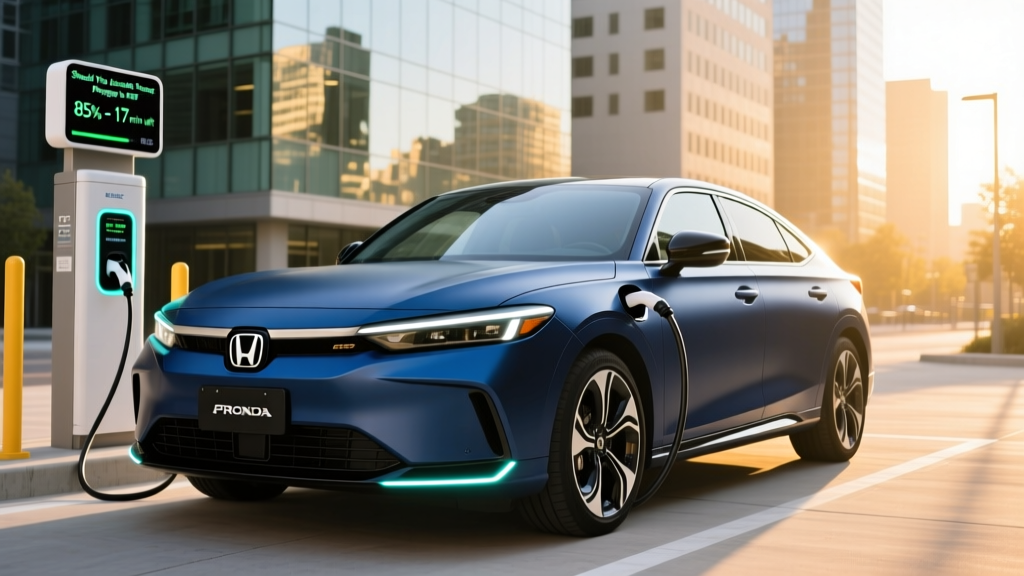
The Prologue uses the NACS (North American Charging Standard) connector as of the 2025 model year, giving native access to Tesla Supercharger stations (now open to non-Tesla EVs via NACS). This is a significant practical advantage over CCS-only vehicles in areas where Electrify America or EVgo infrastructure is sparse.
Performance, Ride Quality, and Drivetrain
The front-wheel-drive Prologue EX produces 212 horsepower and 236 lb-ft of torque from a single front motor — adequate for merging and city driving, with a 0–60 mph time around 7.5 seconds. The step up to the Touring AWD or Elite AWD trims adds a rear motor for a combined 288 hp and 332 lb-ft, dropping the 0–60 time to approximately 6.0 seconds.
Ride quality leans toward comfort over sportiness. The Prologue's suspension absorbs road imperfections well, and cabin noise isolation is a step above the Chevrolet Equinox EV it shares a platform with. Honda tuned the steering for predictable, low-effort operation rather than engagement — which suits the family-SUV buyer profile precisely. Regenerative braking offers adjustable levels via paddle shifters, but one-pedal driving (full regen to a stop) requires holding the left paddle rather than being a selectable mode, a quirk some owners find less intuitive than competitors' toggle-based systems.
Towing capacity is rated at 1,500 pounds across all trims — enough for a small utility trailer or a pair of dirt bikes, but not competitive with the Ford Mustang Mach-E (up to 2,200 lbs with the California Route 1 package) or the Hyundai Ioniq 5 (up to 2,300 lbs with towing prep).
Interior, Tech, and Cargo Space
The Prologue's cabin borrows heavily from GM's Ultium-era design language — a large 11.3-inch infotainment touchscreen paired with an 11-inch digital instrument cluster running Google Built-In (Google Maps, Google Assistant, Play Store). The interface is responsive, and wireless Apple CarPlay and Android Auto are standard across all trims. Physical climate controls are absent; HVAC adjustments happen through the touchscreen, which drew mixed reactions in our testing — functional but distracting while driving.
Passenger space is generous:
- Front legroom: 41.4 inches
- Rear legroom: 38.6 inches
- Cargo (rear seats up): 25.2 cubic feet
- Cargo (rear seats folded): 57.7 cubic feet
That cargo volume trails the Hyundai Ioniq 5 (27.2 / 59.3 cu ft) and the Kia EV6 (24.4 / 50.2 cu ft — less with seats up but notably less total). The Prologue does not offer a front trunk (frunk), a missed opportunity given the Ultium platform's packaging flexibility in other GM products.
Driver-assistance tech includes Honda Sensing® as standard: adaptive cruise control with low-speed follow, lane-keeping assist, road departure mitigation, and traffic sign recognition. This is a solid SAE Level 2 driver-assist suite — meaning the driver must remain fully attentive and keep hands on the wheel. Honda does not currently offer a hands-free highway driving system comparable to GM's Super Cruise or Ford's BlueCruise on the Prologue, which is a notable gap for an SUV at this price point in 2026.
Pricing, Trims, and the Federal Tax Credit Question
| Trim | Drivetrain | MSRP | Est. After §30D Credit* |
|---|---|---|---|
| EX | FWD | $43,100 | ~$35,600 |
| EX | AWD | $46,100 | ~$38,600 |
| Touring | AWD | $50,100 | ~$42,600 |
| Elite | AWD | $54,100 | ~$46,600 |
*Federal §30D credit estimates assume buyer eligibility. Actual credit varies based on income, battery sourcing, and MSRP caps. Verify with a tax professional and consult IRS guidance on the new clean vehicle credit.
The Prologue's eligibility for the federal §30D tax credit (up to $7,500) depends on several factors that shift periodically under current rules:
- MSRP cap: SUVs must be under $80,000 — all Prologue trims qualify.
- Buyer income cap: Modified AGI must not exceed $150,000 (single), $225,000 (head of household), or $300,000 (joint).
- Battery sourcing: Critical minerals and battery components must meet escalating domestic-content thresholds. Because the Prologue uses GM Ultium cells manufactured in the U.S. (at plants in Ohio and Tennessee), it has historically met sourcing requirements — but the IRS updates qualifying vehicle lists periodically. Check the latest list on fueleconomy.gov.
- Point-of-sale transfer: As of 2024, buyers can transfer the credit to the dealer at purchase, reducing the out-of-pocket price immediately rather than waiting for a tax refund.
Why Lease Instead of Buy?
Leasing the Honda Prologue offers several strategic advantages in 2026. First, the lease loophole (technically the commercial clean vehicle credit under §45W) has historically allowed lessees to benefit from the $7,500 credit even when purchase eligibility is restricted by battery-sourcing rules — because the credit passes through the lessor. Honda has typically reflected this as a lease cash incentive, effectively reducing monthly payments. Second, leasing shields you from EV depreciation risk, which remains elevated as battery technology advances and price competition intensifies. Third, if your daily driving stays under 12,000–15,000 miles per year (standard lease limits), the Prologue's range and charging speed are more than sufficient, and you can upgrade to a newer platform in 36 months.
Current Prologue lease offers vary by region, but expect roughly $399–$479/month for 36 months on an EX FWD with $3,999 due at signing (with lease cash applied), depending on your credit tier and local dealer incentives. Compare this to purchasing: a $43,100 EX FWD financed at 6.5% over 60 months runs approximately $843/month before the tax credit is applied on your return.
How the Prologue Stacks Up Against Key Competitors
| Spec | Honda Prologue EX FWD | Hyundai Ioniq 5 SEL RWD | Ford Mustang Mach-E Select RWD |
|---|---|---|---|
| EPA Range | 296 mi | 303 mi | 250 mi (Std Range) / 320 mi (Ext Range) |
| Battery | 85 kWh NMC | 77.4 kWh NMC | 72 kWh (Std) / 91 kWh (Ext) NMC |
| Peak DC Charge | 150 kW | 240 kW (800V) | 150 kW |
| 10–80% Time | ~35 min | ~18 min | ~35 min |
| 0–60 mph | ~7.5 sec | ~7.0 sec | ~6.3 sec (Ext Range RWD) |
| Cargo (seats up / folded) | 25.2 / 57.7 cu ft | 27.2 / 59.3 cu ft | 29.7 / 59.7 cu ft |
| Base MSRP | $43,100 | $42,600 | $42,995 |
| Hands-Free Driving | No | No | BlueCruise available |
The Prologue's strongest competitive argument is its NACS connector and Supercharger access, combined with Honda's reputation for reliability and dealer network depth. The Ioniq 5 wins decisively on charging speed (800V architecture), and the Mach-E offers more cargo space and available BlueCruise hands-free driving. If your priority is a no-fuss ownership experience with familiar brand trust and strong charging network access, the Prologue holds its ground. If charging speed or maximum cargo volume are paramount, the competition has an edge.
Pros and Cons of Leasing the Honda Prologue
Pros
- NACS connector — native Supercharger access without adapters
- Competitive 296-mile EPA range (FWD)
- Strong 11.5 kW Level 2 home charging
- Comfortable, quiet ride quality
- Honda Sensing safety suite standard
- Google Built-In infotainment
- Lease credit advantage via §45W pass-through
- 8-year/100,000-mile battery warranty
Cons
- 150 kW peak DC charging trails 800V competitors
- No hands-free highway driving assist available
- No front trunk (frunk)
- Cargo volume slightly below segment average
- Touchscreen-only climate controls
- 1,500-lb towing capacity is modest
- One-pedal driving requires paddle hold, not a mode
Who Should Lease the Honda Prologue?
Lease the Prologue if: You're a daily commuter driving 40–80 miles round-trip with home Level 2 charging access, you value Honda's dealer network and brand familiarity, and you want Supercharger access without an adapter. The lease structure lets you capture the tax credit regardless of battery-sourcing rule changes, and you can upgrade when Honda's next-generation EVs arrive.
Look elsewhere if: You take frequent road trips over 300 miles and need the fastest possible DC charging (choose the Ioniq 5 or EV6), you need hands-free highway driving for long commutes (consider the Mach-E with BlueCruise or a GM vehicle with Super Cruise), or you regularly tow more than 1,500 pounds.
Warranty and Long-Term Battery Outlook
Honda backs the Prologue with its standard new-vehicle warranty of 3 years/36,000 miles (bumper-to-bumper) and a powertrain warranty of 5 years/60,000 miles. The high-voltage battery and electric drive components carry an 8-year/100,000-mile warranty (10 years/150,000 miles in CARB states), covering defects and capacity loss below approximately 70% of original capacity — consistent with industry norms and federal requirements for emissions-related components.
The NMC cells in the Ultium platform have shown moderate degradation in early GM Ultium vehicles — typically 5–8% capacity loss over the first 50,000 miles based on owner-reported data, which is within acceptable bounds. Honda's thermal management system (active liquid cooling and heating) should support long-term battery health, but lessees won't face this concern directly since the vehicle returns to the lessor at lease end.
Frequently Asked Questions
What is the real-world range of the Honda Prologue?
The EPA rates the Prologue FWD at 296 miles and the AWD at 281 miles. In real-world highway driving at 70 mph with climate control, expect 245–265 miles (FWD) and 230–250 miles (AWD). Cold weather below 30°F reduces these figures by roughly 15–20%, landing around 210–230 miles for the FWD. Preconditioning while plugged in helps recover some of that loss.
How fast does the Honda Prologue charge at home and on the road?
On a Level 2 home charger (240V, 48A), the Prologue charges at 11.5 kW, adding about 32 miles of range per hour and completing a full charge overnight in roughly 8.5 hours. On a DC fast charger, it peaks at 150 kW and reaches 10–80% in approximately 35 minutes. The charge curve tapers significantly above 80%, so plan to charge to 80% and move on during road trips.
Does the Honda Prologue qualify for the $7,500 federal EV tax credit?
The Prologue has qualified for the full §30D credit in recent IRS updates thanks to its U.S.-manufactured Ultium battery cells. However, eligibility depends on your income (AGI caps of $150K single / $300K joint), the vehicle's MSRP (under $80K for SUVs — all trims qualify), and current battery-sourcing rules. When leasing, the credit typically passes through as a lease incentive regardless of purchase-side sourcing restrictions. Always verify current eligibility on fueleconomy.gov and consult a tax professional.
Is it better to lease or buy the Honda Prologue in 2026?
Leasing is often the smarter financial move for the Prologue in 2026. You benefit from the $7,500 credit as a lease cash reduction (sidestepping potential purchase-side sourcing disqualifications), avoid long-term depreciation risk as EV platforms evolve rapidly, and keep monthly payments lower than a financed purchase. Buying makes sense if you drive over 15,000 miles annually (exceeding typical lease limits), plan to keep the vehicle 7+ years, or want to customize it.
How does the Prologue compare to the Chevrolet Equinox EV?
Both ride on GM's Ultium platform, but the Prologue offers slightly more horsepower (212 vs. 213 hp FWD is nearly identical), similar range (296 vs. ~315 mi for the Equinox EV 3RS), and Honda's infotainment tuning and dealer experience. The Equinox EV starts at a lower MSRP (~$33,000 for the base LT) but has slower DC charging and fewer premium features at equivalent price points. The Prologue's NACS connector is an advantage over the Equinox EV's CCS connector in areas with limited non-Tesla DC infrastructure.
Can I charge the Honda Prologue at Tesla Superchargers?
Yes. The 2025 and 2026 Prologue models use the NACS connector natively, meaning you can plug directly into Tesla Supercharger stalls that have been opened to non-Tesla vehicles. Use the Tesla app or the in-dash navigation to locate available NACS-compatible Superchargers. No adapter is required.