Why the Las Vegas Tunnels Tesla Matters to Everyday Buyers
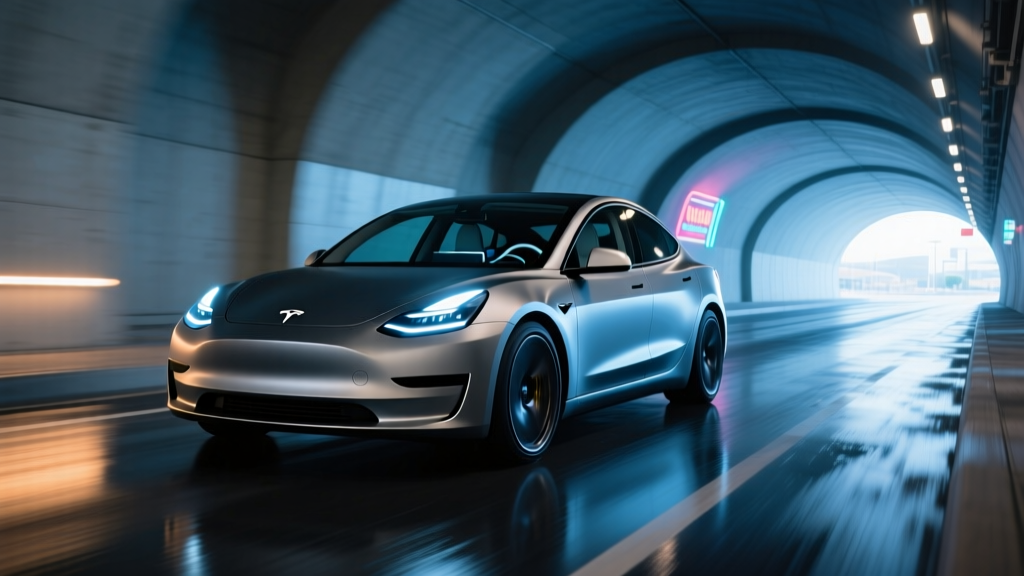
If you've visited the Las Vegas Convention Center since 2021, you've likely ridden in one: a Tesla Model 3 or Model Y whisking you through underground tunnels at up to 35 mph, guided by a human driver on a fixed route. The Vegas Loop, operated by The Boring Company, now spans over 30 miles of tunnel (with expansion ongoing toward the Strip and Harry Reid International Airport) and relies entirely on Tesla's consumer electric vehicles. It's one of the most visible real-world deployments of Tesla's EVs in a high-utilization fleet environment — and it raises a practical question for shoppers: if these cars can handle thousands of tunnel miles a year in Las Vegas heat, what does that tell us about buying one for yourself?
This review focuses on the 2026 Tesla Model 3 Long Range Rear-Wheel Drive, the variant most closely aligned with the Vegas Loop fleet spec. We'll break down its EPA range, charging curve, battery chemistry, pricing after federal tax credits, and whether it's the right EV for your driveway — not just a tunnel.
2026 Tesla Model 3 Long Range RWD: Core Specifications
| Attribute | Value |
|---|---|
| EPA Range | 363 miles |
| Battery (usable) | ~75 kWh, NMC (nickel manganese cobalt) |
| Drivetrain | Rear-Wheel Drive (single motor) |
| Horsepower | 271 hp |
| 0–60 mph | 5.8 seconds |
| EPA Efficiency | 132 MPGe combined (25 kWh/100 mi) |
| Max DC Fast Charge | 250 kW peak (CCS via NACS adapter or native NACS) |
| 10–80% DC Charge | ~25 minutes (V4 Supercharger or equivalent) |
| Level 2 Home Charge | 11.5 kW (~44 mi/hr on 48A circuit) |
| Cargo (trunk + frunk) | 23 cu ft trunk + 3.1 cu ft frunk (26.1 cu ft total) |
| Rear Legroom | 35.3 inches |
| Battery Warranty | 8 years / 120,000 miles (min 70% retention) |
| Base MSRP | $44,130 (before destination) |
| Destination Fee | $1,390 |
Sources: fueleconomy.gov, Tesla Model 3 design page.
Real-World Range: What the EPA Sticker Doesn't Tell You
EPA estimate: 363 miles
Real-world highway (70–80 mph, 75°F): expect ~290–320 miles
Cold weather (30°F, highway + cabin heat): expect ~240–275 miles
City/regenerative driving (mild temps): can approach or exceed EPA, ~340–370 miles
The 363-mile EPA figure is among the highest in the midsize EV sedan segment, but EPA testing cycles include generous city/regenerative braking scenarios. On a sustained highway run at 75 mph — the kind of trip where range actually matters — the Model 3 Long Range RWD delivers roughly 290 to 320 miles before you'll want to stop. That's still excellent, and enough for most single-day road trips without charging (Los Angeles to Las Vegas, for example, is ~270 miles).
Cold weather hits NMC batteries harder than LFP chemistry. In freezing temperatures with cabin heating active, expect a 25–35% reduction from the EPA sticker. Tesla's heat pump (standard on the refreshed Model 3) mitigates this compared to older resistive-heating EVs, but physics is physics. If you live in the upper Midwest or Northeast, budget for ~250 miles of usable winter range on highway trips.
In the Las Vegas Tunnels Tesla Loop context, range is essentially irrelevant: fleet vehicles charge between shifts and never travel more than a few miles per trip. But for you, the retail buyer, it's the single most important number after price.
Charging Speed: DC Fast, Level 2, and the Charge Curve Reality
| Charging Level | Power | Speed (approx.) | Typical Use Case |
|---|---|---|---|
| Level 1 (120V outlet) | ~1.4 kW | ~5 mi/hr | Emergency / overnight trickle |
| Level 2 (240V, 48A) | 11.5 kW | ~44 mi/hr | Home daily charging (8–10 hr full charge) |
| Level 2 (240V, 32A Mobile) | 7.7 kW | ~30 mi/hr | Portable / apartment charging |
| DC Fast (Tesla V4 Supercharger) | 250 kW peak | 10–80% in ~25 min | Road trips, highway corridor stops |
| DC Fast (non-Tesla CCS 150 kW) | 150 kW peak | 10–80% in ~35 min | Electrify America, EVgo, etc. |
Understanding the charge curve: The 250 kW peak only applies between roughly 10–30% state of charge (SoC). Above 50%, the battery management system tapers power to protect cell longevity. By 80%, you're pulling maybe 60–80 kW. This is why we quote 10–80% time rather than peak kW — sustained rate matters more than headline rate.
On a Tesla V4 Supercharger cabinet (now widely deployed across the US), the Model 3 Long Range sustains strong charging through the mid-SoC range, making it one of the faster-charging sedans in its price class. On non-Tesla networks using the NACS-to-CCS adapter (included with new Teslas or available as an accessory), expect slightly slower ramps due to handshake protocols and station variability.
For home charging, a 48-amp Level 2 wall connector on a 60-amp breaker circuit adds ~44 miles of range per hour. A full overnight charge from 20% to 100% takes about 9 hours. Most owners charge to 80% daily (per Tesla's recommendation for NMC chemistry) and only charge to 100% before long trips. This is a key ownership habit: unlike LFP batteries, NMC cells degrade faster when held at 100% SoC for extended periods.
Battery Chemistry, Degradation, and the Vegas Loop Stress Test
The 2026 Model 3 Long Range uses an NMC (nickel manganese cobalt) lithium-ion battery pack with approximately 75 kWh of usable capacity. NMC offers higher energy density than LFP (lithium iron phosphate), which is why the Long Range variant achieves 363 miles in a relatively compact sedan footprint. The trade-off: NMC is more sensitive to sustained high SoC and benefits from the 80% daily charge limit.
Tesla's battery warranty covers 8 years or 120,000 miles (whichever comes first) with a minimum 70% capacity retention guarantee. If your pack degrades below 70% of original capacity within that window, Tesla replaces or remediates it at no cost.
Here's where the Las Vegas Tunnels Tesla connection gets interesting: fleet data from high-utilization environments suggests Tesla's NMC packs hold up well under frequent partial cycling (the shallow charge-discharge pattern the Vegas Loop vehicles follow). Consumer reports and long-term owner data show most Model 3 packs retain 88–92% capacity after 100,000 miles under normal use. The Vegas Loop fleet vehicles likely accumulate miles faster than any consumer, and The Boring Company has not reported systemic battery failures — a quiet endorsement of the platform's durability.
For comparison, the base Model 3 RWD (the more affordable trim) uses an LFP battery (~57.5 kWh usable, 272-mile EPA range). LFP tolerates 100% daily charging and has a longer cycle life, but sacrifices ~90 miles of range. If range is your priority, Long Range NMC is the call. If you want a cheaper commuter you can charge to 100% daily without worry, the base RWD LFP is compelling at its lower price point.
Pricing, Trims, and Federal Tax Credit Eligibility
| Trim | MSRP (incl. destination) | Est. After §30D Credit | Battery |
|---|---|---|---|
| RWD (base) | $39,880 | ~$32,380* | ~57.5 kWh LFP |
| Long Range RWD | $45,520 | ~$38,020* | ~75 kWh NMC |
| Long Range AWD | $48,520 | ~$41,020* | ~75 kWh NMC |
| Performance AWD | $54,130 | ~$46,630* | ~75 kWh NMC |
*After-tax-credit prices assume full $7,500 IRS §30D eligibility. Your actual credit depends on income, battery sourcing, and MSRP caps. Always verify with a tax professional.
- MSRP cap: Sedans must be ≤ $55,000 (all Model 3 trims qualify)
- Buyer income cap: AGI ≤ $150,000 (single) / $300,000 (joint)
- Battery sourcing: Critical minerals and battery components must meet phased-in domestic/free-trade sourcing thresholds — Tesla has largely restructured supply chains to comply, but verify VIN eligibility at fueleconomy.gov
- Point-of-sale transfer: You can transfer the credit to Tesla at purchase for an immediate price reduction (rather than waiting for tax filing)
- One credit per vehicle, per buyer: You cannot claim §30D if you've already used it on another new EV in the same tax year
The Long Range RWD at ~$38,000 after credit (if you qualify for the full $7,500) is one of the best value-per-mile-of-range propositions in the EV market. The base RWD at ~$32,400 after credit is a bargain for commuters who don't need 363 miles. The Performance AWD crosses $46,000 after credit and trades some range (315 miles EPA) for a 3.1-second 0–60 time and adaptive suspension.
Interior, Tech, and Driver Assistance
The refreshed Model 3 (internally called "Highland") brought meaningful interior upgrades over the pre-2024 version: ventilated front seats, ambient lighting, rear-seat touchscreen, acoustic glass for reduced cabin noise, and a slightly larger 15.4-inch center display. Build quality, once a Tesla weak point, has improved substantially at the Fremont and Shanghai factories.
Infotainment: Tesla's proprietary OS remains the industry benchmark for responsiveness and over-the-air update frequency. Navigation, media, and vehicle controls all route through the center screen. No Apple CarPlay or Android Auto — this is still a dealbreaker for some buyers. Tesla's native navigation includes real-time Supercharger availability and automatic preconditioning (heating the battery before arrival at a DC fast charger to maximize charge speed).
Driver assistance — Autopilot and FSD (Supervised):
Tesla Autopilot and Full Self-Driving (Supervised) are Level 2 driver-assist systems per SAE International classification. The driver must remain fully engaged, hands on or near the wheel, eyes on the road, and ready to take over at any moment. These are not self-driving systems. Only Level 4 services like Waymo operate without a human driver. Never treat FSD as a substitute for attentive driving.
Autopilot (standard) includes adaptive cruise control, lane centering, and automatic emergency braking. FSD (Supervised), available as a $8,000 one-time purchase or $99/month subscription, adds automatic lane changes, traffic light/stop sign recognition, and city-street navigation assistance. It's impressive in many scenarios and inconsistent in others — expect occasional phantom braking and awkward lane-change decisions. It does not make the car autonomous, and the driver bears full legal responsibility.
Notable drawbacks:
- No physical turn signal stalks on the refreshed Model 3 — signals are activated via steering-wheel buttons (controversial and poorly received by many reviewers)
- No Apple CarPlay / Android Auto
- Rear visibility is limited; rely on the backup camera
- Insurance costs: Tesla insurance or third-party premiums for Model 3 average 15–30% higher than comparable non-Tesla sedans due to repair cost data
Who Should Buy the 2026 Model 3 Long Range RWD?
- You want 350+ miles of real-world range for under $40,000 (after credit)
- You road-trip regularly and want access to the Tesla Supercharger network (17,000+ stalls in North America)
- You can install a Level 2 home charger and want fast overnight replenishment
- You value OTA updates and a tech-forward interface
- You need a hatchback or SUV cargo opening (consider Model Y or Hyundai Ioniq 5)
- You refuse to live without Apple CarPlay
- You live in an apartment without charging access and your area has limited public DC infrastructure
- You want AWD for snow-belt winters (step up to Long Range AWD at +$3,000)
The Vegas Loop chose the Model 3 (and Model Y) for its tunnel fleet because of reliability, low operating cost, and compact dimensions that fit the tunnel bore. Those same traits — efficiency, low per-mile electricity cost (~$0.04/mile at residential rates), and proven durability — make it an outstanding personal vehicle for commuters, tech-savvy couples, and road-trippers who plan around Superchargers.
Pros and Cons at a Glance
- 363-mile EPA range — class-leading for the price
- 250 kW DC fast charging, 10–80% in ~25 min
- Supercharger network access (most reliable US DC network)
- Low operating cost (~$0.04/mi home charging)
- Strong OTA update cadence
- Eligible for $7,500 federal credit (verify VIN)
- 8-year/120,000-mi battery warranty
- No Apple CarPlay / Android Auto
- Button-based turn signals (no stalk)
- Rear seat legroom is average (35.3 in) — tight for tall adults
- Insurance premiums run 15–30% above segment average
- FSD (Supervised) is expensive and still Level 2 only
- NMC battery requires 80% daily charge discipline
- Low ground clearance — not ideal for deep snow or rough roads
How the Model 3 Compares to Key Competitors
| Spec | Tesla Model 3 LR RWD | Hyundai Ioniq 6 SEL | BMW i4 eDrive40 |
|---|---|---|---|
| EPA Range | 363 mi | 342 mi | 307 mi |
| Battery | ~75 kWh NMC | 77.4 kWh NMC | 81.5 kWh NMC |
| Max DC Charge | 250 kW | 240 kW | 205 kW |
| 10–80% DC | ~25 min | ~18 min | ~31 min |
| 0–60 mph | 5.8 sec | 6.1 sec | 5.5 sec |
| MSRP (before credit) | $45,520 | $43,600 | $57,975 |
| Tax Credit (§30D) | $7,500* | $7,500* | $7,500* |
| Charging Network | Supercharger + CCS | CCS (NACS by 2025+) | CCS (NACS by 2025+) |
The Ioniq 6 charges faster (18-minute 10–80% is class-best) and costs slightly less, but the Model 3's Supercharger access and longer range give it the edge for road-trippers. The BMW i4 is a premium option but costs $12,000+ more before credit and offers less range. For pure value-per-mile-of-range, the Model 3 Long Range RWD remains the benchmark.
Frequently Asked Questions
What is the real-world range of the 2026 Tesla Model 3 Long Range?
The EPA rates it at 363 miles. In real-world highway driving at 75 mph in mild weather, expect 290–320 miles. In freezing temperatures, budget for 240–275 miles. City driving with regenerative braking can approach or exceed the EPA number.
How fast does the Model 3 Long Range charge at home and on the road?
On a 48-amp Level 2 home charger, it adds ~44 miles of range per hour (full charge in ~9 hours). On a 250 kW DC fast charger (Tesla V4 Supercharger), 10–80% takes approximately 25 minutes. On 150 kW non-Tesla chargers, expect ~35 minutes for the same window.
Does the 2026 Tesla Model 3 qualify for the $7,500 federal EV tax credit?
All Model 3 trims fall under the $55,000 MSRP cap for sedans and are expected to meet battery-sourcing requirements for the full $7,500 credit under IRS §30D. However, buyer income caps ($150K single / $300K joint) apply, and critical-mineral sourcing rules are subject to change. Verify your specific VIN's eligibility at fueleconomy.gov and consult a tax professional. The credit can be transferred at point of sale for an immediate price reduction.
Is the Tesla Model 3 worth buying over the Hyundai Ioniq 6 or BMW i4?
If you road-trip frequently, the Tesla Supercharger network and 363-mile range make the Model 3 the practical winner. If charging speed is your top priority (18-minute 10–80%), the Ioniq 6 is superior on paper. If you want a luxury badge and don't mind paying $12K+ more, the i4 delivers a more premium cabin. For most buyers seeking range, value, and charging infrastructure, the Model 3 Long Range RWD is the default recommendation.
What battery does the Las Vegas Tunnels Tesla use?
The Vegas Loop fleet primarily uses Model 3 and Model Y vehicles. The Model 3 Long Range uses a ~75 kWh NMC (nickel manganese cobalt) pack. The base Model 3 RWD uses a ~57.5 kWh LFP (lithium iron phosphate) pack. Fleet vehicles in the tunnels follow shallow charge-discharge cycles, which is gentle on battery longevity.
How long will the Model 3 battery last?
Tesla warranties the Long Range battery for 8 years or 120,000 miles with a minimum 70% capacity retention guarantee. Real-world data from high-mileage owners suggests most NMC packs retain 88–92% capacity at 100,000 miles when charged responsibly (80% daily limit, 100% only for trips). Full battery replacement out of warranty costs approximately $12,000–$16,000, though this is rare within the first 150,000 miles.
Can I use non-Tesla chargers with the Model 3?
Yes. All 2026 Model 3 vehicles come with a NACS (North American Charging Standard) port. Tesla includes or sells a NACS-to-CCS adapter, enabling access to Electrify America, EVgo, ChargePoint, and other CCS networks. Tesla is also opening its Supercharger network to non-Tesla EVs via the Tesla app, making it the de facto national charging standard.