Why Las Vegas Police Are Testing the Cybertruck for Patrol
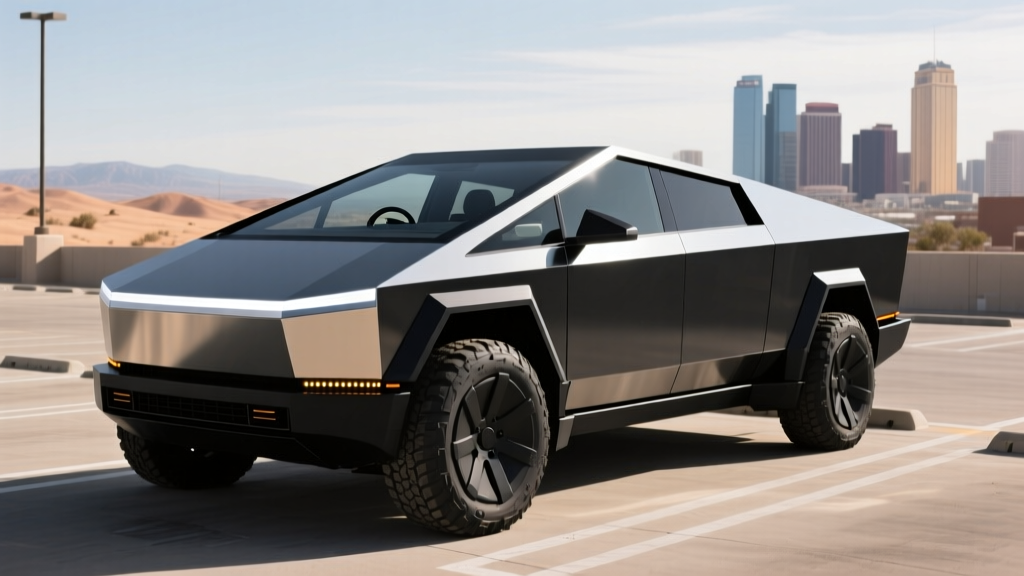
When the Las Vegas Metropolitan Police Department (LVMPD) began evaluating the Tesla Cybertruck for community liaison and light patrol duties, it triggered a wave of national interest. The image of an angular stainless-steel EV pickup in police livery cruising the Strip is undeniably attention-grabbing — but beyond the optics, the question that matters to fleet managers, EV watchers, and prospective buyers is whether the Cybertruck actually holds up under the demands of real-world duty use.
This review profiles the 2026 Tesla Cybertruck — specifically the dual-motor AWD and tri-motor Cyberbeast trims most relevant to fleet and patrol applications — with an eye toward the exact metrics that determine viability: EPA range versus real-world expectations, DC fast-charging speed, durability under high-idle and high-mileage conditions, and total cost of ownership compared to the gas-powered interceptors it aims to replace.
Range, Battery, and Efficiency: What Patrol Driving Actually Demands
The 2026 Cybertruck is offered in two primary configurations. The dual-motor AWD variant carries an EPA-estimated 340 miles of range, while the tri-motor Cyberbeast is rated at approximately 320 miles. Both draw from a structural battery pack using a 4680-format cell architecture with an NMC (nickel manganese cobalt) chemistry — chosen for energy density and power delivery rather than the cycle-life longevity of LFP.
EPA estimates assume mixed driving at moderate temperatures. In Las Vegas summer heat — where ambient temperatures routinely exceed 110°F — expect cabin cooling and battery thermal management to reduce effective range by 10–15%. Highway patrol speeds (75–85 mph sustained) further cut efficiency. Real-world patrol-range expectation: 250–290 miles depending on climate load and driving profile. Cold-weather markets should plan for 20–30% range loss in winter.
| Specification | Dual-Motor AWD | Cyberbeast (Tri-Motor) |
|---|---|---|
| EPA Range | 340 mi | 320 mi |
| Battery (usable, est.) | ~123 kWh (NMC, 4680) | ~123 kWh (NMC, 4680) |
| Efficiency | ~48 MPGe / 70 kWh/100mi | ~44 MPGe / 76 kWh/100mi |
| 0–60 mph | 4.1 sec | 2.6 sec |
| Horsepower | 600 hp | 845 hp |
| Drivetrain | Dual-motor AWD | Tri-motor AWD |
| Max DC Fast Charge | 250 kW (V3 Supercharger) | 250 kW (V3 Supercharger) |
| 10–80% DC Charge | ~22 min (peak conditions) | ~22 min (peak conditions) |
| Level 2 Home Charging | 11.5 kW (~37 mi/hr) | 11.5 kW (~37 mi/hr) |
| Towing Capacity | 11,000 lbs | 11,000 lbs |
| Cargo Bed Length | 6 ft (72 in) | 6 ft (72 in) |
| Cargo Volume (bed + frunk) | ~67 cu ft bed / ~7 cu ft frunk | ~67 cu ft bed / ~7 cu ft frunk |
| Base MSRP | $79,990 | $99,990 |
| Battery/Drive Unit Warranty | 8 yr / 120,000 mi | 8 yr / 120,000 mi |
For context on efficiency, the Cybertruck's 70 kWh/100mi figure is high compared to a sedan like the Model 3 (24–27 kWh/100mi) but competitive within the full-size electric truck segment. The Ford F-150 Lightning Extended Range, for example, operates at roughly 66–70 kWh/100mi. (fueleconomy.gov)
Charging Speed: Can a Patrol Fleet Keep Up?
Fleet viability hinges on charging turnaround. The Cybertruck supports a peak DC fast-charge rate of 250 kW on Tesla V3 Superchargers, achieving a 10–80% charge in approximately 22 minutes under ideal conditions — meaning battery preconditioning is active and the cell temperature is within the optimal window.
| Charge Level | Power (kW) | Approx. Miles Added per Hour | Typical Use Case |
|---|---|---|---|
| Level 1 (120V) | ~1.4 kW | ~4 mi/hr | Emergency / trickle only |
| Level 2 (240V / 48A) | 11.5 kW | ~37 mi/hr | Depot overnight charging |
| DC Fast (V3 Supercharger) | 250 kW peak | ~130 mi in 15 min | Mid-shift top-up |
The charge curve matters here. The Cybertruck, like most large-pack NMC vehicles, sustains peak charge rate only up to roughly 50–55% SoC before tapering. A 10–80% session averages closer to 150–170 kW sustained, not the headline 250 kW. For fleet depots installing Level 2 infrastructure, a full 0–100% charge takes approximately 11–12 hours — well-suited to overnight rotation schedules but requiring dedicated 60A circuits per vehicle.
Tesla's NACS connector is now the industry standard adopted by most major automakers through 2025–2026, meaning future public-charging access for the Cybertruck will only improve as Ford, GM, Rivian, and others transition their fleets to Supercharger compatibility.
Performance and Capability: More Than a Showpiece
The dual-motor Cybertruck's 4.1-second 0–60 mph time and 600 hp output place it well ahead of any traditional police interceptor on acceleration — a relevant metric for pursuit scenarios, though most departments emphasize de-escalation and policy over raw speed. The Cyberbeast's 2.6-second run is supercar territory and largely irrelevant to patrol duty, but it signals the powertrain's headroom.
More operationally useful is the 11,000-pound towing capacity and the 6-foot bed with a powered tonneau cover rated to 300 pounds of distributed load. For community liaison roles — towing trailers to events, hauling equipment to outreach sites, transporting barricades — the Cybertruck offers genuine utility beyond passenger sedans and SUVs.
The steer-by-wire system and 4-wheel steering give the Cybertruck a surprisingly tight 34-foot turning circle, narrower than many midsize SUVs. In urban patrol environments, this translates to easy U-turns and maneuverability in tight precinct lots.
Pricing, Tax Credits, and Fleet Economics
At a base MSRP of $79,990 for the dual-motor AWD and $99,990 for the Cyberbeast, the Cybertruck is not a budget fleet vehicle. However, the economics shift when evaluated on a total-cost-of-ownership (TCO) basis against gas-powered alternatives like the Ford Explorer Police Interceptor or Dodge Charger Pursuit.
As of 2026, the §30D Clean Vehicle Credit offers up to $7,500 for qualifying new EVs. However, eligibility depends on:
- MSRP Cap: Pickup trucks must have an MSRP at or below $80,000 — meaning the dual-motor AWD at $79,990 qualifies, but the Cyberbeast at $99,990 does not.
- Buyer Income Limits: AGI must not exceed $150,000 (single), $225,000 (head of household), or $300,000 (joint). Fleet purchases by government entities or tax-exempt organizations may qualify under the separate §45W commercial clean vehicle credit instead.
- Battery Sourcing: Critical minerals and battery component requirements phase in annually. Verify current-year compliance at irs.gov.
- Point-of-Sale Transfer: Buyers can transfer the credit to the dealer at purchase, reducing the upfront price directly.
For government fleet purchases (like LVMPD), the §45W credit of up to $7,500 per vehicle applies to tax-exempt entities — a critical distinction from the consumer §30D credit. Consult a municipal tax advisor for current eligibility. (irs.gov §45W)
On a per-mile energy-cost basis, the Cybertruck charging at depot rates (~$0.12/kWh) costs approximately $0.084/mile in electricity, compared to $0.18–$0.22/mile for a gas interceptor averaging 14–16 mpg at $3.20/gallon. Over a 100,000-mile service life, that's a fuel savings of roughly $10,000–$14,000 per vehicle — meaningful at fleet scale, though it only partially offsets the higher acquisition cost.
Interior, Tech, and Officer Experience
The Cybertruck's cabin is minimalist in the extreme: an 18.5-inch central touchscreen handles all infotainment, climate, and vehicle controls. There is no traditional instrument cluster; all driver information is projected on the main screen. For police upfitting, this presents both opportunity (large, configurable display for CAD/AVL integration) and challenge (no physical knobs for gloved operation, reliance on touchscreen for critical functions).
Tesla's Autopilot suite is standard, providing adaptive cruise control, lane centering, and automatic emergency braking. This is an SAE Level 2 driver-assistance system — the driver must remain fully engaged at all times. It is not autonomous driving. Enhanced Autopilot and Full Self-Driving (Supervised) are available as add-ons but do not change the driver-responsibility requirement.
Tesla Autopilot and FSD (Supervised) are SAE Level 2 systems. They require continuous driver supervision and do not constitute self-driving. In patrol scenarios, officers must maintain manual control — particularly in emergency-response situations where traffic-law exemptions apply and ADAS systems may conflict with required driving behavior.
Cabin space is adequate for two front occupants but the rear seat is tighter than a full-size truck like the F-150. Rear legroom measures approximately 34.5 inches — sufficient for occasional passengers but not ideal for prisoner transport, which typically requires dedicated cage-equipped sedans or SUVs anyway.
Who the Cybertruck Suits — And Who Should Look Elsewhere
Best suited for: Community liaison and public-relations roles; light utility patrol in warm climates; departments with depot-charging infrastructure and overnight rotation schedules; fleets seeking high-visibility community engagement vehicles.
Less suited for: High-speed pursuit roles (weight and tire wear are concerns); rural agencies without reliable DC fast-charging access; departments needing rear-seat prisoner transport; cold-climate fleets where range degradation compounds operational risk.
- 340-mile EPA range covers most single-shift patrol needs
- 250 kW DC fast charging enables mid-shift top-up
- Low per-mile energy cost vs. gas interceptors
- High-visibility community engagement value
- 11,000-lb towing, 6-ft bed for utility tasks
- 4-wheel steering for tight urban maneuverability
- 8-year/120,000-mile battery warranty
- $79,990+ acquisition cost exceeds gas interceptors by 2–3×
- Stainless steel body complicates collision repair and upfitting
- Touchscreen-only controls problematic for gloved/tactical use
- Real-world range drops 15–30% under extreme heat or cold
- No dedicated police upfit package from Tesla (as of 2026)
- Rear seat impractical for detainee transport
- Weight (~6,700 lbs) increases tire wear and braking distance
The Verdict: A Niche Patrol Tool, Not a Universal Replacement
The Las Vegas police Cybertruck experiment is best understood as a pilot program evaluating EV viability in specific, limited patrol roles — not a wholesale fleet transition. For community outreach, event presence, and light utility duty in a warm climate with depot charging, the Cybertruck's range, charging speed, and operating economics make a credible case. For agencies needing a pursuit-rated, all-weather, prisoner-capable interceptor, the F-150 Lightning (with its available police upfit packages from recognized upfitters) or a PHEV option remains the more pragmatic choice.
For civilian buyers watching the LVMPD pilot, the takeaway is that the Cybertruck's durability and operational cost advantages are real — but so are its limitations. If your use case aligns with its strengths (warm climate, home charging access, utility needs, high-visibility presence), it's a compelling electric truck. If you need back-seat practicality, easy repairability, or cold-weather range certainty, cross-shop the Rivian R1T and Ford F-150 Lightning carefully before committing.
Frequently Asked Questions
What is the real-world range of the Cybertruck in Las Vegas heat?
The EPA estimates 340 miles for the dual-motor AWD. In sustained Las Vegas summer heat above 110°F with cabin cooling active, expect 250–290 miles of usable range depending on driving profile. Highway-speed driving reduces range further compared to stop-and-go urban patrol routes where regenerative braking recovers energy.
How fast does the Cybertruck charge at a Supercharger?
The Cybertruck peaks at 250 kW on a V3 Supercharger, achieving a 10–80% charge in approximately 22 minutes under ideal (preconditioned) conditions. Sustained average rate is closer to 150–170 kW due to charge-curve taper above 55% SoC. Always precondition the battery via the vehicle's navigation routing to a Supercharger for optimal speed.
Does the Cybertruck qualify for the federal EV tax credit?
The dual-motor AWD at $79,990 MSRP falls under the §30D truck MSRP cap of $80,000 and may qualify for up to $7,500 if buyer income and battery-sourcing requirements are met. The Cyberbeast at $99,990 exceeds the cap and does not qualify under §30D. Government fleet purchases may qualify under the separate §45W commercial credit. Verify current rules at irs.gov.
Is the Cybertruck worth buying over the F-150 Lightning or Rivian R1T?
The Cybertruck leads on range (340 mi vs. Lightning's 320 mi Extended Range) and charging speed (250 kW vs. Lightning's 150 kW). The F-150 Lightning offers a more conventional interior, established police upfitter support, and a lower starting price (~$55,000 for the standard-range fleet trim). The Rivian R1T offers superior interior quality and a quad-motor option but at a higher price point and with a smaller service network. Choose the Cybertruck if range, charging speed, and Tesla's Supercharger network are priorities; choose the Lightning for fleet upfitting familiarity and lower acquisition cost.
What is the Cybertruck's battery warranty?
Tesla covers the Cybertruck battery and drive units for 8 years or 120,000 miles, whichever comes first, with a minimum 70% capacity retention threshold. This is competitive with the F-150 Lightning's 8-year/100,000-mile battery warranty and slightly more generous on mileage. (tesla.com/support)