Why the Las Vegas Cybertruck Police Program Has Everyone Talking
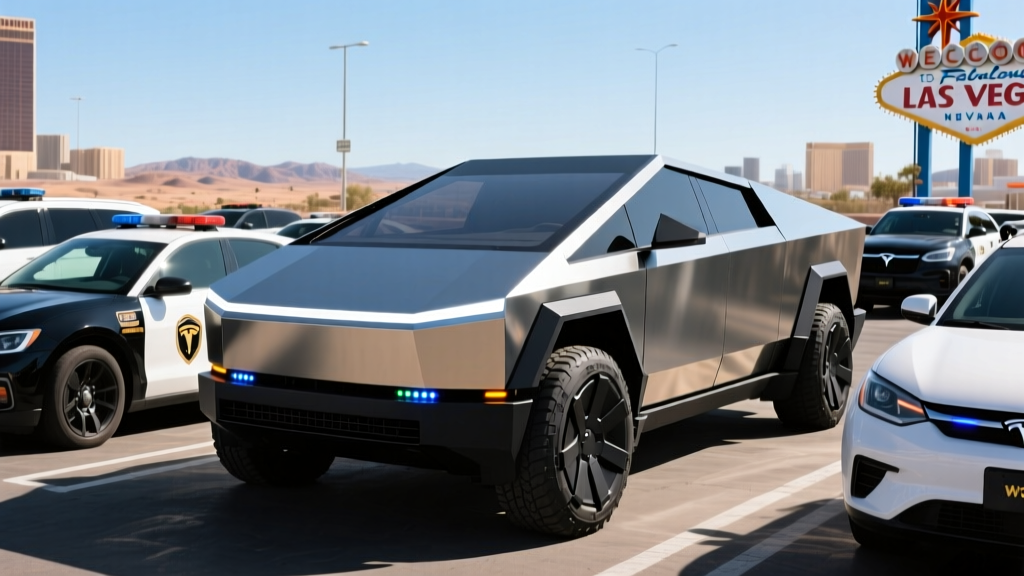
When the Las Vegas Metropolitan Police Department (LVMPD) began evaluating the Tesla Cybertruck for fleet and community-policing roles, it triggered a wave of searches about whether an electric pickup can survive the rigors of law enforcement in the Mojave Desert. The Las Vegas Cybertruck police pilot isn't a full fleet replacement — it's a high-visibility evaluation of EV viability for specialized duty, from community outreach to light pursuit support and mobile command presence.
But the questions LVMPD is asking are the same ones any truck buyer should ask: What's the real range when you're driving hard in 110°F heat? How fast does it charge between shifts? Does the tax credit actually apply to a vehicle this expensive? Below, we break down the Cybertruck AWD (the variant most relevant to fleet and consumer buyers alike) with the exact numbers that matter.
Range & Efficiency: EPA Sticker vs. Desert Reality
Real-World Expectation: ~250–275 miles highway at 70+ mph; expect 20–30% range loss in sustained 100°F+ Las Vegas summer heat with aggressive driving and A/C load. Fleet/pursuit-style driving can cut range to under 200 miles per charge.
The Cybertruck AWD carries an EPA-estimated 318 miles of range on a full charge, per fueleconomy.gov. That's the dual-motor all-wheel-drive variant with the standard battery pack. The rear-wheel-drive model, when available, targets a lower price point but has been delayed repeatedly.
Efficiency lands at approximately 73 MPGe combined, translating to roughly 46 kWh per 100 miles — not class-leading for an EV, but competitive for a 6,800+ lb stainless-steel pickup. The angular exoskeleton design creates meaningful aerodynamic drag at highway speeds, which is why real-world highway range drops noticeably compared to the EPA combined figure.
For Las Vegas police use, the thermal picture matters enormously. Battery cooling systems work overtime in desert heat, and aggressive acceleration (as pursuit or rapid-response scenarios demand) draws substantially more current. Fleet managers should plan for 180–220 miles of usable range under demanding patrol conditions before needing a charge.
Battery, Chemistry & Powertrain Specs
| Specification | Cybertruck AWD |
|---|---|
| Battery Capacity (usable) | ~123 kWh |
| Chemistry | NMC (Nickel Manganese Cobalt) |
| Drivetrain | Dual-Motor AWD |
| Horsepower | 600 hp |
| 0–60 mph | 4.1 seconds |
| EPA Range | 318 miles |
| Efficiency | 73 MPGe / 46 kWh/100mi |
| Towing Capacity | 11,000 lbs |
| Payload | 2,500 lbs |
| Bed Length | 6 ft (72 in) |
| Cargo Volume (bed + frunk) | ~67 cu ft bed + ~7 cu ft frunk |
| Ground Clearance | Up to 17.4 in (adaptive air suspension) |
Tesla has not published the exact usable kWh figure, but teardown analyses and charging data place the Cybertruck's usable battery capacity at approximately 123 kWh using NMC chemistry. This is important for longevity: NMC cells offer higher energy density than LFP (lithium iron phosphate) but are more sensitive to sustained 100% state-of-charge storage and extreme heat — both factors in a Las Vegas fleet environment.
The dual-motor AWD setup delivers 600 horsepower and a 4.1-second 0–60 mph time. That acceleration capability is relevant for police applications where rapid response matters, though the Cybertruck's 6,800+ lb curb weight means braking distances are longer than a purpose-built pursuit sedan like the retired Dodge Charger Pursuit.
Charging Speed: DC Fast, Level 2 & Fleet Implications
| Charging Level | Max Power | Speed / Time |
|---|---|---|
| DC Fast Charge (NACS) | ~250 kW peak | 10–80% in ~30 minutes |
| Level 2 Home (48A / 11.5 kW) | 11.5 kW | ~30 miles of range per hour; full charge in ~12 hours |
| Level 1 (120V) | ~1.4 kW | ~3–4 miles per hour (not practical for daily use) |
The Cybertruck uses the NACS (North American Charging Standard) connector native to Tesla's Supercharger network. Peak DC fast-charging reaches approximately 250 kW, though the massive 123 kWh battery means the 10–80% session takes roughly 30 minutes — longer than smaller-battery EVs like the Model Y (~15 min) because there's simply more energy to push.
The charging curve tapers significantly above 80% state of charge. For fleet operations, this means charging to 80% is the sweet spot for turnaround time. Pushing from 80% to 100% can add another 25–35 minutes. Police fleet managers in Las Vegas would need to install depot-level DC fast chargers or rely on Supercharger proximity for between-shift top-ups.
For home or precinct Level 2 charging, the onboard charger accepts up to 11.5 kW (48 amps on a 60-amp circuit). A full charge from empty takes about 12 hours — feasible for overnight charging but tight for multi-shift fleet rotations.
Pricing, Trims & Federal Tax Credit Eligibility
| Trim | Base MSRP | Federal §30D Credit | Effective Price |
|---|---|---|---|
| AWD | $79,990 | $0 (exceeds MSRP cap) | $79,990 |
| Cyberbeast (Tri-Motor) | $99,990 | $0 (exceeds MSRP cap) | $99,990 |
| RWD (announced, not yet available) | ~$60,990 (est.) | Potentially eligible* | TBD |
*The RWD Cybertruck has been announced but is not currently available for purchase. Specs and pricing are preliminary.
This is where the Cybertruck hits a wall for tax-credit seekers. Under current IRS §30D rules, the federal clean vehicle credit caps eligible trucks at an MSRP of $80,000. The Cybertruck AWD at $79,990 squeaks under the cap — but destination charges, options, and any dealer additions can push the total above $80,000, disqualifying it. The Cyberbeast at $99,990 is firmly ineligible.
Additionally, buyers must meet income caps ($150,000 single / $300,000 joint filers) and the vehicle must satisfy critical-mineral and battery-component sourcing requirements, which have tightened progressively through 2025 and 2026. The point-of-sale transfer option allows eligible buyers to apply the credit as a down-payment reduction at the dealer, but only if all criteria are met at the time of purchase.
For the Las Vegas Cybertruck police evaluation, fleet purchases are generally exempt from the consumer §30D credit structure. Municipal fleets may qualify under the separate §45W commercial clean vehicle credit (up to $7,500 for vehicles under 14,000 lbs GVWR), which has different sourcing and domestic-content requirements. Fleet procurement officers should consult IRS guidance on §45W directly.
Interior, Tech & Police-Specific Considerations
The Cybertruck's interior is minimalist by design — a single 18.5-inch front touchscreen handles navigation, climate, cameras, and vehicle settings. Rear passengers get a 9.4-inch touchscreen. There is no traditional instrument cluster; all driving information routes through the main display.
For police use, this presents integration challenges. Standard law enforcement equipment — light bars, sirens, prisoner partitions, weapon racks, mobile data terminals (MDTs), and radio systems — requires aftermarket upfitting that Tesla does not offer from the factory. Third-party upfitters like Setina and Whelen have begun developing Cybertruck-compatible packages, but the stainless-steel exoskeleton and unconventional roofline complicate traditional mounting solutions.
The Cybertruck's steer-by-wire system (no mechanical connection between the yoke and the wheels) is a first for a production vehicle at this scale. It enables variable steering ratios — less turning of the yoke at low speeds, more at highway speeds — but it also means that a complete electrical failure would eliminate steering, a concern for any safety-critical application. Tesla includes redundant power and control systems to mitigate this risk.
Autopilot, Tesla's Level 2 driver-assistance system, is standard. Full Self-Driving (Supervised) is an optional $8,000 add-on or $99/month subscription. Neither system makes the Cybertruck autonomous — the driver must remain fully engaged at all times. This is an SAE Level 2 system, meaning hands-on-wheel (or hands-on-yoke) supervision is mandatory.
Warranty & Long-Term Ownership Costs
Tesla covers the Cybertruck with a 4-year/50,000-mile limited vehicle warranty and an 8-year/120,000-mile battery and drive unit warranty. The battery warranty guarantees a minimum of 70% capacity retention over the coverage period. If degradation drops below that threshold within 8 years or 120,000 miles, Tesla will repair or replace the pack.
For police fleet duty, the 120,000-mile battery warranty is a relevant benchmark. Patrol vehicles typically accumulate 20,000–30,000 miles per year, meaning the battery warranty covers roughly 4–6 years of active service. Replacement costs for a Cybertruck battery pack are not yet publicly listed by Tesla, but based on Model S/X precedent and the pack's ~123 kWh size, an out-of-warranty replacement could range from $18,000 to $28,000.
Tesla's Supercharger network remains the most reliable public DC fast-charging infrastructure in the U.S., which is a meaningful advantage for any fleet or individual owner who needs dependable charging on the road. However, reliance on a single manufacturer's proprietary network (now opening to other brands via NACS adapters) is a strategic consideration for fleet planners.
Who Should Buy the Cybertruck — And Who Shouldn't
- 600 hp dual-motor AWD with 4.1-sec 0–60
- 318-mile EPA range (class-competitive for electric trucks)
- 11,000-lb towing capacity
- Stainless-steel exoskeleton resists dents and corrosion
- Access to Tesla Supercharger network (20,000+ stalls)
- Adaptive air suspension with up to 17.4" ground clearance
- Steer-by-wire enables tight low-speed maneuvering
- $79,990+ MSRP makes §30D tax credit eligibility precarious
- 30-min 10–80% DC charge is slow vs. smaller-battery EVs
- Steer-by-wire is unproven at fleet/police scale
- Aftermarket police upfitting ecosystem still immature
- Visibility compromised by angular design and small rear window
- Bed access limited by motorized tonneau cover design
- NMC battery degrades faster in sustained desert heat vs. LFP
Best for: Tech-forward buyers who want a statement electric truck with genuine performance and towing capability, and who have reliable home or depot charging. For police fleets, it works best as a community-outreach or command-presence vehicle rather than a primary pursuit unit.
Skip it if: You need a proven, upfitter-friendly police platform; you want the lowest cost-per-mile fleet vehicle; or you need guaranteed federal tax credit eligibility without MSRP-cap risk.
Frequently Asked Questions
What is the real-world range of the Cybertruck in Las Vegas heat?
In sustained 100°F+ temperatures with aggressive driving and heavy A/C use, expect 20–30% below the 318-mile EPA estimate — roughly 220–250 miles. Highway cruising at 75 mph in moderate temperatures yields closer to 270 miles.
How fast does the Cybertruck charge at a Supercharger?
Peak DC fast-charging reaches ~250 kW on a V3 or V4 Supercharger, achieving a 10–80% charge in approximately 30 minutes. Charging slows substantially above 80% SoC.
Does the Cybertruck qualify for the $7,500 federal EV tax credit?
The AWD trim at $79,990 base MSRP is at the very edge of the §30D truck MSRP cap of $80,000. Any options, destination fees, or dealer add-ons that push the total above $80,000 will disqualify it. The Cyberbeast at $99,990 does not qualify. Always verify current-year rules at IRS.gov.
Is the Las Vegas Cybertruck police program a full fleet deployment?
No. As of 2026, LVMPD has been evaluating the Cybertruck in limited community-policing and demonstration roles. It is not a replacement for purpose-built pursuit vehicles. The stainless-steel body, steer-by-wire system, and lack of established police upfitting packages make full fleet adoption unlikely in the near term.
How does the Cybertruck compare to the Ford F-150 Lightning for fleet use?
The F-150 Lightning offers a more established police/fleet upfitting ecosystem, a lower starting price (~$55,000 for Pro trim), and easier §30D credit eligibility. The Cybertruck offers more range (318 vs. ~230–320 depending on Lightning battery option), faster acceleration, and Supercharger network access. For traditional fleet duty, the Lightning remains the more practical choice in 2026.
What is the Cybertruck's battery warranty?
Tesla provides an 8-year/120,000-mile battery and drive unit warranty with a minimum 70% capacity retention guarantee.