Quick Answer: What Is the Kindred Chevy 3100 EV?
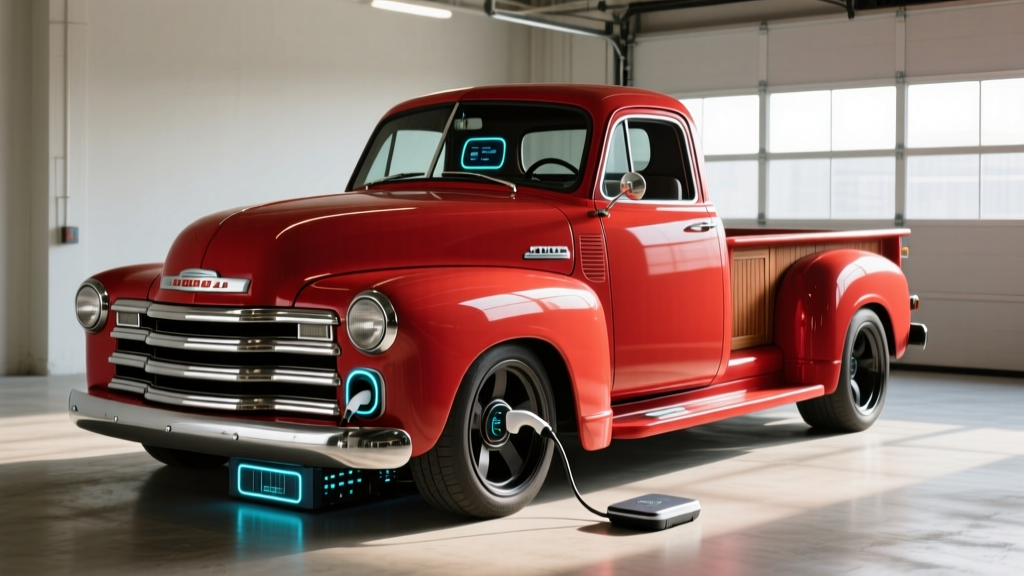
The Kindred Chevy 3100 EV is a restomod electric conversion of the 1947–1955 Chevrolet Advance Design 3100 pickup, performed by Kindred Motorworks (formerly Icon 4x4) in California. Rather than a factory production EV, it's a coach-built classic truck fitted with a modern electric powertrain, lithium-ion battery pack, and upgraded chassis. Pricing starts around $175,000 and can exceed $225,000 depending on spec. Expect roughly 150–200 miles of range, DC fast charging capability, and a 0–60 mph time in the 4–6 second range. Each build is commissioned individually with a lead time of approximately 12–18 months.
What Kindred Motorworks Actually Builds
Kindred Motorworks, based in San Carlos, California, specializes in electrified restomods — taking vintage vehicles and replacing their aging internal-combustion drivetrains with modern EV components while restoring or upgrading the body, interior, and chassis. The Chevy 3100 Advance Design is one of their flagship platforms.
The conversion process involves:
- Full body-off restoration of a donor 1947–1955 Chevy 3100 truck
- Electric motor swap — typically a single or dual-motor setup producing between 200 and 400+ horsepower, depending on the commissioned configuration
- Lithium-ion battery pack — generally in the 40–70 kWh usable range, sourced from proven OEM modules (often recycled Tesla or similar NMC cells)
- Modern suspension, brakes, and steering upgrades to handle the additional weight and torque
- Custom interior with modern amenities — air conditioning, power windows, updated gauges, Bluetooth audio — while preserving the classic aesthetic
Every Kindred Chevy 3100 EV is essentially a bespoke commission. Buyers select paint, interior materials, motor output, battery size, and optional features during the specification process. This means specs vary build-to-build, and the figures below represent the most common configurations Kindred has publicly detailed.
Range, Battery, and Charging Specs
Because this is a coach-built conversion rather than a mass-production vehicle, the Kindred Chevy 3100 EV does not carry an official EPA range rating. However, based on Kindred's published build specifications and real-world owner reports from similar restomod EVs, here's what to expect:
| Specification | Typical Build Configuration |
|---|---|
| Battery Chemistry | NMC (Nickel Manganese Cobalt) lithium-ion modules |
| Battery Capacity (Usable) | ~50–70 kWh (varies by commission) |
| Estimated Real-World Range | 150–200 miles (combined city/highway) |
| Motor Output | 200–400+ HP (single or dual motor options) |
| 0–60 mph | ~4–6 seconds (depending on motor config) |
| Level 2 AC Charging | ~7–11 kW onboard charger |
| DC Fast Charging | Available on select builds (CCS or NACS, ~50–100 kW peak) |
| 10–80% DC Charge Time | ~35–60 minutes (varies by charger and pack size) |
| Thermal Management | Active liquid cooling on most builds |
| Regenerative Braking | Adjustable, multi-mode |
Real-World Range Reality Check
Without EPA certification, the 150–200 mile estimate is based on the battery capacity, vehicle weight (typically 4,000–4,800 lbs after conversion), and the aerodynamic profile of a 1950s pickup. Highway driving at 70+ mph will reduce range significantly — expect 120–150 miles in sustained highway use. Cold weather (below 40°F) can reduce range by an additional 15–25%, as the battery must use energy for thermal management and the cabin heater draws from the traction pack.
Most Kindred 3100 EV builds are equipped with Level 2 (240V AC) charging as standard, using a J1772 or NACS connector. DC fast charging is an available upgrade on newer commissions, though the charge rate is limited by the pack size and BMS configuration — don't expect the 250 kW speeds of a modern Tesla or Hyundai Ioniq 5. For a truck this size and battery capacity, a 50–100 kW peak DC charge rate is appropriate and keeps cell stress manageable.
EV Conversion vs. Gas-Powered Classic: Cost & Ownership Comparison
The fundamental question for a prospective Kindred Chevy 3100 EV buyer is whether electrification makes sense compared to a traditionally restored gas-powered 3100 — or simply keeping a modern daily driver. Here's a data-driven breakdown:
| Factor | Kindred 3100 EV Conversion | Gas-Restored Chevy 3100 (Original I6/V8) |
|---|---|---|
| Build/Purchase Cost | $175,000–$225,000+ | $60,000–$130,000 (full restoration) |
| Fuel/Energy Cost per Mile | ~$0.04–$0.06/mile (home charging, $0.13/kWh avg) | ~$0.22–$0.30/mile (13–16 MPG, $3.50/gal) |
| Annual Maintenance | ~$300–$600 (tires, cabin filter, fluid top-offs) | ~$1,200–$2,500 (tune-ups, carb rebuilds, gaskets, exhaust) |
| Oil Changes | None | 2–4 per year ($50–$80 each) |
| Emissions/Smog | Exempt (zero tailpipe emissions) | Varies by state; classic exemptions may apply |
| Reliability (Daily Use) | High — electric drivetrains have far fewer failure points | Low to moderate — vintage carbureted engines require frequent attention |
| Driving Experience | Silent, instant torque, smooth, one-pedal capable | Raw, mechanical, noisy, manual choke and warm-up |
| Resale/Collector Value | Emerging market; niche buyer pool | Established collector market; broader demand |
5-Year Operating Cost Snapshot (10,000 Miles/Year)
| Cost Category | Kindred 3100 EV | Gas-Restored 3100 |
|---|---|---|
| Energy/Fuel (5 years) | $2,000–$3,000 | $11,000–$15,000 |
| Maintenance (5 years) | $1,500–$3,000 | $6,000–$12,500 |
| Insurance (est. annual) | $2,500–$4,500/yr (agreed-value collector policy) | $1,800–$3,500/yr (agreed-value collector policy) |
| Total 5-Year Operating | ~$16,000–$25,500 | ~$26,000–$45,000 |
Note: Neither figure includes the initial purchase/build cost. Insurance for EV restomods tends to be higher due to the agreed replacement value of the electric components. Obtain quotes from collector-car insurers like Hagerty or Grundy before committing.
Federal Tax Credits and Incentives: What Applies?
This is where the Kindred Chevy 3100 EV differs sharply from a new production electric vehicle. Under current IRS §30D rules, the federal clean vehicle credit of up to $7,500 applies only to new qualifying vehicles purchased from a manufacturer. Because the Kindred 3100 EV is a coach-built conversion of a vintage vehicle — not a new car sold through a franchised dealer — it does not qualify for the §30D new-vehicle credit.
However, there are other potential incentives:
- Used EV Credit (§25E): Up to $4,000 or 30% of the sale price (whichever is less) for qualifying used EVs. This requires the vehicle to be sold through a dealer, priced under $25,000, and meet buyer income caps. A Kindred 3100 EV will far exceed the $25,000 price cap, making this credit inapplicable.
- State and Local Incentives: Some states offer rebates or tax credits for EV conversions or custom electric vehicles. California's CEC and certain air-district programs have historically offered conversion incentives. Check your state's energy office for current programs.
- Utility Rebates: Many utilities offer rebates for Level 2 home charger installation ($250–$1,000), which applies regardless of the EV you drive.
- Commercial EV Conversion Credit: If the truck is used for business purposes, different credits under §45W (commercial clean vehicle) may apply — consult a tax professional.
Real-World Ownership: What First-Time EV Buyers Must Know
Buying a Kindred Chevy 3100 EV is not like picking up a Tesla Model Y from a delivery center. Here are the practical ownership considerations that will define your experience:
Home Charging Is Essential
With a 50–70 kWh battery and an estimated 3–4 miles per kWh efficiency, you'll consume roughly 15–20 kWh per 60 miles of driving. A standard 120V household outlet (Level 1) adds only about 3–5 miles of range per hour — inadequate for anything beyond occasional top-ups. You will need a Level 2 home charger (240V, 32–48 amps) to fully replenish the pack overnight. Budget $800–$2,500 for a quality Level 2 unit (ChargePoint Home Flex, Emporia Vue, or similar) plus $500–$2,000 for professional electrical installation, depending on whether your panel needs a service upgrade to support a 50-amp circuit.
Public Charging Limitations
If your Kindred build includes DC fast charging, you can use networks like Electrify America, EVgo, or Tesla Superchargers (with NACS connector). However, the 50–100 kW peak rate means a 10–80% session will take 35–60 minutes — longer than modern production EVs with larger thermal budgets. Plan road trips around charging stops, and understand that the 150–200 mile range makes this a local and regional driver, not a cross-country tourer.
Climate and Storage
NMC lithium-ion batteries perform best between 60–80°F. If you live in a region with harsh winters (sustained temps below 20°F), expect 15–25% range loss and longer charge times unless the truck is garage-kept and preconditioned. In hot climates (Arizona, Texas summers), battery longevity depends on active thermal management — confirm with Kindred that your build includes liquid cooling for both the pack and motor. Garage parking with a Level 2 charger is strongly recommended to enable scheduled preconditioning.
Service and Support
Kindred Motorworks provides build support and can service their conversions, but they are a small shop in Northern California. If you live elsewhere, you'll need to identify a local EV-savvy mechanic or ship the truck back to Kindred for major service. The electric drivetrain components (motor, inverter, BMS) are typically sourced from established suppliers, which helps with parts availability, but the integration is proprietary. Factor in limited service infrastructure compared to any mainstream EV brand.
Common Misconceptions About EV Conversions
| Myth | Fact |
|---|---|
| "EV conversions are unreliable because they're home-brewed." | Professional conversions from shops like Kindred use OEM-grade battery modules, proven motor/inverter packages, and engineered BMS systems. Reliability is typically higher than the original 70-year-old drivetrain. |
| "The battery will need replacement in 5 years." | NMC modules from reputable sources (Tesla, LG, Samsung SDI) retain 80%+ capacity after 1,000–1,500 full charge cycles — equivalent to 150,000–250,000+ miles. Most conversion batteries outlast the owner's time with the vehicle. |
| "I can't take it on road trips." | You can, but with planning. A 150–200 mile range means DC fast charging every 2 hours on the highway. It's feasible for 300–400 mile day trips; multi-day cross-country drives require patience and route planning. |
| "Converting a classic destroys its value." | This depends on the vehicle and the quality of the work. For common, non-rare trucks like the Chevy 3100 (over 500,000 were produced), a high-quality EV conversion can actually increase value among younger collectors who want a usable, emissions-free classic. |
| "It qualifies for the $7,500 federal tax credit." | It does not. §30D applies to new production EVs only. The used-EV credit has a $25,000 price cap that a Kindred build far exceeds. |
Decision Framework: Is the Kindred Chevy 3100 EV Right for You?
Choose the Kindred Chevy 3100 EV if:
- You have a budget of $175,000–$225,000+ and view this as a collector vehicle / lifestyle purchase, not a cost-saving commuter
- You have garage access with a Level 2 charger (or can install one)
- Your typical driving is under 120 miles per day — local errands, weekend cruises, car shows, short commutes
- You want the aesthetic and soul of a 1950s Chevy truck with modern drivability, reliability, and zero tailpipe emissions
- You value bespoke craftsmanship and are comfortable with a 12–18 month build timeline
Consider an alternative if:
- You need a daily driver with 300+ mile range and fast DC charging for road trips — look at a Rivian R1T, Ford F-150 Lightning, or Tesla Cybertruck instead
- Your budget is under $80,000 — a traditional gas restoration of a 3100 or a used production EV will serve you better
- You live in an area with no access to EV service and no willingness to ship the vehicle for maintenance
- You want tax credit incentives — this vehicle does not qualify for federal EV credits
- You're buying purely as an investment — the EV restomod resale market is still emerging and less predictable than traditional collector-car values
How to Commission a Kindred Chevy 3100 EV
If the specs and ownership profile align with your goals, the commissioning process typically follows these steps:
- Initial Consultation: Contact Kindred Motorworks directly to discuss your vision, budget, and timeline.
- Donor Vehicle Sourcing: Kindred can source a suitable 1947–1955 Chevy 3100 donor, or you can provide your own. Condition of the donor cab and bed affects restoration cost.
- Specification and Design: Choose your motor output, battery capacity, paint color, interior materials, wheels, and optional features (power steering, AC, custom audio).
- Deposit and Build Queue: A build deposit (typically 20–30% of the estimated price) secures your spot. Build timelines run 12–18 months depending on shop capacity and spec complexity.
- Build Updates: Kindred provides progress photos and milestone updates throughout the restoration and conversion.
- Delivery and Orientation: Upon completion, you'll receive the truck with a full walkthrough of the EV systems, charging procedures, and maintenance schedule.
Frequently Asked Questions
How much does a Kindred Chevy 3100 EV cost?
Builds start around $175,000 and typically land between $185,000 and $225,000 depending on the level of restoration, motor configuration, battery size, and custom interior options. Highly optioned builds with dual motors, larger packs, and premium finishes can exceed $250,000.
What is the real-world range of the Kindred Chevy 3100 EV?
Most builds achieve 150–200 miles in mixed driving. Highway use at 70+ mph reduces this to approximately 120–150 miles. Cold weather (below 40°F) can shave another 15–25% off those figures. Range varies based on the commissioned battery size — a 70 kWh pack will obviously outperform a 50 kWh pack.
Does the Kindred Chevy 3100 EV qualify for any tax credits?
No. The vehicle does not qualify for the federal §30D new clean vehicle credit (it's not a new production vehicle) or the §25E used EV credit (the price far exceeds the $25,000 cap). Some state-level or utility-level incentives for EV conversions or home charger installation may apply. Consult a tax professional and your state energy office.
Can I fast-charge a Kindred 3100 EV on a road trip?
If your build includes the DC fast charging option, yes. Expect peak rates of 50–100 kW via CCS or NACS, meaning a 10–80% session takes roughly 35–60 minutes. This is adequate for road trips with planned stops, but significantly slower than modern production EVs capable of 200–350 kW peak charging.
How long will the battery last before needing replacement?
NMC lithium-ion modules from established manufacturers typically retain 80% or more of their original capacity after 1,000–1,500 full charge cycles. At an average of 175 miles per cycle, that's 175,000–260,000+ miles. Given that most Kindred 3100 EVs are driven 5,000–10,000 miles per year as collector/weekend vehicles, the battery should last 20+ years under normal use.
Is the Kindred Chevy 3100 EV practical as a daily driver?
It can be, if your daily round-trip commute is under 100 miles and you have reliable home charging. The truck drives smoothly, has modern brakes and suspension, and offers instant torque. However, it lacks modern safety features (airbags, crumple zones, ADAS), has limited range for spontaneous long drives, and carries collector-car insurance requirements. Most owners use it as a secondary or weekend vehicle.
What happens if something goes wrong with the EV system?
Kindred Motorworks supports their builds and can handle warranty and service work. However, they are a small shop based in Northern California. If you're outside the region, you'll need to either ship the truck to Kindred or find a local EV technician familiar with conversion systems. The motor and inverter are typically sourced from established suppliers, which aids in diagnostics and parts sourcing.