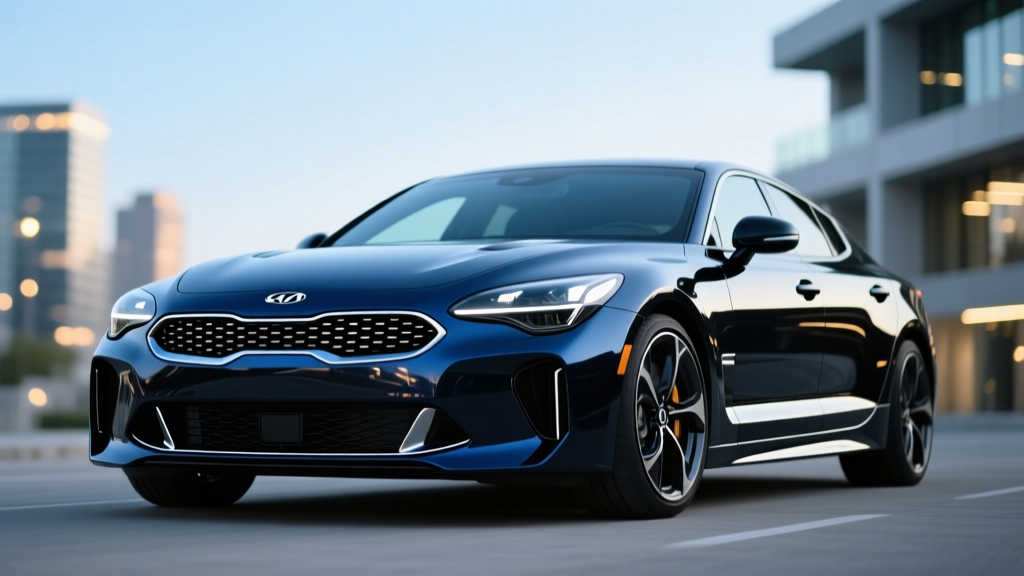
Quick Answer: Is There a Kia Stinger Electric?
As of early 2026, Kia has not officially confirmed a direct Kia Stinger electric successor. The original gas-powered Stinger was discontinued after the 2023 model year. However, Kia's parent company Hyundai Motor Group has signaled that a performance-oriented electric sedan is under development on the E-GMP (and potentially the next-generation eM) platform, which would serve as a spiritual replacement for the Stinger. If announced, expect a 300+ mile EPA range, 800V architecture for ultra-fast charging, and a starting price near $55,000. Until Kia makes a formal reveal, everything below is based on platform capabilities, trademark filings, and executive statements — not confirmed production specs.
Why the Stinger Went Away — and Why an Electric Version Makes Sense
The Kia Stinger carved out a unique niche: a rear-drive-biased, turbocharged sports sedan from a mainstream brand, competing against the BMW 4 Series Gran Coupe and Audi A5 Sportback at a fraction of the price. The 2023 Stinger GT packed a 3.3L twin-turbo V6 producing 368 hp and 376 lb-ft of torque, with a 0-60 mph time around 4.7 seconds and an EPA combined fuel economy of roughly 20 MPG.
Sales, however, never matched the enthusiasm of the car's fanbase. Kia moved approximately 12,000-15,000 units annually in the U.S. before pulling the plug — a fraction of what the Telluride or Sportage moves. The economics of a low-volume, rear-drive, internal-combustion sedan didn't survive Kia's pivot toward electrification and SUVs.
But the Stinger's role — halo performance car that elevates the brand's image — remains unfilled in Kia's EV lineup. The EV6 GT is fast (576 hp, 0-60 in 3.4 seconds), but it's a crossover. The EV9 is a three-row SUV. A low-slung electric sport sedan would fill the gap, and Hyundai Motor Group's platform architecture makes it feasible.
Platform and Powertrain: What E-GMP and eM Can Deliver
The current Hyundai Motor Group E-GMP platform underpins the Kia EV6, Hyundai Ioniq 5, and Genesis GV60. Key specs of this architecture relevant to a Stinger electric successor:
| Specification | Value |
|---|---|
| Battery options | 58 kWh (standard) / 77.4 kWh (long-range) / 84 kWh (EV6 GT) |
| Chemistry | NMC (nickel manganese cobalt) |
| Architecture voltage | 800V native (400V compatible) |
| Peak DC fast charge rate | Up to 240 kW (EV6 GT: 240 kW) |
| 10-80% DC fast charge time | ~18 minutes (under ideal conditions) |
| Drivetrain | RWD or AWD dual-motor |
| Max system output (EV6 GT AWD) | 576 hp / 545 lb-ft |
The next-generation eM platform, expected to debut in Hyundai Motor Group vehicles around 2026-2027, promises further improvements: integrated drive modules, potential for larger battery packs (up to ~100 kWh), and improved energy density. If a Kia Stinger electric arrives on eM, it could target a 350-400 mile EPA range with a dual-motor AWD performance variant pushing 600+ hp.
Projected Specs: A Stinger EV vs. the Old Gas Stinger
Since no official spec sheet exists, the following table is an informed projection based on the EV6 GT's known performance, the E-GMP/eM platform trajectory, and the Stinger's historical positioning as a more premium, longer-wheelbase sedan than the EV6.
| Specification | 2023 Stinger GT (Gas, Confirmed) | Stinger Electric (Projected) |
|---|---|---|
| Powertrain | 3.3L Twin-Turbo V6, 8-speed auto | Dual-motor AWD (est.) |
| Horsepower | 368 hp | 500-600 hp (est.) |
| 0-60 mph | ~4.7 sec | ~3.2-3.8 sec (est.) |
| EPA Range / Fuel Economy | 20 MPG combined | 300-380 mi EPA (est.) |
| Battery Capacity | N/A | 84-100 kWh (est.) |
| DC Fast Charge (10-80%) | N/A | ~18-22 min at 250+ kW (est.) |
| Cargo Space | 23.3 cu ft (hatchback) | ~18-22 cu ft (est., sedan trunk + frunk) |
| Base MSRP (at launch) | $53,005 (2023 GT) | ~$55,000-$65,000 (est.) |
A few notes on these projections. The Stinger's hatchback body style gave it class-leading cargo utility for a sport sedan. An electric successor could retain a liftback design, but battery packaging under the floor might raise the load floor slightly. The frunk (front trunk) would offset some of that loss, adding roughly 2-3 cu ft of enclosed storage.
Competitive Landscape: What a Stinger EV Would Face
The electric sport sedan segment is small but growing. A Kia Stinger electric would compete against:
- Tesla Model S — Starting around $75,000 in 2026, with up to 402 miles EPA range (Long Range) and 2.3-second 0-60 (Plaid). Aging platform, but still the benchmark.
- Hyundai Ioniq 6 — A corporate cousin with up to 361 miles EPA range, starting near $42,000. More efficiency-focused than performance-oriented.
- BMW i4 M50 — Starting around $68,000, 536 hp, 270 miles EPA. A premium alternative with traditional BMW driving dynamics.
- Porsche Taycan — Starting near $92,000, with up to 318 miles EPA (2025 refresh). The performance benchmark but at a steep premium.
- Genesis Electrified G80 — Starting around $80,000, 282 miles EPA. Luxury-focused, also on the Hyundai Motor Group platform.
A Kia-badged electric sport sedan priced in the $55,000-$65,000 range would undercut the Tesla Model S, BMW i4 M50, and Porsche Taycan significantly, while offering comparable or better straight-line performance thanks to dual-motor AWD. The key question is whether Kia's brand positioning can support a $60,000+ sedan — something the original Stinger struggled with at $53,000.
Real Costs: Buying and Owning a $60K Electric Sport Sedan
Let's model ownership costs assuming a Stinger electric arrives at a $58,000 base MSRP. This analysis compares it against a hypothetical gas sport sedan getting 22 MPG combined at $3.50/gallon.
| Category | Stinger Electric (Projected) | Gas Sport Sedan (Baseline) |
|---|---|---|
| Purchase Price (MSRP) | $58,000 | $48,000 |
| Federal Tax Credit (§30D) | Up to $7,500 (see eligibility below) | $0 |
| Effective Purchase Price | ~$50,500 | $48,000 |
| Fuel/Energy (5 yr, 60,000 mi) | ~$3,600 (home L2 at $0.14/kWh) | ~$9,545 (22 MPG, $3.50/gal) |
| Maintenance (5 yr) | ~$1,800 (tires, cabin filter, fluid top-offs) | ~$4,200 (oil, brakes, filters, plugs) |
| Insurance (5 yr avg) | ~$14,000 (EV performance sedan premium) | ~$11,000 |
| Estimated Depreciation (5 yr) | ~$22,000 (EV sedan depreciation steeper than SUV) | ~$20,000 |
| Total 5-Year Cost | ~$91,900 | ~$92,745 |
Sources: EPA fueleconomy.gov for efficiency data; insurance estimates based on industry averages for performance sedans. Actual costs vary by state, driving habits, and electricity rates.
The electric sedan roughly breaks even over five years despite a higher sticker price, primarily due to fuel savings (~$6,000) and lower maintenance (~$2,400). The higher insurance cost (~$3,000 more) partially offsets those gains. If you can charge at home with cheap overnight electricity (under $0.12/kWh in many states), the EV pulls ahead more decisively.
Federal Tax Credit Eligibility (§30D)
Under current IRS §30D rules, the $7,500 federal tax credit for new EVs has several requirements that a Stinger electric would need to meet:
- MSRP cap: Sedans must be under $55,000 MSRP. A $58,000 base Stinger EV would exceed this cap, potentially disqualifying it — unless Kia prices a base trim under $55K.
- Buyer income cap: Modified AGI must not exceed $150,000 (single) or $300,000 (joint).
- Battery sourcing: Critical minerals and battery components must meet phased-in domestic/free-trade-partner sourcing thresholds that tighten annually through 2029.
- Point-of-sale transfer: Eligible buyers can apply the credit as a down-payment reduction at the dealer rather than waiting for a tax refund.
The $55,000 sedan MSRP cap is the critical hurdle. If Kia wants the Stinger electric to qualify for the full credit, expect a well-equipped base model priced at or just under $55,000, with GT or performance trims exceeding the cap. Consult a tax professional for your specific eligibility.
Real-World Ownership: What First-Time EV Buyers Should Know
If you've never owned an EV and are considering a future Stinger electric, here are the practical realities that spec sheets don't convey:
Home Charging Is Non-Negotiable for Convenience
Public DC fast charging works for road trips, but 80-90% of EV charging happens at home. A Level 2 home charger (240V, 32-48 amps / 7.7-11.5 kW) will add roughly 25-35 miles of range per hour, fully replenishing an 84 kWh battery overnight in about 8-10 hours. Installation costs range from $500-$2,500 depending on your electrical panel's capacity. If you need a panel upgrade from 100A to 200A service, add $1,500-$3,000.
If you live in an apartment or lack a dedicated parking spot with electrical access, daily EV ownership becomes significantly more burdensome. Plan this before purchasing.
Real-World Range vs. EPA Sticker
EPA range estimates assume a mix of city and highway driving at moderate temperatures. In practice:
- Highway driving at 75+ mph: Expect 15-20% less range than the EPA figure. A 350-mile EPA rating drops to ~280-300 miles on a sustained interstate run.
- Cold weather (below 30°F): Battery chemistry slows, cabin heating draws significant energy, and range can drop 20-35%. A 350-mile EPA car might deliver 230-270 miles in deep winter.
- Heat pump advantage: Hyundai Motor Group equips many E-GMP vehicles with a heat pump, which reduces cold-weather HVAC energy draw by 30-50% compared to resistive heating. Expect this on a Stinger electric.
Charging Speed Is About the Curve, Not the Peak
A "250 kW peak charge rate" sounds impressive, but that peak only holds for a narrow portion of the charge session — typically between 10-40% state of charge. Above 80%, charging slows dramatically (often below 50 kW) to protect battery longevity. A realistic 10-80% session at a 350 kW-capable charger takes about 18-22 minutes for an 84 kWh pack on 800V architecture. Plan road-trip stops accordingly.
| Myth | Fact |
|---|---|
| "An electric Stinger won't be as fun to drive" | Dual-motor EVs deliver instant torque with no turbo lag or shift delay. The EV6 GT already outperforms the old Stinger GT in 0-60. Low center of gravity from floor-mounted batteries improves cornering. |
| "I'll never be able to take road trips" | With 800V architecture and 250+ kW charging, you add ~150 miles of range in a 15-minute stop. The Tesla Supercharger and Electrify America networks cover most U.S. interstate corridors. |
| "The battery will need replacing in 5 years" | Hyundai Motor Group warranties its EV batteries for 10 years/100,000 miles (minimum 70% capacity retention). Real-world degradation data from EV6 owners shows ~5-8% capacity loss over the first 60,000 miles. |
| "It will definitely qualify for the $7,500 tax credit" | The §30D sedan MSRP cap is $55,000. A performance trim priced above that would not qualify. Battery sourcing rules also tighten annually. |
| "Kia has confirmed the Stinger EV" | As of early 2026, Kia has not officially announced a Stinger electric. Executive hints and trademark activity suggest it's in development, but no production timeline is confirmed. |
Decision Framework: Should You Wait or Buy Now?
Since the Kia Stinger electric remains unconfirmed, here's a practical framework for your next move:
Wait for a Stinger electric if:
- You specifically want a Kia-badged performance sedan and can defer your purchase 1-2+ years.
- You want a sport sedan under $60,000 with 300+ miles of range and ultra-fast charging.
- You currently own a Stinger and want to stay in the Kia ecosystem while going electric.
- Home Level 2 charging is already set up or feasible at your residence.
Buy something else now if:
- You need a vehicle within the next 6 months — the Stinger electric is not confirmed for any model year.
- You want a proven EV sport sedan today: the BMW i4 (premium), Hyundai Ioniq 6 (value), or Tesla Model 3 Performance (tech/performance) are all available.
- You want Kia/Hyundai EV performance now: the Kia EV6 GT delivers 576 hp and 3.4-second 0-60 in a crossover package, starting around $62,000.
- You lack reliable home charging access — consider a PHEV like the BMW 330e as a bridge solution.
Battery Longevity and Warranty Expectations
Hyundai Motor Group currently offers one of the strongest EV battery warranties in the industry: 10 years / 100,000 miles with a capacity retention threshold of 70%. This applies to the EV6, Ioniq 5, and Ioniq 6, and a Stinger electric would almost certainly carry the same coverage.
For context on real-world degradation: EV6 owners reporting on forums and tracking platforms like fueleconomy.gov and Recurrent Auto's battery health data show NMC packs on the E-GMP platform losing approximately 5-8% of original capacity over the first 50,000-60,000 miles, after which the degradation curve flattens significantly. A Stinger electric with an 84-100 kWh pack would likely retain 300+ miles of usable range even after 100,000 miles, assuming a starting EPA rating of 350 miles.
If Kia eventually adopts LFP (lithium iron phosphate) chemistry for a base Stinger electric trim — as Tesla and Ford have for some models — expect a slightly lower energy density (shorter range for the same pack size) but better long-term cycle life and the ability to charge to 100% regularly without accelerated degradation. LFP trades peak range for longevity and lower cost.
Frequently Asked Questions
Has Kia officially announced an electric Stinger?
No. As of early 2026, Kia has not confirmed a Stinger electric or any direct successor to the gas Stinger. However, Hyundai Motor Group executives have referenced performance electric sedans in development, and the E-GMP/eM platform architecture supports this vehicle type.
When might a Kia Stinger electric be available?
If announced in 2026, a production model would likely arrive for the 2028 or 2029 model year. Kia typically takes 18-24 months from reveal to U.S. market availability. This is speculative and subject to change based on corporate strategy.
Would a Stinger electric use the same platform as the EV6?
It would likely use an evolution of the E-GMP platform or the next-generation eM platform, both of which share core architecture with the EV6, Ioniq 5, and Ioniq 6. The Stinger would likely have a longer wheelbase and larger battery than the EV6 to support its sedan proportions and higher range targets.
Would it be rear-wheel drive or all-wheel drive?
E-GMP supports both. The original Stinger was RWD-biased with available AWD. A Stinger electric would likely offer a single-motor RWD base model (for maximum range and a lower price) and a dual-motor AWD performance variant. The AWD version would deliver the sub-4-second 0-60 times that Stinger GT buyers expect.
What's the most likely starting price?
Based on Kia's current EV pricing (EV6 starts ~$43,000; EV6 GT ~$62,000) and the Stinger GT's final MSRP of ~$53,000, expect a Stinger electric to start between $52,000 and $58,000 for a well-equipped base model, with a performance GT variant potentially reaching $65,000-$70,000. The §30D sedan MSRP cap of $55,000 creates strong incentive for Kia to price the base trim at or below that threshold.
Is there anything I can buy right now that's similar?
The closest current alternatives are the Hyundai Ioniq 6 (from $42,000, up to 361 mi EPA, more efficiency than sport), the Kia EV6 GT (from ~$62,000, 576 hp, crossover body style), the Tesla Model 3 Performance (from ~$55,000, 315 mi EPA, 2.9-sec 0-60), and the BMW i4 M50 (from ~$68,000, 536 hp, 270 mi EPA). Each makes different compromises in body style, price, and brand prestige.