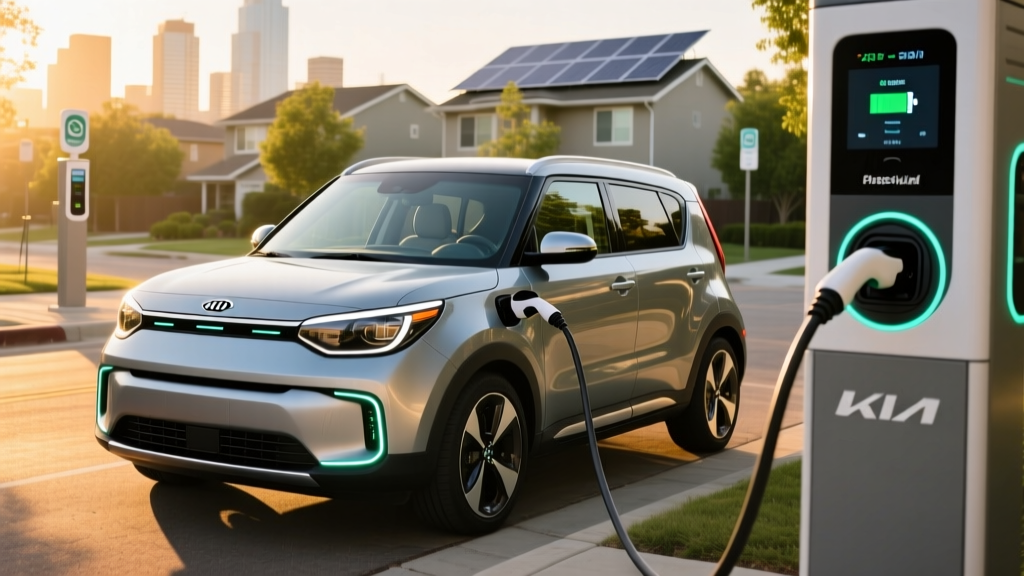
The short answer: The 2026 Kia Soul EV delivers an EPA-estimated 243 miles of range from its 64 kWh battery, charges at up to 77 kW on DC fast chargers (10–80% in roughly 54 minutes), and starts around $36,500 before incentives. It's one of the most practical and affordable electric crossovers on the market — but its moderate charging speed and limited public fast-charging compatibility mean it's best suited to buyers with reliable home Level 2 access and mostly urban or suburban driving patterns.
The Kia Soul has long been a favorite for its boxy utility, easy visibility, and compact footprint. The Soul EV carries that formula into the electric era, offering a tall-riding hatchback with genuine cargo space and a usable real-world range that handles most daily routines without drama. But the EV landscape in 2026 is crowded, and buyers comparing the Soul EV against rivals — or against the gas-powered Soul — need hard numbers, not marketing. This guide breaks down exactly what you're getting, what it costs to own, and where this EV fits in a realistic garage.
Kia Soul EV Specs at a Glance
| Specification | 2026 Kia Soul EV (Wind / GT-Line) |
|---|---|
| EPA Range | 243 miles (Wind) / 220 miles (GT-Line, larger wheels) |
| Real-World Range Expectation | ~195–220 mi highway; ~170–195 mi cold weather (below 32°F) |
| Battery Capacity (Usable) | 64 kWh, NMC lithium-ion |
| Drivetrain | FWD, single motor |
| Horsepower / Torque | 201 HP / 291 lb-ft |
| 0–60 mph | ~7.0 seconds |
| Max DC Fast Charge Rate | 77 kW (CCS1 connector) |
| 10–80% DC Fast Charge Time | ~54 minutes (under optimal conditions) |
| Level 2 Charge Rate | 7.2 kW (~26 miles of range per hour) |
| Level 1 (120V) Charge Rate | ~1.4 kW (~5 miles per hour) |
| MPGe (Combined) | 120 MPGe (Wind) |
| Efficiency | 28 kWh/100 mi |
| Cargo Volume (rear seats up / folded) | 24.2 / 62.1 cu ft |
| Battery Warranty | 10 years / 100,000 miles |
| Base MSRP (Wind trim) | ~$36,500 |
| Federal Tax Credit Eligibility (§30D) | Varies — see eligibility section below |
The numbers tell a clear story: the Soul EV is a competent city and suburban electric vehicle with adequate range for most commutes and errands, but its 77 kW DC fast-charging ceiling puts it behind competitors like the Hyundai Kona Electric (which charges at up to 100+ kW on newer platforms) and the Chevrolet Equinox EV (up to 150 kW). On a road trip, that difference translates to longer stops and more patience required at highway chargers.
Real-world range reality check: The EPA rates the Soul EV Wind at 243 miles. In mixed highway driving at 70–75 mph, expect closer to 195–220 miles. In sustained cold weather (below freezing), battery chemistry and cabin heating demands can drop usable range to 170–195 miles. The Soul EV uses a resistive PTC heater rather than a heat pump, which draws more energy from the battery in winter. If you live in a northern climate and regularly drive 60+ miles round-trip, plan around the lower figure.
Kia Soul EV vs. Gas Kia Soul: Cost and Ownership Comparison
One of the most common questions from Soul shoppers is whether the EV version justifies its higher sticker price compared to the gas-powered Soul. Let's run the numbers over a 5-year, 75,000-mile ownership period.
| Cost Category | 2026 Kia Soul EV (Wind) | 2026 Kia Soul (Gas, S trim) |
|---|---|---|
| Base MSRP | $36,500 | $24,500 |
| Est. Federal Tax Credit (§30D) | Up to $7,500 (if eligible) | $0 |
| Effective Purchase Price | ~$29,000 (if full credit applies) | $24,500 |
| Fuel / Electricity (75,000 mi) | ~$2,625 (home charging at $0.15/kWh) | ~$8,750 (at 29 MPG combined, $3.40/gal) |
| Maintenance (5 years) | ~$1,200 (no oil changes, fewer brake replacements) | ~$3,500 (oil, filters, brakes, spark plugs) |
| Insurance (est. 5-yr total) | ~$7,500 (EV premium ~10–15% higher) | ~$6,500 |
| Estimated 5-Year Total Cost | ~$40,325 | ~$43,250 |
The math is revealing. Even with a ~$12,000 higher sticker price, the Soul EV can break even or come out ahead over five years when you factor in the federal tax credit, dramatically lower fueling costs, and reduced maintenance. The break-even point typically arrives around year 3–4 for drivers covering 15,000 miles annually. However, this calculation assumes you qualify for the full §30D credit and charge primarily at home at average residential electricity rates. Public DC fast charging at $0.35–$0.50/kWh narrows the fuel-cost advantage significantly.
According to fueleconomy.gov, the Soul EV Wind achieves 120 MPGe combined, compared to the gas Soul's 29 MPG combined. That efficiency gap is the single largest driver of long-term savings.
Charging the Kia Soul EV: What You Need to Know
Understanding the Soul EV's charging profile is essential before you buy, because its 77 kW peak DC rate and CCS1 connector shape your daily and road-trip experience.
Home Charging (Level 2)
Most Soul EV owners will do 90%+ of their charging at home on a 240V Level 2 charger. At 7.2 kW, the Soul EV adds about 26 miles of range per hour. A full charge from 10% to 100% takes roughly 9 hours — easily accomplished overnight. A Level 2 home charger installation typically costs $500–$1,500 for the equipment and $500–$2,000 for electrician labor, depending on whether your electrical panel needs an upgrade. If your panel is already 200 amps with spare breaker slots, expect the lower end of that range.
DC Fast Charging (Public)
The Soul EV's 77 kW peak charge rate means a 10–80% session takes approximately 54 minutes under ideal conditions. In practice, charging curves taper as the battery fills: you might see 77 kW up to around 40% state of charge, then a step down to 50–60 kW, and further tapering above 60%. The Soul EV uses the CCS1 connector standard, which is widely available on Electrify America, EVgo, and ChargePoint DC stations — though the industry's ongoing shift toward the NACS (Tesla-style) connector means CCS availability may shift in coming years.
Level 1 (Standard 120V Outlet)
Plugging into a standard household outlet delivers about 1.4 kW, or roughly 5 miles of range per hour. That's adequate only for overnight top-ups if your daily driving is under 30 miles. For a full charge from empty, Level 1 would take over 45 hours — impractical as a primary charging strategy.
Critical note for first-time EV buyers: kW (kilowatts) measures charging power — the speed at which energy flows into the battery. kWh (kilowatt-hours) measures battery capacity — the total energy the battery stores. The Soul EV's 64 kWh battery charged at 7.2 kW takes about 9 hours from empty. Confusing these two units is the most common mistake new EV owners make when estimating charge times.
Federal Tax Credit Eligibility for the Kia Soul EV
The IRS §30D Clean Vehicle Credit can provide up to $7,500 for qualifying new EV purchases — but eligibility depends on multiple factors that change periodically. As of 2026, the key requirements include:
- MSRP Cap: The vehicle must have an MSRP at or below $55,000 for SUVs/crossovers (the Soul EV qualifies).
- Buyer Income Limits: Adjusted gross income must not exceed $150,000 (single), $225,000 (head of household), or $300,000 (married filing jointly).
- Battery Sourcing Requirements: A percentage of critical minerals and battery components must be sourced from the U.S. or free-trade-agreement partners. These thresholds increase annually and may reduce or eliminate the credit amount for some models.
- Point-of-Sale Transfer: Qualified buyers can transfer the credit to the dealer at purchase, reducing the upfront price rather than waiting for a tax refund.
- Assembly Requirement: Final assembly must occur in North America.
The Kia Soul EV is assembled in South Korea, which has historically complicated §30D eligibility under the North American final-assembly requirement. Kia has been working to shift production of certain EV models to U.S. plants (notably the new Georgia facility). Buyers should verify current eligibility directly at fueleconomy.gov's tax credit page and consult a tax professional before relying on the credit in their purchase budget. State and local incentives may also apply — check the AFDC state incentive database for your area.
Real-World Ownership: Who the Kia Soul EV Actually Works For
The Soul EV isn't trying to be a road-trip champion or a performance machine. It's a practical, efficient daily driver with excellent cargo versatility. Here's an honest look at where it shines and where it falls short.
Strengths
- Spacious, boxy cargo area (62.1 cu ft with seats folded) rivals small SUVs
- Strong low-end torque (291 lb-ft) makes city driving effortless
- Excellent efficiency at 28 kWh/100 mi keeps home-charging costs low
- 10-year/100,000-mile battery warranty provides long-term peace of mind
- Competitive pricing in the EV crossover segment
- Good outward visibility and tight turning radius for urban parking
Limitations
- 77 kW peak DC charging is slow by 2026 standards — road trips require patience
- No heat pump — cold-weather range loss is more pronounced than rivals with heat pumps
- FWD only — no AWD option for snowy climates
- CCS1 connector in a market shifting toward NACS
- South Korean assembly may affect federal tax credit eligibility
- Regenerative braking is adjustable but doesn't offer true one-pedal driving in all modes
Climate and Driving Pattern Fit
If you live in a mild climate (think California, the Southeast, or Pacific Northwest at lower elevations) and your daily commute is under 80 miles round-trip, the Soul EV is an excellent match. You'll rarely think about range, and overnight Level 2 charging covers everything. If you live in the upper Midwest or Northeast with harsh winters, the lack of a heat pump and FWD-only drivetrain become real compromises — expect 20–30% range reduction in deep cold, and consider whether AWD alternatives like the Hyundai Ioniq 5 or Ford Mustang Mach-E better suit your needs.
Home Charging Access Is Non-Negotiable
The Soul EV's moderate DC charging speed makes it a poor fit for buyers who must rely exclusively on public charging. If you can't install a Level 2 charger at home or at work, the 54-minute fast-charge sessions and limited public infrastructure in some areas will become a daily frustration. Confirm your charging situation before purchasing.
Common Kia Soul EV Misconceptions — Corrected
| Myth | Fact |
|---|---|
| "The Soul EV can go 243 miles no matter how you drive." | 243 miles is the EPA combined estimate. Sustained highway speeds of 70–80 mph reduce range to ~195–220 miles. Cold weather drops it further to ~170–195 miles. |
| "DC fast charging fills the battery in 20 minutes." | At 77 kW peak, 10–80% takes ~54 minutes. The charge curve tapers significantly above 60% SoC. Expect ~70+ minutes for a 10–90% session. |
| "The battery will need expensive replacement within a few years." | Kia's 10-year/100,000-mile battery warranty covers capacity below 70%. NMC batteries in the Soul EV typically degrade 10–15% over 100,000 miles based on industry data — far from needing replacement. |
| "EVs cost more to insure, so savings disappear." | EV insurance is typically 10–15% higher, but the Soul EV's fuel and maintenance savings (~$6,000+ over 5 years) far outweigh the ~$1,000 insurance premium increase. |
| "You'll always get the full $7,500 federal tax credit." | §30D eligibility depends on income, battery sourcing, MSRP caps, and final assembly location. The Soul EV's South Korean assembly has historically affected eligibility. Always verify before purchasing. |
Decision Framework: Is the Kia Soul EV Right for You?
Choose the Kia Soul EV if:
- You have access to Level 2 home or workplace charging
- Your daily driving is under 80 miles round-trip
- You live in a mild-to-moderate climate (or accept winter range reduction)
- You value cargo versatility and a compact footprint over road-trip charging speed
- You want a lower-cost EV with a strong battery warranty
- You primarily drive in urban or suburban environments
Look elsewhere if:
- You take frequent road trips of 200+ miles and want faster DC charging (consider Hyundai Ioniq 5, Tesla Model Y, or Ford Mustang Mach-E)
- You need AWD for heavy snow (consider the Ioniq 5 AWD or Subaru Solterra)
- You have no access to home or workplace charging and must rely on public infrastructure
- You live in a consistently sub-freezing climate and want a heat pump for winter efficiency
- You want NACS connector compatibility for Tesla Supercharger access without an adapter
Frequently Asked Questions
What is the real-world range of the Kia Soul EV?
The EPA rates the Soul EV Wind at 243 miles combined. In real-world highway driving at 70–75 mph, expect 195–220 miles. In cold weather below freezing, plan for 170–195 miles. The GT-Line trim with larger 19-inch wheels drops to a 220-mile EPA rating and slightly less in practice.
How long does it take to charge the Kia Soul EV at home?
On a 240V Level 2 charger at 7.2 kW, a full charge from near-empty takes about 9 hours. Most owners charge overnight and wake up to a full battery every morning. On a standard 120V outlet, a full charge takes over 45 hours — not practical as a primary method.
Does the Kia Soul EV qualify for the $7,500 federal tax credit?
Eligibility is not guaranteed. The §30D credit requires North American final assembly, buyer income below certain thresholds, and battery sourcing compliance. Because the Soul EV has been assembled in South Korea, it may not meet the assembly requirement. Verify current status at fueleconomy.gov and consult a tax professional before budgeting for the credit.
How does the Kia Soul EV compare to the gas Soul on cost?
The Soul EV costs about $12,000 more upfront but saves roughly $6,000–$7,000 in fuel and maintenance over 5 years (assuming home charging and full tax credit eligibility). The break-even point typically arrives around year 3–4. Without the tax credit, the EV's payback period extends to 5–6 years.
Is the Kia Soul EV good in winter and snow?
The Soul EV is front-wheel drive only, which limits traction in heavy snow compared to AWD alternatives. Cold weather also reduces range by 20–30% due to the resistive cabin heater (no heat pump) and battery chemistry effects. If you regularly drive in deep snow or sub-zero temperatures, an AWD EV with a heat pump may be a better choice.
What connector does the Kia Soul EV use?
The Soul EV uses the CCS1 connector for DC fast charging and the J1772 connector for Level 1 and Level 2 AC charging. As the industry transitions toward the NACS (Tesla) standard, adapters may become available, but native CCS1 infrastructure remains widely available at Electrify America, EVgo, and ChargePoint stations.